

Dicruridae – Drongos

The Dicruridae (Drongos), are a family of passerines of the Old-World tropics. They are related to the Rhipidurinae (Australasian Fantails), Monarchinae (Monarchs and Paradise Flycatchers) and Grallininae (Magpie-larks).
Drongos are mostly black or dark grey, short-legged birds, with an upright stance when perched. They have forked tails and some have elaborate tail decorations. They feed on insects which they catch in flight. Several species of animals and birds respond to drongos’ alarm calls, which often warn of the presence of a predator. They have been shown to utter hoax alarm calls in order to benefit from the false alarms as other birds scatter leaving them to the food source. (Fork-tailed or Common Drongos in the Kalahari Desert are known to use alarm calls in the absence of a predator to cause animals to flee and abandon food, which they eat, getting up to 23% of their food this way.) These insectivorous birds are usually found in open forests or bush. They sit very upright whilst perched, like a shrike. Two to four eggs are laid in a nest high in a tree. Despite their small size, they are aggressive and fearless, and will attack much larger species if their nest or young are threatened.
The Black Drongo Dicrurus macrocercus is typical of the family. It is a common resident breeder in much of tropical southern Asia from southwest Iran through Pakistan, India, Bangladesh and Sri Lanka east to southern China and Indonesia and accidental visitor of Japan. It is an all-black bird with a distinctive forked tail and measures 28 cm in length. It feeds on insects, and is common in open agricultural areas and light forest throughout its range, perching conspicuously on a bare perch or along power or telephone lines.
|
|
|
|
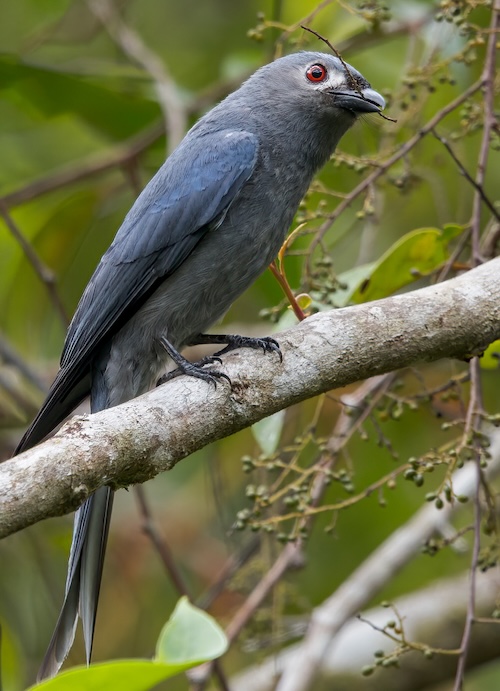
Ashy Drongo Dicrurus leucophaeus |
Mayotte Drongo Dicrurus waldenii |
|
All photos inn this text courtesy of ©Dubi Shapiro unless otherwise attributed |
|
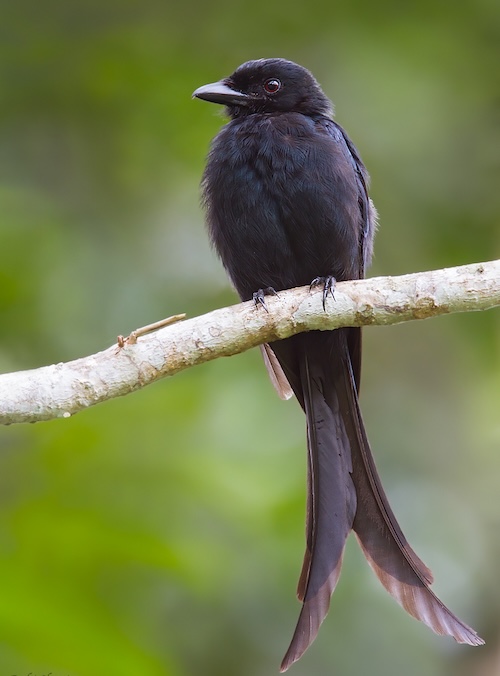
It is known for its aggressive behaviour towards much larger birds, such as crows, never hesitating to dive-bomb any bird of prey that invades its territory. This behaviour earns it the informal name of ‘king crow’. Smaller birds often nest in the well-guarded vicinity of a nesting Black Drongo. Previously grouped along with the African Fork-tailed Drongo Dicrurus adsimilis, the Asian forms are now treated as a separate species with several distinct populations. It is listed as least concern by the International Union for Conservation of Nature (IUCN) on the IUCN Red List, due to its large range and relative commonness. It has been introduced to some Pacific islands, where it has thrived and become abundant to the point of threatening and causing the extinction of native and endemic bird species there.
|
|
|
|
Velvet-mantled Drongo Dicrurus modestus |
Wallacean Drongo Dicrurus densus |

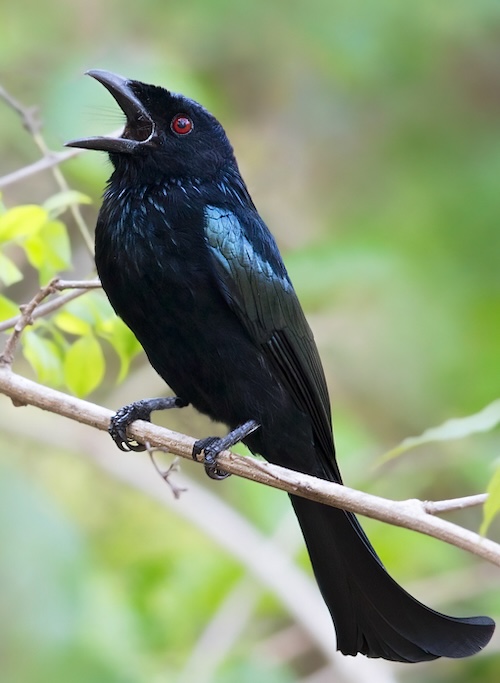
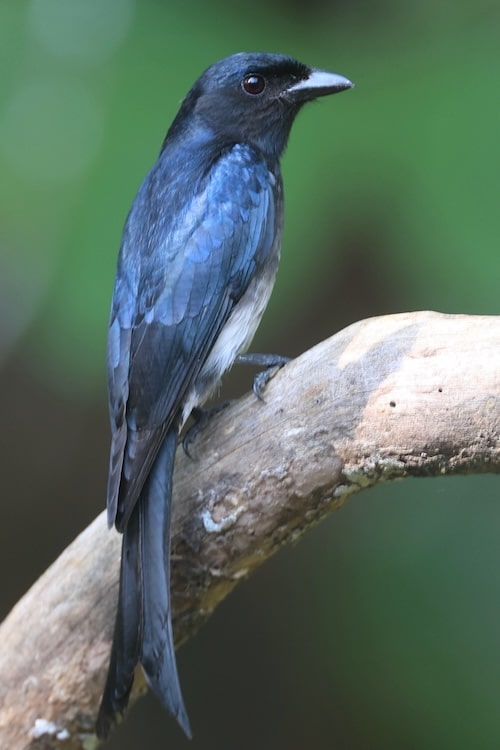
Like most drongos, this bird is glossy black with a wide fork to the tail. Adults usually have a small white spot at the base of the gape. The iris is dark brown (not crimson as in the similar Ashy Drongo). The sexes cannot be told apart in the field. Juveniles are brownish and may have some white barring or speckling towards the belly and vent, and can be mistaken for the White-bellied Drongo. First-year birds have white tips to the feathers of the belly, while second-years have these white-tipped feathers restricted to the vent. They fly with strong flaps of the wing and are capable of fast manoeuvres that enable them to capture flying insects. With short legs, they sit upright on thorny bushes, bare perches or electricity wires. They may also perch on grazing animals. They are capable of producing a wide range of calls but a common call is a two note ‘tee-hee’ call resembling that of the Shikra Accipiter badius.
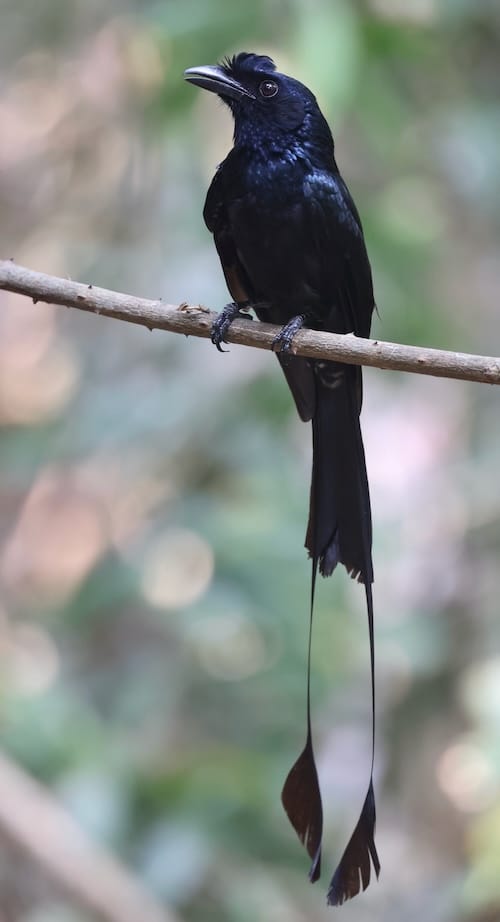
Greater Racket-tailed Drongo Dicrurus paradiseus – ©Nick Ludovic Green Bird-Photo-Tours ASIA
Found predominantly in open country, it usually perches and hunts close to the ground. They are mostly aerial predators of insects, but also glean from the ground or off vegetation. Some populations show seasonal movements that are poorly understood while populations in Korea are known to be migratory. It can be found in savanna, fields, and urban habitats.
They become active very early at dawn and roost later than many other birds. They feed mainly on insects such as grasshoppers, cicadas, termites, wasps, bees, ants, moths, beetles and dragonflies. They sometimes fly close to tree branches, attempting to disturb any insects that may be present. They congregate in fields being ploughed, picking up exposed caterpillars and beetle grubs. As many as 35 birds have been seen at such congregations. They are also attracted to fires in scrub and grasslands habitats where insects are disturbed. They appear to avoid flies. They associate with Common Mynas, Cattle Egrets and other birds that share a similar diet and habitat. Drongos benefit from this association and are more successful in their foraging. There is only partial overlap in the insect prey sought by Mynas and Drongos although in rare instances the drongos may rob prey from mynas.
It has been suggested that they may feed on birds more intensively on migration. An individual on a migratory stop-over island in Korea caught several birds one after the other, killing them by striking at the back of the head and neck and feeding selectively on parts, especially the brain. They have also, on occasion, been seen feeding on fish. Flowers of trees such as Erythrina and Bombax may be visited for water and nectar and they are sometimes known to feed on grains. They are only rarely known to take larger arthropods such as scorpions and centipedes. They feed on milkweed butterflies that are often avoided by other predators and are known to feed late in the evening or night, often on insects attracted to artificial lights.
|
|
|
|
White-bellied Drongo Dicrurus caerulescens |
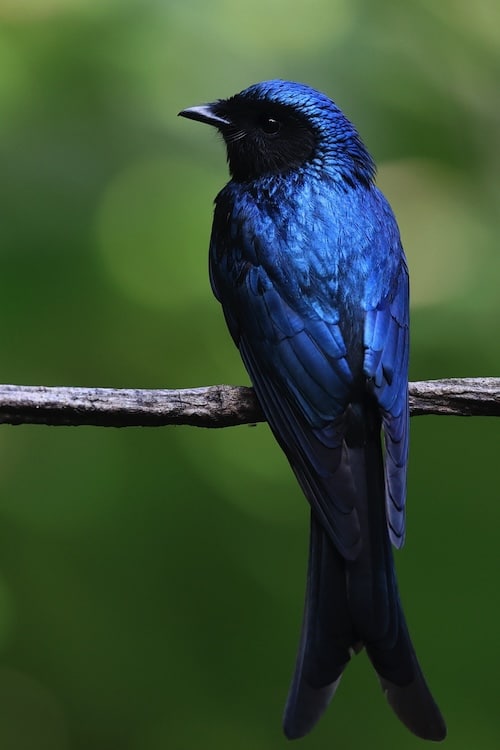
Bronzed Drongo Dicrurus aeneus |
|
The two photos above are courtesy of ©Nick Ludovic Green Bird-Photo-Tours ASIA
|
|
Black Drongos breed mainly in February and March in southern India, and until August in other parts of the country. Males and females sing in the mornings during the breeding season. Courtship can include aerobatic chases and they may lock their wings and beaks together, with the pair sometimes falling to the ground. Displays may be made on the ground. Pair bonds are retained for a whole breeding season. Their nest is a cup made with a thin layer of sticks placed in the fork of branch, and is built in a week by both the male and female. Eggs are laid close to the first rains in April. The usual clutch is three or rarely four eggs laid in a cup nest placed in the fork of an outer branch of tree. Large leafy trees such as the jackfruit are preferred. The eggs are pale cream to red with spots and markings and are 26 mm long and 19 mm wide. The eggs are incubated by both parents and hatch after 14 to 15 days. Nestlings are brooded for the first five days, after which the young are capable of maintaining a fairly constant body temperature. A second clutch may be laid if the first is destroyed. Nests are sometimes built in telephone poles.
Helpers, offspring from the previous brood, have sometimes been noted to assist in feeding the fledglings at the nest of their parents. Cases of brood parasitism by the Asian Koel have been noted. An average breeding success of 44% has been noted with the main cause of fledgling mortality being shortage of insect food which in turn was dependent on rainfall.
Their habit of driving away predators from near their nests is believed to encourage other birds such as orioles, doves, pigeons, babblers, and especially bulbuls, to nest in the vicinity. In one study 18 of 40 nests had Red-vented Bulbuls nesting within 10 metres. An abnormal case of interspecific feeding with a Red-vented Bulbul feeding the chicks of a Black Drongo at their nest has been recorded.
-
Number of bird species: 28
(As at November 2025)
According to the recently (2025) amalgamated AviList, there are twenty-eight species of Drongos, in one genus in the Dicruridae family. They are:
Bronzed Drongo Dicrurus aeneus
Lesser Racket-tailed Drongo Dicrurus remifer
Crow-billed Drongo Dicrurus annectans
Sri Lanka Drongo Dicrurus lophorinus
Andaman Drongo Dicrurus andamanensis
Greater Racket-tailed Drongo Dicrurus paradiseus
Sumatran Drongo Dicrurus sumatranus
Wallacean Drongo Dicrurus densus
Hair-crested Drongo Dicrurus hottentottus
Paradise Drongo Dicrurus megarhynchus
Sulawesi Drongo Dicrurus montanus
Spangled Drongo Dicrurus bracteatus
Tablas Drongo Dicrurus menagei
Palawan Drongo Dicrurus palawanensis
Short-tailed Drongo Dicrurus striatus
Balicassiao Dicrurus balicassius
Square-tailed Drongo Dicrurus ludwigii
Shining Drongo Dicrurus atripennis
Sharpe’s Drongo Dicrurus sharpei
White-bellied Drongo Dicrurus caerulescens
Ashy Drongo Dicrurus leucophaeus
Fork-tailed Drongo Dicrurus adsimilis
Grand Comoro Drongo Dicrurus fuscipennis
Black Drongo Dicrurus macrocercus
Velvet-mantled Drongo Dicrurus modestus
Mayotte Drongo Dicrurus waldenii
Aldabra Drongo Dicrurus aldabranus
Crested Drongo Dicrurus forficatus
-
Dicruridae
Family Accountdrongos are sleek and shiny black flycatching birds of Africa, Asia, and Australia, the species usually distinguished by rackets or distinctive bends or warps -
Dicruridae
Family AccountA drongo is a member of the family Dicruridae of passerine birds of the Old World tropics. The 28 species in the family are placed in a single genus, Dicrurus.
Given the number of species in this single genus family, Fatbirder does not provide quick links to all of them. However, the entries below do include links to all those illustrated and some of the most often encountered, iconic or sought-after species.
-
Ashy Drongo Dicrurus leucophaeus
Species AccountA slim, medium-sized drongo with bright red eyes and gray plumage that is almost black. -
Ashy Drongo Dicrurus leucophaeus
Species AccountSound archive and distribution map -
Black Drongo Dicrurus macrocercus
Species AccountAn adaptable songbird of open areas such as farmland, forest edge, meadows, wetlands, and fields and a common sight as a familiar dark silhouette. -
Black Drongo Dicrurus macrocercus
Species AccountSound archive and distribution map -
Bronzed Drongo Dicrurus aeneus
Species AccountThe bronzed drongo (Dicrurus aeneus) is a small Indomalayan bird belonging to the drongo group. -
Bronzed Drongo Dicrurus aeneus
Species AccountSound archive and distribution map -
Crested Drongo Dicrurus forficatus
Species AccountThe crested drongo (Dicrurus forficatus) is a species of bird in the Dicruridae family. This bird is black with a bluish-green sheen, a distinctive crest on the forehead and a forked tail. -
Crested Drongo Dicrurus forficatus
Species AccountSound archive and distribution map -
Fork-tailed Drongo Dicrurus adsimilis
Species Accounthe fork-tailed drongo, also called the common drongo, African drongo, or savanna drongo (Dicrurus adsimilis), is a species of drongo in the family Dicruridae, which are medium-sized[2] passerine birds of the Old World. It is native to the tropics, subtropics and temperate zones of the Afrotropics. Its range was formerly considered to include Asia, but the Asian species is now called the black drongo (Dicrurus macrocercus). -
Fork-tailed Drongo Dicrurus adsimilis
Species AccountSound archive and distribution map -
Greater Racket-tailed Drongo Dicrurus paradiseus
Species AccountThe greater racket-tailed drongo (Dicrurus paradiseus) is a medium-sized Asian bird which is distinctive in having elongated outer tail... -
Greater Racket-tailed Drongo Dicrurus paradiseus
Species AccountSound archive and distribution map -
Mayotte Drongo Dicrurus waldenii
Species AccountThe Mayotte drongo (Dicrurus waldenii) is a species of bird in the family Dicruridae. It is endemic to Mayotte. -
Mayotte Drongo Dicrurus waldenii
Species AccountSound archive and distribution map -
Velvet-mantled Drongo Dicrurus modestus
Species AccountLarge drongo with a strongly forked tail. Found in forest, usually in the canopy or on prominent open perches. Often in pairs. -
Velvet-mantled Drongo Dicrurus modestus
Species AccountSound archive and distribution map -
Wallacean Drongo Dicrurus densus
Species AccountA large red-eyed, glossy-black bird with a heavy bill and diagnostic tail shape. A noisy, vocal bird with highly varied calls, including metallic fluty note... -
Wallacean Drongo Dicrurus densus
Species AccountSound archive and distribution map -
White-bellied Drongo Dicrurus caerulescens
Species AccountA small drongo with a dull-black back and a relatively short, distinctively forked tail. -
White-bellied Drongo Dicrurus caerulescens
Species AccountSound archive and distribution map