

Donacobiidae – Donacobius
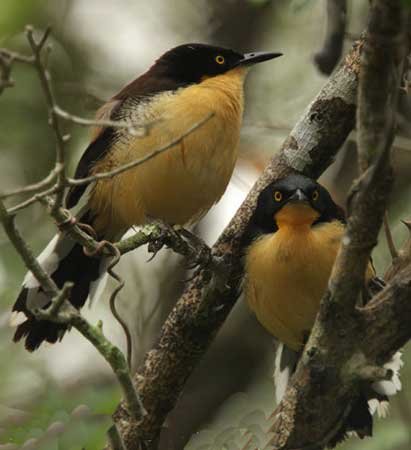
The Donacobiidae family has just one genus; Donacobius with a single species; Black-capped Donacobius Donacobius atricapilla. It was formerly of uncertain taxonomy but has now been placed in a family of its own. Its familial placement is not established, and ornithologists disagree as to its closest relations.
The Black-capped Donacobius Donacobius atricapilla is a conspicuous, vocal South American passerine. It is found in tropical swamps and wetlands in Argentina, Bolivia, Brazil, Colombia, Ecuador, French Guiana, Guyana, Paraguay, Peru, Suriname, and Venezuela; also in Panama in Central America.
In the 19th century, it was placed in the Turdidae, and in the 20th century, moved to the Mimidae. It had various English names, including the ‘Black-capped Mockingthrush’. In the 1980s and 1990s, there were suggestions that it was a type of wren Troglodytidae’ which was accepted by the South American Classification Committee (SACC), the American Ornithologists Union (AOU) and most other authorities. More recently, listing organizations and authors follow Van Remsen and Keith Barker’s conclusion that it is not a wren either, but instead most closely related to an Old World (probably African) lineage.
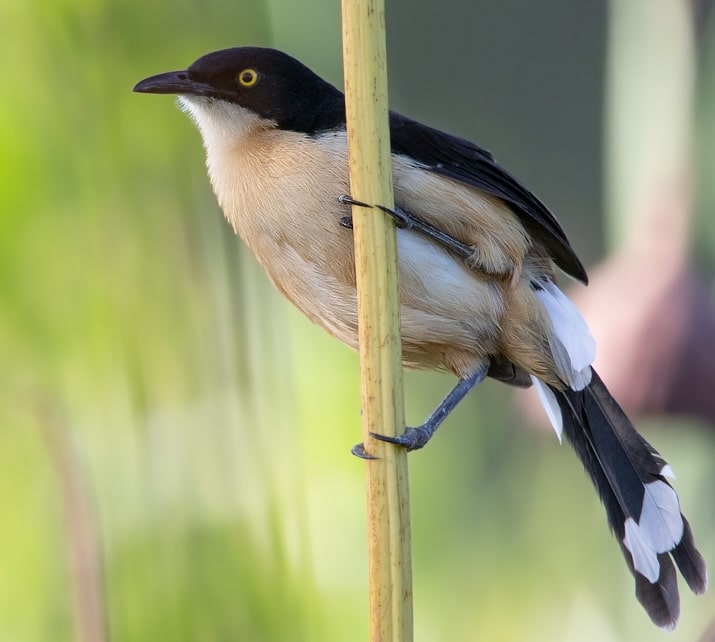
Black-capped Donacobius Donacobius atricapilla – ©Dubi Shapiro
Black-capped Donacobiuses are common in a wide range of Amazonian wetlands, including oxbow lakes, riparian zones, and other areas with tall dense aquatic or semi-aquatic vegetation. They do move away from riverine habitat and wetlands, but always breed in marshy areas. The nests are large deep cupped structures made up of fibres etc. They lay two or three white eggs with a purple tinge, which the female incubates alone for sixteen to eighteen days. Both parents feed the nestlings as well as other helpers and the fledge at around seventeen days. A third of the species range is outside the Amazon Basin, from Panama, northern Colombia, and western Venezuela, the Orinoco River system of Venezuela, to southeast coastal and inland Brazil, and neighbouring countries southward, Paraguay, and extreme northern Argentina.
They are almost exclusively insectivorous favouring beetles, spiders and other invertebrates. These are mostly taken off leaves, but sometimes in flight.
Mating for life, pairs can be seen frequently and throughout the day out in the open atop thickets of dense lakeside or streamside vegetation. They often will engage in duetting with the loud, ringing calls of males responded to with the harsh chatter of females. Adult offspring will remain with their parents and help raise siblings from subsequent nesting periods in a system of cooperative breeding.
-
Number of bird species: 1
(As at October 2025)
According to the recently (2025) amalgamated AviList, there is just the one species, in one genus of the Donacobiidae family. It is:
Black-capped Donacobius Donacobius atricapilla
-
Donacobiidae
Family AccountThis lanky passerine of South American marshes and swamps makes a series of whistles and churrs that could pass for a really large wren or a babbler. -
Donacobiidae
Family AccountThe black-capped donacobius is the only member of the genus Donacobius and the family Donacobiidae.
-
Black-capped Donacobius Donacobius atricapilla
Species AccountThe black-capped donacobius is a conspicuous, vocal South American bird. It is found in tropical swamps and wetlands in Argentina, Bolivia, Brazil, Colombia... -
Black-capped Donacobius Donacobius atricapilla
Species AccountUnmistakable thrasher-like species found in lowland marshy habitats from extreme eastern Panama to northern Argentina. -
Black-capped Donacobius Donacobius atricapilla
Species AccountThe Black-capped Donacobius (Donacobius atricapilla) is a conspicuous, vocal South American bird. It is found in tropical swamps and wetlands in Argentina, Bolivia, Brazil, Colombia, Ecuador, French Guiana, Guyana, Paraguay, Peru, Suriname, and Venezuela; also Panama of Central America… -
Black-capped Donacobius Donacobius atricapilla
Species AccountSound archive and distribution map