

Dulidae – Palmchat
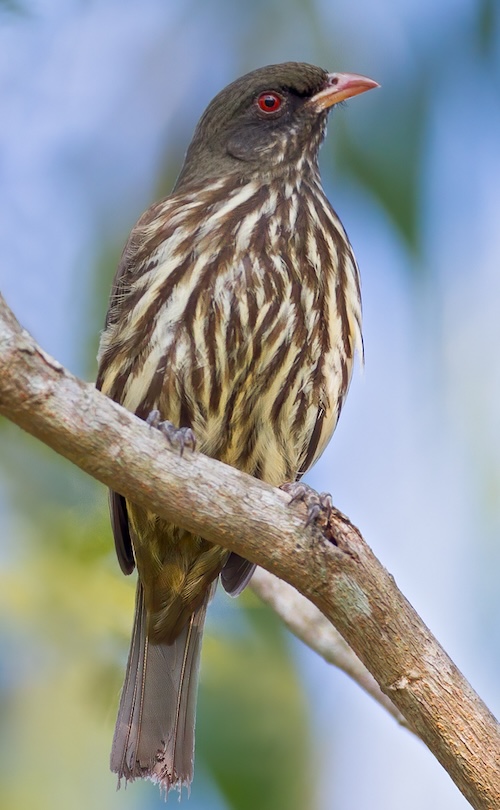
The Dulidae (Palmchat Dulus Dominicus) consists of just one species; a small, long-tailed passerine, which is the only species in the genus Dulus. The family is thought to be related to the waxwings, family Bombycillidae, and has sometimes been classified with that group. The name reflects its strong association with palms for feeding, roosting and nesting. It is the national bird of the Dominican Republic.
Palmchats are about 20 cm in length. They are olive-brown above, and cream-buff, heavily streaked with brown, below. Their rumps and the edges of their primary feathers are dark yellow-green. They have strong yellow bills and russet eyes. They lack the soft silky plumage of the waxwings or silky-flycatchers. Adults are alike in appearance; immature birds have dark throats.
The species is endemic to the island of Hispaniola (Haiti and the Dominican Republic), including the adjacent Saona and Gonâve Islands, where it is common and widespread. It inhabits areas from sea-level to 1500m above sea-level where palm savannas can be found, or other open areas with scattered trees. Where its food trees are present (they feed on fruits and berries, including those of palms and of the Gumbo-limbo tree, as well as on flowers, especially those of epiphytic orchids), it has adapted well to city parks and gardens.
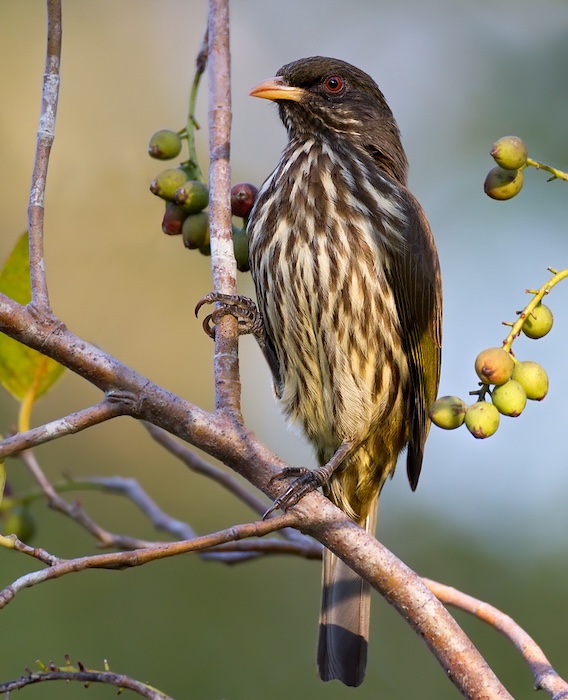
Palmchat Dulus Dominicus – ©Dubi Shapiro
Palmchats are very sociable birds, often seen in small flocks containing several pairs which will roost closely together with their bodies in contact. They are voluble and noisy birds, with a large repertoire of gurgling and cheeping sounds constantly used in their social behaviour.
The breeding season is mainly from March to June. The birds build large, messy, communal nests of twigs in the crowns of palms (mainly royal palms Roystonea). Occasionally, in the absence of palms, other trees or even telephone poles, may be used. The whole nesting structure may be up to 2m across, containing up to 30 adjoining nests with their own separate chambers and entrances. The females lay clutches of 2-4 thickly spotted, grey-purple eggs.
-
Number of bird species: 1
(As at October 2025)
There is just one species, in one genus in the Dulidae family. It is:
Palmchat Dulus dominicus
-
Dulidae
Family AccountThe Palmchat Dulus dominicus is endemic to the island of Hispaniola, where it is especially common in a variety of lowland habitats -
Dulidae
Family AccountThe palmchat (Dulus dominicus) is a small, long-tailed passerine bird, the only species in the genus Dulus and the family Dulidae endemic to...
-
Palmchat Dulus dominicus
Species AccountVery nice Image + The Palmchat is endemic to the island of Hispaniola in the Caribbean where it is common. In fact, it was the very first bird we saw in the Dominican Republic from our hotel in the capital city of Santo Domingo. It particularly favors Royal palms Roystonea, and gregarious gangs of Palmchats are frequent wherever the palms occur. They build large communal nests but our visit was apparently during the non-breeding season… -
Palmchat Dulus dominicus
Species AccountA small but conspicuous noisy species found in a variety of open and disturbed habitats that contain palms; often found in small flocks high in palm trees. -
Palmchat Dulus dominicus
Species AccountThe palmchat, the Cigua Palmera in Spanish, is the national bird of Dominican Republic, and its scientific name is Dulus dominicus. This family is endemic of La Hispaniola, and there is only one member. The Cigua Palmera lives in any environment but prefers settling in the palm plantations. There are many of these on the Saona Island. -
Palmchat Dulus dominicus
Species AccountSound archive and distribution map.