

Hydrobatidae – Northern Storm Petrels
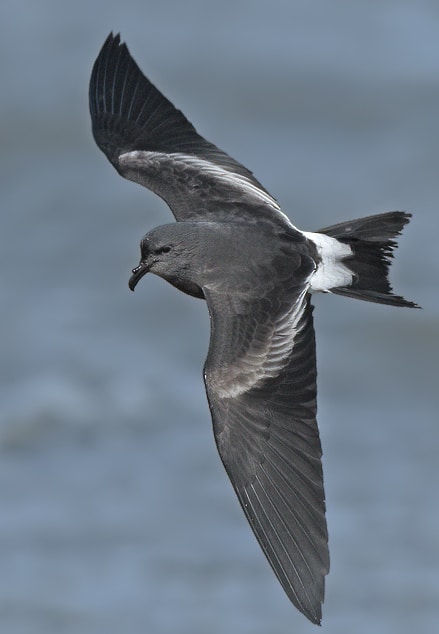
The Hydrobatidae (Northern Storm Petrels) are, along with other seabirds – Diomedeidae (Albatrosses), Oceanitidae, Austral Storm Petrels and Procellariidae (Shearwaters, Petrels & Diving Petrels) – part of the Procellariiformes order. They are found in all the world’s oceans but, are predominantly found in the northern hemisphere.
Two subfamilies were traditionally recognised. The Oceanitinae that are mostly found in southern waters (though the Wilson’s storm petrel regularly migrates into the northern hemisphere); there are seven species in five genera. The Hydrobatinae are the two genera Hydrobates and Oceanodroma. They are largely restricted to the northern hemisphere, although a few can visit or breed a short distance beyond the equator. Cytochrome b DNA sequence analysis suggests that the family is paraphyletic and so they are now more accurately treated as distinct families.
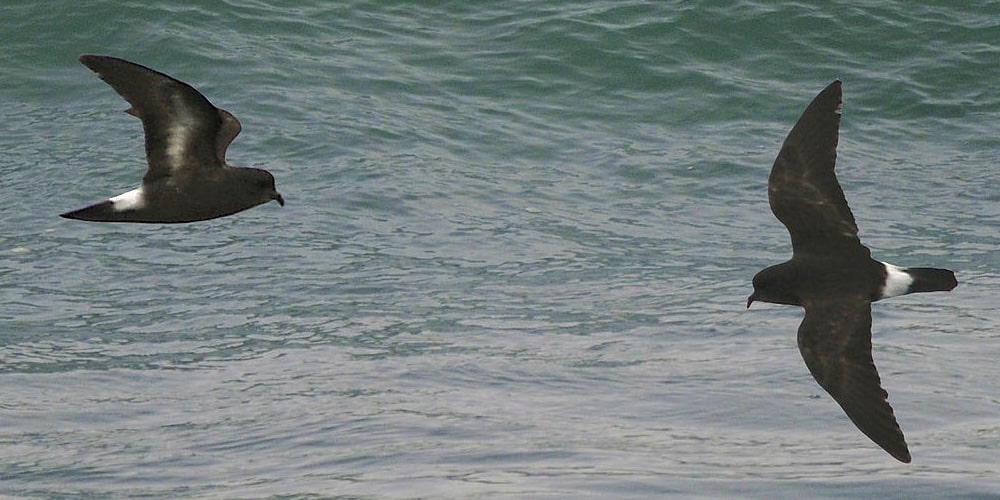
European Storm Petrels Hydrobates pelagicus – ©Richard Crossley CC BY-SA 3.0 via Wikimedia Commons
These smallest of seabirds feed on planktonic crustaceans and small fish picked from the surface, typically while hovering. Their flight is fluttering and sometimes bat-like. They are strictly pelagic, coming to land only when breeding. In the case of most species, little is known of their behaviour and distribution at sea, where they can be hard to find and harder to identify. They are colonial nesters, displaying strong philopatry to their natal colonies and nesting sites. Most species nest in crevices or burrows and all but one species attend the breeding colonies nocturnally. Pairs form long-term monogamous bonds and share incubation and chick-feeding duties. Like many species of seabird, nesting is highly protracted with incubation taking up to 50 days and fledging another 70 days after that.
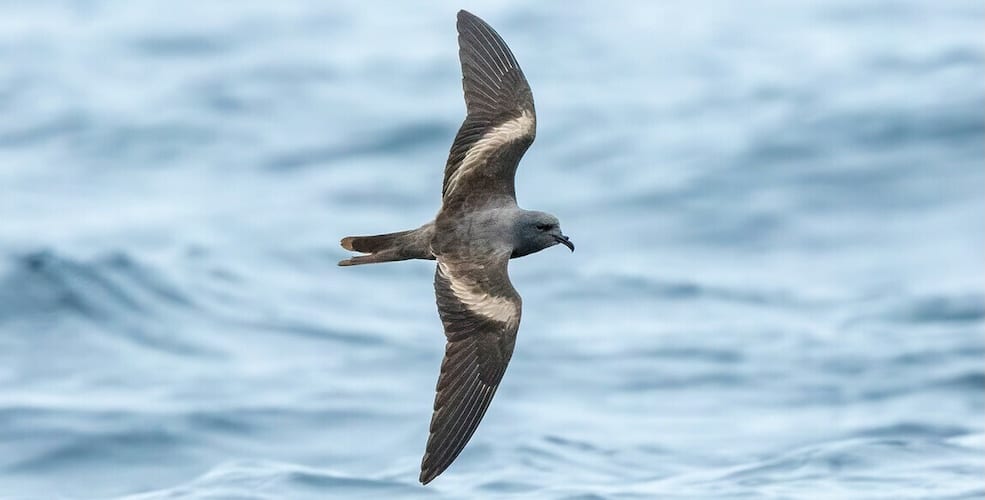
Markham’s Storm Petrel Hydrobates markhami – ©thibaudaronson CC BY-SA 4.0 via Wikimedia Commons
The diet of many storm petrel species is poorly known owing to difficulties in researching; overall the family is thought to concentrate on crustaceans. Small fish, oil droplets and molluscs are also taken by many species. Some species are known to be rather more specialised; the Grey-backed Storm Petrel, for example, is known to concentrate on the larvae of Goose Barnacles.
Almost all species forage in the pelagic zone. Although storm petrels are capable of swimming well and often form rafts on the water’s surface, they do not feed on the water. Instead feeding usually takes place on the wing, with birds hovering above or ‘walking’ on the surface (see morphology) and snatching small morsels. Rarely prey is obtained by making shallow dives under the surface.
-
Number of bird species: 18
(As at August 2025)
There are, according to the recently (2025) unified AviList, 18 species in just one genus in the Hydrobatidae family of Northern Storm Petrels, in the Procellariiformes order. They are:
European Storm Petrel Hydrobates pelagicus
Fork-tailed Storm Petrel Hydrobates furcatus
Cape Verde Storm Petrel Hydrobates jabejabe
Band-rumped Storm Petrel Hydrobates castro
Monteiro’s Storm Petrel Hydrobates monteiroi
Black Storm Petrel Hydrobates melania
Markham’s Storm Petrel Hydrobates markhami
Least Storm Petrel Hydrobates microsoma
Wedge-rumped Storm Petrel Hydrobates tethys
Hornby’s Storm Petrel Hydrobates hornbyi
Ashy Storm Petrel Hydrobates homochroa
Tristram’s Storm Petrel Hydrobates tristrami
Swinhoe’s Storm Petrel Hydrobates monorhis
Matsudaira’s Storm Petrel Hydrobates matsudairae
Guadalupe Storm Petrel Hydrobates macrodactylus
Townsend’s Storm Petrel Hydrobates socorroensis
Ainley’s Storm Petrel Hydrobates cheimomnestes
Leach’s Storm Petrel Hydrobates leucorhous
-
Albatrosses, Petrels and Shearwaters of the World
| By Derek Onley & Paul Scofield | Christopher Helm | 2007 | Paperback | 240 pages, 46 colour plates, distribution maps | ISBN: 9780713643329 Buy this book from NHBS.com -
Flight Identification of European Seabirds
| By Anders Blomdahl, Bertil Breife & Niklas Holmstrom | Christopher Helm | 2007 | Paperback | 374 pages, 690 colour photos | ISBN: 9780713686166 Buy this book from NHBS.com -
Seabirds - A Natural History
| By Anthony J Gaston | A&C Black | 2004 | Hardback | 222 pages, 22 colour plates, b/w photos, illustrations, figures | ISBN: 9780713665574 Buy this book from NHBS.com -
Storm-petrels of the Eastern Pacific Ocean
| (Species Assembly and Diversity along Marine Habitat Gradients) | By Larry B Spear & David G Ainley | American Ornithologists' Union | 2007 | Paperback | 77 pages, Figures, tables | ISBN: 9780943610719 Buy this book from NHBS.com
-
Hydrobatidae
Family AccountThese storm-petrels of the northern oceans have shorter legs and skulls and longer wings than those of their cousins... -
Hydrobatidae
Family AccountNorthern storm petrels are seabirds in the genus Hydrobates in the family Hydrobatidae, part of the order Procellariiformes.
Fatbirder does not provide quick links to all of the species in this family. However, the entries below do include links to several representatives of the genus, including some of the most often encountered, iconic or sought-after species.
-
Ashy Storm-petrel Hydrobates homochroa
Species AccountMedium-sized, dark-rumped storm-petrel with a long, deeply notched tail and grayish tones to the plumage. Usually flies fairly directly with light fluttering wingbeats; can be stronger in windy conditions. -
Ashy Storm-petrel Hydrobates homochroa
Species AccountThe ashy storm petrel (Oceanodroma homochroa) is a small, scarce seabird of the storm petrel family Hydrobatidae. It breeds colonially on islands off the coasts of California and Mexico, and is one of six species of storm petrel that live and feed in the rich California Current system. -
Ashy Storm-petrel Hydrobates homochroa
Species AccountSound archive and distribution map. -
European Storm Petrel Hydrobates pelagicus
Species AccountTiny black seabird with rounded tail tip, white rump, and white stripe on underside of wing. Like many other storm-petrels, can be fairly common... -
European Storm Petrel Hydrobates pelagicus
Species AccountThe European storm petrel, British storm petrel or just storm petrel (Hydrobates pelagicus) is a seabird in the storm petrel family, Hydrobatidae. It is the only member of the genus Hydrobates. -
European Storm Petrel Hydrobates pelagicus
Species AccountSound archive and distribution map. -
Fork-tailed Storm Petrel Hydrobates furcatus
Species AccountUnique among storm-petrels in having an entirely silvery-gray plumage. Aside from overall plumage color, look for contrasting dark underwings. -
Fork-tailed Storm Petrel Hydrobates furcatus
Species AccountThe fork-tailed storm petrel (Hydrobates furcatus) is a small seabird of the storm petrel family Hydrobatidae. -
Fork-tailed Storm Petrel Hydrobates furcatus
Species AccountSound archive and distribution map. -
Leach’s Storm Petrel Hydrobates leucorhous
Species AccountLeach's storm petrel or Leach's petrel (Hydrobates leucorhous) is a small seabird of the tubenose order. -
Leach’s Storm Petrel Hydrobates leucorhous
Species AccountSound archive and distribution map. -
Markham’s Storm Petrel Hydrobates markhami
Species AccountMarkham's storm petrel (Hydrobates markhami) is a seabird native to the Pacific Ocean around Peru, Chile, and Ecuador. -
Markham’s Storm Petrel Hydrobates markhami
Species AccountSound archive and distribution map. -
Swinhoe’s Storm Petrel Hydrobates monorhis
Species AccountSwinhoe's storm petrel or Swinhoe's petrel (Hydrobates monorhis) is a small, all-brown seabird of the storm petrel family Hydrobatidae. -
Swinhoe’s Storm Petrel Hydrobates monorhis
Species AccountSound archive and distribution map.