

Laniidae – Shrikes
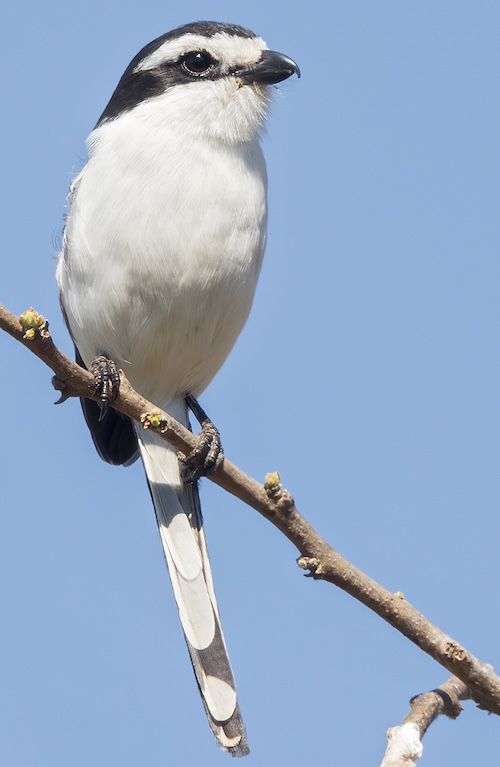
Laniidae (Shrikes & Fiscals) is a carnivorous passerines family. It is composed of 34 species in four genera. The family name, and that of by far the largest genus, Lanius, is derived from the Latin word for ‘butcher’, and some shrikes are also known as ‘butcherbirds’ because of their feeding habits – catching prey and using a thornbush as a larder with prey items impaled on its thorns. The larders act as both a food store and an attractant to females. The common English name shrike is from Old English scrīc, alluding to the shrike’s shriek-like call.
Most shrike species have a Eurasian and African distribution, with just two breeding in North America (the Loggerhead and Great Grey shrikes). No members of this family occur in South America or Australia, although one species reaches New Guinea. The shrikes vary in the extent of their ranges, with some species such as the Great Grey Shrike ranging across the Northern Hemisphere to the Newton’s Fiscal which is restricted to the island of São Tomé.
They inhabit open habitats, especially steppe and savannah. A few species of shrikes are forest dwellers, seldom occurring in open habitats. Some species breed in northern latitudes during the summer, then migrate to warmer climes for the winter.
Shrikes are medium-sized birds with grey, brown, or black and white plumage. Most species are between 16 cm and 25 cm in size, however, the genus Corvinella with its extremely elongated tail feathers may reach up to 50 cm in length. Their beaks are hooked, like those of a bird of prey, reflecting their predatory nature, and their calls are strident.
 |
 |
|
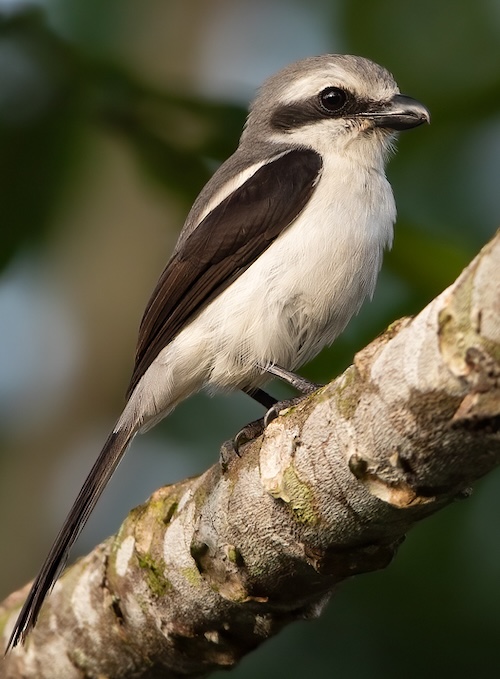
Mackinnon’s Shrike Lanius mackinnoni |
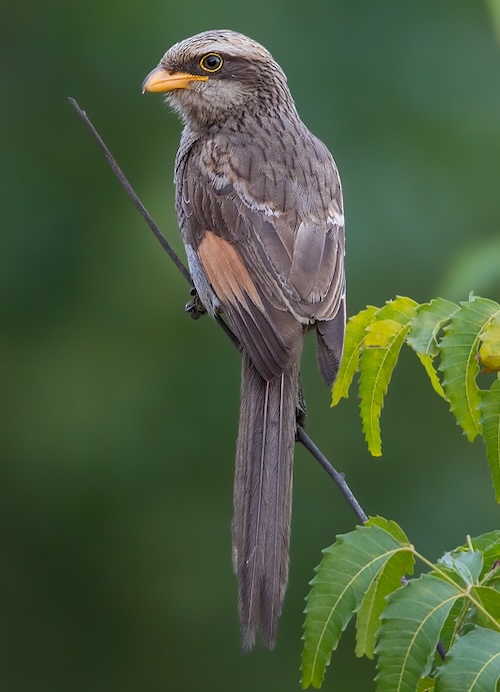
Yellow-billed Shrike Corvinella corvina |
 |
 |
|
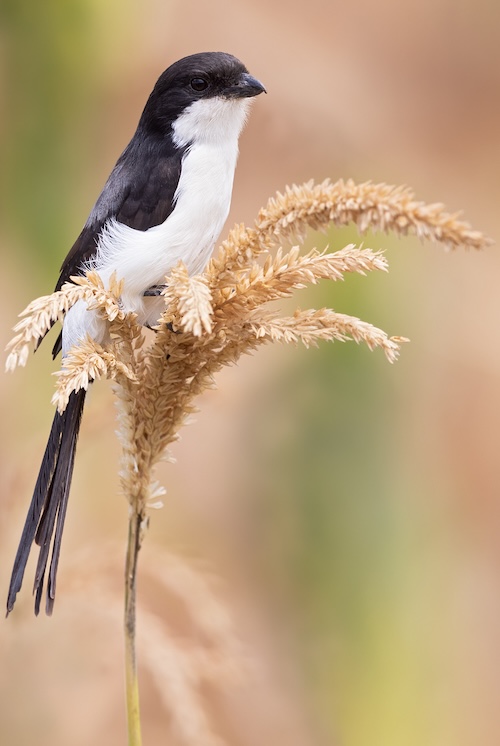
Long-tailed Fiscal Lanius cabanisi |
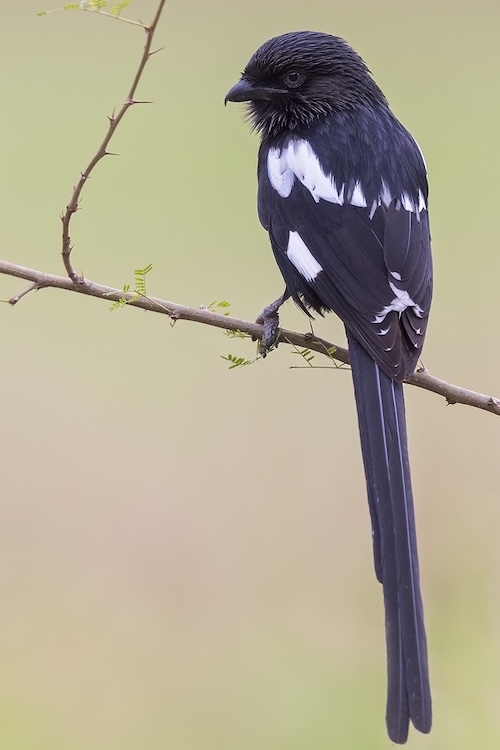
Magpie Shrike Urolestes melanoleucus |
|
All photographs on this page courtesy of ©Dubi Shapiro unless otherwise attributed |
|
Shrikes are known for their habit of catching insects and small vertebrates and impaling their bodies on thorns, the spikes on barbed-wire fences, or any available sharp point. This helps them to tear the flesh into smaller, more conveniently sized fragments, and, as its primary purpose, serves as a cache so that the shrike can return to the uneaten portions at a later time. However, it is also thought to be for males to display their fitness and the quality of the territory held to prospective mates, as the impaling behaviour increases during the onset of the breeding season. Female shrikes have been known to impale prey, but primarily to assist in dismembering prey. Moreo er, this behaviour may also serve another purpose, as an adaptation to eating the toxic Lubber Grasshopper, Romalea microptera, as birds wait a couple of days for the toxins within the grasshopper to degrade before eating it. Shrikes, at least the Loggerhead Shrike, deals with its vertebrate prey by impaling their neck with its beak and then shaking them violently.
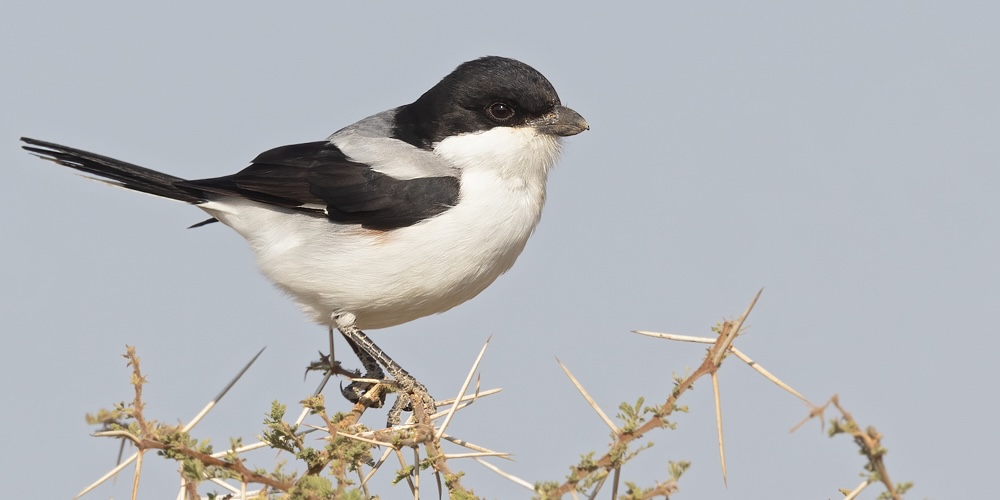
Taita Fiscal Lanius dorsalis
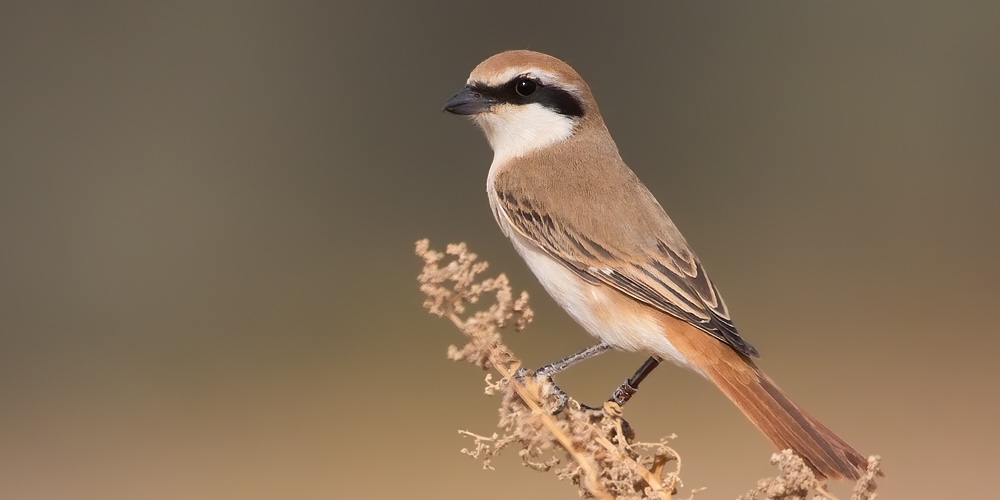
Red-tailed Shrike Lanius phoenicuroides
Shrikes are territorial, and these territories are defended from other pairs. In migratory species, a breeding territory is defended in the breeding grounds and a smaller feeding territory is established during migration and in the wintering grounds. Where several species of shrikes exist together, competition for territories can be intense.
Shrikes make regular use of exposed perch sites, where they adopt a conspicuous upright stance. These sites are used to watch for prey and to advertise their presence to rivals.
|
|
|
|
Burmese Shrike Lanius collurioides |
Long-tailed Shrike Lanius schach |
|
|
|
| Brown Shrike Lanius cristatus |
Great Grey Shrike Lanius excubitor |
|
The above four photos courtesy of ©Nick Ludovic Green Bird-Photo-Tours ASIA |
|
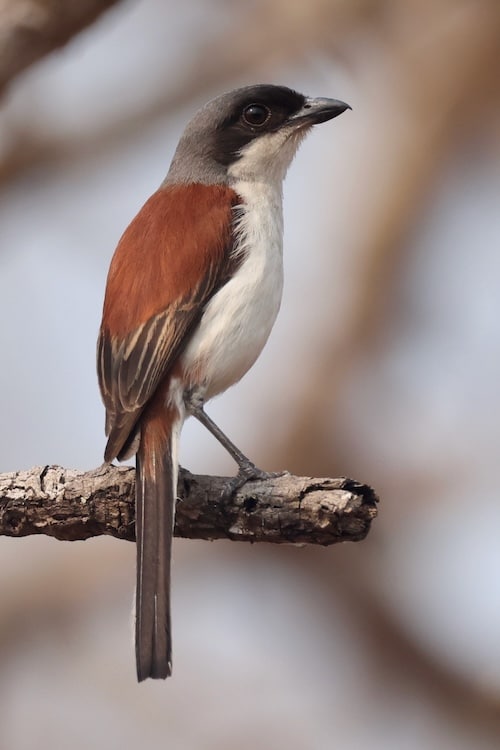
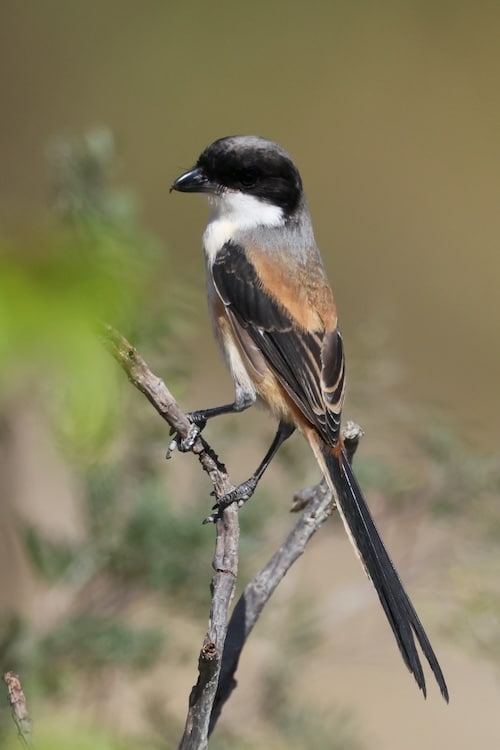
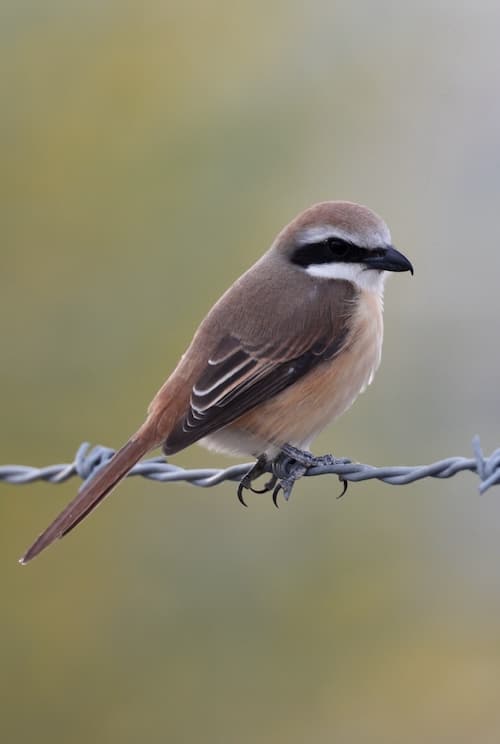
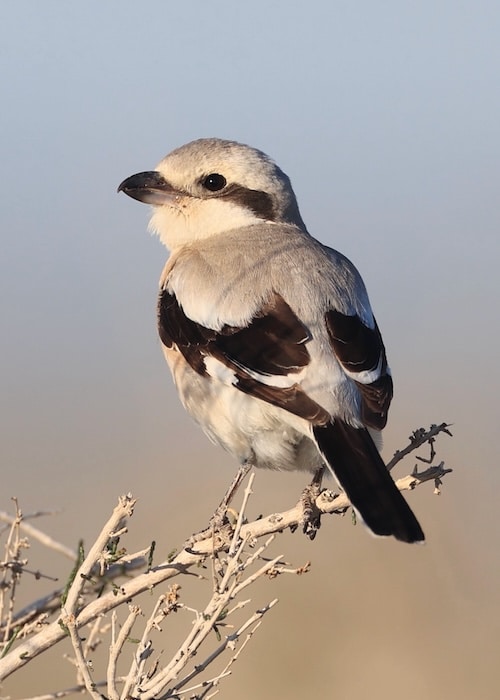
Shrikes are generally monogamous breeders, although polygyny has been recorded in some species. Co-operative breeding, where younger birds help their parents raise the next generation of young, has been recorded in both species in the genera Eurocephalus and Corvinella, as well as one species of Lanius. Males attract females to their territory with well-stocked caches, which may include inedible but brightly coloured items. During courtship, the male performs a ritualised dance which includes actions that mimic the skewering of prey on thorns, and feeds the female. Shrikes make simple, cup-shaped nests from twigs and grasses, in bushes and the lower branches of trees.
-
Number of bird species: 34
(As at December 2025)
According to the recently (2025) amalgamated AviList, there are thirty-four species, in four genera in the family. They are:
Yellow-billed Shrike Corvinella corvina
Magpie Shrike Urolestes melanoleucus
Long-tailed Fiscal Lanius cabanisi
Grey-backed Fiscal Lanius excubitoroides
Taita Fiscal Lanius dorsalis
Somali Fiscal Lanius somalicus
Great Grey Shrike Lanius excubitor
Loggerhead Shrike Lanius ludovicianus
Chinese Grey Shrike Lanius sphenocercus
Giant Grey Shrike Lanius giganteus
Southern Grey Shrike Lanius meridionalis
Northern Shrike Lanius borealis
Masked Shrike Lanius nubicus
Lesser Grey Shrike Lanius minor
Woodchat Shrike Lanius senator
Emin’s Shrike Lanius gubernator
Mackinnon’s Shrike Lanius mackinnoni
Sao Tome Fiscal Lanius newtoni
Northern Fiscal Lanius humeralis
Souza’s Shrike Lanius souzae
Southern Fiscal Lanius collaris
Tiger Shrike Lanius tigrinus
Bay-backed Shrike Lanius vittatus
Burmese Shrike Lanius collurioides
Isabelline Shrike Lanius isabellinus
Red-backed Shrike Lanius collurio
Red-tailed Shrike Lanius phoenicuroides
Long-tailed Shrike Lanius schach
Brown Shrike Lanius cristatus
Grey-backed Shrike Lanius tephronotus
Mountain Shrike Lanius validirostris
Bull-headed Shrike Lanius bucephalus
Northern White-crowned Shrike Eurocephalus ruppelli
Southern White-crowned Shrike Eurocephalus anguitimens
-
Shrikes and Bush-Shrikes
| (Including Wood-Shrikes, Helmet-Shrikes, Flycatcher-Shrikes, Philentomas, Batises and Wattle-Eyes) | by Tony Harris & Kim Franklin | Christopher Helm | 2000 | Hardback | 392 pages, 41 colour plates, line illustrations, 114 maps | ISBN: 9780713638615 Buy this book from NHBS.com -
Shrikes of the World
| By Norbert Lefranc & Tim Worfolk | Helm | 2022 | Edition 2 | Hardback | 336 pages, 21 plates with colour illustrations; colour photos, b/w illustrations, colour distribution maps | ISBN: 9781472933775 Buy this book from NHBS.com -
The True Shrikes (Laniidae) of the World
| (Ecology, Behaviour and Evolution) | by EN Panov | Pensoft Publishers | 2011 | Hardback | 910 pages, Colour plates, colour & b/w figures, maps, tables | ISBN: 9789546425768 Buy this book from NHBS.com
-
Laniidae
Family AccountShrikes are passerines that evolved to become diurnal birds of prey, and their appearance and behavior converge on small raptors in many respects. -
Laniidae
Family AccountShrikes are passerine birds of the family Laniidae. The family is composed of 34 species in two genera.
Given the number of species in this family, Fatbirder does not provide quick links to all of them. However, the entries below do include links to representatives of every genera, all those illustrated and some of the most often encountered, iconic or sought-after species.
-
Brown Shrike Lanius cristatus
Species AccountMedium-sized shrike with a slender black mask and rufous-brown rump and tail. Plumage varies across range: “Japanese” has the warmest rufous tones. -
Brown Shrike Lanius cristatus
Species AccountThe Brown Shrike (Lanius cristatus) is a bird in the shrike family that is found mainly in Asia. It is closely related to the Red-backed Shrike (L. collurio) and Isabelline Shrike (L. isabellinus). Like most other shrikes, it has a distinctive black "bandit-mask" through the eye…. -
Brown Shrike Lanius cristatus
Species AccountSound archive and distribution map -
Burmese Shrike Lanius collurioides
Species AccountThe Burmese shrike (Lanius collurioides) is a species of bird in the family Laniidae. I -
Burmese Shrike Lanius collurioides
Species AccountSound archive and distribution map -
Great Grey Shrike Lanius excubitor
Species AccountThrush-sized bird; pale gray overall with black mask. In flight, watch for white patches in the wings. -
Great Grey Shrike Lanius excubitor
Species AccountSound archive and distribution map -
Loggerhead Shrike Lanius ludovicianus
Species AccountBlack-masked bandit of open areas with some bushes and trees. Bold black, white, and gray pattern is distinctive; also note stout hooked bill. -
Loggerhead Shrike Lanius ludovicianus
Species AccountThe loggerhead shrike (Lanius ludovicianus) is a passerine bird in the family Laniidae. It is the only member of the shrike family endemic to North America. -
Loggerhead Shrike Lanius ludovicianus
Species AccountSound archive and distribution map -
Long-tailed Fiscal Lanius cabanisi
Species AccountThe long-tailed fiscal (Lanius cabanisi) is a species of bird in the shrike family Laniidae. -
Long-tailed Fiscal Lanius cabanisi
Species AccountSound archive and distribution map -
Long-tailed Shrike Lanius schach
Species AccountA large, noisy shrike typical of open habitats across Asia. -
Long-tailed Shrike Lanius schach
Species AccountSound archive and distribution map -
Mackinnon's Shrike Lanius mackinnoni
Species AccountMedium-sized, slim shrike patterned in dark gray, black, and white. The male has completely white underparts, while the female has a rufous flank patch. -
Mackinnon's Shrike Lanius mackinnoni
Species AccountSound archive and distribution map -
Magpie Shrike Urolestes melanoleucus
Species AccountSound archive and distribution map -
Magpie Shrike Urolestes melanoleucus
Species AccountThe magpie shrike (Urolestes melanoleucus), also known as the African long-tailed shrike, is a species of bird in the family Laniidae. -
Northern White-crowned Shrike Eurocephalus rueppellii
Species AccountThe northern white-crowned shrike or white-rumped shrike (Eurocephalus ruppelli), is a shrike found in dry thornbush, semi-desert, and open acacia woodland in east Africa from south eastern South Sudan and southern Ethiopia to Tanzania. Its binomial name commemorates the German naturalist and explorer Eduard Rüppell. -
Northern White-crowned Shrike Eurocephalus rueppellii
Species AccountSound archive and distribution map -
Red-backed Shrike Lanius collurio
Species AccountThe red-backed shrike (Lanius collurio) is a carnivorous passerine bird and member of the shrike family, Laniidae. -
Red-backed Shrike Lanius collurio
Species AccountSound archive and distribution map -
Red-tailed Shrike Lanius phoenicuroides
Species AccountSmall, plain shrike of dry, open areas with low shrubby cover. Gray-backed and white-bellied, with a black mask and a rusty tail and crown. -
Red-tailed Shrike Lanius phoenicuroides
Species AccountSound archive and distribution map -
Southern Fiscal Lanius collaris
Species AccountSound archive and distribution map. -
Southern Fiscal Lanius collaris
Species AccountThe southern fiscal or fiscal shrike (Lanius collaris) is a member of the shrike family found through most of Sub-Saharan Africa. -
Southern White-crowned Shrike Eurocephalus anguitimens
Species AccountThe southern white-crowned shrike (Eurocephalus anguitimens) is a species of bird in the family Laniidae. -
Southern White-crowned Shrike Eurocephalus anguitimens
Species AccountSound archive and distribution map -
Taita Fiscal Lanius dorsalis
Species AccountThe Taita fiscal or Teita fiscal (Lanius dorsalis) is a member of the shrike family found in east Africa from southeastern South Sudan, southern Ethiopia... -
Taita Fiscal Lanius dorsalis
Species AccountSound archive and distribution map -
Woodchat Shrike Lanius senator
Species AccountVery distinctive black-masked shrike with a red crown and nape. Stocky and big-headed, with prominent white wing patches. -
Woodchat Shrike Lanius senator
Species AccountSound archive and distribution map -
Yellow-billed Shrike Corvinella corvina
Species AccountA large, very long-tailed streaky brownish shrike with a paler eyebrow and underparts, a rusty wing panel, and a chunky bright yellow bill and eye-ring. -
Yellow-billed Shrike Corvinella corvina
Species AccountSound archive and distribution map