

Laridae – Gulls, Terns & Skimmers
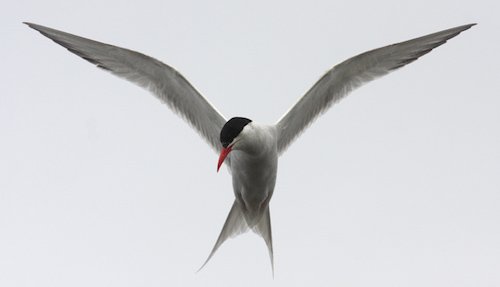
The Laridae (Gulls, Terns & Skimmers) family, despite appearances, are closely related to waders. The order Charadriiformes also includes Charadriidae (Plovers & Lapwings), Pluvianellidae (Magellanic Plover), Chionidae (Sheathbills), Burhinidae (Thick-knees & Stone Curlews), Pluvianidae (Egyptian Plover), Recurvirostridae (Stilts & Avocets) Ibidorhynchidae (Ibisbill), Haematopodidae (Oystercatchers), Pedionomidae (Plains Wanderer), Thinocoridae (Seedsnipes), Rostratulidae (Painted Snipe), Jacanidae (Jacanas), Scolopacidae (Sandpipers), Turnicidae (Buttonquails), Dromadidae (Crab-Plover), Glareolidae (Coursers & Pratincoles) and Stercorariidae (Skuas), Alcidae (Auks).
The IOC fairly recently lumped into the Laridae family that had formerly been all the gulls, two other groups, which had been treated as families in their own right, Skimmers and Terns. The latter contains some of the most beautiful species and in many ways the most birdy of birds – the Arctic Tern, which, in the course of two years, completely circumnavigates the globe going from pole to pole and back again.
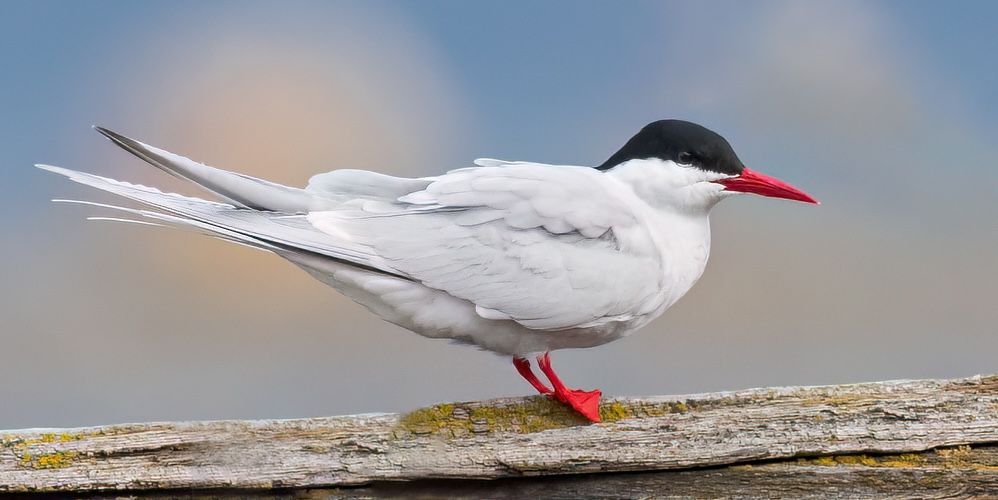 South American Tern Sterna hirundinacea –Dubi Shapiro
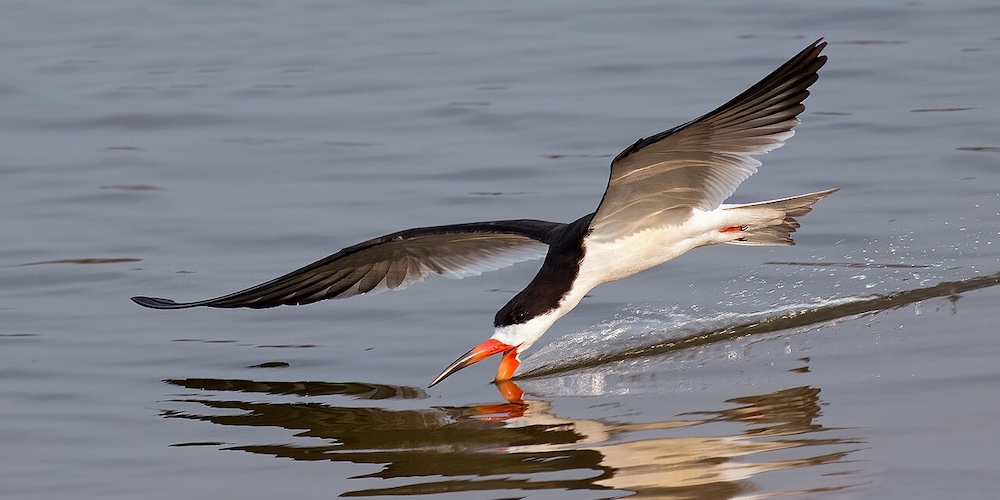
Black Skimmer Rynchops niger – Charles J Sharp via Wikimedia Commons
The Laridae are the most familiar birds of every shore. Active, obvious, and seldom shy, they are sometimes in our lives even more than we would like. They can be divided by what they eat: Gulls generally eat any animal they can swallow, dead or alive, and they gather their food with an astonishing opportunism and ingenuity; terns mostly eat fish that they dive for, and they stay out of each other’s way in loose foraging aggregations; and skimmers use their highly specialized bills to snag their prey from the surface of calm water, often in gracefully coordinated bands. Larids lay their eggs on sandy beaches, atop precarious cliff ledges, and even in trees, and the precocial young are fed at home until they fledge.
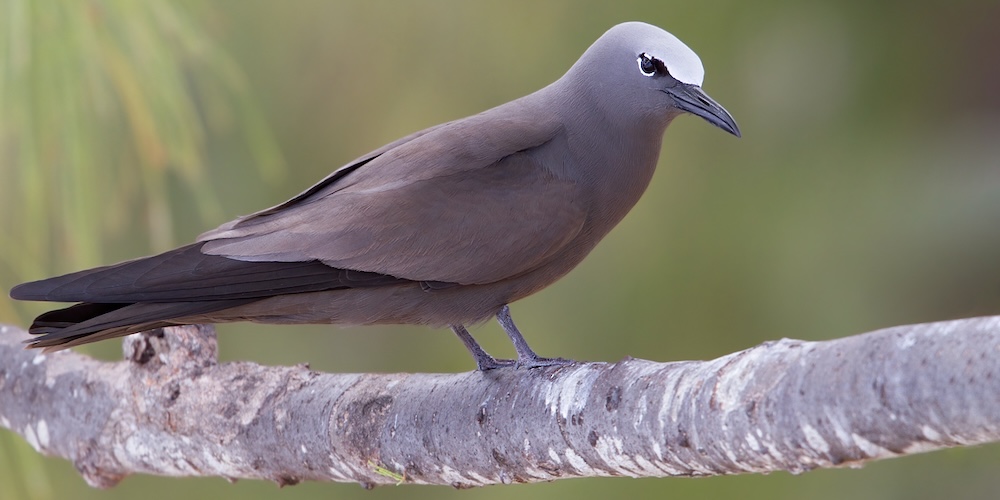
Brown Noddy Anous stolidus – Dubi Shapiro
Laridae is a family of seabirds that includes the gulls, terns (including white terns), noddies, and skimmers. It includes over one hundred species arranged into twenty-three genera. They are an adaptable group of mostly aerial birds found worldwide.
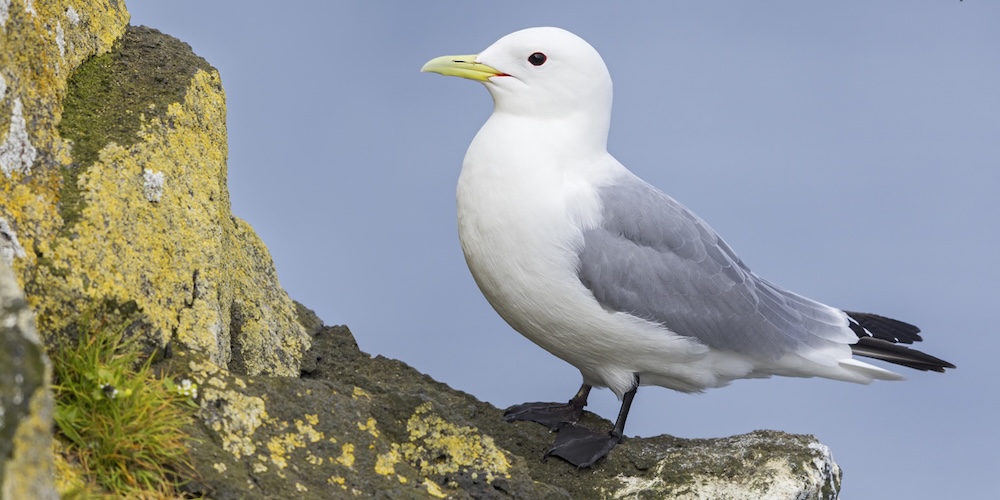
Black-legged Kittiwake Rissa tridactyla – ©Dubi Shapiro
Their adaptability has likely been a factor in their spread around the world. Most have become much more aerial (preferring flight) than their ancestor, which likely resembled some form of beachcombing shorebird. In general, most gulls tend to inhabit in the northern hemisphere at temperate latitudes (except for the Ivory Gull breeding in the High Arctic). By comparison, skimmers and terns tend to live in subtropical and tropical regions of the globe. During the nonbreeding season, many species of larids fly offshore, often becoming pelagic. In the breeding season, they mostly nest along coastal regions or marshlands, although in some places they take advantage of the man-made ‘cliffs’ in cities.
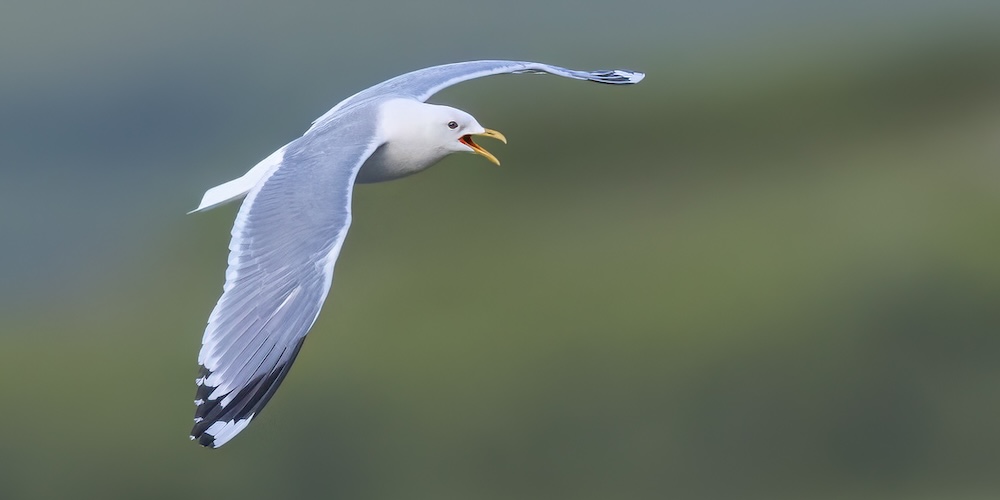
Short-billed Gull Larus brachyrhynchus – ©Dubi Shapiro
I really do not know why Gulls excite such passion. Frankly, I, like very many birders, find the taxa difficult to ID quickly and, sorry chaps, rather boring. It’s a bit like the old Ford dictum – you can have any colour you like as long as its black! With gulls that’s black, white and shades of grey. On the other hand, terns are so elegant in form that it is hard not to find them attractive despite their mostly monochrome hues.
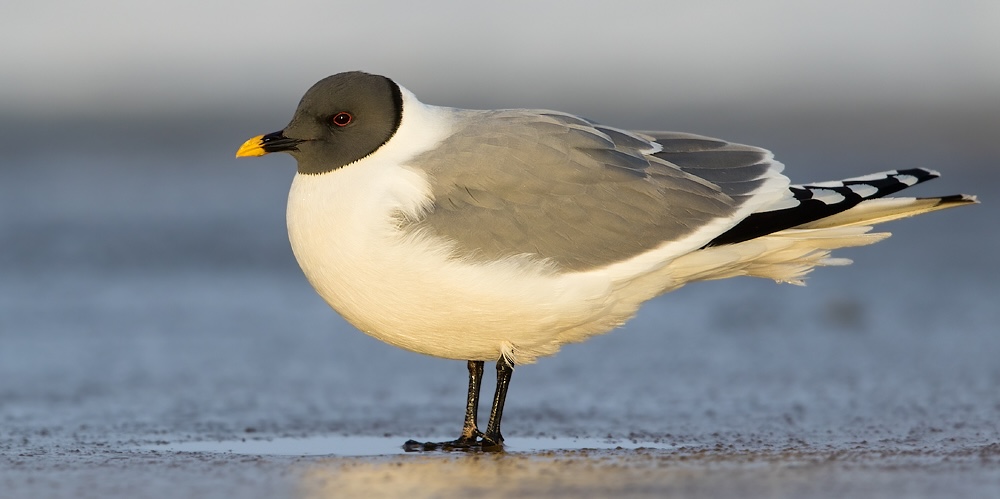
Sabine’s Gull Xema sabini – ©Dubi Shapiro
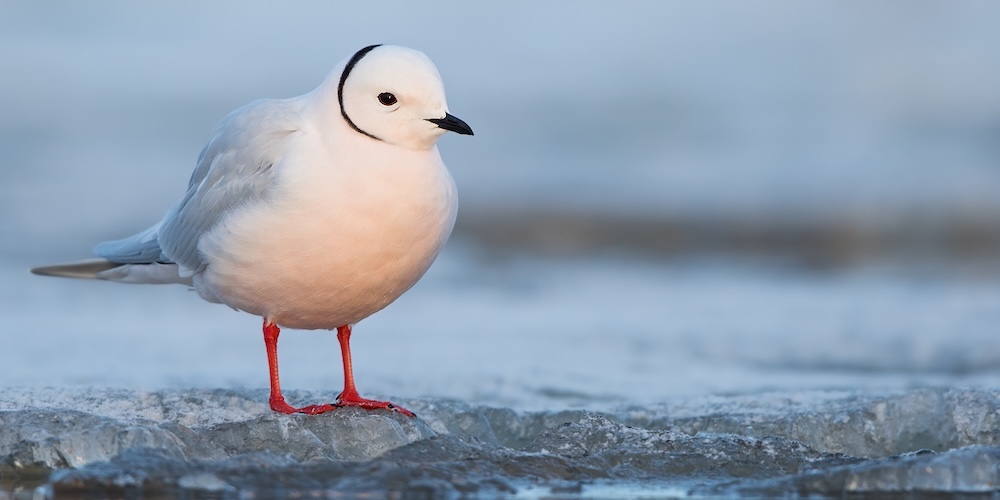
Ross’s Gull Rhodostethia rosea – ©Dubi Shapiro
Nevertheless, there are a great many very dedicated gull watchers ready to identify by leg shade or gape colour. Good luck to you I say – I admit it has one great advantage – every town with a rubbish tip has plenty of gulls and these successful birds are very much more common inland than they used to be. Laridae are, of course, a good way of recognising a birder and separating him or her from the populous at large. Point at the black and white bird and ask what it is. Most people will tell you it’s a sea-gull. Birders will tell you it’s a gull!
-
Number of bird species: 104
(As atr September 2025)
According to the recently (2025) amalgamated AviList, the family Laridae (Terns, Skimmers & Gulls) consists of one hundred and four species in twenty-three genera. They are:
African Skimmer Rynchops flavirostris
Indian Skimmer Rynchops albicollis
Black Skimmer Rynchops niger
Atlantic White Tern Gygis alba
Blue-billed White Tern Gygis candida
Little nWhite Tern Gygis microrhyncha
Brown Noddy Anous stolidus
Lesser Noddy Anous tenuirostris
Black Noddy Anous minutus
Grey Noddy Anous albivitta
Blue Noddy Anous ceruleus
Aleutian Tern Onychoprion aleuticus
Sooty Tern Onychoprion fuscatus
Spectacled Tern Onychoprion lunatus
Bridled Tern Onychoprion anaethetus
Damara Tern Sternula balaenarum
Fairy Tern Sternula nereis
Little Tern Sternula albifrons
Yellow-billed Tern Sternula superciliaris
Peruvian Tern Sternula lorata
Saunders’s Tern Sternula saundersi
Least Tern Sternula antillarum
Large-billed Tern Phaetusa simplex
Caspian Tern Hydroprogne caspia
Gull-billed Tern Gelochelidon macrotarsa
Gull-billed Tern Gelochelidon nilotica
Inca Tern Larosterna inca
Whiskered Tern Chlidonias hybrida
Black-fronted Tern Chlidonias albostriatus
White-winged Tern Chlidonias leucopterus
Black Tern Chlidonias niger
Sandwich Tern Thalasseus sandvicensis
Elegant Tern Thalasseus elegans
Chinese Crested Tern Thalasseus bernsteini
Greater Crested Tern Thalasseus bergii
Royal Tern Thalasseus maximus
West African Crested Tern Thalasseus ablbididorsalis
Lesser Crested Tern Thalasseus bengalensis
River Tern Sterna aurantia
Forster’s Tern Sterna forsteri
Snowy-crowned Tern Sterna trudeaui
Arctic Tern Sterna paradisaea
South American Tern Sterna hirundinacea
Antarctic Tern Sterna vittata
Kerguelen Tern Sterna virgata
Common Tern Sterna hirundo
White-cheeked Tern Sterna repressa
Black-naped Tern Sterna sumatrana
Roseate Tern Sterna dougallii
White-fronted Tern Sterna striata
Black-bellied Tern Sterna acuticauda
Swallow-tailed Gull Creagrus furcatus
Little Gull Hydrocoloeus minutus
Ross’s Gull Rhodostethia rosea
Red-legged Kittiwake Rissa brevirostris
Black-legged Kittiwake Rissa tridactyla
Sabine’s Gull Xema sabini
Ivory Gull Pagophila eburnea
Saunders’s Gull Saundersilarus saundersi
Slender-billed Gull Chroicocephalus genei
Bonaparte’s Gull Chroicocephalus philadelphia
Black-headed Gull Chroicocephalus ridibundus
Brown-headed Gull Chroicocephalus brunnicephalus
Hartlaub’s Gull Chroicocephalus hartlaubii
Grey-headed Gull Chroicocephalus cirrocephalus
Brown-hooded Gull Chroicocephalus maculipennis
Andean Gull Chroicocephalus serranus
Black-billed Gull Chroicocephalus bulleri
Silver Gull Chroicocephalus novaehollandiae
Dolphin Gull Leucophaeus scoresbii
Grey Gull Leucophaeus modestus
Laughing Gull Leucophaeus atricilla
Franklin’s Gull Leucophaeus pipixcan
Lava Gull Leucophaeus fuliginosus
Pallas’s Gull Ichthyaetus ichthyaetus
Relict Gull Ichthyaetus relictus
Audouin’s Gull Ichthyaetus audouinii
Mediterranean Gull Ichthyaetus melanocephalus
White-eyed Gull Ichthyaetus leucophthalmus
Sooty Gull Ichthyaetus hemprichii
Pacific Gull Larus pacificus
Belcher’s Gull Larus belcheri
Black-tailed Gull Larus crassirostris
Olrog’s Gull Larus atlanticus
Heermann’s Gull Larus heermanni
Ring-billed Gull Larus delawarensis
Short-billed Gull Larus brachyrhynchus
Common Gull Larus canus
Yellow-footed Gull Larus livens
Western Gull Larus occidentalis
Caspian Gull Larus cachinnans
Kelp Gull Larus dominicanus
American Herring Gull Larus smithsonianus
Vega Gull Larus vegae
Mongolian Gull Larus mongolicus
European Herring Gull Larus argentatus
Yellow-legged Gull Larus michahellis
Armenian Gull Larus armenicus
Great Black-backed Gull Larus marinus
Glaucous Gull Larus hyperboreus
Lesser Black-backed Gull Larus fuscus
California Gull Larus californicus
Glaucous-winged Gull Larus glaucescens
Slaty-backed Gull Larus schistisagus
Iceland Gull Larus glaucoides
-
Southern Oceans Seabird Study Association
WebsiteSOSSA was founded by members of the New South Wales Albatross Study Group (NSWASG) in 1994. It was set up to be an umbrella organisation for many study groups concerned with studies of Southern Ocean bio-diversity. SOSSA is a wildlife research and conservation group which consists of dedicated people both professional and amateur. These people share a common interest and concern for the environment and the wildlife of the Southern Oceans -
The Seabird Group
WebsiteThe Seabird Group, a registered charity, was founded in 1966 to promote and help coordinate the study and conservation of seabirds
-
Birds of Paradox - The Life of Terns
| By Peter Trull | Schiffer | 2029 | Hardback | 96 pages, 100+ colour photos | ISBN: 9780764357640 Buy this book from NHBS.com -
Clinging to the Edge - A Year in the Life of a Little Tern Colony
| By Richard Boon | Pelagic | 2024 | Paperback | 134 pages, colour photos | ISBN: 9781784274894 Buy this book from NHBS.com -
Flight Identification of European Seabirds
| By Anders Blomdahl, Bertil Breife & Niklas Holmstrom | Helm | 2007 | Paperback | 374 pages, 690 colourphotos | ISBN: 9780713686166 Buy this book from NHBS.com -
Gulls - A Guide to Identification
| By P J Grant | T & AD Poyser | 2010 | Edition 2 | Hardback | 352 pages, B/w photos, b/w illustrations, maps | ISBN: 9781408138311 Buy this book from NHBS.com -
Gulls Simplified: A Comparative Approach to Identification
| By Pete Dunne & Kevin T Karlson | Princeton University Press | 2018 | Paperback | 208 pages, 330 colour photos | ISBN: 9780691156941 Buy this book from NHBS.com -
Seabirds
| By Peter Harrison, Martin Perrow & Hans Larsson | Lynx Edicions | 2021 | Hardback | 600 pages, 239 plates with 3800+ colour illustrations; colour distribution maps | ISBN: 9788416728411 Buy this book from NHBS.com -
Seabirds - a natural history
| By Anthony J Gaston | A&C Black | 2004 | Hardback | 222 pages, 22 colour plates, b/w photos, illustrations, figures | ISBN: 9780713665574 Buy this book from NHBS.com -
Terns of North America - A Photopgraphic guide
| By Cameron Cox | PUOP | 2023 | Paperback | 201 pages, 325 colour photos | ISBN: 9780691161877 Buy this book from NHBS.com
-
Laridae
Family AccountThe Laridae are the most familiar charadriiform birds of every shore. -
Laridae
Family AccountLaridae is a family of seabirds in the order Charadriiformes that includes the gulls, terns (including white terns), noddies, and skimmers.
Given that there are over a hundred species in this family, Fatbirder does not provide quick links to all of them. However, the entries below do include links to representatives of every genera, all those illustrated and some of the most often encountered, iconic or sought-after species.
-
Saunders’s Gull Saundersilarus saundersi
Species AccountSound archive and distribution map -
Atlantic White Tern Gygis alba
Species AccountA medium-sized tern with entirely white plumage, a slightly forked tail, and glittering inky pools for eyes. The bill is black with a blue base. -
Atlantic White Tern Gygis alba
Species AccountSound archive and distribution map -
Black Skimmer Rynchops niger
Species AccountUnusual tern-like bird with oversized bill—lower mandible is much longer than upper mandible. Feeds by flying close to surface of water... -
Black Skimmer Rynchops niger
Species AccountSound archive and distribution map -
Black Tern Chlidonias niger
Species AccountThe black tern (Chlidonias niger) is a small tern generally found in or near inland water that breeds in Europe, Western Asia and North America. -
Black Tern Chlidonias niger
Species AccountSound archive and distribution map -
Black-headed Gull Chroicocephalus ridibundus
Species AccountFairly small gull, common and widespread across Eurasia. All plumages have big white blaze on leading edge of wing. -
Black-headed Gull Chroicocephalus ridibundus
Species AccountSound archive and distribution map -
Black-legged Kittiwake Rissa tridactyla
Species AccountThe black-legged kittiwake (Rissa tridactyla) is a seabird species in the gull family Laridae. This species was first described by Carl Linnaeus. -
Black-legged Kittiwake Rissa tridactyla
Species AccountSound archive and distribution map -
Bonaparte’s Gull Chroicocephalus philadelphia
Species AccountThe most common small gull through most of North America, especially inland. -
Bonaparte’s Gull Chroicocephalus philadelphia
Species AccountSound archive and distribution map -
Bridled Tern Onychoprion anaethetus
Species AccountBridled Tern is found in warm tropical waters worldwide. It breeds on islands, usually concealed by a large rock or bush. Otherwise, usually stays far offshore. -
Bridled Tern Onychoprion anaethetus
Species AccountSound archive and distribution map -
Brown Noddy Anous stolidus
Species AccountThe brown noddy or common noddy (Anous stolidus) is a seabird in the family Laridae. The largest of the noddies, it can be told from the closely related... -
Brown Noddy Anous stolidus
Species AccountSound archive and distribution map -
Caspian Gull Larus cachinnans
Species AccountCaspian gull is a name applied to the gull taxon Larus cachinnans, a member of the herring gull/lesser black-backed gull complex. -
Caspian Gull Larus cachinnans
Species AccountSound archive and distribution map -
Caspian Tern Hydroprogne caspia
Species AccountThe Caspian tern (Hydroprogne caspia) is the world's largest species of tern, with a subcosmopolitan but scattered distribution. Despite its extensive range... -
Caspian Tern Hydroprogne caspia
Species AccountSound archive and distribution map -
Gull-billed Tern Gelochelidon nilotica
Species AccountMedium-sized tern with thick black bill. Very pale overall with black cap in breeding plumage. Legs black. Nonbreeding plumage shows dark cheek patch. -
Gull-billed Tern Gelochelidon nilotica
Species AccountSound archive and distribution map -
Inca Tern Larosterna inca
Species AccountThe Inca tern (Larosterna inca) is a near-threatened species of tern in the subfamily Sterninae of the family Laridae (the gulls, terns, and skimmers). -
Inca Tern Larosterna inca
Species AccountSound archive and distribution map -
Ivory Gull Pagophila eburnea
Species AccountThe ivory gull (Pagophila eburnea) is a small gull, the only species in the genus Pagophila. It is a resident breeding bird in the high Arctic. -
Ivory Gull Pagophila eburnea
Species AccountSound archive and distribution map -
Large-billed Tern Phaetusa simplex
Species AccountUnmistakable large noisy tern, with a long, thick yellow bill, black crown, three-toned wings (black outer wing, pale middle, and gray inner wing), and a gray... -
Large-billed Tern Phaetusa simplex
Species AccountSound archive and distribution map -
Laughing Gull Leucophaeus atricilla
Species AccountSlender, medium-sized gull with long wings. Medium-gray upperparts. -
Laughing Gull Leucophaeus atricilla
Species AccountSound archive and distribution map -
Lesser Black-backed Gull Larus fuscus
Species AccountThe lesser black-backed gull (Larus fuscus) is a large gull that breeds on the Atlantic coasts of Europe. The scientific name is from Latin. Larus appears to have referred to a gull or other large seabird, and fuscus meant black or brown. -
Lesser Black-backed Gull Larus fuscus
Species AccountSound archive and distribution map -
Little Gull Hydrocoloeus minutus
Species AccountThe little gull (Hydrocoloeus minutus), is a species of gull belonging to the family Laridae which is mainly found in the Palearctic with some small colonie... -
Little Gull Hydrocoloeus minutus
Species AccountSound archive and distribution map -
Little Tern Sternula albifrons
Species AccountThe little tern (Sternula albifrons) is a seabird of the family Laridae. It was first described by the German naturalist Peter Simon Pallas in 1764. -
Little Tern Sternula albifrons
Species AccountSound archive and distribution map -
Mediterranean Gull Ichthyaetus melanocephalus
Species AccountThe Mediterranean gull (Ichthyaetus melanocephalus) is a small gull. The scientific name is from Ancient Greek. -
Mediterranean Gull Ichthyaetus melanocephalus
Species AccountSound archive and distribution map -
Roseate Tern Sterna dougallii
Species AccountThe roseate tern (Sterna dougallii) is a species of tern in the family Laridae. The genus name Sterna is derived from Old English "stearn", "tern". -
Roseate Tern Sterna dougallii
Species AccountSound archive and distribution map -
Ross’s Gull Rhodostethia rosea
Species AccountLong-winged, wedge-tailed, delicate seabird of far northern climates, nesting in open wet tundra and wintering around sea ice, occasionally moving... -
Ross’s Gull Rhodostethia rosea
Species AccountSound archive and distribution map -
Sabine’s Gull Xema sabini
Species AccountSmall oceanic gull with stunning wing pattern. All ages show distinctive black outer wing, white inner wing, and dark back. -
Sabine’s Gull Xema sabini
Species AccountSound archive and distribution map -
Sandwich Tern Thalasseus sandvicensis
Species AccountPale medium-sized tern with a geographically variable bill pattern: black with a distinct yellow tip in most of its range; entirely yellow in the Caribbean... -
Sandwich Tern Thalasseus sandvicensis
Species AccountSound archive and distribution map -
Saunders’s Gull Saundersilarus saundersi
Species AccountElegant, dark-hooded gull, restricted to coastal East Asia. Small but stout-bodied and long-winged, with a dark bill in all plumages. -
Short-billed Gull Larus brachyrhynchus
Species AccountThe short-billed gull (Larus brachyrhynchus) is a species of gull that breeds in northwestern North America. -
Short-billed Gull Larus brachyrhynchus
Species AccountSound archive and distribution map -
South American Tern Sterna hirundinacea
Species AccountThe South American tern (Sterna hirundinacea) is a species of tern found in coastal regions of southern South America, including the Falkland Islands, ranging north to Peru (Pacific coast) and Brazil (Atlantic coast). -
South American Tern Sterna hirundinacea
Species AccountSound archive and distribution map -
Swallow-tailed Gull Creagrus furcatus
Species AccountSound archive and distribution map -
Swallow-tailed Gull Creagrus furcatus
Species AccountThe antithesis of confusing northern gulls, Swallow-tailed is stunning and distinctive.
-
Great Gull Island
WebsiteGreat Gull Island is the site of an ongoing research project on Common Terns and Roseate Terns. -
Italian Gulls – Gabbiani d'Italia
WebsiteWelcome to the web site featuring the Italian gull species. Here you'll learn all about the gulls flying over Italy, where they nest, from where they arrive and where they go… -
Rudy's Birding Page
WebsiteWelcome to my homepage. This site will be an information-page about everything that is linked to my favourite hobby: birdwatching! Surprisingly, even for me, that everything turned out to be mostly Gulls!!