

Oceanitidae – Austral Storm Petrels
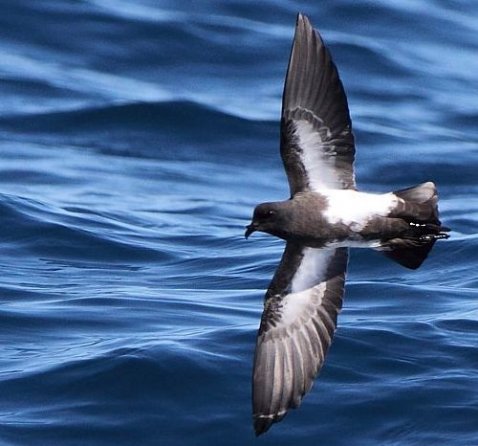
The Oceanitidae – Austral Storm Petrels – are, along with Diomedeidae (Albatrosses), Hydrobatidae (Northern Storm Petrels) and Procellariidae (Shearwaters, Petrels & Diving Petrels) part of the Procellariiformes order. They are found in all the world’s oceans but, are predominantly found in the southern hemisphere – only Wilson’s & White-faced Sorm Petrels are found in the northern hemisphere.
The family contains five genera, in which there are ten species. They were the second group of storm petrels to break off from the ancestral petrel stock, and for this reason, it was recently agreed that they constitute a separate family from the other Procellariiformes. The New Zealand storm petrel was presumed extinct until recently rediscovered (2003) by birdwatchers.
They are some of the smallest of all the seabirds, ranging in size from 13–26 cm in length, with short wings, square tails, elongated skulls, and long legs. The legs of all storm petrels are proportionally longer than those of other Procellariiformes, but they are very weak and unable to support the bird’s weight for more than a few steps. They are notoriously difficult to identify at sea.
The plumage of all the Oceanitidae (with the exception of Wilson’s storm petrel) is dark with white underparts. It has been suggested (Onley and Scofield 2007) that much published information is incorrect, and that photographs, even in some of the major seabird books and websites, are frequently incorrectly ascribed as to species. It is also thought that several national bird lists include species which have been incorrectly identified or have been accepted on inadequate evidence.
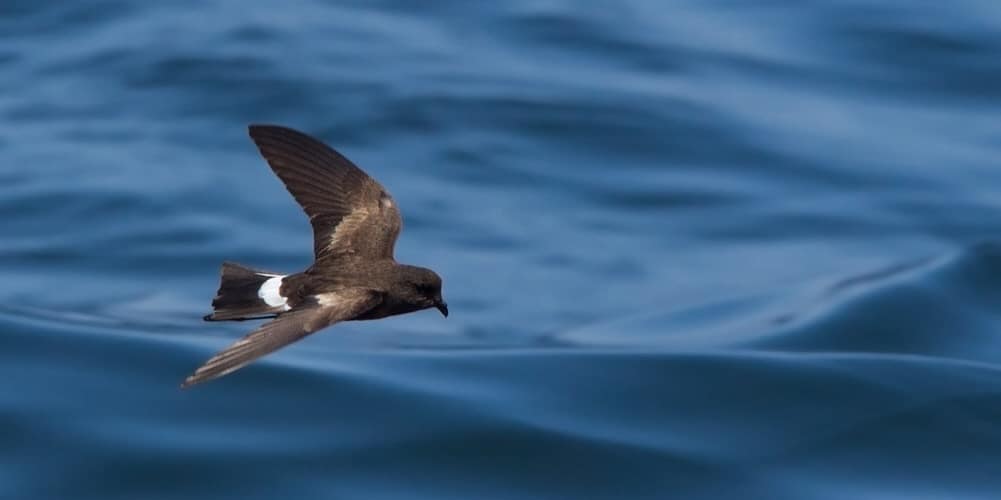
Wilson’s Storm Petrel Oceanites oceanicus – ©Dubi Shapiro
This family use a variety of techniques to aid flight. Most species will occasionally feed by surface pattering, holding and moving their feet on the water’s surface while holding steady above the water, and this method of feeding flight is the method most commonly used by Austral Storm Petrels. The White-faced Storm Petrel possesses a unique variation on pattering, holding its wings motionless and at an angle into the wind, it pushes itself off the water’s surface in a succession of bounding jumps. Storm petrels also use dynamic soaring and slope soaring to travel over the ocean surface, although this method is used less by this family compared to the northern storm petrels. Slope soaring is favoured by the Oceanitidae, the storm petrel turns to the wind, gaining height, from where it can then glide back down to the sea.
They feed on planktonic crustaceans and small fish picked from the surface, typically while hovering. Their usual flight is fluttering and is sometimes described as like that of bats. Some species are known to be rather more specialised; for example, the Grey-backed Storm Petrel is known to concentrate on the larvae of goose barnacles. Like many types of seabirds, storm petrels associate with other species of seabird and marine mammal species to help obtain food. They may benefit from the actions of diving predators such as seals and penguins, which push prey up towards the surface while hunting, allowing the surface-feeding storm petrels to reach them.
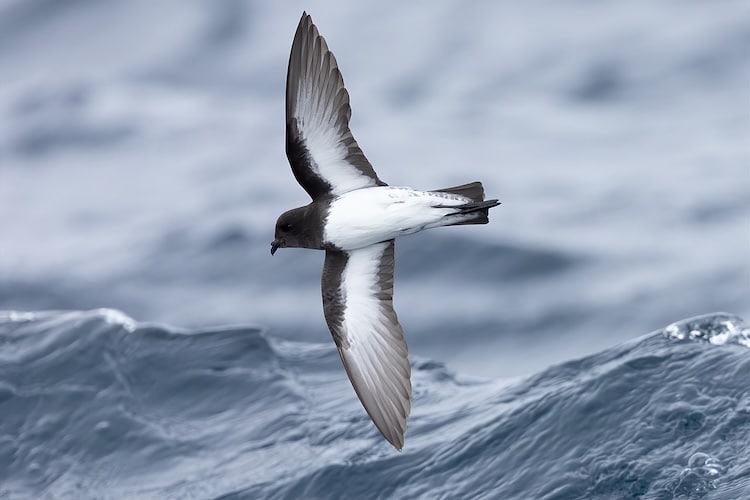
Grey-backed Storm Petrel Garrodia nereis – ©JJ Harrison CC BY-SA 3.0 via Wikimedia Commons
They are almost all strictly pelagic, coming to land only when breeding (Elliot’s Storm Petrel is an exception feeding in the Galapagos Islands’ coastal waters). In the case of most petrel species, little is known of their behaviour and distribution at sea, where they can be hard to find. They are colonial nesters, displaying strong philopatry to their natal colonies and nesting sites. Some colonies are enormous with over threequarters of a million birds. Most species nest in crevices or burrows, and all but one species attend the breeding colonies nocturnally. Pairs form long-term monogamous bonds and share incubation and chick-feeding duties. Like many species of seabirds, nesting is highly protracted with incubation taking up to 50 days and fledging another 70 days after that.
Several species are threatened by human activities. The principal threats to storm petrels are introduced species, particularly mammals, in their breeding colonies; many storm petrels habitually nest on isolated mammal-free islands and are unable to cope with predators such as rats and feral cats.
-
Number of bird species: 10
(As at August 2025)
According to the recently (2025) combined AviList, there are just ten Austral Storm Petrels, in five genera in the newly split family of Oceanitidae. They are:
Wilson’s Storm Petrel Oceanites oceanicus
Pincoya Storm Petrel Oceanites pincoyae
Elliot’s Storm Petrel Oceanites gracilis
Polynesian Storm Petrel Nesofregetta fuliginosa
Grey-backed Storm Petrel Garrodia nereis
White-faced Storm Petrel Pelagodroma marina
White-bellied Storm Petrel Fregetta grallaria
New Zealand Storm Petrel Fregetta maoriana
New Calledonian Storm Petrel Fregetta lineata
Black-bellied Storm Petrel Fregetta tropica
-
Oceanitidae
Family AccountOceanitidae is a family within Procellariiformes. Traditionally this family was classified as a subfamily within the Hydrobatidae... -
Oceanitidae
Family AccountAustral storm petrels, or southern storm petrels, are seabirds in the family Oceanitidae, part of the order Procellariiformes.
-
Black-bellied Storm Petrel Fregetta tropica
Species AccountStriking small seabird of cold subantarctic waters; some birds range farther north in winter (mainly May–August). Despite the name, its bold white belly is -
Black-bellied Storm Petrel Fregetta tropica
Species AccountSound archive and distribution map. -
Black-bellied Storm Petrel Fregetta tropica
Species AccountIt is found in Antarctica, Argentina, Australia, Bouvet Island, Brazil, Chile, Falkland Islands, French Polynesia, French Southern Territories, Madagascar, Mozambique, New Zealand, Oman, Peru, Saint Helena, São Tomé and Príncipe, Solomon Islands, South Africa, South Georgia and the South Sandwich Islands, Uruguay, and Vanuatu. -
Black-bellied Storm Petrel Fregetta tropica
Species AccountBlack-bellied storm petrels are found throughout the Southern Ocean, where they breed on many subantarctic islands, and may sometimes be seen off the southern New Zealand coast during the breeding season. -
Elliot’s Storm Petrel Oceanites gracilis
Species AccountCommon small storm-petrel of the northern Humboldt Current (can be seen from shore in northern Chile) and Galapagos Islands (where often follows boats) -
Elliot’s Storm Petrel Oceanites gracilis
Species AccountElliot's storm petrel (Oceanites gracilis) is a species of seabird in the storm petrel family Oceanitidae. -
Elliot’s Storm Petrel Oceanites gracilis
Species AccountSound archive and distribution map. -
Grey-backed Storm Petrel Garrodia nereis
Species AccountA very small seabird of southern oceans. Gray-black on head, neck, throat, and top of breast. Back and upperwing are paler in color and rump is ash-gray. -
Grey-backed Storm Petrel Garrodia nereis
Species AccountSound archive and distribution map. -
Grey-backed Storm Petrel Garrodia nereis
Species AccountIt is monotypic within the genus Garrodia. ... It is found in Antarctica, Argentina, Australia, Chile, Falkland Islands, French Southern Territories, New Zealand... -
New Calledonian Storm Petrel Fregetta lineata
Species AccountVery little is known, with the species only known to breed in New Caledonia, where a juvenile was caught by local people at Port Bouraké in 2014. -
New Calledonian Storm Petrel Fregetta lineata
Species AccountOnly formally recognized in 2022, this enigmatic little seabird has been documented around in the Coral Sea, especially around New Caledonia... -
New Calledonian Storm Petrel Fregetta lineata
Species AccountThe New Caledonian storm petrel (Fregetta lineata) is a species of bird in the family Oceanitidae. New Caledonian storm petrel. -
New Zealand Storm Petrel Fregetta maoriana
Species AccountSmall seabird endemic to New Zealand. Dark blackish-brown head, breast, upperparts, and tail. Rump and belly white with variable dark streaking running down... -
New Zealand Storm Petrel Fregetta maoriana
Species AccountThe New Zealand storm petrel (Fregetta maoriana) is a small seabird of the family Oceanitidae endemic to New Zealand. Thought to be extinct since 1850. -
New Zealand Storm Petrel Fregetta maoriana
Species AccountSound archive and distribution map. -
Pincoya Storm Petrel Oceanites pincoyae
Species AccountSound archive and distribution map etc. -
Pincoya Storm Petrel Oceanites pincoyae
Species Account“Classic” Pincoya has big white panel on underside of wing, but other birds darker overall, and may not be distinguishable from Wilson's Storm-Petrel. -
Pincoya Storm Petrel Oceanites pincoyae
Species AccountThe Pincoya storm petrel (Oceanites pincoyae) is a sea bird of the storm petrel family. The specific name commemorates the Pincoya, a female water spirit. -
Polynesian Storm Petrel Nesofregetta fuliginosa
Species AccountA very large storm-petrel with large broad wings and a long forked tail. White rump and throat patch are often strikingly obvious, even with brief views. -
Polynesian Storm Petrel Nesofregetta fuliginosa
Species AccountPolynesian Storm-petrels can weigh anywhere from 56–86 g (2.0–3.0 oz) and can be as tall as 10.2 inches (260 mm). They are identifiable by their black bills, broad, round wings, and black feet. -
Polynesian Storm Petrel Nesofregetta fuliginosa
Species AccountSound archive and distribution map. -
White-bellied Storm Petrel Fregetta grallaria
Species AccountSmall black-and-white storm petrel. Note distinctive sooty black upperparts and white belly and rump. Breeds across the South Pacific, South Atlantic... -
White-bellied Storm Petrel Fregetta grallaria
Species AccountThe white-bellied storm petrel (Fregetta grallaria) is a species of seabird in the family Oceanitidae. It is found in Angola, Argentina, Australia, Brazil... -
White-bellied Storm Petrel Fregetta grallaria
Species AccountSound archive and distribution map. -
White-faced Storm Petrel Pelagodroma marina
Species AccountStriking white-bodied storm-petrel with distinctive flight style: glides on stiff wings and bounces across the sea surface with both feet, much like a hopping... -
White-faced Storm Petrel Pelagodroma marina
Species AccountThe white-faced storm petrel (Pelagodroma marina), (Māori: takahikare) also known as white-faced petrel or frigate petrel is a small seabird of the austral... -
White-faced Storm Petrel Pelagodroma marina
Species AccountSound archive and distribution map. -
Wilson’s Storm Petrel Oceanites oceanicus
Species AccountSmall and fluttery. Dark blackish-brown overall with even-width white rump patch and conspicuous pale wing panels. Long legs extend past the tail in flight. -
Wilson’s Storm Petrel Oceanites oceanicus
Species AccountWilson's storm petrel (Oceanites oceanicus), also known as Wilson's petrel, is a small seabird of the austral storm petrel family Oceanitidae. -
Wilson’s Storm Petrel Oceanites oceanicus
Species AccountOne of the most abundant birds in the world, Wilson's Storm Petrel breeds on islands throughout the southern oceans. -
Wilson’s Storm Petrel Oceanites oceanicus
Species AccountSound archive and distribution map etc.