

Oreoicidae – Australasian Bellbirds
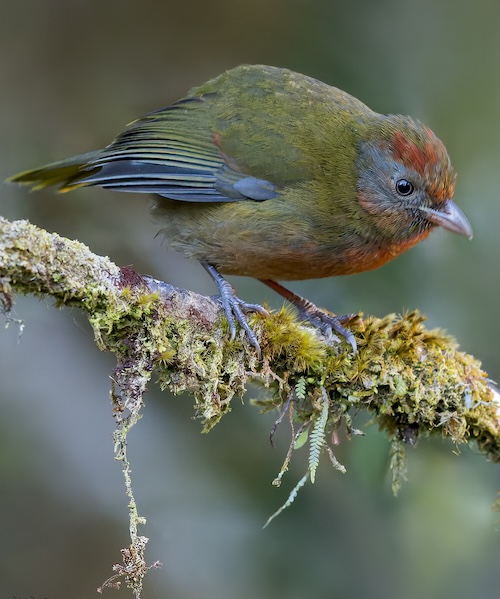
Oreoicidae (Australo-Papuan Bellbirds) is a newly recognised family of small insectivorous passerines, formerly placed in the Old-World warbler dustbin ‘incerta sedis’ family. They are confined to Australasia; two in New Guinea and the third in Australia. It contains just three species, all in different genera, each containing a single species: Aleadryas, which contains the Rufous-naped Bellbird; Ornorectes, which contains the Piping Bellbird; and Oreoica, which contains the Crested Bellbird.
A more apt name for these birds might be “ground bellbirds,” as all are mid-sized passerines that spend a lot of time on the ground, with songs of rhythmically repeating syllables and rich, ringing whistles connecting with variable amounts of lispy, high twittered notes. The rhythmic quality of the song gave at least one of the species, the Crested Bellbird, its alternative onomatopoeic common names: the aborigines know it as ‘panpanpanella’ and early Europeans called it ‘dick-dick-the-devil’. All three genera were once placed in Pachycephalidae, but various recent molecular analyses have all reached the same conclusion: these three birds are each other’s closest relatives, forming a distinct clade that makes more sense as a separate family.
Within the passerines, the relationship of the Australo-Papuan bellbirds to other bird families has been difficult to establish; they have been thought to be close to a range of families including the cuckoo-shrikes, whistlers, mottled berryhunter, painted berrypeckers, butcherbirds and woodswallows, and Old-World orioles.
The family shares a small number of characteristics. They are small medium to medium-sized songbirds with stout bodies, ranging from 16.5 to 18 cm in length for the Rufous-naped Whistler to 25 to 26 cm in the Crested Pitohui. They also all have semi-erectile crests and shrike-like bills. The plumage is either the same between the sexes (as in the Rufous-naped and Piping Bellbird) or only slightly different (as in the Crested Bellbird).
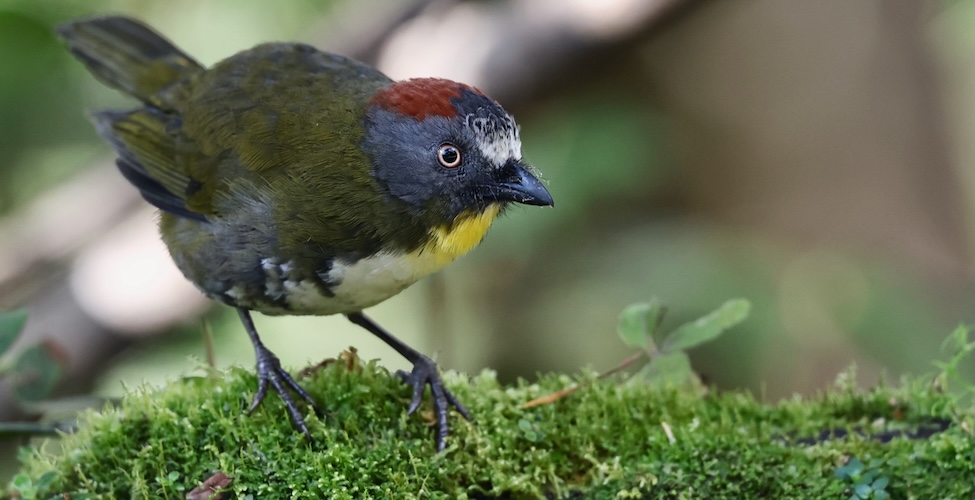
Rufous-naped Bellbird Aleadryas rufinucha – ©Nick Ludovic Green Bird-Photo-Tours ASIA
The family occupies a range of habitats. Two species, the Rufous-naped Bellbird and the Piping Bellbird, are endemic to New Guinea, whilst the Crested Bellbird is endemic to Australia. The two New Guinean species are found in rainforest; lowland and hill forest in the Piping Bellbird, or montane forest and secondary forest in the case of the Rufous-naped Bellbird. The Crested Bellbird occupies drier habitats in Australia including dry woodlands and scrublands.
All members of Oreoicidae have melodious piping songs consisting of rhythmically repeating ringing notes of different lengths, typically mostly or all at the same pitch. The bell-like quality of their songs is the source of the common name bellbird, which was first applied to the Crested Bellbird and more recently to the other two species, once their close relationships to each other, and distant relationship to whistlers and other pitohuis was revealed. The Rufous-naped Bellbird also makes harsh rasping calls.
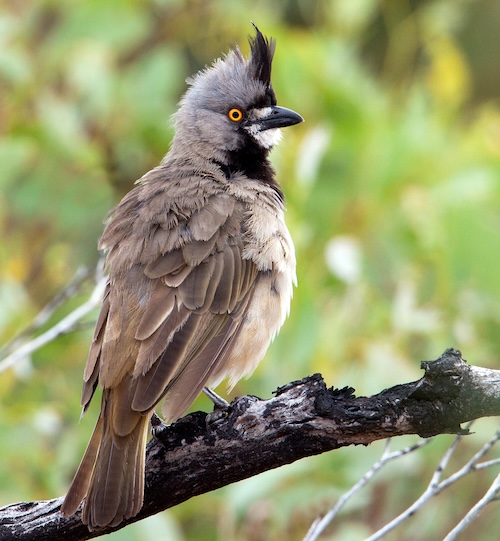
©Peter Jacobs from Australia, CC BY-SA 2.0 via Wikimedia Commons
The Crested Bellbird is the most studied. It feeds on seeds and small invertebrates, foraging on the ground or in low bushes. They hop rapidly, foraging on the ground or flying low between low shrubs or into low branches of trees. They are usually solitary foragers, but may feed in pairs during breeding season or in mixed feeding flocks with Chestnut-rumped Thornbills and Red-capped Robins. Their deep, cup-shaped nest is usually within a couple of metres of the ground, built in the fork of a branch or in a crevice in a stump. They form pairs during breeding season and prepare nests made of fine sticks and twigs or bark, and lined with fine bark, fibres, or leaves. Nests are prepared in various places. The eggs are incubated by both sexes. The breeding season is variable but usually ranges from August till December with clutch sizes ranging from one to four eggs. The eggs are white or tinged with blue, and lightly blotched with dark brown and grey. An interesting aspect of the nest-making process is that the bird places caterpillars of various species in and around its nest. It will nip the necks of the caterpillars to immobilise them, and it is theorised that the hairy caterpillars are either gathered as a cache of fresh food for parents and nestlings, or as a defensive barrier for their young.
Overall, it is quite common, but in some regions, such as Victoria, it is threatened by fragmentation of its habitat. The species is sedentary or locally nomadic and is distributed throughout most of the continent including west of the Great Dividing Range, in the south of tropical northern Australia, and through South Australia to the west coast of Western Australia. The bellbird avoids the far north and the humid eastern and extreme south-western regions.
-
Number of bird species: 3
(As at December 2025)
According to the recently (2025) amalgamated AviList, there are just three species, each in their own genus in the Oreoicidae family. They are:
Crested Bellbird Oreoica gutturalis
Piping Bellbird Ornorectes cristatus
Rufous-naped Bellbird Aleadryas rufinucha
-
Oreoicidae
Family AccountA more apt name for these birds might be “ground bellbirds,” as all are mid-sized passerines that spend a lot of time on the ground, with songs of rhythmically repeating syllables and rich, ringing whistles connecting with variable amounts of lispy, high twittered notes. -
Oreoicidae
Family AccountOreoicidae is a newly recognized family of small insectivorous songbirds from New Guinea and Australia, commonly known as the Australo-Papuan bellbirds.
Given that this is a very small family with just three species, albeit each in its own genus, Fatbirder provides active links below to all species.
-
Crested Bellbird Oreoica gutturalis
Species Accounthe crested bellbird (Oreoica gutturalis) is a medium-sized passerine bird in the family Oreoicidae. It is native to drier parts of Australia where its typical habitats are acacia scrublands, eucalypt woodlands, spinifex and saltbush plains and, dunes. The male is about 20 cm (8 in) long and has a grey head, a black crest and breast, and a grey or olive brown body. The female and juvenile are similar but the colours are more muted and the black breast is lacking. The distinctive call is a high pitched bell-like sound, audible at some distance. Sometimes a pair of birds duet. -
Crested Bellbird Oreoica gutturalis
Species AccountThe Crested Bellbird is a medium-sized bird. Adult males have grey heads with a raised black crest, a white forehead and throat, and a prominent black breast. The rest of the body is grey or brown and they have orange-red eyes. Females and immature birds are less prominently coloured than the males, lacking the black breast and having a smaller, unraised black crest. This species is also known as the Crested Thrush, as well as having names such as 'Dick-Dick-the Devil'. -
Crested Bellbird Oreoica gutturalis
Species AccountSound archive and distribution map -
Piping Bellbird Ornorectes cristatus
Species AccountThe piping bellbird (Ornorectes cristatus), or crested pitohui, is a species of bird in the family Oreoicidae. I -
Piping Bellbird Ornorectes cristatus
Species AccountSound archive and distribution map -
Rufous-naped Bellbird Aleadryas rufinucha
Species AccountThe rufous-naped bellbird (Aleadryas rufinucha), or rufous-naped whistler, is a species of bird in the family Oreoicidae. -
Rufous-naped Bellbird Aleadryas rufinucha
Species AccountSound archive and distribution map