

Panuridae – Bearded Reedling
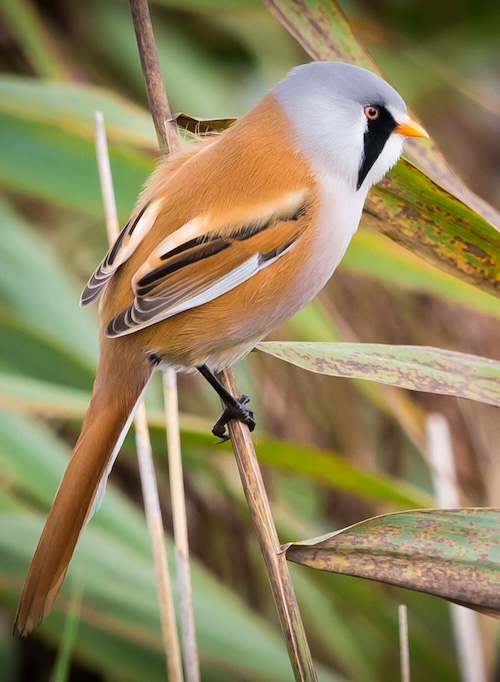
The Panuridae consist of just one species; the Bearded Reedling, which is a small, sexually dimorphic reed-bed passerine. It is frequently known as the Bearded Tit (due to some similarities to the Long-tailed Tit), or the Bearded Parrotbill. It was formerly placed with the parrotbills in the family Paradoxornithidae, following their removal from the true tits in the family Paridae. More recent research suggests that the Bearded Reedling is actually a unique passerine; no other living species seems to be particularly closely related to it. There has long been controversy about just which family the Bearded Reedling belongs in and most thought it resolved when it was declared a parrotbill. However, DNA sequencing has shown that it warrants a family to itself.
The Bearded Reedling is a small bird, 14.5–17 cm in length, with a long tail and an undulating flight. The plumage is mostly orange-brown, with a whitish throat and chest, some contrasting black and white parts in the wings, and white edges to the tail feathers. The adult male has a grey head, black ‘moustache’ (not a beard) and black undertail coverts. The adult female is generally paler, with a more brownish head and no black moustaches or undertail coverts, but sometimes with black streaks/spots to the crown or back. Whereas these streaks/spots vary from completely absent to really strong in the west of the species’ range, they are absent to faint in the east. The adult female’s bill is often somewhat duller that the adult male’s bright orange-yellow bill. Adults go through a single complete moult in the late summer to early autumn, generally starting in August (just after the breeding season) and being finished around 50 days later.
Juveniles of both sexes resemble the adult female, but are overall buffier in colour, have a roughly rectangular black patch on the back (well beyond the streaks/spots on the backs of even the most strongly marked adult females) and extensive black to the tail feathers. The juvenile male has a relatively large and contrasting black loreal patch and a bright orange-yellow bill, whereas the juvenile female has a smaller dusky-grey loreal patch and a blackish, brownish or yellowish-dusky bill. This sex-related difference in juvenile bill colour is already evident at the late nestling stage. Unlike most birds, Bearded Reedlings undergo a complete post-juvenile moult, starting in late July to early September and ending with an adult plumage in October. This means that birds hatched only a few months earlier already are indistinguishable from older adults by the autumn. When first fledged, juveniles have dark brown eyes, which then become grey and later grey-yellow or yellow. Once they have moulted into the adult plumage they also generally have the adult yellow or orange eye colour; however Bearded Reedlings in adult plumage with juvenile-like brown or grey eyes occur on occasion.
This species is a wetland specialist, breeding colonially in large reed beds by lakes or swamps. It eats reed aphids in summer, and reed seeds in winter, its digestive system changing to cope with the very different seasonal diets. Because of their well-camouflaged plumage and dense reed bed habitat, they are easily overlooked, but their presence is often revealed by their characteristic metallic ‘ping’ call, which is used by them to maintain contact with each other. The male’s song has been described as a tuneful tschin-schik-schra. During flight, their short wings give a whirring sound. Flocks often betray their presence by their characteristic ‘ping’.
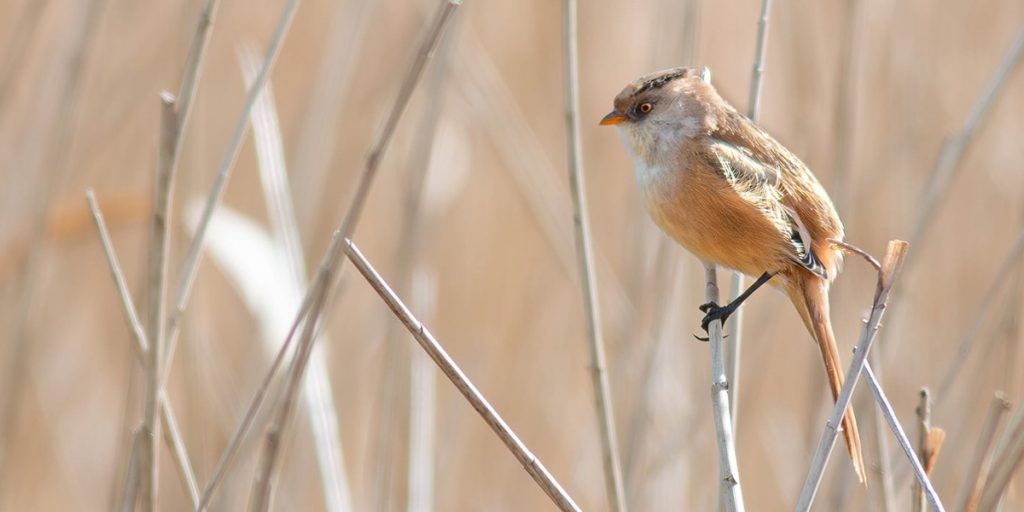
Bearded Reedling Panurus biarmicus (Youngster) – ©Ashley Beolens
It is generally a species of temperate Europe and Asia. It is resident, and most birds do not migrate other than eruptive or cold weather movements. It is vulnerable to hard winters, which may kill many birds. The English population of about 700 pairs was largely confined to the south and east with a small population in Leighton Moss in north Lancashire. It is now much more widespread in England and Wales. In Ireland a handful of pairs breed in County Wexford. The largest single population in Great Britain is to be found in the reedbeds at the mouth of the River Tay in Perth and Kinross, Scotland, where there may be as many as 1000 individuals.
The Bearded Reedling is social and during the non-breeding season it is usually seen in groups of up to a few tens of birds, exceptionally up to two hundred. During the breeding season, it is most commonly seen in pairs, family groups or groups of independent young.
Young birds already form pairs when still juvenile, only a few weeks after having fledged. Once formed, a pairing is generally life-long and they stay together throughout the year, also sleeping closely together. If one part of a pair dies, the surviving bird may join groups of young to find a new partner to pair up with. A pair is monogamous, although mating with another partner (infidelity) is not uncommon for either sex. The length of a male’s black moustache is an honest signal indicating his dominance (in competitions for food between males the one with the longest moustaches usually wins) and females prefer males where it is longer. Both sexes, but especially females, also prefer partners with longer tails and tail length plays a role in a bird’s movement agility. In juveniles of both sexes, the size of the loreal patch is an honest signal of body condition, but whether this plays a role in mate choice when pairs are first established is unknown.
Breeding happens in the spring and summer, from late March to early September, but how early it starts and late it ends depends on environmental conditions and availability of food, and April to July is common. There are typically two or three, less frequently four and rarely five, broods in a season. In captivity where not limited by the same conditions as in the wild, they may already begin to breed in late February and exceptionally there can be attempts of up to seven broods in a season, although it is doubtful that this many can be raised successfully. A pair may nest alone or as part of a small loose colony that on average consists of six pairs with nests located a few metres apart.
Both sexes participate in the building of the cup-shaped nest, which has a diameter of between 7.5 and 17 cm (3.0–6.7 in). It is attached to reeds or similar vegetation and can be positioned from almost ground or water level to a height of about 0.7 m. Artificial nests are also accepted. Both sexes share in the up to two-week long incubation of the 3 to 11 (usually 4 to 8) eggs, which is followed by another up to about two week long nestling period. After having left the nest, which frequently happens before being able to fly, the young continue to rely on the parents for up to about two weeks, rarely more. On average they reach an age of two or three years, but the record is seven years and three months.
-
Number of bird species: 1
(As at October 2025)
According to the recently (2025) amalgamated AviList, there is just one species, in one genus in the Panuridae family. It is:
Bearded Reedling Panurus biarmicus
-
Panuridae
Family AccountThe Bearded Reedling, as its name suggests, is found mostly in dense reedbeds, primarily in Phragmites. -
Panuridae
Family AccountThe bearded reedling (Panurus biarmicus) is a small, long-tailed passerine bird found in reed beds near water in the temperate zone of Eurasia.
-
Bearded Reedling Panurus biarmicus
Species AccountStriking long-tailed bird of extensive reed beds. No other species looks very similar, particularly given habitat and behavior. -
Bearded Reedling Panurus biarmicus
Species AccountPanurus biarmicus is listed as Least Concern. -
Bearded Reedling Panurus biarmicus
Species AccountYou might hear them referred to as 'Reedlings' because calling them Bearded Tits is a misnomer; they're neither a tit nor bearded. -
Bearded Reedling Panurus biarmicus
Species AccountA brown, long-tailed bird, usually seen flying rapidly across the top of a reedbed. Males have black 'moustaches' rather than 'beards'. They are sociable and noisy, their 'ping' calls often being the first clue to their presence.… -
Bearded Reedling Panurus biarmicus
Species AccountSound archive and distribution map