

Phoenicopteridae – Flamingos
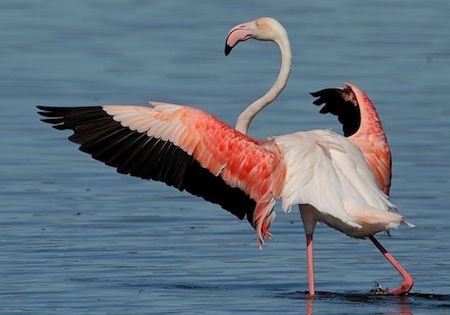
Phoenicopteridae are a small family of wading birds made up of the flamingos. Flamingos (or flamingoes) are the only family in the order Phoenicopteriformes. There are four flamingo species in the Americas and two species in the Old World all in a single genus.
Traditionally, the long-legged Ciconiiformes, probably a paraphyletic assemblage, have been considered the flamingos’ closest relatives and the family was included in the order. Usually, the ibises and spoonbills of the Threskiornithidae were considered their closest relatives within this order. Earlier genetic studies, such as those of Charles Sibley and colleagues, also supported this relationship. Relationships to the waterfowl were considered as well, especially as flamingos are parasitized by feather lice of the genus Anaticola, which are otherwise exclusively found on ducks and geese. The peculiar presbyornithids were used to argue for a close relationship between flamingos, waterfowl, and waders. A 2002 paper concluded they are waterfowl, but a 2014 comprehensive study of bird orders found that flamingos and grebes are not waterfowl, but rather are part of Columbea, along with doves, sandgrouse, and mesites.
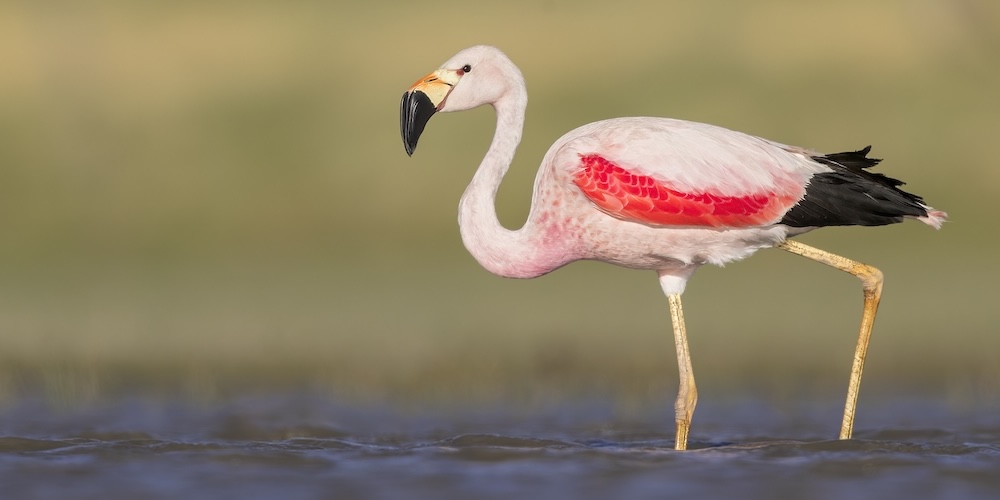
Andean Flamingo Phoenicopterus andinus – ©Dubi Shapiro
Recent molecular studies have suggested a relation with grebes, while morphological evidence also strongly supports a relationship between flamingos and grebes. They hold at least 11 morphological traits in common, which are not found in other birds. Many of these characteristics have been previously identified on flamingos, but not on grebes.
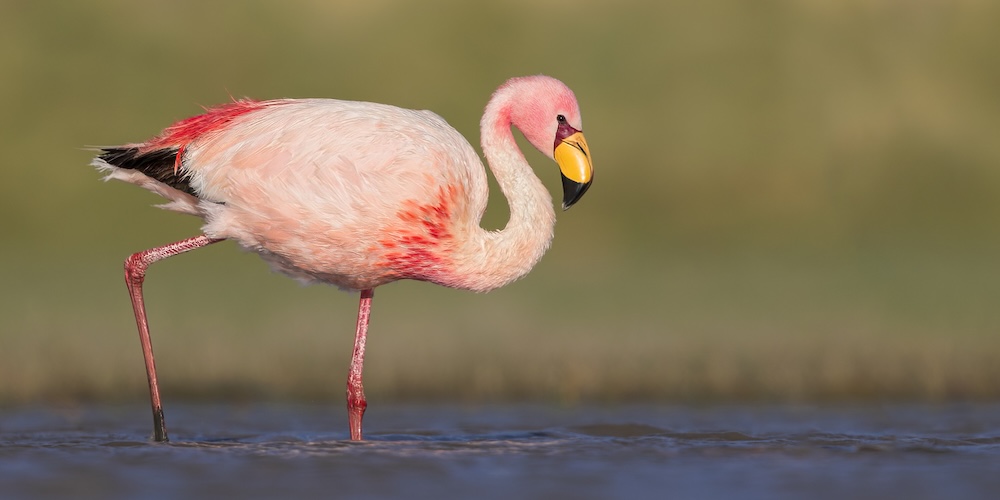
James’s Flamingo Phoenicopterus jamesi – ©Dubi Shapiro
They are large waterbirds with long neck and legs, and unique down-curved bill adapted to filter-feeding. The bill, held upside down, is used to filter the water for small shrimps, molluscs and insects, with the tongue acting as a piston to draw water through the bill. Their pink colour comes from algae rich in carotenid pigments. They are thus adapted to life in a fairly specialised habitat, salt lakes. Their distribution is world-wide excepting Australasia and Antarctic.
Flamingos usually stand on one leg while the other is tucked beneath their body. The reason for this behaviour is not fully understood. Recent research indicates that standing on one leg may allow the birds to conserve more body heat, given that they spend a significant amount of time wading in cold water. However, the behaviour also takes place in warm water. As well as standing in the water, flamingos may stamp their webbed feet in the mud to stir up food from the bottom.
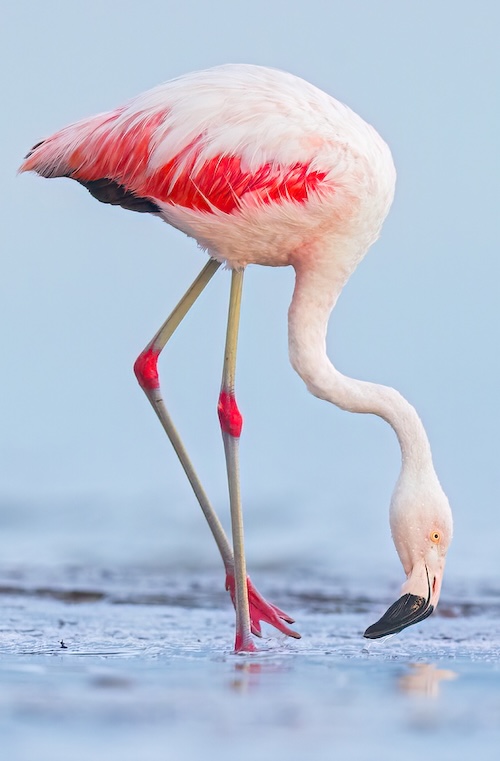
Chilean Flamingo Phoenicopterus chilensis – ©Dubi Shapiro
Flamingos are very social birds; they live in colonies whose population can number in the thousands – the African species can sometimes be seen in the hundreds of thousands. These large colonies are believed to serve three purposes for the flamingos: avoiding predators, maximising food intake, and using scarce suitable nesting sites more efficiently.
Before breeding, flamingo colonies split into breeding groups of about 15 to 50 birds. Both males and females in these groups perform synchronised ritual displays. The members of a group stand together and display to each other by stretching their necks upwards, then uttering calls while head-flagging, and then flapping their wings. The displays do not seem to be directed towards an individual but instead occur randomly.
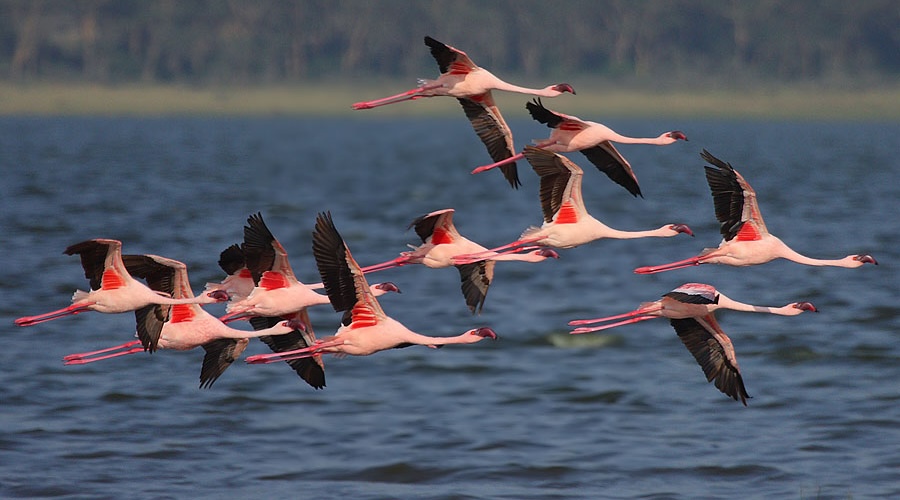
Lesser Flamingos Phoenicopterus minor – ©Steve Garvie CC BY-SA 2.0 via Wikimedia Commons
Flamingos form strong pair bonds, although in larger colonies, flamingos sometimes change mates, presumably because more mates are available to choose. Flamingo pairs establish and defend nesting territories. They locate a suitable spot on the mudflat to build a nest (the female usually selects the place). Copulation usually occurs during nest building, which is sometimes interrupted by another flamingo pair trying to commandeer the nesting site for their use. Flamingos aggressively defend their nesting sites. Both the male and the female contribute to building the nest, and to protecting the nest and egg. Same-sex pairs have been reported.
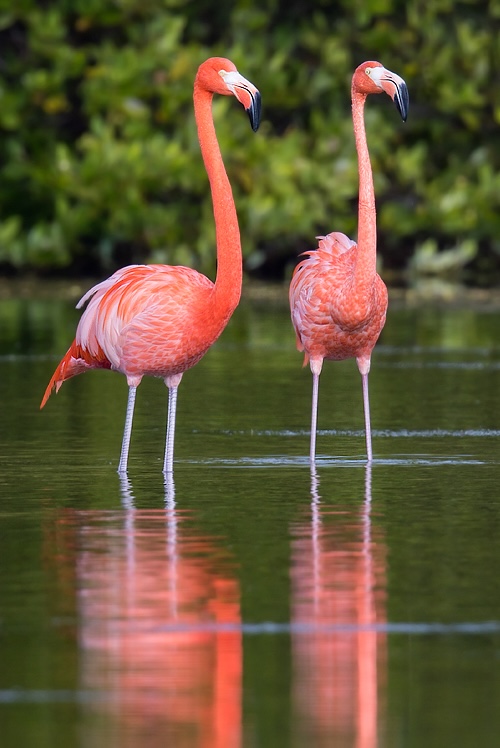
American Flamingo Phoenicopterus ruber – ©Dubi Shapiro
After the chicks hatch, the only parental expense is feeding. Both the male and the female feed their chicks with a kind of crop milk, produced in glands lining the whole of the upper digestive tract (not just the crop). The hormone prolactin stimulates production. Crop milk contains both fat and protein, as with mammalian milk, but unlike mammalian milk, it contains no carbohydrates. (Pigeons and doves also produce crop milk, though just in the glands lining the crop, which contains less fat and more protein than flamingo crop milk.)
For the first six days after the chicks hatch, the adults and chicks stay in the nesting sites. At around 7–12 days old, the chicks begin to move out of their nests and explore their surroundings. When they are two weeks old, the chicks congregate in groups, called ‘microcrèches’, and their parents leave them alone. After a while, the microcrèches merge into larger crèches” containing thousands of chicks. Chicks that do not stay in their crèches are vulnerable to predators. When young flamingos are around three to three and a half months old, their flight feathers will finish growing in, allowing them to fly.
-
Number of bird species: 6
(As at Auguist 2025)
According to the unified AviList (2025) there are just six species of Phoenicopteridae – the only family of the order Phoenicopteriformes; they are all in just one genus. They are:
Lesser Flamingo Phoenicopterus minor
Andean Flamingo Phoenicopterus andinus
James’s Flamingo Phoenicopterus jamesi
Chilean Flamingo Phoenicopterus chilensis
Greater Flamingo Phoenicopterus roseus
American Flamingo Phoenicopterus ruber
-
Flamingo
| By Claudio Contreras Koob | TeNeues Publishing UK Ltd | 2022 | Haredback | 224 pages, 120+ colour photos | ISBN: 9783961713875 Buy this book from NHBS.com -
Flamingos
| By Janet Kear & Nicole Duplaix-Hall | T & AD Poyser Ltd (A & C Black) | 2011 | Hardback | 246 pages, Col & b/w photos, figs, tabs | ISBN: 9781408137505 Buy this book from NHBS.com -
Flamingos - Behavior, Biology, and Relationship with Humans
| Edited by Matthew J Anderson | Nova Science | 2016 | Paperback | 78 pages, b/w photos, b/w illustrations, tables | ISBN: 9781536102369 Buy this book from NHBS.com -
Lesser Flamingos - Descendants of Phoenix
| By Lothar Krienitz| Springer Nature | 2019 | Hardback | 244 pages, 99 colour photos, 3 b/w illustrations, tables | ISBN: 9783662581629 Buy this book from NHBS.com -
The Greater Flamingo
| By Alan Johnson & Frank Cezilly | T & AD Poyser Ltd (A & C Black) | 2008 | Hardback | 336 pages, 25 b&w illus, 8 page colour section | ISBN: 9780713665628 Buy this book from NHBS.com
-
Phoenicopteridae
Family AccountFlamingos or flamingoes are a type of wading bird in the family Phoenicopteridae, which is the only extant family in the order Phoenicopteriformes.
Given that this is a small family with just 6 species in only one genus, Fatbirder provides active links below to all species.
-
American Flamingo Phoenicopterus ruber
Species AccountBirdLife species profile and status -
American Flamingo Phoenicopterus ruber
Species AccountCornell species account -
American Flamingo Phoenicopterus ruber
Species AccountSound archive and distribution map. -
American Flamingo Phoenicopterus ruber
Species AccountThe American flamingo (Phoenicopterus ruber) is a large species of flamingo native to the West Indies, northern South America (including the Galápagos Islands) and the Yucatán Peninsula. -
Andean Flamingo Phoenicopterus andinus
Species AccountBirdLife species status and profile -
Andean Flamingo Phoenicopterus andinus
Species AccountThe Andean flamingo (Phoenicoparrus andinus) is one of the rarest flamingos in the world. It lives in the Andes mountains of South America. -
Andean Flamingo Phoenicopterus andinus
Species AccountSound archive and distribution map. -
Chilean Flamingo Phoenicopterus chilensis
Species AccountIUCN species status and profile -
Chilean Flamingo Phoenicopterus chilensis
Species AccountSound archive and distribution map. -
Chilean Flamingo Phoenicopterus chilensis
Species AccountCornell species account -
Chilean Flamingo Phoenicopterus chilensis
Species AccountThe Chilean flamingo (Phoenicopterus chilensis) is a large species of flamingo at 110–130 cm (43–51 in) closely related to Caribbean flamingo and greater flamingo, with which it was sometimes considered conspecific... -
Chilean Flamingo Phoenicopterus chilensis
Species AccountFull species account -
Greater Flamingo Phoenicopterus roseus
Species AccountBirdLife species profile -
Greater Flamingo Phoenicopterus roseus
Species AccountThe greater flamingo (Phoenicopterus roseus) is the most widespread species of the flamingo family. It is found in Africa, on the Indian subcontinent, in the Middle East and southern Europe. -
Greater Flamingo Phoenicopterus roseus
Species AccountSound archive and distribution map. -
James's Flamingo Phoenicopterus jamesi
Species AccountBirdLife species profile and status -
James's or Puna Flamingo Phoenicopterus jamesi
Species AccountThe James's flamingo (Phoenicoparrus jamesi), also known as the puna flamingo, is a species of flamingo that populates the high altitudes of Andean plateaus of Peru, Chile, Bolivia and Argentina. -
James's or Puna Flamingo Phoenicopterus jamesi
Species AccountSound archive and distribution map. -
Lesser Flamingo Phoeniconaias minor
Species AccountBirdLife species profile and status -
Lesser Flamingo Phoeniconaias minor
Species AccountThe lesser flamingo (Phoeniconaias minor) is a species of flamingo occurring in sub-Saharan Africa with another population in India. Birds are occasionally reported from further north, but these are generally considered vagrants. -
Lesser Flamingo Phoeniconaias minor
Species AccountLesser Flamingo Phoeniconaias minor has most recently been assessed for The IUCN Red List of Threatened Species in 2018. Phoeniconaias minor is listed as Near Threatened under criteria A2c+3c+4c. -
Lesser Flamingo Phoeniconaias minor
Species AccountSound archive and distribution map.