

Study & Behaviour
This section has links to a number of websites concerned generally with the study of birds and, in particular their behaviour. There are tips on how to note your observations as well as pointers to larger on-line reference resources. For a good starting point I recommend Ornithology.com whose strap line is: Authoritative Information about Wild Birds from a Professional Ornithologist.
There are too, some sites devoted to study in the sense of offering ornithology for full-time students as well as a number of courses for amateur ornithologists; ornithology & birding courses are listed on a separate page. Despite the popularity of birding as a pastime there are surprisingly few full-time university degree courses.
Part of the fascination for us birders is the behaviour of the birds we watch. We do not just appreciate their simple beauty, but for their actions during migration, mating, nesting, overwintering, etc. I’ve been birding for the best part of 70 years, and yet just this week I observed a behaviour for the very first time in a bird species I know well. It is certainly part of the enjoyment for me of our pastime. Rarity chasing is all well and good and none of us would pass up the opportunity to see a bird we’ve never seen before. But everyday birding from your window, looking at your bird tables or on your way to work, it’s often very common birds that we enjoy and it’s always a red-letter day when we see something new in an old friend.
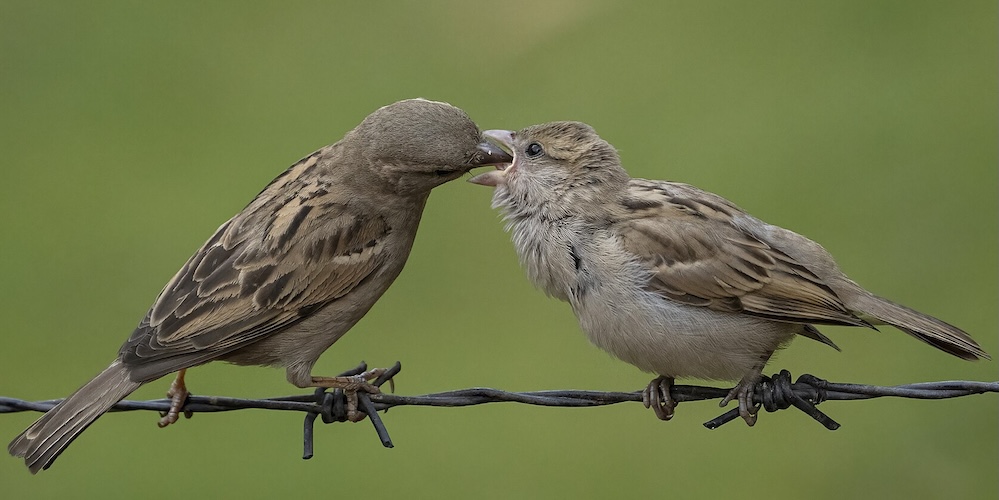
Female House Sparrow Passer domesticus feeding its young during the spring breeding season, in Kathmandu, Nepal – ©Prasan Shrestha CC BY-SA 4.0 via Wikimedia Commons
Indeed, on a wider scale, citizen science is an important part of ornithology, and for some hundreds of years, the science has very much relied upon amateur observation to progress. There are too few professional ornithologists to enable most studies to continue across the world. And it’s down to amateur birders and banders, ringers and general observers to tell us about population sizes and movements, etc.
Us Everyday Birders will find some useful information from some of the websites below. There are, of course, many overlaps with this section and the sections on conservation, taxonomy etc.
-
A Concise History of Ornithology
| By Michael Walters | Helm | 2024 | Hardback | 255 pages, B/w photos | ISBN: 9781399421003 Buy this book from NHBS.com -
Bird Population Studies - Relevance to Conservation & Management
| By CM Perrins, J-D Lebreton & GJM Hirons | OUP | 1993 | Paperback | 650 pages, 155 line illustrations, tables, maps | ISBN: 9780198540823 Buy this book from NHBS.com -
Bird Senses - How and What Birds See, Hear, Smell, Taste & Feel
| By Professor Graham R Martin | Pelagic Publishing | 2020 | Paperback | 300 Pages | 100+ Colour Photos & Illustrations | ISBN: 9781784272166 | £29.99p | ISBN: 9781784272166 Buy this book from NHBS.com -
The Living Bird - 100 Years of Listening to Nature
| By Gerrit Vyn | Barbara Kingsolver | Jared Diamond | John W Fitzpatrick | Lyanda Lynn Haupt & Scott Weidensaul | Mountaineers Books | 2015 | Hardback | 208 pages, 250 colour photos | ISBN: 9781594859656 Buy this book from NHBS.com -
Wings and Rings - A History of Bird Migration Studies in Europe
| By Richard Vaughan | Isabelline Books | 2009 | Paperback | 256 pages, colour and black & white plates | ISBN: 9780955278747 Buy this book from NHBS.com
-
AMNH Ornithology
WebsiteThe Department of Ornithology maintains one of the largest collections of bird specimens in the world. The research collections of the Department number nearly one million specimens; these include skins, skeletons, alcoholic preparations, eggs, nests, and tissue samples for molecular biochemical studies. -
Academy of Natural Sciences of Drexel University
WebsiteThe Ornithology Collection at the Academy of Natural Sciences of Drexel University is one of the 10 largest and taxonomically most complete bird collections in the world. There are over 205,000 study skins, from over 7,000 species, and over 17,000 tissue samples. -
Animal Demography Unit - University of Cape Town
WebsiteHome About Team Research Education Outputs News & Events Newsletters News archive Right Here, Right Now Global Climate Summit Event archive Opportunities Contact Us Breadcrumb Home Animal Demography Unit (ADU) Animal Demography Unit (ADU) The Animal Demography Unit is built on three pillars. Digital Biodiversity. Some 16 million dated and georeferenced records of birds, butterflies, frogs, mammals and reptiles. -
Cornell Lab of Ornithology
WebsiteWe bring together scientists, students, and people from all walks of life in the quest to generate new knowledge and conserve our shared natural world. You can help. -
Edward Grey Institute
WebsiteThe Edward Grey Institute of Field Ornithology (EGI) is an internationally renowned centre for scientific research on avian biology, and forms part of the University of Oxford Department of Biology. The institute takes a multidisciplinary approach to address questions related to the behaviour, ecology, evolution, genetics, physiology and conservation of birds. -
Harvard University Ornithology
WebsiteThe Ornithology collection houses recent birds. -
Max Planck Institute for Ornithology
WebsiteBirds are probably the most fascinating species in the world - no other group attracts so many devotees and amateur scientists. As diurnal animals, birds can be seen everywhere. They move into every kind of territory, even apparently inhospitable areas such as the Antarctica or the Sahara Desert. -
Smithsonian
WebsiteOrnithology is the study of birds. Birds are distinguished from other living vertebrates by three things: feathers, hollow bones, and hard shelled eggs. Birds are found worldwide, and roughy 10,000 species are known to exist. Ornithological research emcompasses many branches, including taxonomy, evolution, anatomy, ecology, conservation biology and wildlife management. The Division of Birds serves the research community through the research of our scientists and stewardship of the bird collections. -
The Natural History Museum
WebsiteThe Museum's avian skin collection is the second largest of its kind in the world, with almost 750,000 specimens representing about 95% of the world's bird species. -
University of Birmingham Centre for Ornithology
WebsiteWe employ birds as model species in the investigation of general principles and mechanisms that are central to understanding key questions in biology and the environment. -
University of Michigan - Museum of Zoology Bird Division
WebsiteThe University of Michigan Museum of Zoology Bird Division is a collection of resources for people who conduct research on or need information about birds. The two Division curators and various graduate students conduct research on the phylogenetic relationships, evolution and behavior of a wide variety of birds using museum collections, molecular techniques, and captive and field studies. We actively maintain a collection of about 200,000 preserved specimens available for study by systematists and other scientists. We have a sound laboratory for analysis of bird vocalizations. Since 1930 the Bird Division has been the headquarters and provided space for the library of the Wilson Ornithological Society, an international organization devoted to the study of birds -
University of Minnesota - Raptor Centre
WebsiteAs top-of-the-food-chain predators, raptors are our lens into the health of the shared environment. Surveilling and aiding in raptor health alerts us to what's happening down the rest of the food chain. -
Universityn of Cambridge
WebsiteProfessor Daniel Field - Strickland Curator of Ornithology. As the Strickland Curator of Ornithology I am responsible for overseeing the museum's impressive collection of bird skins, skeletons, taxidermy, nests...
-
American Ornithological Society
WebsitePublications -
Birds.com
WebsiteBirdwatching encyclopedia -
Birdwatcher's Encyclopaedia & Dictionary
WebsiteA searchable data base and dictionary which is a good starting place when undertaking a study -
Birdwatching with Dominic Couzens
WebsiteMy site offers the chance to book for Day-trips (mainly in the South-East of England); Birding Weekends (in the UK) and Foreign Tours. For a flavour of what you might expect, visit my Recent Highlights page. You can also invite Dominic to lecture etc. -
CVANET - Cavity-Nesting Bird Research
WebsiteCAVNET has been established to facilitate scientific discussions concerning cavity-nesting birds.This list has been created for researchers, academics, and others with a common interest in discussing the scientific aspects of cavity nesters -
European Colour Ringing
WebsiteAll about the European studies using colour rings… -
How to write field notes
WebsiteMost of us are not called upon to explore a continent, but occasionally we might come across a detail about the world around us that others may find of interest. The quality of the details written affects how seriously the record is taken. Practising with field notes every day prepares the amateur naturalist for the unexpected event -
Hydridisation
WebsiteFrench Canadian site including a mailing group in French. -
Kids Wings
WebsiteLots of birding info and activities for young birders -
Laura Erickson's For the Birds
WebsiteAccording to this author -
Ornithology.com
WebsiteAuthoritative Information about Wild Birds from a Professional Ornithologist -
SORA - Searchable Ornithological Research Archive
WebsiteSORA provides access to an extensive library of ornithological literature of international scope, and detailed material documenting the history of ornithology in North America over the last 120 years. -
Studying Birds
WebsiteWe Harness People Power to Restore Biodiversity -
VIREO - Visual Resources for Ornithology
WebsiteVisual Resources for Ornithology (VIREO), the worldwide bird photograph collection of the https://www.ansp.org, is a taxonomically curated collection of over 200,000 remarkable, scientific and historical images.