

Lakshadweep
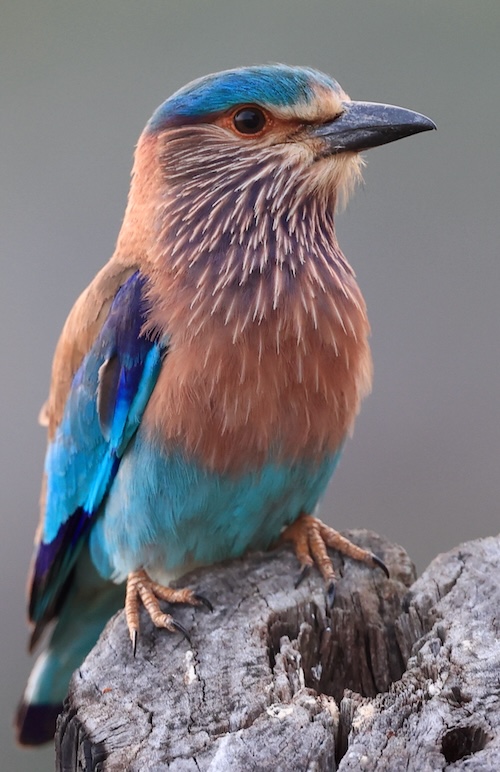
Lakshadweep is a union territory of India. It is an archipelago of 36 islands divided into three island subgroups: the Amindivi Islands in the north, the Laccadive Islands (separated from Amindivi roughly by the 11th parallel north), and the atoll of Minicoy to the south of the Nine Degree Channel. The islands are located between the Arabian Sea to the west and the Laccadive Sea to the east, about 220–440 km (140–270 miles) off the Malabar Coast of mainland India. The islands occupy a total land area of approximately 32.62 km2 (12.59 square miles) with a population of about 70,000 people across the ten inhabited islands. There is a 132 km (82 mile) long coastline with a lagoon area of 4,200 km2 (1,600 square miles), territorial waters of 20,000 km2 (7,700 square miles) and an exclusive economic zone of 400,000 km2 (150,000 square miles). It is the northernmost island group of the exposed undersea mountain range, the Chagos-Lakshadweep Ridge. The entire union territory is administered as a single district with Kavaratti as its capital. It is an archipelago of 36 islands and islets that includes 12 atolls, three reefs, and five submerged banks and only ten of the islands are inhabited.
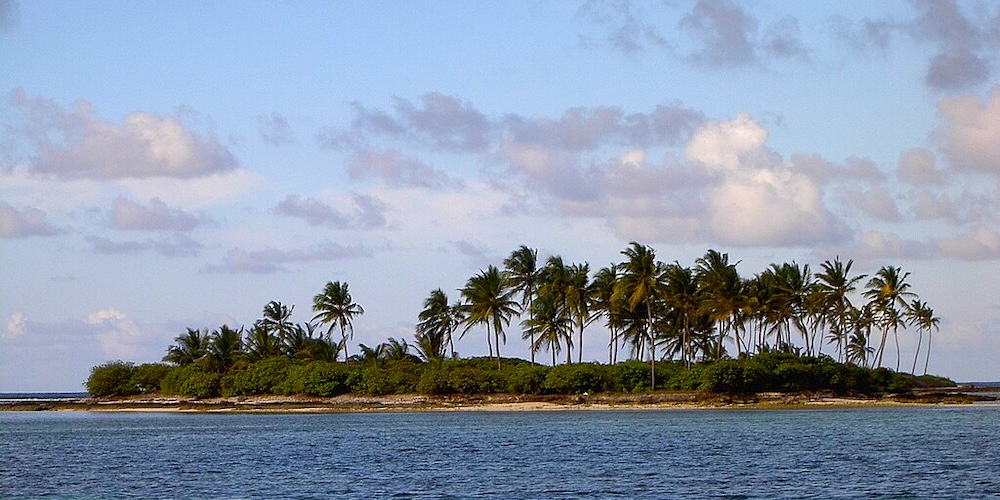
One of the uninhabited islands – ©CC BY-SA 2.5 via Wikimedia Commons
While there are no conclusive theories about the formation of the atolls, Charles Darwin proposed that the subsidence of a volcanic island resulted in the formation of a fringing reef, which grew upwards with continual subsidence. The individual islands are small, with none of them measuring more than 1.6 kilometres across. Most inhabited islands are situated on the eastern side of Lakshadweep and away from the low-lying lagoons to the West. The soil is generally sandy, derived from coral. Parali I island of Bangaram atoll has eroded and is now completely inundated. Four other islands in the atoll also show various degrees of erosion: Parali II (80%), Thinnakara (14.4%), Parali III (11.4%), and Bangaram (9.9%)
The islands have a tropical monsoon climate, bordering on a tropical savanna climate. The weather is warm throughout the year with temperatures ranging from 20 to 32 degree Celsius. While tropical cyclones arising in the Arabian Sea rarely strike the islands due to its smaller size, winds and waves associated with them could alter the features of the islands considerably
Birding Lakshadweep
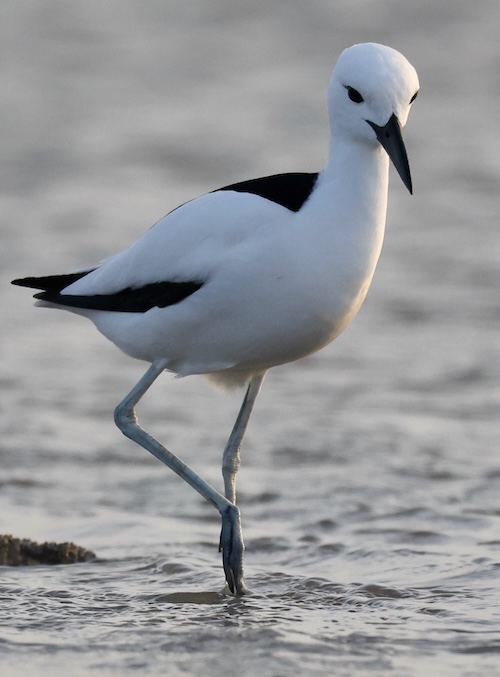
Crab Plover Dromas ardeola – Bird-Photo-Tours ASIA
Lakshadweep is part of the Maldives-Lakshadweep-Chagos Archipelago tropical moist forests ecoregion, but there are no forests on the islands. Nearly 400 species of flowering plants have been documented, including three species of sea grasses, fungi, algae, and lichens. It includes coconut groves and coastal shrubs. The Archipelago forms a terrestrial ecoregion together with the Maldives and the Chagos. There are over 600 recorded species of marine fishes, 78 species of corals, 82 of seaweed, 52 crabs, 2 lobsters, 48 gastropods, and 12 species of bivalves. It is one of the four coral reef regions in India.
Cetacean diversity off the Lakshadweep Islands and in adjacent areas include several whales (pygmy blue, Bryde’s, sperm, orca, pilot whale) and dolphins. There are about 100 species of birds, common amongst them include terns, gulls and water birds such as herons. Pitti island is a declared bird sanctuary and an important breeding place for sea turtles and a number of pelagic birds including Brown Noddy Anous stolidus, Sooty Tern Onychoprion fuscatus, Lesser and Greater Crested Terns, Sterna bengalensis and Sterna bergii.
Other species include Black Noddy, White-bellied Sea-Eagle, Pacific Golden-Plover, Western Reef-Heron, Eastern Cattle-Egret, Asian Koel, Indian White-eye and Rose-ringed Parakeet.
-
Wikipedia
GNU Free Documentation License
https://en.wikipedia.org/wiki/Lakshadweep
-
Number of bird species: 133
(As at June 2025)State Bird: Sooty Tern Sterna fuscapa
-
Avibase
PDF ChecklistThis checklist includes all bird species found in Lakshadweep , based on the best information available at this time. It is based on a wide variety of sources that I collated over many years. I am pleased to offer these checklists as a service to birdwatchers. If you find any error, please do not hesitate to report them. -
Birds of Lakshadweep Islands Oriental Bird Club
Scientific Paper with ChecklistSYSTEMATIC LIST OF THE BIRDS OF LAKSHADWEEP. -
E-Bird
PDF ChecklistThis checklist is generated with data from eBird (ebird.org), a global database of bird sightings from birders like you. If you enjoy this checklist, please consider contributing your sightings to eBird. It is 100% free to take part, and your observations will help support birders, researchers, and conservationists worldwide.

-
Birds of the Indian Subcontinent
| By Richard Grimmett, Carol Inskipp & Tim Inskipp | Helm | 2025 | Edition 2 | Paperback | 544 pages, 240+ plates with colour illustrations; colour distribution maps, b/w illustrations | ISBN: 9781472984777 Buy this book from NHBS.com
Birds of the Indian Subcontinent
Apple iOS | AndroidThe eGuide to Birds of the Indian Subcontinent is an interactive companion to Birds of the Indian Subcontinent – the definitive guide for birdwatchers visiting the region. It covers India, Pakistan, Nepal, Bhutan, Bangladesh, Sri Lanka and the Maldives. This application has specific features that will enhance your birding experience.
Indian Birds
Apple iOS | AndroidPioneers in bringing Indian Birding to the smart phone generation - Introducing Indian Birds, the time-honoured and cherished birding companion for India. Established in 2010, it proudly remains the sole mobile app available on App Store, offering bird enthusiasts the ability to explore bird namesReserves-
BS Pitti Island
InformationSatellite ViewPitti is the local name for bird... so means bird island. The island is low and arid and, lacking adequate anchorage points, of difficult accessibility. (There is another island with the same name in Lakshadweep which is part of the Kalpeni Atoll.) Pitti Island is 300 x 200 m in size and devoid of vegetation. It is an important nesting place for pelagic birds such as the sooty tern (Sterna fuliginosa), the greater crested tern (Sterna bergii) and the brown noddy (Anous stolidus). The birds nest side by side, but not intermixed, on the dry coral rubble. There is a seasonal pattern in the breeding period of the birds. Since it has no protecting reef surrounding it, the islet is periodically rinsed by wave action and there is no accumulation of guano on it. -
MBCR PM Sayeed Marine Birds Conservation Reserve
InformationSatellite ViewIt covers an area of 62 km2 and protects four pelagic species: Greater crested tern, Lesser crested tern, Sooty tern and Brown noddy.
Sightings, News & Forums-
eBird
SightingseBirding This Month
Trip Reports-
2007 [02 February] - An ornithological expedition
PDF ReportAn ornithological expedition to the Lakshadweep archipelago:Assessment of threats to pelagic and other birds and recommendations. The last ornithological survey of the archipelago was in1990–1991 (Santharam et al. 1996). The present 2nd PelagicBirds Survey from 12–16.iii.2006, a joint effort of ELAFoundation, Pune and Ecological Society, Pune together withIndian Coast Guard, was carried out after a lapse of 16 years.The first part of this survey focused on pelagic bird life off thewestern coast of India, in the Arabian Sea, and was completedin October–November 2005 (Pande 2005). Here we presentthe findings of the second lap of our survey, which wasrestricted to the Lakshadweep archipelago. Pitti Island, a partof the Lakshadweep archipelago, is an Important Bird Area(Islam & Rahmani 2004). -
2007 [08 February] - Mike Prince
PDF Report...t I joined the Bombay Natural History Society (BNHS) camp in Lakshadweep in February 2008. Whilst this was not particularly a birding visit, instead concentrating on the rich marine life of the archipelago through a combination of snorkelling and diving, I was particularly keen to visit the spectacular tern breeding colonies...
Fatbirder - linking birders worldwide...
Skip to content