

Sikkim
Sikkim is a state in northeastern India. It borders the Tibet Autonomous Region of China in the north and northeast, Bhutan in the east, Koshi Province of Nepal in the west, and West Bengal in the south. Sikkim is also close to the Siliguri Corridor, which borders Bangladesh. Sikkim is the least populous with less than 700,000 people and the second-smallest among the Indian states, covering a little over 7,000 km2 (2,740 square miles). Situated in the Eastern Himalaya, Sikkim is notable for its biodiversity, including alpine and subtropical climates. Sikkim’s capital and largest city is Gangtok. Almost 35% of the state is covered by Khangchendzonga National Park – a UNESCO World Heritage Site.
Situated in the Himalayan mountains, the state of Sikkim is characterised by mountainous terrain. Almost the entire state is hilly, with an elevation ranging from 920 feet in the south at the border with West Bengal to 28,169 feet in the northern peaks near Nepal and Tibet. The summit of Kangchenjunga, India’s highest and the world’s third-highest peak, is the state’s highest point, situated on the border between Sikkim and Nepal. For the most part, the land is unfit for agriculture because of the rocky, precipitous slopes. However, some hill slopes have been converted into terrace farms. Numerous snow-fed streams have carved out river valleys in the west and south of the state. These streams combine into the major Teesta River and its tributary, the Rangeet, which flow through the state from north to south. About a third of the state is heavily forested. The Himalayan mountains surround the northern, eastern and western borders of Sikkim. The Lower Himalayas, lying in the southern reaches of the state, are the most densely populated.
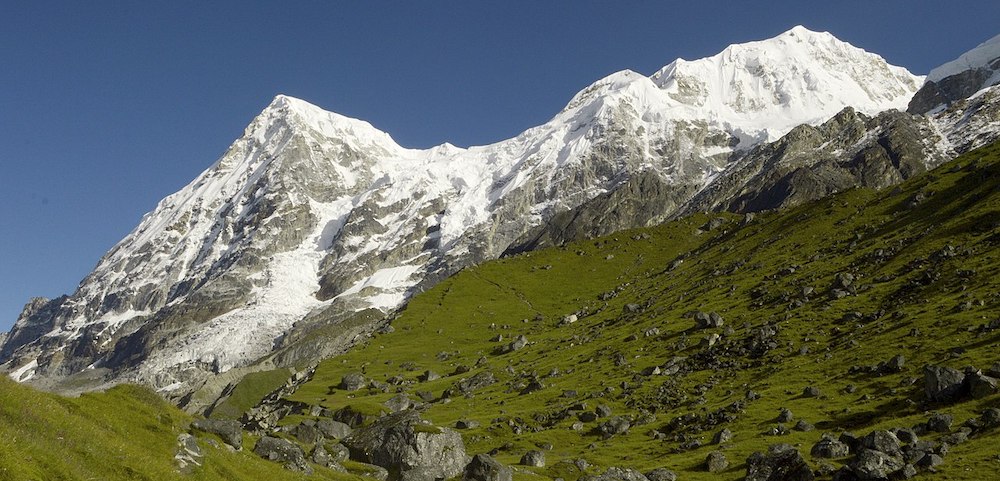
Khangchendzonga National Park – ©G Devadarshan Sharma, CC BY-SA 4.0 via Wikimedia Commons
The state has 28 mountain peaks, more than 80 glaciers, 227 high-altitude lakes (including the Tsongmo, Gurudongmar and Khecheopalri Lakes), five major hot springs, and more than 100 rivers and streams. Eight mountain passes connect the state to Tibet, Bhutan and Nepal. Sikkim’s hot springs are renowned for their medicinal and therapeutic value. Among the state’s most notable hot springs are those at Phurchachu, Yumthang, Borang, Ralang, Taram-chu and Yumey Samdong. The springs, which have a high sulphur content, are located near river banks; some are known to emit hydrogen with an average temperature of the water of 50 °C.

Khecheopalri Lake – ©Yoghya, CC BY-SA 4.0 via Wikimedia Commons
The state has five seasons: winter, summer, spring, autumn, and monsoon season. Sikkim’s climate ranges from sub-tropical in the south to tundra in the north. Most of the inhabited regions of Sikkim experience a temperate climate, with temperatures seldom exceeding 28 °C in summer. The average annual temperature for most of Sikkim is around 18 °C. Sikkim is one of the few states in India to receive regular snowfall. The snow line ranges from 20,000 feet in the south of the state to 16,100 feet in the north. The tundra-type region in the north is snowbound for four months every year, and the temperature drops below 0 °C almost every night. In north-western Sikkim, the peaks are frozen year-round because of the high altitude, temperatures in the mountains can drop to as low as −40 °C in winter. During the monsoon, heavy rains increase the risk of landslides. Fog affects many parts of the state during winter and the monsoons, making transportation perilous.
Sikkim is situated in an ecological hotspot of the lower Himalayas. The forested regions of the state exhibit a diverse range of fauna and flora. Owing to its altitudinal gradation, the state has a wide variety of plants, from tropical species to temperate, alpine and tundra ones, and is perhaps one of the few regions to exhibit such a diversity within such a small area. Nearly 81 per cent of the area of Sikkim comes under the administration of its forest department. Sikkim is home to around 5,000 species of flowering plants, 515 rare orchids, 60 primula species, 36 rhododendron species, 11 oak varieties, 23 bamboo varieties, 16 conifer species, 362 types of ferns and ferns allies, 8 tree ferns, and over 900 medicinal plants.
Birding Sikkim
The fauna of Sikkim Include Snow Leopard, Musk Deer, Himalayan Tahr, Red Panda, Himalayan Marmot, Himalayan Serow, Himalayan Goral, Muntjac, Common Langur, Asian Black Bear, Clouded Leopard, Marbled Cat, Leopard Cat, Dhole, Tibetan Wolf, Hog Badger, Binturong and Himalayan Jungle Cat. Among the animals more commonly found in the alpine zone are yaks, mainly reared for their milk, meat, and as a beast of burden.
The best birding region comprising the state if Sikkim and the adjoining parts of North Bengal – Darjeeling and Kalimpong, lies between Latitude 27 and 28 degrees North, and Longitude 87 to 89 degrees East. It is a rugged strip of vertical mountain country. Wedged between Nepal, Tibet, Bhutan, and the North Bengal Plains of India. This tiny region is just 90kms wide and 150kms deep. The country rises from near sea level to 8,500 meters, in a very short distance, the Great Himalayan Range with its giant spurs – Singelila and Chola, virtually enclose this region in a titanic horseshoe. Starting from the plains of North Bengal tangled interlacing ridges rise range after range to the foot of the great wall of high peaks and passes opening into Tibet, Nepal and Bhutan.
The climate varies between the tropical heat of the valleys and the alpine cold of the snowy regions. With high rainfall, it is the most humid region of the Himalayas. Dry season is from November to March. The altitudinal zones of vegetation range from Tropical, through sub-tropical and temperate to Alpine. In some places only 10kms in a direct line separate the palm growing valleys from perpetual snow. This telescoping of terrain has created marked altitudinal zones in the humidity, rainfall, climate and vegetation. This factor is responsible for the great variety and abundance of the resident bird life, making this area arguably one of the richest areas of its size anywhere in the world.
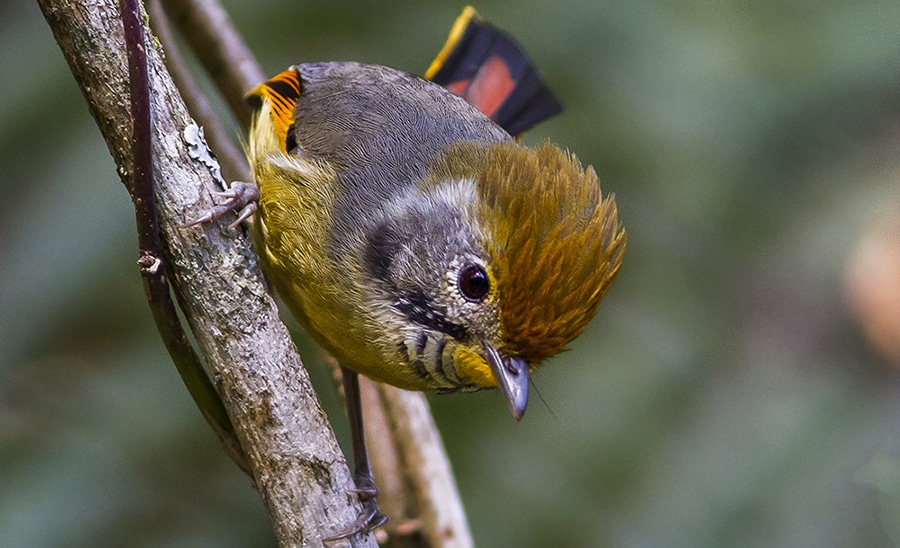
Chestnut-tailed Minla Actinodura strigula Fambong Lho WLS – Dibyendu Ash, CC BY-SA 3.0 via Wikimedia Commons
Dr Salim Ali – one of India’s foremost ornithologists recorded 527 species of resident birds. In addition, there are vagrants, and transients on migration. It is estimated that more than 30 percent of the species of the Indian sub-continent can be spotted in this region.
This page is sponsored by Bird-Photo-Tours ASIA

-
Khechepheri Lake - West Sikkim
InformationSatellite ViewThe Khechepheri Lake at an altitude of 1980 m is 28Km from Pamayangtse, is a sacred lake located in a natural crater-like basin. The lake hosts migrant ducks and occasionally some rare species such as Black-necked Grebe, Baer's Pochard or Greater Scaup. Other birds spotted have been Speckled Woodpigeon, Emerald Cuckoo, Blue-winged & Scaly Laughing Thrushes; White-naped Yuhina and many of the birds that can be seen at Pamayangtse. Khichipheri Lake is 28Km from Pamayangtse and Yoksom is another 32Km. It is feasible to drive from Pamayangtse/Pelling to Yoksom with a days birding at Khechepheri Lake. -
Pamayangtse - West Sikkim
InformationSatellite ViewThe Pamayangtse Monastery stands on a lovely site at 2085m altitude with breathtaking views of Mount Khangchen Dzonga. It is the second oldest in Sikkim, and the main attraction of West Sikkim. Around Pamayangtse and the nearby village of Pelling there are several excellent birding sites and hikes. Pamayangtse is 77km from Darjeeling and it takes 4 hours by jeep. It is also connected to Kalimpong (100km in 4 hrs). If you want to go directly from Bagdogra it is 148km and takes 5½ hrs. Some of the best species from Pamayangtse area are: Himalayan Griffon, White-throated Needletail, Streak-breasted Scimitar Babbler, Rufous-capped and Black-chinned Babbler, Rufous-winged & White-browed Fulvetta, Cutia, White-browed Shrike-Babbler, Pygmy Blue Flycatcher, Verditer, Snowy-browed and Sapphire Flycatcher, Fire-tailed and Green-tailed Sunbird, Fire-breasted Flowerpecker, White-tailed Robin, Dark-breasted Rosefinch and Red-headed Bullfinch. -
Tholung Valley - North Sikkim
Satellite ViewThis is an unexplored area in North Sikkim. Peter Lobo did the first birding exploration in Nov 2001, followed by the first tour in April 2002. The entry is through Mangan - located on the North Sikkim High way. It is 70Km (2½ hrs) from Gangtok and 153km (5½ hrs) from Bagdogra. Onwards it is 14km by jeep on a rough trail, from where the birding walk starts. Tholung Valley is located in the shadow of the 6888m high Siniolchu, and the 5,200m Lamo Anden, this is virtually an uninhabited valley with a miniscule population. Due to restricted entry there is no tourist traffic. It is the domain of glaciers, snow-clad peaks, alpine lakes, waterfalls, hot springs, bio-diverse forests, cascading rivers and streams, and twittering birds, The altitudinal variation ranges between 1000m to 4,500m. The lower valley has mixed open forest with amazing biodiversity. The variation in altitude, variety of trees and shrubs, lack of human population and vehicular traffic combine to make it a haven for birds, and a prime birding site. The mossy oak and Rhododendron forests, coniferous forests and bamboo stands support some beautiful East Himalayan specialties. A very good walking trail with offshoots of grazing trails provides access for birding. The entire length of the walking trail of 15km is a birding hot spot. Not yet on the birding map, the area is mainly unexplored. The first birding tour to this area in April 2002 recorded over 100 species. Highlights: Crested Serpent Eagle, Northern Goshawk, Upland Buzzard, Satyr Tragopan, Whimbrel, Ashy Woodpigeon, Greater Coucal, Brown Wood Owl, Golden-throated Barbet, Rufous-bellied Woodpecker, Bay Woodpecker, Yellow-rumped Honeyguide, Nepal Martin, Citrine Wagtail, Rosy Pipit, Orange-bellied Leafbird, Winter Wren, Plain-backed Thrush, Long-tailed Thrush, Scaly Thrush, White-browed Shortwing, Chestnut-headed Tesia, Slaty-bellied Tesia, Brownish-flanked Bush Warbler, Tickell's Leaf Warbler, Ferruginous Flycatcher, Rufous-gorgeted Flycatcher, Snowy-browed Flycatcher, Pygmy Wren Babbler, Spotted Wren Babbler, Cutia, Rusty-flanked Treecreeper, Wallcreeper, Gould's Sunbird and Scarlet Finch. A special entry permit is required to proceed beyond Mangan. -
Vershay and Dentam
Satellite ViewVershay is located at 3300m, on a massive ridge covered with protected forests of Silver Fir, Hemlock, Magnolia, and Rhododendrons. It is one of the best birding areas in Sikkim. Starting from the road head at the small village of Hilley at 2700m, it is an easy walk up to the ridge top. Hilley is 79Km from Darjeeling (4 hrs). It can also be reached from Kalimpong in 4½ hours. If moving directly from Bagdogra Airport it will take 6 hours. From Vershay a days birding trek through mixed forests of Rhododendrons, Magnolia and diverse flora to Dentam (1500m) is rewarding. Birds you are likely to see include: Red-breasted Tragopan, Satyr Tragopan, Kalij Pheasant, Red-eared Bay Woodpecker, Brown Wood Owl, Rufus-bellied woodpecker, Fire-tailed Myzornis, Brown Parrotbills, Slaty-backed Flycatchers, Golden Robin, Long-tailed Thrushes, Grey-crested Tits, Streak-breasted, Rusty-cheeked, and Slender-billed Scimitar Babblers, various Laughing Thrushes, and Red-tailed Minla. There is also the attraction of breathtaking views of Mount Khangchen Dzonga, apart from the delightful Rhododendrons in bloom in Feb-March. -
Yoksom Village - West Sikkim
InformationSatellite ViewYoksom Village at 1,780m is as far as you can go by jeep. Around Yoksom some of the birds recorded are Mountain Hawk Eagle, Crimson-breasted Woodpecker, Maroon Oriole, Short-billed and Grey-chinned Minevets, Himalayan Bulbul, Red-tailed Minla, White-naped Yuhina, various Thrushes, Grey-winged Blackbird, various Tits, White-tailed Nuthatch, various sunbirds, and various bushchats.
-
Number of bird species: 782
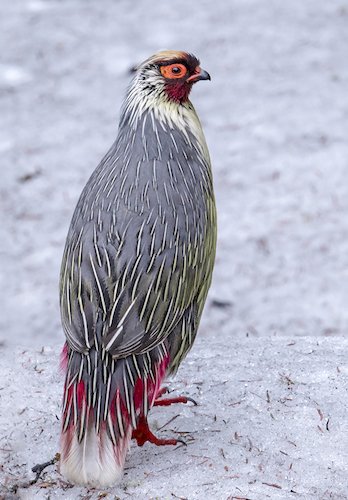
(As at August 2024)Blood Pheasant Ithaginis cruentus
-
Avibase
PDF ChecklistThis checklist includes all bird species found in Sikkim , based on the best information available at this time. It is based on a wide variety of sources that I collated over many years. I am pleased to offer these checklists as a service to birdwatchers. If you find any error, please do not hesitate to report them. -
BUBO
ChecklistChecklist of the Birds of Sikkim -
Nature Safari India
PDF ChecklistBird Checklist for Sikkim -
Wild Feathers
PDF ChecklistDetailed Checklist of Birds of Sikkim -
eBird
PDF ChecklistThis checklist is generated with data from eBird (ebird.org), a global database of bird sightings from birders like you. If you enjoy this checklist, please consider contributing your sightings to eBird. It is 100% free to take part, and your observations will help support birders, researchers, and conservationists worldwide.

-
Field Guide Birds of India
| By Amitava Majumder, Gopinathan Maheswaran, Imran Alam, Kailash Chandra, JRB Alfred & Biswajit Roy Choudhury | Zoological Survey of India | 2022 | Paperback | 599 pages, colour & b/w photos, colour illustrations, colour distribution maps | ISBN: 9788181715814 Buy this book from NHBS.com -
Birds of Nepal With Reference to Kashmir and Sikkim
| By Robert L Fleming, Sr. et al | Ardarsh Enterprises | 2024 | Edition 5 | Paperback | 367 pages, 152 colour plates | ISBN: 9788187138129 Buy this book from NHBS.com
-
Sikkim Ornithological Society
Facebook PageSikkim Ornithological Society was launched on 12th November 2005 at Himalayan Zoological Park (Bulbuley)...
-
*Protected areas of Sikkim
InformationSatellite ViewNational Parks & Wildlife Sanctuaries -
NP BR Khangchendzonga
InformationSatellite ViewAbout 550 species of birds are found inside the park including blood pheasant, satyr tragopan, osprey, Himalayan griffon, lammergeier, Tragopan pheasant, green pigeon, Tibetan snowcock, snow pigeon, impeyan pheasant, Asian emerald cuckoo, sunbird and eagle. A new species of bird named Himalayan Forest Thrush has been found in 2016. Its scientific name is Zoothera salimalii -
WS Fambong Lho
InformationSatellite ViewThis sanctuary falls at the junction of Palearctic ecozone and Indomalaya ecozone, supporting a large variety of mammalian and avian fauna. Birds at Fambong Lho Wildlife Sanctuary include species like the hill partridge, satyr tragopan, fire-tailed myzornis, bar-throated minla, red-tailed minla, black-eared shrike babbler, scaly laughingthrush, streak-breasted scimitar babbler, rusty-fronted barwing, yellow-browed tit, red-headed bullfinch, crimson-browed finch, chestnut-crowned warbler etc. The endangered rufous-headed hornbill has been sighted here. -
WS Kyongnosla Alpine Sanctuary
InformationSatellite ViewRich in both flora and fauna, rare, endangered ground orchids and rhododendrons interspersed among tall junipers and taller silver firs are among the important plants present. Rhododendron niveum (the State Tree of Sikkim) and Cypripedium tibeticum (the ground slipper orchid), which is on the verge of extinction, have also been introduced here. -
WS Maenam
InformationSatellite ViewThe first wildlife skywalk in India will be constructed at Maenam Wildlife Sanctuary. The state government of Sikkim proposed construction of the 22 kilometres (14 mi) rope-way from Maenam Wildlife Sanctuary to a skywalk which will be built over the edge of the Bhalleydhunga steep face. There will be a rain shelter and public conveniences at the skywalk. The environment ministry has also approved the proposal, which will cost 5 billion Rupees -
WS Pangolakha
InformationSatellite ViewThis wildlife sanctuary is linked to the forests of Bhutan and Neora Valley National Park of West Bengal. Some high altitude lakes are present there, which acts as a biodiversity hotspot for migratory birds.
-
Asian Adventures
Tour OperatorWe have recently introduced this birding tour in the Northern part of Sikkim, based on our experiences. While we usually visit Northern Sikkim in the winter for birds like Grandala and Blood Pheasant, this summer tour aims to highlight the beautiful resident birds of the region, including Speckled Wood Pigeon, Yellow-rumped Honeyguide, a variety of babblers and leaf warblers, and more. -
Bird-Photo-Tours ASIA
Tour OperatorBird-Photo-Tours ASIA is the specialists in bird photography tours on the Asian continent with a portfolio of 50 bird photography tours across 26 countries and a particular specialism in bird photography in India including the State of Sikkim. -
Bluetail Birding
Tour OperatorA 12-day, small group birding tour of the Eastern Himalayas that combines the densely forested mid-elevations with high elevation valleys and pastures approaching the Trans-Himalayas of the Tibetan plateau in Sikkim and West Bengal. -
Cultural Safari Tours
Tour OperatorSikkim Bird Watching Tour -
Jungle Travel India
Tour OperatorSmall and beautiful, SIKKIM is situated in the Eastern Himalayas, Spread below the Mount Kanchenzonga (8534 mts.); the third highest mountain in the world, it is revered by the Sikkimese as their protective deity. Amidst the gradeur of the mountain peaks, the lush valleys, fast-flowing rivers, terraced hills, Sikkim offers her visitors a rare and singular experience. Within hours one can move from the tropical heat of the lower valleys to the cold of the mountain slopes that reach up to the areas of perpetual show… -
Nature Safari India
Tour Operator -
Sikkim Birding Tours
Tour OperatorWe are a team of dedicated Bird Guides providing bird-watching, birding, and bird photography tours, across the Himalayas. We focus on the Eastern Himalayan region of Sikkim, Bhutan, Assam, and Arunachal Pradesh. We offer package tours to people who want to watch, photograph and explore birds and wildlife of the Himalayas in their natural habitat. -
Sikkim Birds
Tour OperatorMost of the natural treasures are located in the protected Areas (PAs) under the Forests, Environment and Wildlife Management Department (FEWMD), Government of Sikkim. It is of utmost necessity that we conserve this natural heritage and at the same time open our doors to welcome bird watchers all over the world -
Wild Voyager
Tour OperatorSikkim & West Bengal Birding
-
2014 [11 November] - Chewang R Bonpo - North Sikkim
PDF ReportAnnotated List -
2015 [05 May] - Aseem Kothiala - Sikkim & North Bengal
ReportLatpanchar is home to the famous Rufous-necked Hornbill. Its nesting time we were told and there was a great opportunity to probably sight them. There were around 10 pairs in all in the region and one of them had been seen often. The nearby fruiting trees did not bear any fruit in this period so the hornbills have to fly to distant locations. -
2016 [02 February] - S S Cheema
ReportI chose Sikkim as the alternate site and started a campaign - posting first on Chandigarh Birds and then on Hyderabad birds. The response was hardly anything to talk about - three calls from Chandigarh Birds and one from Hyderabad birds. After repeating the plans, the budget and everything - no response. I took is fine I suppose - as I almost forgot everything about it. -
2017 [11 November] - Julian Bell - Darjeeling & Sikkim
ReportThis trip report covers the best part of a week spent in Darjeeling and Sikkim, starting off at Kurseong for a few days before moving to Glenburn and then onwards to Biksthang (Sikkim). As usual for my holidays this was not by any means a full-on birding trip - though I did spend a whole day birding in the vicinity of Kurseoung and had a number of early morning walks. -
2023 [03 March] - Chewang R Bonpo - West Sikkim
PDF ReportAnnotated List -
2024 [05 May] - Chewang R Bonpo - West Sikkim
PDF ReportSikkim is one of the smallest Mountain state in North-East of India and popular destination now among tourist due to its Mountain (World 3 rd Highest peak Mt. Kanchendzonga), Hills, Waterfalls, and virgin forest which harbours around 500 species of birds.
-
Kate on Conservation
WebpageSikkim in India is one of the world’s best places for birding. This is why. -
Sikkim Birdwatching
WebpageYou should know, if you love nature and birds, birdwatching in Sikkim will stay in your memory. Sikkim is a small place surrounded by Himalayan mountains in the northeast of India and it has many different kinds of birds. Sikkim, with its dense woods, lakes high up in the mountains, and beautiful valleys provides an ideal place for watching birds.