

Brandenburg
Landlocked Brandenburg, located in the northeast of Germany is one its sixteen federal states. The state covers an area of 29,478 km2 (11,382 square miles) and has a population of around 2.6 million residents, the fifth-largest German state by area and tenth-most populous. Potsdam is the state capital and largest city, while other major cities include Brandenburg an der Havel, Cottbus, and Frankfurt (Oder). Brandenburg surrounds the national capital and city-state of Berlin, which together form the Berlin/Brandenburg Metropolitan Region, the third-largest metropolitan area in Germany. Brandenburg borders the state of Mecklenburg-Vorpommern to the north, Lower Saxony to the west, Saxony-Anhalt to the west and southwest and Saxony to the south. To the east lies the country of Poland, separated by the wide River Oder.
The other main rivers in the state are the Spree and the Havel, and part of the western border is the Elbe. In the southeast there are wetland regions called the Spree Ward.
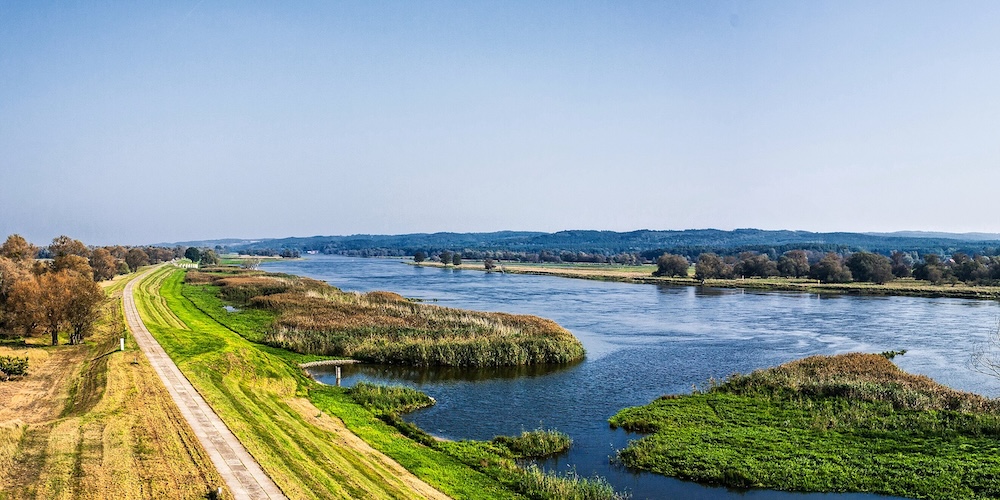
Lower Oda Valley National Park – ©Uckermaerker CC BY-SA 4.0 via Wikimedia Commons
Large areas of the natural environment are well-preserved and there are 15 large protected areas, each given state funding with ranger staff and often with visitor centres and other wildlife watching facilities. One of these is a national park, the Lower Oda Valley National Park, and there are several biosphere reserves. The Spreewald Biosphere Reserve and the Schorfheide-Chorin Biosphere Reserve. The rest are designated nature parks; the largest being the Westhavelland Nature Park which covers over 500 square miles.
Birding Brandenburg
The Federal State of Brandenburg is now recognised as a good birding venue by Birdwatchers outside Germany. Facilities for birdwatching are very good, with well-constructed hides, observation towers and display boards at key sites. The terrain is mainly flat but diverse with large rivers, lakes, fishponds and extensive forests and heaths giving a rich variety of bird life. A selection of which are mentioned below.
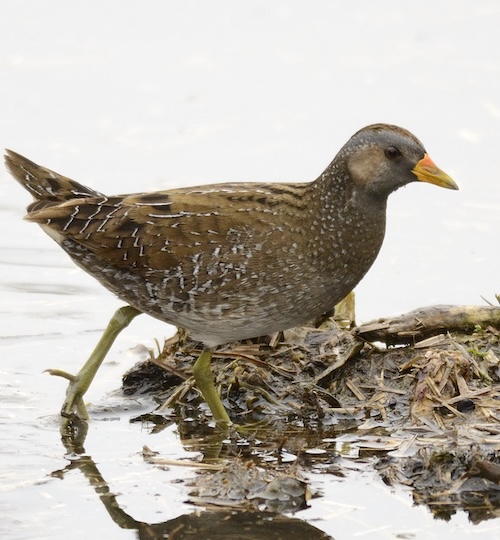
Among the many excellent sites, special mention should be made of the Lower Oder National Park along the Polish border. The polders, lakes and rivers and surrounding forests provide habitats for a wide variety of species, some of which, such as Thrush Nightingale, River Warbler and Red-breasted Flycatcher are at the western edge of their breeding range in mainland Europe. The Corncrake population is healthy and both Spotted and Little Crake can be found. Along the river Oder are colonies of Black and sometimes White-winged Black Terns, and Bluethroats are found in the damp areas. In winter, the valley is transformed by extensive flooding bringing in thousands of swans, geese and ducks from the north.

Gülper See – ©Botaurus, Public domain, via Wikimedia Commons
Gülper See, and its environs, is perhaps the best place to see huge flocks of wintering geese. Most of the geese are Bean, White-front, and Greylag plus a few Lesser White-fronts and Red-breasted Geese. Flocks can reach 40-50,000.
Cranes breed and large numbers pass through on migration. Throughout the State are a number of well-known roosting sites, often with observation towers and hides. The largest roost is at Linum where, in October, the awesome sight of thousands of Cranes arriving in the late afternoon has become a tourist attraction. In 2014 the number reached a record of 100,000.
One of the special birds of Brandenburg is the Great Bustard. There is a small remnant population in protected areas to the west of Berlin. Numbers are increasing and there are now over one hundred birds. They can be watched from hides.
As well as all the forests and the water bodies, extensive areas of partially wooded heathland remain from military training by the Russian army. In summer these provide good habitat for Honey Buzzard, Wryneck, Woodlark, Nightjar, Red-backed and Great Grey Shrike, Wheatear and Tawny Pipit.

Westhavelland Nature Park – ©Andreas Lippold CC BY-SA 4.0 via Wikimedia Commons
The city state of Berlin lies in the centre of Brandenburg, and within the city boundaries are forests, and lakes. Red-necked Grebe breed at the fish ponds. Two Black Tern colonies are in the south-east of the city. Black and Middle Spotted Woodpeckers are in the woodlands.
Birdwatching is well developed in Germany, and NABU (the German society for conservation) oversees nature protection. Most of the literature about birds is written in German, and this is probably one of the main reasons why the country has not been well known to birdwatchers from the UK and other parts of Western Europe.
There is a guidebook in English – A Birdwatching Guide to Brandenburg and Berlin. It describes 110 sites, and has photographs, coloured maps, and details of habitats, access and species.
-
Number of bird species: 357
(As at June 2026)State Bird - Great Bustard Otis tarda
-
Avibase
PDF ChecklistThis checklist includes all bird species found in Brandenburg , based on the best information available at this time. It is based on a wide variety of sources that I collated over many years. I am pleased to offer these checklists as a service to birdwatchers. If you find any error, please do not hesitate to report them. -
eBird
PDF ChecklistThis checklist is generated with data from eBird (ebird.org), a global database of bird sightings from birders like you. If you enjoy this checklist, please consider contributing your sightings to eBird. It is 100% free to take part, and your observations will help support birders, researchers, and conservationists worldwide.

-
A Birdwatching Guide to Brandenburg & Berlin
| Written & Published by Roger White | 2012 | Paperback | 230 pages, colour photos, colour maps | ISBN: 9780957169500 Buy this book from NHBS.com
-
NABU Brandwenburg
WebsiteIf you would like to support the projects of the NABU Brandenburg, you will find all necessary information here. -
Society for the Promotion of Great Bustard Protection
WebsiteThe aim of the society is the initiation and promotion of measures and activities designed to support the conservation of the Great Bustard as breeding bird in a cultivated countryside in Brandenburg, rich in flora and fauna. The site (in German) gives an overview of the distribution,biolocy and relevant literature. It also has up to date news on the breeding population, provides information for visitors and sets out the aims and work of the society. Visitors who want to see the spectacular display at the start of the breeding season are advised to visit from mid-March to mid-May. The summer months are not good for observation as the birds extremely shy at this atage and, despite their size, can scarcelly be found in the high vegetation. In winter, with a little luck, small groups can be found on rapeseed oil fields. There is an information centre in the centre of the region at Buckow near Nennhausen which is annually open from the beginning of April to the end of May on weekends and public holidays (except Easter Sunday) between 10.00-13.00. See map of Eastern Brandenburg. Guided tours for groups can be arranged with sufficient advance notice (Tel.: +49 33878/60257 Fax: +49 033878/60600)
-
BR Schorfheide-Chorin
InformationSatellite View...composed of extensive woodlands (most of which are dominated by either oaks or pines), a wide range of bodies of standing water like lakes (most notably Werbellinsee, Grimnitzsee and Parsteiner See), ponds and renaturated bogs, as well as heathlands. Some parts of the Schorfheide are left as a wilderness. Due to its water bodies, the area serves as an important breeding and resting ground for birds like white-tailed eagles and cranes. -
BR Spreewald
InformationSatellite ViewIt is known for its traditional irrigation system, consisting of more than 200 small canals within the 484-square-kilometre (187 sq mi) area. Alder forests on wetlands and pine forests on sandy dry areas are characteristic for the region. Grasslands and fields can be found as well. About 18,000 species of flora and fauna have been counted -
NP Lower Oder Valley IBA
InformationSatellite ViewThe Lower Oder Valley International Park is a shared German-Polish nature reserve. It comprises the western banks of the Oder (Polish: Odra) river within the Uckermark district in the German state of Brandenburg as well as the steep eastern banks in the Gryfino and Police counties of the Polish West Pomeranian Voivodeship further north. The area comprises 165 km2 (64 sq mi) (Germany 105 km2 (41 sq mi), Poland 60 km2 (23 sq mi)); together with adjoining nature reserves in Germany and Poland the total area is 1,172 km2 (453 sq mi). There is a Special Protection Area (SPA) for birds. These plains are habitats for birds such as the black stork, the aquatic warbler, and the corn crake. -
NR Naturepark Dahme-Heideseen
InformationSatellite ViewThe heart of the region southeast of Berlin is the Dahme-Heideseen lakes, also known as Dahmeland. Their glacial origins and the centuries-long influence of the people living here are responsible for the captivating and diverse natural landscape, with its over 100 lakes, larger and smaller streams, springs, moors, valleys, hills... -
NR Westhavelland Nature Park
InformationSatellite ViewThe most extensive large-scale reserve in Brandenburg measures 1,315 square kilometres (ca. 508 sq miles) and is situated only 70 kilometres (43.5 miles) west of Berlin, nestled in the lower Havel river valley near the border to Saxony-Anhalt.
-
Brandenburg Rare Bird Alert
SightingsThe report below shows observations of rare birds in Brandenburg. Includes both unreviewed and reviewed/approved observations.
-
Birding Berlin
Local Tour OperatorOn these full day trips, dependent on the time of year, we can visit the Rietzer Lake (IBA BB 005), Upper Rhinluch/Havelland Luch Nauen-Friesack“ (IBA BB 003), Döberitz Heath (IBA BB 004) und Lower Rhinluch –Dreetzer Lake/ Havelland Luch/ Belzig countryside meadows“ (IBA BB 0410) by car. The wetlands in particular are home to many different water fowl and wader species. In the low-lying grassland areas several bird of prey species, the Ortolan Bunting and Germany’s last remaining Great Bustard population are to be found. -
NatureTrek
Tour OperatorThe Birds of Brandenburg & Berlin. A 5-day birdwatching break to north-east Germany in search of migrating Cranes as well as wintering Great Bustard, geese, ducks and raptors.
-
2018 [02 February] - Ben Locke
ReportIn Salzgitter in the morning, a Wood Mouse was feeding in the bird feeders and Greenfinches, Starlings, House Sparrows and Blue and Great Tits could be seen from the windows. We headed back to Hannover to meet friends, but stopped off at Steinfeldsee on the way. A series of lakes, mostly completely frozen over, were filled with hundreds of geese and large numbers of Great Cormorants, and small numbers of Mallard, Tufted Duck and Coot. A distant Bittern was a German first for me, and a possible Willow Tit, though it’s always a nightmare to distinguish them from the Marsh Tit. In this habitat, either were likely. -
2024 [11 November] - Rolf Nessing
Report10,000 birds -
2026 [05 May] - Andreas Stadler
eBird ReportFrühjahr im West- Havelland
-
Hotel Haus Chorin
AccommodationThe Hotel Haus Chorin is nestled in untouched nature right by the Amtssee lake and only a few minutes' walk from the Chorin Abbey. Located in a natural forest park, our hotel complex offers the ideal stay in the biosphere reserve Schorfheide for relaxation seekers, conference guests or business travellers.
-
Stork Nest Webcam - White Stork
GalleryThe NABU Stork Station Vetschau