

Teretristidae – Cuban Warblers
The Cuban warblers are a genus, Teretistris, and family, Teretistridae, of birds endemic to Cuba and its surrounding cays. Until 2002 they were thought to be New-World warblers, but DNA studies have shown that they are not at all closely related to that family. The Teretistridae consists of just two extant species, the Yellow-headed Warbler and the Oriente Warbler. Both species are found in forest and scrub, with the Yellow-headed Warbler ranging in the west of the island and the Oriente Warbler in the east. The Cuban warblers are 13 cm long and have similar yellow and grey plumage.
They are insectivores, with beetles forming a large part of the diet. Small reptiles and fruit are also taken. They feed in bushes and trees, in pairs or in small flocks during the non-breeding season and are often the nucleus species for mixed-species feeding flocks with other birds, particularly migrants from North America.
The genus Teretistris was long thought to sit in the New World warbler family Parulidae, until a study examined 25 genera of New World warbler using mitochondrial and nuclear DNA found that six genera were best placed outside the family, including Teretistris. Five of the genera had long been suspected to not sit comfortably inside Parulidae, but before this study there had never been a suggestion that Teretistris did not belong in the New World warbler family.
A follow-up study (2013) supported the separation of the genus from Parulidae, but found it difficult to resolve exactly where it sat with the other nine-primaried passerines. Their closest relatives may be the Wrenthrush, genus Zeledonia, now often treated as a monotypic family, Zeledoniidae. The study’s authors nevertheless recommended separating the genus into its own family, Teretistridae. The family has been accepted by the International Ornithological Congress’ (IOC) Birds of the World: Recommended English Names, the Handbook of the Birds of the World’s HBW Alive and The Clements Checklist of Birds of the World. These four authorities have also adopted the common name of Cuban warblers for the family. The (2013) Howard and Moore Complete Checklist of the Birds of the World took a different approach, however, and placed the two Cuban warblers with the Wrenthrush in the family Zeledoniidae.

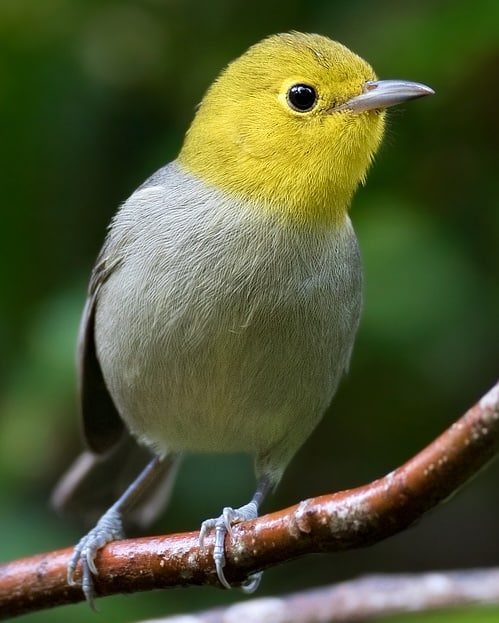
Oriente Warbler Teretistris fornsi – ©Dubi Shapiro
The family contains two closely related species, usually treated as a species pair; the Yellow-headed Warbler is monotypic. A subspecies of the Oriente Warbler, turquinensis, was described (2000) from Pico Turquino, a mountain in the south of the island and has been accepted by some authorities, but one has suggested that further research is required.
The Cuban warblers are, as their name suggests, endemic to Cuba and its surrounding islands and cays. They have an allopatric distribution, with the yellow-headed warbler living in the west of the island and the Oriente warbler living in the east. The Yellow-headed Warbler is found on the northern coast of the west of the island, as well as the Zapata Peninsula, Guanahacabibes Peninsula and Isla de la Juventud to the south of Cuba.
The Oriente Warbler has a more discontinuous range along the northern coast of the east of the island, and a more continuous presence in the south of the island in the Oriente region. The subspecies turquinensis is found in the eastern mountains of Oriente. The species is also found on the cays to the north of Cuba, but not any cays to the south. The disjunct populations are thought to be due to a lack of suitable habitat in the east. Where the two species co-occur in the Matanzas Province the Oriente Warbler is found along the coast whereas the Yellow-headed Warbler is found inland.
Both species of Cuban warbler inhabit a range of natural forest with good understory and drier scrubbier habitat, from sea-level up into the mountains of Cuba. The Oriente Warbler is more likely to live in scrub nearer the coasts, and humid forests higher in hills and mountains. The Cuban warblers weigh between 6–18 g. Both are similar in appearance to New-World warblers, and have similar plumage to each other. They have grey backs, wings and tails, and yellow faces and throats; the Oriente Warbler has a grey crown and forehead and yellow down to the upper belly, with a white lower belly and rear, and the Yellow-headed had an entirely yellow head but a grey breast, belly and rear. Both species have a yellow eye-ring. The sexes are almost identical, but females have slightly shorter tails. The bills are robust and slightly curved, and blackish-grey to grey.
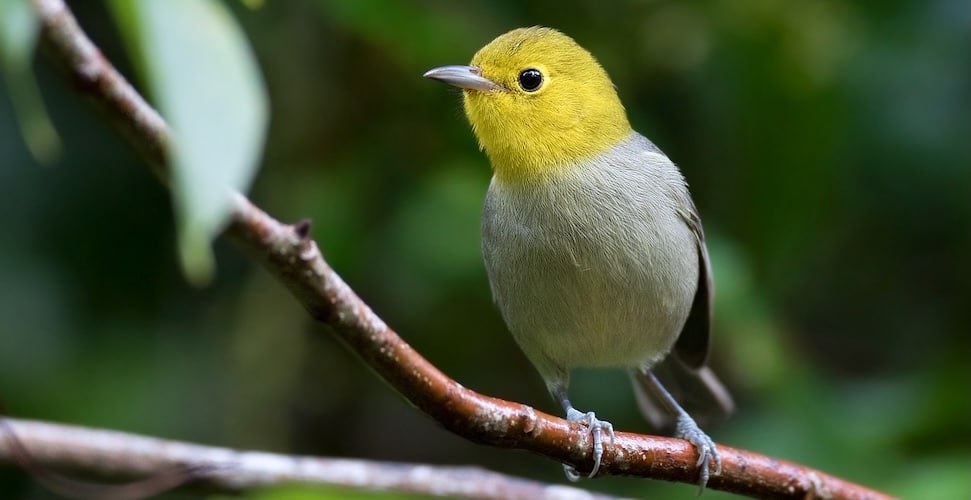
Yellow-headed Warbler Teretistris fernandinaeb – ©Dubi Shapiro
Insects form a large part of their diet. Stomach-content analysis of the Oriente Warbler showed that beetles formed a large part of its diet, with a smaller part of its diet being composed of Hemiptera (true bugs) and Lepidoptera (moths & butterflies). Both species are also reported to take small lizards; the Oriente Warbler has also been reported eating small fruit. The Yellow-headed Warbler typically feeds in the understorey and mid canopy parts of the forest, a form of niche partitioning with the Olive-capped Warbler, which more usually forages in the higher canopy, whereas the Oriente Warbler feeds at higher levels in the canopy, above 15 feet in the morning, before moving to feed closer to the ground in the evening. It has been suggested that this shift may relate to the changes in temperature over the day; as the day heats up foraging birds move lower where it may be cooler.
Cuban Warblers are often found in flocks of up to six birds in the non-breeding season. These small flocks often serve as the nucleus of mixed-species feeding flocks of native species and in particular overwintering migrants from North America. The Yellow-headed Warbler was found in 82% of mixed species flocks observed in its range, and the Orinete Warbler in 42% of its potential flocks (although the sample size was much smaller).
The nesting biology of the Cuban warblers has not been documented in detail. Both species are seasonal breeders, with a nesting season ranging from March to July and an egg-laying period from March to May. The nest of the Oriente Warbler is a simple unlined cup constructed of small vines, roots, moss and feathers. The cup measures 40 to 55 mm in diameter, and is 35 mm high with a depth of 23 mm. The nests are usually placed within 1 m on a branch usually concealed among epiphytes such as Tillandsia moss or parasitic plants. The nest of the Yellow-headed Warbler is also a cup, made of similar materials and grass, placed close to the ground in low vegetation.
-
Number of bird species: 2
(As at October 2025)
According to the recently (2025) amalgamated AviList, there are just two species, in one genus in the Teretristidae family. They are:
Yellow-headed Warbler Teretistris fernandinae
Oriente Warbler Teretistris fornsi
-
Teretristidae
Family AccountThe Cuban Warblers [Teretristidae] are two species of warbler-like birds endemic to Cuba. Recent molecular evidence has provided evidence... -
Teretristidae
Family AccountThe Cuban warblers are a genus, Teretistris, and family, Teretistridae, of birds endemic to Cuba and its surrounding cays. Until 2002 they were thought to be New World warblers, but DNA studies have shown that they are not closely related to that family.
Fatbirder supplies hot links to both these species in this small family:
-
Oriente Warbler Teretistris fornsi
Species AccountA noisy flocking species that uses a wide variety of wooded and scrubby habitats. Its combination of blue-gray upperparts, yellow from throat to upper belly... -
Oriente Warbler Teretistris fornsi
Species AccountThe Oriente warbler (Teretistris fornsi) is one of two species of bird in the Cuban warbler family Teretistridae. It is endemic to central and eastern Cuba. -
Oriente Warbler Teretistris fornsi
Species AccountSound archive and distribution map -
Yellow-headed Warbler Teretistris fernandinae
Species AccountA gregarious resident of dense tangles and thickets in otherwise open habitats; not found in dense forest or mangroves. -
Yellow-headed Warbler Teretistris fernandinae
Species AccountThe yellow-headed warbler (Teretistris fernandinae) is one of two species of bird in the Cuban warbler family Teretistridae. It is endemic to western Cuba. -
Yellow-headed Warbler Teretistris fernandinae
Species AccountSound archive and distribution map.