

Gruidae – Cranes
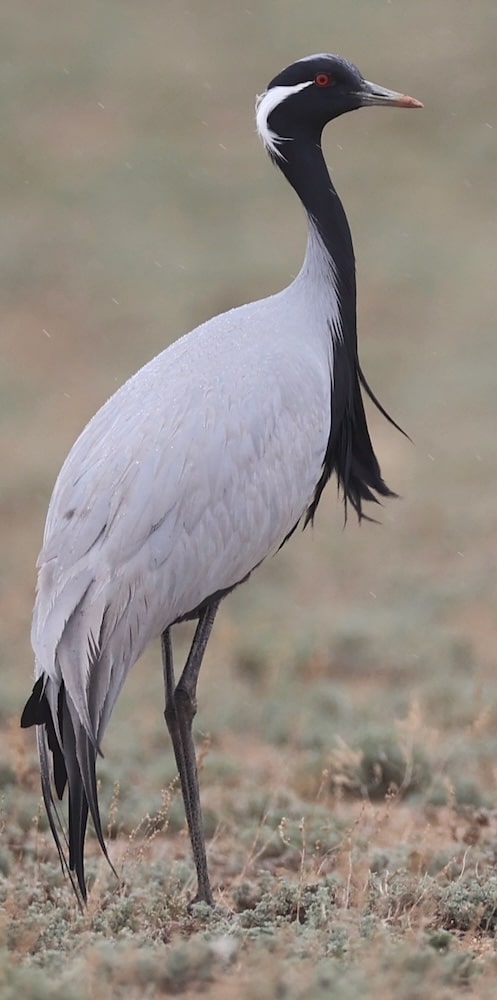
The Gruidae or cranes are a family of large, long-legged and long-necked birds in the group Gruiformes. There are fifteen species of crane in just four genera (after recent classification 2025). Unlike the similar-looking but unrelated herons, cranes fly with necks outstretched, not pulled back. Cranes live on all continents except Antarctica and South America.
They are opportunistic feeders that change their diet according to the season and their own nutrient requirements. They eat a range of items from suitably sized small rodents, fish, amphibians, and insects to grain, berries, and plants.
Cranes construct platform nests in shallow water, and typically lay two eggs at a time. Both parents help to rear the young, which remain with them until the next breeding season.
Some species and populations of cranes migrate over long distances; others do not migrate at all. Cranes are solitary during the breeding season, occurring in pairs, but during the non-breeding season they are gregarious, forming very large flocks where their numbers are sufficient. These congregations are among the most spectacular of avian sights.
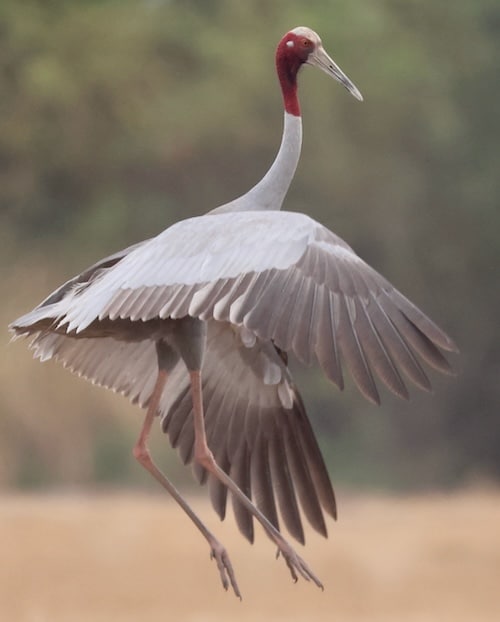
Sarus Crane Antigone antigone – ©Bird-Photo-Tours ASIA
Most species of cranes have been affected by human activities and are at the least classified as threatened, if not critically endangered. The plight of the whooping cranes of North America inspired some of the first US legislation to protect endangered species.
-
Number of bird species: 15
(Species list as at July 2025)
According to the IOC there are 15 extant crane species. They are:
Grey Crowned Crane Balearica regulorum
Black Crowned Crane Balearica pavonina
Siberian Crane Leucogeranus leucogeranus
Sandhill Crane Antigone canadensis
White-naped Crane Antigone vipio
Brolga Antigone rubicunda
Sarus Crane Antigone antigone
Wattled Crane Grus carunculata
Demoiselle Crane Grus virgo
Blue Crane Grus paradisea
Red-crowned Crane Grus japonensis
Whooping Crane Grus americana
Common Crane Grus grus
Hooded Crane Grus monacha
Black-necked Crane Grus nigricollis
-
Crane Working Group of Eurasia
WebsiteThe Crane Working Group of Eurasia (CWGE) was founded in year 2000, about 10 years after the Crane Working Group of the former Soviet Union stopped their work. The main goals of CWGE are to collect and spread information about the distribution, threats and conservation activities of the different crane populations in Russia and the rest of the world. -
IUCN SSC Crane Specialist Group
WebsiteThe International Crane Foundation (ICF) supports the activities of the IUCN SSC Crane Specialist Group (CSG). The CSG has 247 members from 56 countries. -
International Crane Foundation
WebsiteCranes are a family of birds that have long been revered by people living near them. In Japan, the cranes are honored as symbols of long life and a happy marriage. In Viet Nam, cranes are believed to carry the souls of the dead to heaven. In North America, Africa, and Australia, native inhabitants have incorporated the crane`s graceful movements into their own dances and regard cranes as auspicious symbols. -
The Great Crane Project
WebpageCranes were once widespread and probably very common across the UK, but they were lost as a breeding species in the Elizabethan Era – around 400 years ago. -
Whooping Crane Conservation Association
WebsiteThe serious plight of the Whooping Crane population alarmed some people many years ago. In response a small loosely organized group of “pen pals” initiated the “Whooper Club” in the 1950’s. This small group of individuals along the great bird’s flyway in the United States and Canada commenced urging government agencies on both sides of the border to do something to halt the demise of Whooping Cranes. Eventually the Whooper Club became the Whooping Crane Conservation Association (WCCA) in 1961.
-
A Chorus of Cranes - The Cranes of North America and the World
| By Paul A Johnsgard & Thomas D Mangelsen | University Press of Colorado | 2015 | Paperback | 226 pages, 35 colour photos, 41 b/w illustrations | ISBN: 9781607324362 Buy this book from NHBS.com -
Cranes, Herons & Storks of Australia
| By David Hollands | Bloomings Books/Green Book Company | 2017 | Hardback | 282 pages, 200+ colour photos, 1 colour map, colour distribution maps | ISBN: 9780992290016 Buy this book from NHBS.com -
Cranes: A Natural History of a Bird in Crisis
| By Janice M Hughes | Firefly Books | 2008 | Hardback | 256 pages, 90 colour photos | ISBN: 9781554073436 Buy this book from NHBS.com -
Cranes: Their Biology, Husbandry and Conservation
| Edited by David H Ellis, George F Gee & Claire M Mirande | Hancock House Publishers | 1996 | Hardback | 308 pages, Colour & b/w photos, illustrations, tables, maps | ISBN: 9780888393852 Buy this book from NHBS.com -
My Life with Cranes - A Collection of Stories
| By George Archibald | International Crane Foundation | 2016 | Paperback | 159 pages, colour & b/w photos, colour & b/w illustrations | ISBN: 9780997940503 Buy this book from NHBS.com -
The Call of the Cranes
| Expeditions into a Mysterious World | By Bernhard Wessling | Springer Nature | 2022 | Paperback | 254 pages, 45 colour photos and colour illustrations, 3 b/w illustrations | ISBN: 9783030982829 Buy this book from NHBS.com -
The Cranes: Status Survey and Conservation Action Plan
| By CD Meine & GW Archibald | International Union for the Conservation of Nature and Natural Resources | 2011 | Paperback | 281 pages, B/w photos, tables, maps | ISBN: 9782831703268 Buy this book from NHBS.com -
The Eurasian Crane in Estonia
| By A Leito, J Kespaik, I Ojaste & J Truu | Estonian University of Life Sciences | 2006 | Paperback | 184 pages, 186 illustrations | Out of Print | ISBN: 9789985830697 Buy this book from NHBS.com -
The Man Who Saved the Whooping Crane
| The Robert Porter Allen Story | Kathleen Kaska | University Press of Florida | 2012 | Hardback | 234 pages, 19 b/w photos | ISBN: 9780813040240 Buy this book from NHBS.com -
The Norfolk Cranes' Story
| By John Buxton & Chris Durdin | Wren Publishing | 2019 | Paperback | 143 pages, 65 colour & 6 b/w photos, 3 colour illustrations | ISBN: 9781999838652 Buy this book from NHBS.com -
The Sentinels - Cranes of South Africa
| By Daniel Dolpire & David Allan | HPH Publishing | 2018 | Hardback | 168 pages, 164 colour photos | ISBN: 9780639947334 Buy this book from NHBS.com -
Those of the Gray Wind - The Sandhill Cranes
| By Paul A Johnsgard | Bison Books (Nebraska UP) | 2017 | Edition 2 | Paperback | 157 pages, 6 b/w photos, 16 b/w illustrations | ISBN: 9781496201577 Buy this book from NHBS.com -
Whooping Cranes Biology and Conservation
| Edited by John B French, Jr., Sarah J Converse & Jane E Austin | Academic Press | 2018 | Hardback | 520 pages, colour photos, colour illustrations, colour maps, colour tables | ISBN: 9780128035559 Buy this book from NHBS.com
-
Gruidae
InformationOverview, distribution etc -
Gruidae
InformationCranes are a type of large bird with long legs and necks in the biological family Gruidae of the order Gruiformes. The family has 15 species placed in four genera which are Antigone, Balearica, Leucogeranus, and Grus...
-
Black-crowned Crane Balearica pavonia
BirdLife Species AccountFull species account... -
Black-crowned Crane Balearica pavonia
Species AccountThe black crowned crane (Balearica pavonina) is a bird in the crane family Gruidae.… -
Black-crowned Crane Balearica pavonia
IUCN Species StatusBlack Crowned Crane Balearica pavonina has most recently been assessed for The IUCN Red List of Threatened Species in 2016. Balearica pavonina is listed as Vulnerable under criteria A4bcd. -
Black-crowned Crane Balearica pavonia
Species AccountSound archive and distribution map. -
Black-necked Crane
Species AccountA regal, rather thickset crane of highland lakes and wet pastures. Pale-bodied with a black neck, a dark drooping ‘bustle’ of elongated feathers above the tail, and a patch of bare red skin on the crown -
Black-necked Crane
Species AccountThe black-necked crane (Grus nigricollis) is a medium-sized crane in Asia that breeds on the Tibetan Plateau and remote parts of India and Bhutan. -
Black-necked Crane
Species AccountVocalisations & distribution -
Blue Crane Anthropoides paradiseus
BirdLife Species AccountFull species account... -
Blue Crane Anthropoides paradiseus
Species AccountThe blue crane (Anthropoides paradiseus), also known as the Stanley crane and the paradise crane, is the national bird of South Africa. -
Blue Crane Anthropoides paradiseus
IUCN Species StatusBlue Crane Anthropoides paradiseus has most recently been assessed for The IUCN Red List of Threatened Species in 2020. Anthropoides paradiseus is listed as Vulnerable under criteria A3cde+4cde. -
Blue Crane Grus paradiseus
Species AccountSound archive and distribution map. -
Brolga
Species AccountRanges shown based on BirdLife International and NatureServe (2011), now curated and maintained by Xeno-canto. -
Brolga
Species AccountThe brolga (Antigone rubicunda), formerly known as the native companion, is a bird in the crane family. -
Brolga
Species AccountTall pale gray crane with grayish legs and red bare skin on head that does not extend down the neck... -
Common Crane Grus grus
IUCN Species StatusCommon Crane Grus grus has most recently been assessed for The IUCN Red List of Threatened Species in 2016. Grus grus is listed as Least Concern. -
Common Cranes Grus grus
Species AccountThe common crane (Grus grus), also known as the Eurasian crane, is a bird of the family Gruidae, the cranes. The scientific name is from the Latin; grus, "crane". -
Common Cranes Grus grus
Species AccountSound archive and distribution map. -
Demoiselle Crane
Species AccountSmall gray crane of open expansive habitats. Adult is an elegantly smooth shade of gray with a black neck, fiery eyes, and pure white plumes extending out from behind the eyes. -
Demoiselle Crane
Species AccountThe demoiselle crane (Grus virgo) is a species of crane found in central Eurosiberia, ranging from the Black Sea to Mongolia and Northeast China. -
Demoiselle Crane
Species AccountVocalisations & distribution -
Grey-crowned Crane Balearica regulorum
BirdLife Species AccountBirdLife species profile… -
Grey-crowned Crane Balearica regulorum
Species AccountThe grey crowned crane (Balearica regulorum) is a bird in the crane family Gruidae. It occurs in dry savannah in Africa south of the Sahara, although it nests in somewhat wetter habitats. They can also be found in marshes, cultivated lands and grassy flatlands near rivers and lakes in Uganda and Kenya and as far south as South Africa. -
Grey-crowned Crane Balearica regulorum
IUCN Species StatusGrey Crowned Crane Balearica regulorum has most recently been assessed for The IUCN Red List of Threatened Species in 2016. Balearica regulorum is listed as Endangered under criteria A2acd+4acd. -
Grey-crowned Crane Balearica regulorum
Species AccountSound archive and distribution map. -
Hooded Crane Grus monacha
Species AccountThe hooded crane (Grus monacha) is a small, dark crane. It has a grey body. The top of the neck and head is white, except for a patch of bare red skin above the eye. It is one of the smallest cranes, but is still a fairly large bird, at 1 m (3.3 ft) long, a weight of 3.7 kg (8.2 lbs) and a wingspan of 1.87 m (6.2 ft). -
Hooded Crane Grus monacha
IUCN Species StatusHooded Crane Grus monacha has most recently been assessed for The IUCN Red List of Threatened Species in 2016. Grus monacha is listed as Vulnerable under criteria B2ab(i,ii,iii,iv). -
Hooded Crane Grus monacha
Species AccountSound archive and distribution map. -
Red-Crowned Crane Grus japonensis
Species AccountSound archive and distribution map. -
Red-Crowned Crane Grus japonensis
Species AccountThe Red-crowned Crane is a stately long-legged, long-necked bird whose immaculate snow-white plumage is accented by black secondary feathers, a black neck with contrasting white nape, and a red crown… -
Red-Crowned Crane Grus japonensis
IUCN Species StatusRed-crowned Crane Grus japonensis has most recently been assessed for The IUCN Red List of Threatened Species in 2021. Grus japonensis is listed as Vulnerable under criteria A2ac+4ac; C1. -
Sandhill Crane Grus canadensis
Species AccountThe sandhill crane (Grus canadensis) is a species of large crane of North America and extreme northeastern Siberia. The common name of this bird refers to habitat like that at the Platte River, on the edge of Nebraska's Sandhills on the American Plains. This is the most important stopover area for the nominotypical subspecies, the lesser sandhill crane (Grus canadensis canadensis), with up to 450,000 of these birds migrating through annually. -
Sandhill Crane Grus canadensis
Cornell Species AccountWhether stepping singly across a wet meadow or filling the sky by the hundreds and thousands, Sandhill Cranes have an elegance that draws attention. -
Sarus Crane
Species AccountTall pale gray crane with pink legs and red bare skin on head extending down the neck... -
Sarus Crane
Species AccountThe sarus crane (Antigone antigone) is a large nonmigratory crane found in parts of the Indian subcontinent, Southeast Asia, and northern Australia. -
Sarus Crane
Species AccountVocalisations & distribution -
Siberian Crane Grus leucogeranus
Species AccountThe Siberian crane (Leucogeranus leucogeranus), also known as the Siberian white crane or the snow crane, is a bird of the family Gruidae, the cranes. They are distinctive among the cranes, adults are nearly all snowy white, except for their black primary feathers that are visible in flight and with two breeding populations in the Arctic tundra of western and eastern Russia. -
Siberian Crane Grus leucogeranus
BirdLife Species AccountBirdLife species profile.… -
Wattled Crane Grus carunculatus
Species AccountWithin southern Africa the wattled crane has a fragmented range. One population extends from Natal to the eastern Transvaal and Swaziland. A second population occurs in the Zimbabwe highlands. All these birds are more or less resident and inhabit permanent wetlands… -
Wattled Crane Grus carunculatus
Species AccountThe wattled crane (Grus carunculata) is a large bird found in Africa, south of the Sahara Desert. It is often placed in the monotypic genus Bugeranus, though some authorities place it with other crane species in the genus Grus. -
Wattled Crane Grus carunculatus
IUCN Species StatusWattled Crane Bugeranus carunculatus has most recently been assessed for The IUCN Red List of Threatened Species in 2018. Bugeranus carunculatus is listed as Vulnerable under criteria A2acde+3cde+4acde. -
Wattled Crane Grus carunculatus
Species AccountSound archive and distribution map. -
White-naped Crane
Species AccountLarge and gracefully built crane with long and droopy wing feathers. Adults are pearl-gray with a red face and a white stripe running from the crown down along the back of the neck. -
White-naped Crane
Species AccountThe white-naped crane is a bird in the crane family, Gruidae. It is a large bird measuring 112–125 cm (44–49 in) long, about 130 cm (4.3 ft) tall... -
White-naped Crane
Species AccountVocalisations & distribution -
Whooping Crane Grus americana
Species AccountThe whooping crane (Grus americana), the tallest North American bird, is an endangered crane species named for its whooping sound. In 2003, there were about 153 pairs of whooping cranes. Along with the sandhill crane, it is one of only two crane species found in North America. -
Whooping Crane Grus americana
Cornell Species AccountThe Whooping Crane is the tallest bird in North America and one of the most awe-inspiring, with its snowy white plumage, crimson cap, bugling call, and graceful courtship dance. -
Whooping Crane Grus americana
IUCN Species StatusWhooping Crane Grus americana has most recently been assessed for The IUCN Red List of Threatened Species in 2020. Grus americana is listed as Endangered under criteria D. -
Whooping Crane Grus americana
Species AccountSound archive and distribution map.
-
The Norfolk Cranes' Story
WebsiteThe cranes’ story starts with their arrival at Horsey in 1979. Their first nesting attempt was in 1981 and the first chick fledged in 1982. From this slow start in the Broads, the re-colonisation of this iconic wetland bird is now taking small but steady steps forwards elsewhere in the UK…