

Nepal’s extraordinary vertical geography packs a planet’s worth of avian life into a single journey from tropical wetlands to the high Himalaya.
By Richard F Silber – Executive Director, International Mountain Trekking
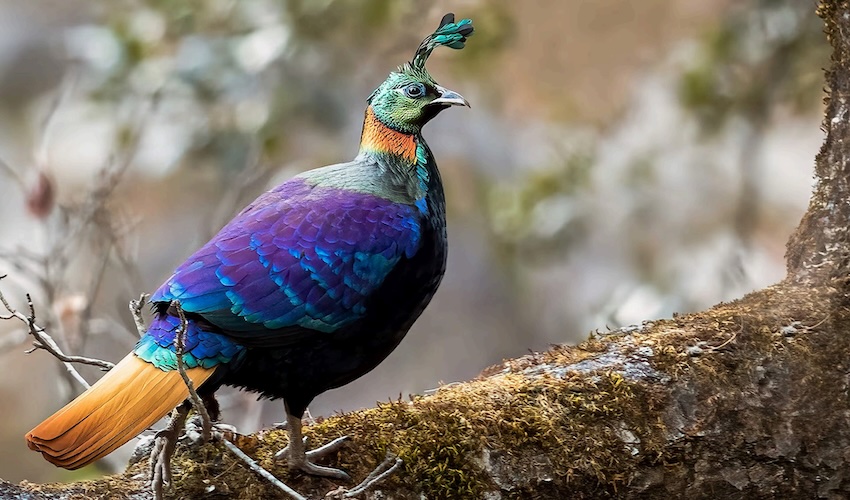
The male Himalayan Monal Lophophorus impejanus, Nepal’s national bird, and arguably the most spectacular pheasant on Earth.
There is a moment, somewhere above 3,000 meters in Nepal’s Khumbu Valley, when the forest thins and the rhododendrons give way to open alpine meadow, and a flash of iridescent green and copper crosses the trail ahead of you. You raise your binoculars. A male Himalayan Monal – known in Nepal as the Danphe, the country’s beloved national bird, arguably the most dazzling pheasant on the planet – turns briefly in the morning light before disappearing into the scrub. It is the kind of moment that serious birders travel a lifetime to find.
Nepal offers these moments with extraordinary regularity. And the reasons why are written into the unique geography of the land itself.
A Planet’s Worth of Birds in One Country
Nepal occupies just 0.1% of the world’s landmass, yet it harbours over 900 recorded bird species representing roughly 8-9% of all bird species on Earth. No comparable area anywhere on the planet approaches that density. The explanation lies in one of nature’s most dramatic experiments in vertical geography: within fewer than 200 kilometres from south to north, Nepal rises from sea-level tropical plains on its southern border with India to the summit of Mount Everest at 8,848 meters.
Five distinct climatic and vegetation zones tropical, subtropical, temperate, subalpine, and arctic are stacked one atop the other, each supporting its own community of birds. A single expedition can yield lowland species at breakfast and high-altitude specialists by afternoon.
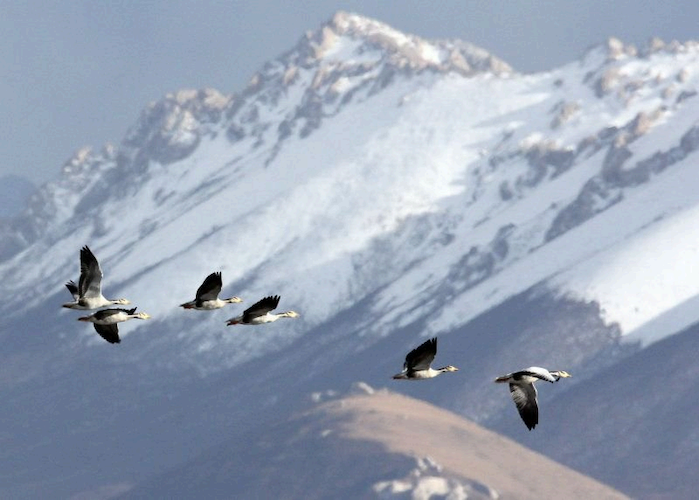
Bar-headed Geese cross directly over Everest on migration among the highest recorded avian flights on Earth.
Nepal also sits at the collision point of two of the world’s great biogeographic realms the Oriental and the Palearctic and species characteristic of both overlap here in ways unique to the Himalayan arc. Add the Himalayas’ role as a migratory corridor and staging ground for birds traveling from as far as Siberia, and the result is an avifauna of staggering richness and variety.
Birds Found Nowhere Else
For the serious birder, Nepal delivers a suite of species that cannot be seen anywhere else on Earth. The Spiny Babbler Nepal’s only true endemic is a pilgrimage target for birders worldwide. The Ibisbill and Wallcreeper, each so evolutionarily distinct they occupy their own monotypic families, haunt the fast-flowing rivers and rocky cliff faces of the middle hills. Blood Pheasant, Satyr Tragopan, Snow Partridge, and Tibetan Snowcock reward those who venture higher. The spectacle of Bar-headed Geese crossing directly over Everest among the highest migratory flights recorded anywhere is a reminder that in Nepal, even the sky operates by different rules.
For conservation-minded birders, Nepal holds additional urgency. Critical and declining populations of Bengal Florican, Sarus Crane, and several vulture species find refuge here, making a Nepal birding expedition as meaningful as it is memorable.
“There is nowhere on Earth where a single expedition can take you from tropical wetlands to the Himalayan high country, encountering species from two biogeographic realms along the way.”
A Journey Through Culture as Well as Habitat
Nepal’s extraordinary avian wealth does not exist in a cultural vacuum. The country that shelters the Danphe also gave the world Lord Buddha, built the great stupas of Swayambhunath and Boudhanath in Kathmandu, and is home to the Sherpa people whose relationship with the high Himalaya is one of the most profound human-landscape bonds on Earth. A birding expedition in Nepal that ignores this dimension misses half the experience.
The ancient Kathmandu Valley, a UNESCO World Heritage Site, is itself a remarkable urban birding environment: Black Kites soar above centuries-old pagodas, Spotted Owlets roost in temple niches, and Himalayan Griffons can be spotted riding thermals above the valley rim. The forested hilltop of Swayambhunath Temple one of the oldest and most sacred Buddhist sites in Nepal offers sweeping panoramic views and excellent raptor watching alongside its constellation of gilded shrines and prayer wheels. The nearby Patan Museum, housed in a 17th-century royal palace, displays one of the finest collections of Himalayan sacred art in Asia.
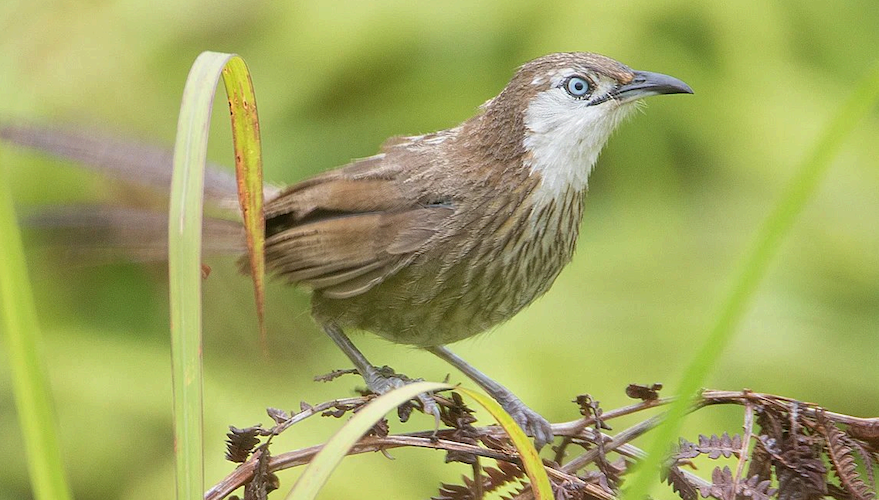 The Spiny Babbler, Nepal’s only true endemic bird species is a pilgrimage target for serious birders worldwide.
Wings of Nepal: IMT’s Birding Expedition
International Mountain Trekking has spent years building the local expertise, Sherpa community partnerships, and scientific relationships that translate Nepal’s extraordinary avian potential into a world-class experience. IMT’s new 16-day expedition, Wings of Nepal: A Birding Journey from the Himalayas to the Terai, departs February 12, 2027, from Kathmandu, and is designed to cover the full vertical and ecological sweep of the country pursuing 250 to 300 possible species during the peak of winter migration.
The journey begins with an exploration of Himalayan birds and a dedicated cultural day in Kathmandu before flying to Koshi Tappu Wildlife Reserve, a Ramsar-listed wetland hosting over 527 species, then west to Chitwan National Park a UNESCO World Heritage Site and onward through the Annapurna foothills and the serene lakes of Pokhara, before returning to the rhododendron forests above Kathmandu for a final sampling of montane specialties, including another chance at the Danphe and the elusive Satyr Tragopan
Expert licensed naturalist guides, deep Sherpa partnerships, and small group sizes ensure that every participant comes away not just with a remarkable species list, but with the kind of immersive cultural and ecological experience that only IMT’s on-the-ground relationships make possible.
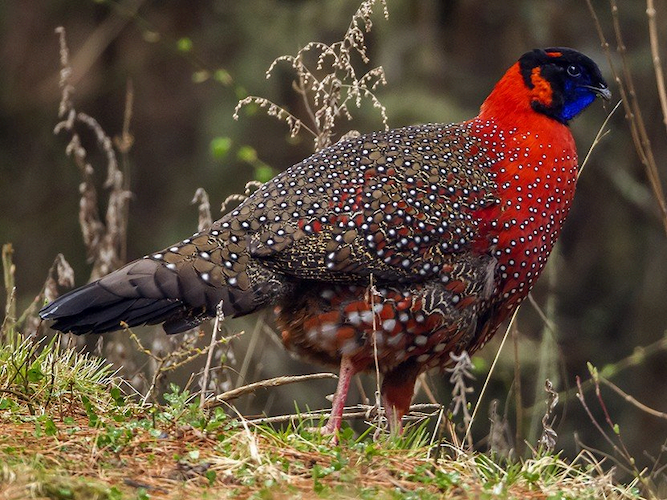
The male Satyr Tragopan a coveted target in the rhododendron forests above Kathmandu is among the most sought-after montane pheasants in Asia.
The Invitation
Nepal has long been celebrated as the world’s trekking capital. Among those who know birds, it is something else entirely: a convergence of geography, evolution, and biodiversity that places it in a category of its own. There are destinations with more endemics. There are destinations with easier logistics. But there is nowhere on Earth where a single expedition can take you from tropical wetlands to the Himalayan high country, encountering species from two biogeographic realms along the way, in landscapes of such awe-inspiring natural and cultural beauty.
That journey is waiting. The Danphe is on the trail ahead.
For full details on joining IMT’s Wings of Nepal Feb 27 click HERE to learn more
Richard F. Silber is Executive Director of International Mountain Trekking and Co-Founder of the Himalayan Climate & Science Institute (HCSI).