

| A Naturalist’s Guide to Garden Birds of Britain and Ireland | Peter Goodfellow & Marianne Taylor | John Beaufoy Publishing | 2026 | Paperback | 160 Pages, 300 Colour Illustrations | ISBN: 9781917879064 |
The Publisher’s View:
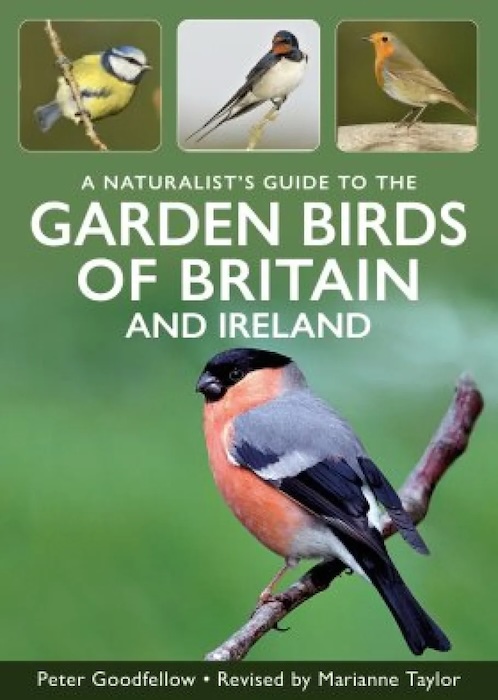
A Naturalist’s Guide to the Garden Birds of Britain & Ireland is an easy-to-use, introductory photographic guide to 90 garden bird species commonly seen in or over the gardens of Britain and Ireland and is perfect for amateur naturalists. High quality photographs from Britain’s top nature photographers are accompanied by detailed species descriptions, which include common and scientific name, length, distribution and habitat. The user-friendly introduction covers classification, making gardens attractive for birds, nest boxes and conservation, as well as a glossary. This fully updated third edition, revised by Marianne Taylor, contains revised descriptions, green, amber or red listings for conservation status and many new photos.
The Authors: Peter Goodfellow is a retired school teacher and lifelong birdwatcher. He is a past Chairman of Devon Birdwatching and Preservation Society, and is regularly involved with BTO surveys. His previous publications include the AA Illustrated Birds of Britain & Europe and A Naturalist’s Guide to Birds of Britain and Northern Europe (John Beaufoy Publishing).
Marianne Taylor specialises in all forms of wildlife with a particular interest in birds. She is a successful writer and editor working on natural history books and magazines.
Paul Sterry is one of the UK’s leading wildlife and natural history photographers, with more than 40 highly successful books to his name. Originally trained as a biologist, he uses his knowledge of natural history and ecology to take images that depict wildlife in a natural context and celebrate its beauty.
Other Views:
“This is an easy-to-use identification guide to 90 bird species which are most commonly seen in or over the gardens of Britain, Ireland and other parts of Northern Europe. Key identification features are described and there is an overview of classification, how to make gardens attractive for birds, nest boxes and conservation. Every species is illustrated in colour.”
– BTO book reviews
Fatbirder View:
The species were selected as those “one would be most likely to see in or above one’s garden”. I guess there will be those lucky enough to get a Grey Partridge wander into their grounds, or spot a Peregrine on the turret of their west wing, but not, apparently, a Yellow Wagtail or a fly by Osprey. My yard is not much bigger than the average lounge… I’ve never seen a Pied Flycatcher or common Redstart, a Bullfinch or a Brambling… but I’ve had a Firecrest and once had four Storks circling overhead. I guess it’s hard to select when you need to cover an urban coastal bungalow and a Highland castle.
Having said that, keeping the numbers small, has meant that most species can be afforded space for a number of images, which I’m all for given the limitations of photographic guides. I I’d probably have balked the inclusion of a nightingale had my daughter not heard one, on the edge of her urban Essex garden.
I guess I also see why such a small format was decided upon. It keeps it affordable and therefore means that those with only a very limited interest in such things would have one in their house for when something turns up they don’t recognise or the kids are asking questions about what’s sat on their lawn.
On the other hand, given that this is strictly for what you’re going to see in your own home, one could have a much larger book allowing for bigger illustrations and more of them and therefore more of a chance for the average householder to identify what they see.
The thing is, larger guides in a better format with drawn or painted illustrations are out there and although they won’t be as inexpensive as this, would not have a prohibitive price.
I truly believe that the least interested, most ignorant naturalists need the best guides to help them decide what they’ve seen. I’m always surprised by the questions I get asked by people when they describe what they’ve seen. What’s that big pink bird with blue wings? Wouldn’t bring to my mind a Jay, but that is often how they’re perceived in passing by someone walking their dog in the local park.
Nevertheless, this is a handy little volume which I would never deny anyone possessing.
A word though to publishers and particularly picture editors, it’s not necessarily the best photographer or wildlife expert that can produce the best sort of illustration in a guide like this. The whole purpose is, after all, identification and therefore the salient identification features are what most need illustrating and that isn’t always going to be found in the most beautiful photograph.
Buy from NHBS
Fatbirder