

Andalucia
Andalucía is a region of Spain (or as they say an ‘autonomous community) covering 87,599 km2 (33,822 square miles) of the south. It stretches roughly 500 km east-west and 200-300 km north-south. In the north, the Sierra Morena separates Andalusia from the plains of Extremadura and Castile-La Mancha on Spain’s Meseta Central, to the south is the Straits of Gibraltar and Gibraltar itself, with Portugal and the Atlantic Ocean to the west and the Mediterranean Sea to the east. It is divided into eight provinces – running west to east these are Huelva, Sevilla and Cadiz, Málaga and Cordoba, Granada and Jaén and Almería.
Andalucia has historically been an agricultural region, compared to the rest of Spain and the rest of Europe. In Almería is the largest complex of greenhouses in the world covering 40,000 hectares, so large it looks like a vast lake in satellite images. It supplies around half of the fruit and vegetables in Europe!
It is the hottest and area in Europe averaging 36C in summer with highs over 40C. Some areas, such as Cabo de Gata are exceedingly dry with less than 6 inches annually, other areas in the west, affected by the Atlantic Ocean’s weather like Cadiz are wet and humid with almost 80 inches of rain per year. Andalucia also includes both the dry Tabernas Desert in the province of Almería and the Sierra de Grazalema Natural Park in the province of Cádiz, which experiences one of highest rainfall in Spain. In general, as one goes from west to east, away from the Atlantic, there is less precipitation. Elevation is also very varied from the low-lying plains to the Sierra Nevada rising to almost 11,500 feet.
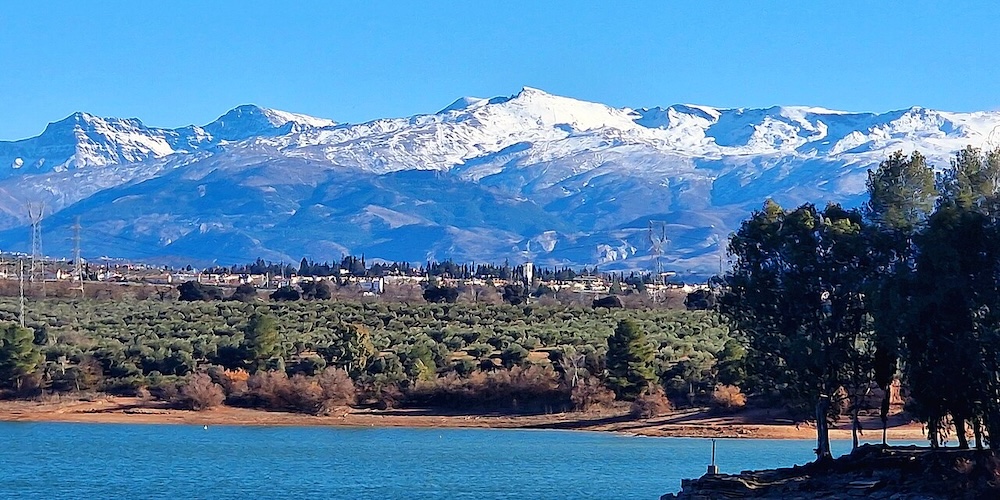
Sierra Nevada – ©Lopezsuarez, CC0, via Wikimedia Commons
Andalucia has rivers that flow into both the Atlantic and the Mediterranean. Flowing to the Atlantic are the Guadiana, Odiel-Tinto, Guadalquivir, Guadalete, and Barbate. Flowing to the Mediterranean are the Guadiaro, Guadalhorce, Guadalmedina, Guadalfeo, Andarax (also known as the Almería) and Almanzora. Of these, the Guadalquivir is the longest in Andalucia and fifth longest on the Iberian Peninsula, at 657 kilometres (408 miles). The rivers of the Atlantic basin are characteristically long, run through mostly flat terrain, and have broad river valleys. As a result, at their mouths are estuaries and wetlands, such as the marshes of Doñana in the delta of the Guadalquivir, and wetlands of the Odiel. In contrast, the rivers of the Mediterranean Basin are shorter, more seasonal, and make a precipitous descent from the mountains of the Baetic Cordillera.

Doñana Dunes – ©A M Felicisimo CC BY 2.0 via Wikimedia Commons
Andalucía is one the most attractive and ecologically diverse areas around the Mediterranean. It includes extensive saline lagoons and wide rivers, extensive marshes, a coastline bordered by some of Europe’s largest sand dune complexes, rugged cliffs, evergreen forests (including the endemic pinsapo firs), the world’s largest cork-oak forest, desert-like badlands, fertile plains, wild olive trees and mountains in excess of 3,600m which support an isolated alpine flora.
Birding Andalucía
This diversity of habitats helps to explain why Andalucía enjoys one of Europe’s richest avifaunas. All of the Iberian specialities can be found in the region: Northern Bald (reintroduced) and Glossy Ibis, Greater Flamingo, Spoonbill, White-headed & Marbled Ducks, Purple Swamphen, Red-knobbed Coot, both Great & Little Bustards, Black-bellied & Pin-tailed Sandgrouse, Spanish Imperial Eagle, Griffon, Cinereous & Egyptian Vultures, Black-winged Kite, Azure-winged (Iberian) Magpie, Iberian Green Woodpecker and Trumpeter Finch and many others… Sadly, the iconic Andalucian Hemipode (Small Button Quail) is now extinct in Iberia (although it survives, barely, just across the straits).
The mass migration of storks and raptors across the straits in spring (mainly March to early May) and autumn (mainly August to November) is one of Europe’s greatest avian spectacles. The movement of passerines across the straits is often overlooked, but it too can be impressive.

Doñana Wetlands – ©Smiley.toerist CC BY-SA 4.0 via Wikimedia Commons
You can enjoy a dream birdwatching holiday in Andalucía but remember that summers can be very hot, so it’s best to avoid the midday heat by relaxing with a cool drink and reserve birding for the early mornings or late afternoon and evenings. Fortunately, in winter and early spring (February onwards), the weather is often far more congenial with pleasant balmy days enlivened by many birds.

Pines at Doñana – ©Nacho Pintos CC BY 2.0 via Wikimedia Commons
The region has around 150 protected areas including three national parks at Doñana, Sierra Nevada and Sierra de las Nieves and 24 Natural Parks, 28 Nature Reserves and over 220 protected wetlands. In total, nearly 20% of the territory of Andalucia lies in one of these protected areas, which constitute roughly 30% of the protected territory in Spain. In the following section are a selection of some of the top birding spots and regions.
-
Almería - Cabo de Gata
WebpageSatellite ViewParque Natural Cabo de Gata y Nijar offers a mix of habitats and a birdlife to match. Offshore sea-watching often produces both Cory's and Balearic shearwaters plus a variety of gulls and terns. Nearby the salinas attracts a wide variety of waders plus Flamingos, both storks, gulls and terns and Lesser Short-toed Larks. The drier habitats are home to 'desert species' like Trumpeter Finch although Dupont's Lark is now rare here with a handful lingering around Amoladeras Altas. -
Almería - Canada de la Norias
InformationSatellite ViewSurrounded by plastic greenhouses this wetland site is a little gem (although there have been problems with water levels in some years). It attracts scarce species such as White-headed Duck plus all of the usual wetland species (Purple Swamphen, small herons, etc.) and waders. -
Almería - Desierto de Tabernas & Sierra Alhamilla
InformationSatellite ViewThe site for steppe/desert species like Trumpeter Finch, Black-bellied Sandgrouse and Stone-curlew but Little Bustard no longer seems to be present. Other notable species includes Black and Black-eared Wheatear, Western Olivaceous Warbler, Rufous Bushchat (Rufous-tailed Scrub-Robin). -
Almería - Punta Entinas-Roquetas de Mar
WebpageSatellite ViewEntinas-Sabinar near Roquetas de Mare and wetlands for species like Red-knobbed Coot, White-headed and Marbled Ducks, waders, Flamingo, etc. -
Cadiz - Bahía de Cadiz
WebpageSatellite ViewOvershadowed by the nearby Coto Doñana and lacking some classic Andalucian wetland species, the Bahía de Cadiz is often neglected by visiting birdwatchers. However, in an Andalucian context this vast complex of salinas and mudflats is exceptional for the numbers of wintering waders (plus Mediterranean Gull and Caspian Tern). All the species familiar to birdwatchers in the north can be seen here plus Kentish Plover, Black-winged Stilts and Audouin's Gull. Excellent for wintering Osprey. The most convenient site is the Marisma de Cetina reserve which holds all the usual waders plus a few Savi’s Warbler, and wintering Bluethroat. -
Cadiz - Chipiona Area
Chipiona itself is home to the largest colony of Little Swift in Spain and in recent years has been the departure point for pelagic trips (Wilson’s Petrel are regular). To the north-east the Playa de Montijo is a hotspot for terns (inc. Lesser Crested) and to the south the lakes on the golf complex at Costa Ballena often hold White-headed Duck and have a good record for rare gulls (Ring-billed is regular) -
Cadiz - La Janda
WebsiteSatellite ViewFor those visiting the Strait of Gibraltar for the autumn migration the remnant of the old Laguna de la Janda is well worth a visit. At this time, it is frequented by hundreds of Glossy Ibis, storks and raptors resting before continuing on their journey south. Spring is almost as good although birds are less likely to linger. Spanish Imperial Eagle breed in the area and juveniles from other parts disperse to here during the winter. There are good wintering populations of Black-winged Kite (a few also breed) and imm. Bonelli's Eagle plus, in recent years, the odd Pallid Harrier and Lesser Spotted Eagle. These, along with 000's of Common Crane, make this site an attractive location for birdwatchers in spring and winter too. Nearby Vejer de la Frontera also plays host to colony of (reintroduced) Northern Bald Ibis. Further along the coast in the Bolonia area there are breeding Little and White-rumped Swift and the elusive, declining Rufous Bushchat (Rufous-tailed Scrub-Robin). Little Bustard can be found between nearby Benalup and Medina Sidonia. -
Cadiz - Sanlucar-Trebujena Area
The marshes, lagunas and pines between Sanlucar de Barameda and Trebujena hold most of the species to be found across the Guadalquivir on the famous Coto Doñana National Park although its smaller size and greater accessibility mean some species are actually easier to see here (e.g. Marbled Duck). The Bonanza salt pans are arguably the best site in Andalucia for obtaining close views of waders. Nearby, the marshes at Mesas de Asta hold the most important Gull-billed Tern colony in Andalucia and up to 40% of the region's Slender-billed Gulls. The vineyards around Trebujena hold Spain’s largest population on Rufous Bushchat (Rufous-tailed Scrub-Robin). Nearby the Adventus Marismas are the best place in the area for Pin-tailed Sandgrouse. -
Cadiz - The Strait of Gibraltar
InformationSatellite ViewTarifa is the shortest crossing (14km) from Europe to Africa although, depending on the wind birds, will attempt to cross further west (Bolonia) or east (Gibraltar) . Thousands of birds rest and mass here on their way south before crossing to the Moroccan coastline. Raptors, passerines, swifts, waders and many other birds arrive from all over Europe and can be easily seen from August to November, in their post-nuptial migration and then again in February to May when they return (often flying low as they reach the coast giving better photo opportunities than may be the case in autumn). At Cazalla (immediately to the east of Tarifa) there is a purpose-built raptor watchpoint (manned in season by experts from 'Fundacion Migres') whilst to the south of Cazalla, by the coast at Punta Camorro, is the new Centro Internacional de Migracion de Aves. To the west of the town is Playa de los Lances which has a rage of waders, gulls and terns inc. Lesser Crested Tern). Passerine migration tends to be neglected but can be spectacular. House Bunting has recently established a small population in Algeciras. -
Córdoba - Guadalquivir at Córdoba
InformationSatellite ViewThe birdlife visible from the bridge over the Guadalquivir at Córdoba provides an interesting diversion from the architectural and cultural glories of the city. There's a mixed heronry (Cattle & Little Egrets, Night & Squacco Herons and Little Bittern) near Puente de San Rafael whilst passage brings raptors, gulls, terns, waders, raptors, etc. -
Córdoba - Lagunas of southern Córdoba
A series of small lagunas in the south of the province (esp. Laguna de Zóñar, Rincón, Amarga & Dulce to the west of the N-331) are strongholds for White-headed Duck and other wetland species. -
Córdoba - Parque Natural Sierras Subbéticas
WebsiteSatellite ViewTucked away in the south-east corner of Córdoba this sierra holds all of the expected species found in mountain areas - a variety of raptors (inc. one of the largest Griffon Vulture colonies in Andalucía), Crag Martin, Black Wheatear, both rockthrushes, a range of warblers, etc. -
Granada - Charca de Suárez
InformationSatellite ViewLike Parque Natural de la Desembocadura del Río Guadalhorce, this is a small reserve in an urban setting (Motril) and, similarly, it punches above it's weight with Red-knobbed Coot (introduced), Purple Gallinule, herons (inc. Little Bittern) and Moustached Warbler (winter). It also has a number of introduced species (e.g. Common Waxbill). -
Granada - Hoya de Baza & Guadix
InformationSatellite ViewThe Hoya de Baza & Guadix areas of steppe and 'badlands' in Grenada that hold some 'classic' Iberian specialities such as Black-bellied Sandgrouse, Great Spotted Cuckoo, Red-necked Nightjar, Pallid Swift, Alpine Swift, European Roller, Dupont's Lark (rare, Gaudix), Lesser Short-toed Lark, Thekla's Lark, Spanish Sparrow and Trumpeter Finch. Cream-coloured Courser has bred. -
Huelva - Coto Doñana National Park
WebsiteSatellite ViewConsidered as the most important wetland in Europe and one of the best places for birds in the whole of the Palearctic region, both for the number of species recorded and for its breeding & wintering importance. Between 300,000 & 400,000 birds settle in Doñana every winter. More than 300 species of birds have been recorded in Doñana, being the most important area in Europe for wintering geese and the second most important breeding area for Spanish Imperial Eagle in the world. Hundreds of birds including raptors, passerines, and sea or wetland birds are seen here, including 80% of all endemic Iberian birds. Best times to go birding there is from November to June. -
Huelva - Marismas Del Odiel & environs
WebpageSatellite ViewThis wetland with wide marshes, sandy spits, coastal dunes, pinewood forests and freshwater lagoons is outstanding for its breeding colonies of Spoonbill (more than 400 pairs) & Little Tern (more than 350 pairs). It is an excellent site for watching plovers, seabirds, cormorants and migrant passerines. To the west Laguna de El Portil often has White-headed Duck whilst on the border with Portugal the Marisma de Isla Cristina (Guadiana estuary) has all the species expected of a coastal wetland. -
Jaén - Sierra Cazorla
InformationSatellite ViewPart of the Prebaetic range lying between the Sierras Morena and the Sierra Baetica, this area contains many of the species expected in those two areas but is significant as the home of a project to reintroduce Lammergeier to Andalucia. -
Málaga - Laguna de Fuente De Piedra
WebpageSatellite ViewThe second most important salty lagoon in Spain is 6.5km long and 2.5km wide, and is situated in the geographic centre of Andalucía . Famous for its breeding colony of Greater Flamingo with a variable population (depending on the rainfall) of 8,000 - 12,000 pairs and the only regular breeding site for Lesser Flamingo (1-2 pairs) in Europe. An important breeding spot for Gull-billed Tern, Slender-billed Gull, Kentish Plover & Montagu's Harrier. The best season extends from December to June; after this, the lagoon dries up presenting a strange reflecting white surface, due to the solid salt cover. Nearby. the Lagunas de Campillos has more wetland species (inc. White-headed Duck) and Little Bustard in surrounding fields. -
Málaga - Parque Natural de la Desembocadura del Río Guadalhorce
InformationSatellite ViewThe location of this small nature reserve makes it worthwhile to include here. Malaga is the most popular entry point for those arriving and departing from Andalucía. This small reserve is only 5 minutes away from the main airport and can provide either an opportunity to introduce yourself to the birds of the region or as a last chance to catch-up on some missed species. The reserve hosts breeding waders and White-headed Duck, whilst the seaward side opens onto the Bay of Malaga, a great place for seawatching and perhaps spot Slender-billed, Audouin's and Mediterranean Gull. The site is also very good for raptors, with even wintering Booted Eagle being seen here. Rarities are often spotted here and so providing another excuse to visit. Note: in recent years a number of birdwatchers have had their cars broken into here so take sensible precautions such as parking somewhere busy and walking a few hundred metres to the reserve. -
Málaga - The Sierra del Torcal or El Torcal
InformationSatellite ViewThe area, designated Natural site of National Interest in 1929, is a relatively small Natural Park Reserve of some 17 square kilometres. The mountain range is easily accessible and is between the cities of Antequera and Malaga. It is a site of particular interest for those wanting to discover the typical mountain birds of the region. Black Wheatear, Blue Rock Thrush and Rock Bunting can be located here, whilst in winter it can be good for Alpine Accentor and Ring Ouzel. Raptors are well represented with both Bonelli's and Golden Eagle present all year. Griffon Vulture is common while Rufous-tailed Rock Thrush breed here during the summer months. Normally Ibex are easy to see here and give an added reason to visit. -
Sevilla - Brazo del Este
WebpageSatellite ViewThis area of rice paddies, reedy oxbows and channels on the east bank of the Guadalquivir is a prime location for wetland species. The paddies can hold thousands of Glossy Ibis, White Storks and numerous waders (inc. regular rarities). Reedbeds and wetlands are home to Marbled Duck, the scarce Savi's Warbler, small crakes and a thriving population of exotic passerines (e.g. Black-headed Weaver & Yellow-crowned Bishop). Nearby, several small wetlands are found around Los Palacios y Villafranca: most notable is the Humedal El Pantano which hold’s Spain’s only breeding Laughing Doves. Also nearby, the Parque Oromana (Alcala de Gudiana) is a good site for Iberian Magpie for those heading south. -
Sevilla - The Marchena-Osuna-Lantejuala Triangle
Satellite ViewThe Marchena-Osuna-Lantejuala Triangle is a mix of "steppe farmland" and small wetlands made accessible by a maze of little used roads and tracks. It is a rich area for birds and of particular interest is are breeding Great and Little Bustards (declining), Stone Curlew, Black-bellied Sandgrouse, Black-winged Kite, Roller, Collared Pratincole and Montagu's Harrier. Around Lantejuala a series of shallow lagunas add wetland species (herons and egrets, Flamingo, Purple Gallinule, Whiskered Terns, Black-necked Grebe and White-headed Duck, etc.) to the mix. Winter brings Common Crane and raptors. -
Sierra Baetica (Almeria, Cadiz, Málaga & Granada)
InformationSatellite View[Includes: Alcornocales, Grazalema, Serranía de Ronda & Nevada] The Sierra Baetica represents a series of sierras and interlinked sites which all have a similar birdlife. These mountains run a few km inland from the Mediterranean coast rising to the east to culminate in the magnificent Sierra Nevada. All areas can hold birds of interest with known "hotspots" sometimes more reflecting access and the presence of birdwatchers rather than the birds themselves. The sandstone Alcornocales (Cadiz) in the west often hold good numbers of migrating raptors (sometimes including Ruppell's Vulture) plus breeding Bonelli's, Short-toed and Booted Eagles, Black-eared Wheatear and the ubiquitous Blue Rock Thrush. Nearby, the Embalse de Barbate has breeding Osprey and White-rumped Swift. Just a little further east the limestone Sierra Grazalema (Cadiz/Málaga) and Serranía de Ronda (Málaga) have all of these breeding species plus Spectacled and Subalpine Warblers, Black Wheatear and Iberian Green Woodpecker (scarce in the Alcornocales). It is also home to one of Spain's most thriving populations of Bonelli's Eagle. In winter these mountains are good for Ring Ousel and Alpine Accentor. The more easterly ranges are better for Common Rockthrush, Crossbill and Pied Flycatcher. The Sierra Nevada (Granada), being the highest range, adds more 'alpine' species to the mix with breeding Citril Finch (a recent discovery esp. Puerto de la Ragua) and Alpine Accentor plus, unusual this far south, a few breeding Common Chiffchaff. Wetlands are scarce in Granada so Laguna de Padul on the western flank of the Sierra Nevada is worthy of note. -
Sierra Morena (Huelva, Seville, Cordoba & Jaén)
InformationSatellite View[Includes: Sierras Aracena, Norte, Andujar & Despeñaperros ]Stretching from the Portuguese border across the north of Andalucia this sierra (and lesser sierras that make up its whole) is, like the Sierra Baetica a series of interlocking sites which also share many of the same species. It is the stronghold for Cinereous Vulture in Andalucía especially around Aracena (Huelva) and Sierra Andujar (Jaén). The latter is also excellent for Spanish Imperial Eagle (and is the stronghold of Iberian Lynx). Other key species include Golden Eagle, Azure-winged Magpie (locally common), Crag Martin, a few White-rumped Swift, Alpine Swift and species more typical of northern Europe like Redstart, Northern Wheatear and Lesser Spotted Woodpecker (Aracena).
-
Number of bird species: 502
(As at April 2026)
-
Avibase
PDF ChecklistThis checklist includes all bird species found in Andalucía , based on the best information available at this time. It is based on a wide variety of sources that I collated over many years. I am pleased to offer these checklists as a service to birdwatchers. If you find any error, please do not hesitate to report them.

-
Crossbill Guide: Eastern Andalucía Córdoba to Cabo de Gata, Spain
| By Dirk Hilbers et al | KNNV/Crossbill | 2017 | Paperback | 256 pages, colour photos, maps | ISBN: 9789491648106 Buy this book from NHBS.com -
Crossbill Guide: Western Andalucía Huelva to Malaga, Spain
| By Dirk Hilbers, John Cantelo et al | KNNV/Crossbill | 2024 | Edition 2 | Paperback | 271 pages, colour photos, maps | ISBN: 9789491648335 Buy this book from NHBS.com -
Finding Birds in Andalucia
| By Dave Gosney | Easybirder | 2009 | Paperback | 48 pages, 20 b/w maps | ISBN: 9781907316005 Buy this book from NHBS.com -
Finding Birds in Andalucia - The DVD
| By Dave Gosney | Easybirder | 2009 | DVD | Runtime: 78 min | ISBN: 9781907316012 Buy this book from NHBS.com -
Where to Watch Birds in Donana
| By Francisco Chiclana Moreno & Jorge Garzon Gutierrez | Lynx Ediciones | 2006 | Paperback | 168 pages, colour photos, maps | ISBN: 9788496553200 Buy this book from NHBS.com -
Where to Watch Birds in Southern and Western Spain: Andalucia, Extremadura and Gibraltar
| By Ernest Garcia & Andrew Paterson | Christopher Helm | 2019 | 4th Edition | Paperback | 400 pages, 30 b&w illustrations, 99 maps | ISBN: 9780713683158 Buy this book from NHBS.com
-
Observatorio del Estrecho
Observatory WebsiteSatellite ViewObservatory of the Strait
-
Andalucian Bird Society
WebsiteHere you will find information on birdwatching in Andalucia. A great resource for exchanging and or getting information on many aspects of birding here in southern Spain. If you intend visiting this area, then an open and free forum allows you to contact locals on specific site or species information. Contibute to our database and conservation efforts by submitting your vacation trip reports and sighting records to the society… -
Asociación Ornitológica Ardea
Facebook PageAnte cualquier duda o sugerencia, no dude en ponerse en contacto a trav -
Fund for the Stewardship and Recovery of the Salt Marsh (SALARTE)
WebsiteSalarte is dedicated to the recovery, conservation and revitalization of the salt marsh in general and of the artisan salinas of Cadiz in particular. In addition to enhancing biodiversity and improving the ecological utility of abandoned saltpans, it plans to generate multiple associated benefits in terms of the creation of income, wealth and employment based on local resources. -
Fundacion Donana 21
WebsiteDoñana es un ámbito de extraordinaria diversidad ecológica y paisajística, siendo uno de los espacios naturales protegidos más emblemático de Europa. -
Fundacion Migres
WebsiteFundacion Migres is a private non-profit, scientific and cultural foundation, oriented to the preservation and enhancement of natural heritage. It is based at the Centre for the Investigation of Migration and Global Change is located at Punta Camorro immediately east of Tarifa. Founded in 2003 its brief is to encourage and promote research and awareness of the environment and undertake research. It organises the monitoring of the passage of soaring birds across the straits by using a volunteer programme. -
Grupo Ornitol
WebsiteEl Grupo Ornitol -
Grupo Ornitologico del Sur
WebsiteLocal ornithological club of Seville -
Siren
WebsiteIn 2002 Siren purchased a 50 acre coastal nature reserve on the southern-most tip of Spain... -
Sociedad Gaditana de Historia Natural
WebsiteStudying and conserving the Natural Heritage and Biodiversity of the province of Cádiz
-
NA Odiel Marshes
InformationSatellite ViewThis 72 square km wetlands reserve lies across the Odiel estuary from Huelva. The Odiel marshes are unspoilt and wild with a large, varied bird population. Some of these birds can be spotted from a 20 km that runs the length of the marshes. In winter there are up to 1000 greater flamingoes and 400 pairs of spoonbill which is around one third of the European population are resident here. Osprey, grey heron and purple heron can also be spied here… -
NP Doñana
InformationSatellite ViewDoñana has a very rich and diverse avifauna, with a total of 365 recorded species of resident and migratory birds. The marsh lies on the west Europe to west Africa migration route and is indispensable as a winter habitat… -
NP Sierra Nevada
WebpageSatellite ViewThe Sierra Nevada is a dramatic, rugged and extensive mountain range, the highest in Europe after the Alps and the most significant section of the Cordillera Penibética. The protected area encompasses 86,208ha of torrential rivers, sheer-sided gorges, stony scree slopes, glacial lakes between snowy summits and, in the foothills of the Alpujarras, cultivated terraces of almond trees and vegetables. The park's main draw for fauna is its rich birdlife, with over 60 species inhabiting the Sierra. Nesting birds of prey include golden eagles, Bonelli's eagles, peregrine falcons, griffon vultures and kestrels. On the higher slopes are Alpine accentors, black redstarts, northern wheateaters, rock thrushes, rock buntings, red-billed choughs and skylarks. In the woodland areas are hoopoes, short-toed treecreepers, green woodpeckers, coal tits, great tits, goldfinches and golden orioles. -
NP Sierra de las Nieves National Park
InformationSatellite ViewMost recently declared National Park in Spain (2021) Home to the southernmost alpine wildlife in Europe -
PN Los Alcornocales
WebpageSatellite ViewThis vast park covers 167,767ha from Tarifa in the south to the Sierra de Grazalema Natural Park in the north. It is named after its handsome and beautifully kept cork tree grove, the largest in the Iberian Peninsula and one of the most important ones in the world. It is the best example of what the densely wooded, primeval Iberian forests may have been like. -
PN Parque Natural de los Alcornocales
Facebook PageSatellite ViewDescripción del Parque Natural de Los Alcornocales etc… -
Veta La Palma - Donana
InformationSatellite View…is a clear example of sustainable development helping many jobs to be created as it promotes value for nature and conservation of bird life in the Guadalquivir marshes herby being an example for these areas and other areas in Andalusia… Veta La Palma provee de alimento, además, a numerosas especies de aves acuáticas que desarrollan una parte de su ciclo anual en las Marismas de Doñana, convirtiéndose en un complemento clave para sus supervivencia. Zampullines, multitud de limícolas, o los omnipresentes flamencos son algunos ejemplos. Veta la Palma representa para esta última especie un punto de referencia obligado para la preservación de la colonia de nidificación de la Laguna de Fuente de Piedra, en la provincia de Málaga, la más importante area de cría del flamenco en el Mediterráneo Occidental…
-
eBird
SightingsIn addition to being a means to record your own sightings, eBird provides bird news and details of birds regularly found at numerous sites across the region
-
Andalucia Nature Trips
Local Tour OperatorAndalucia Nature Trips was born from a long and rich experience enjoying nature and sharing feelings with my fellow travellers. Since I am a kid, I listen birds singing in my parents’ garden, look for flowers, walk along the French coast gazing at birds, or I just go fishing with my dad and granddad, hike in the forest close to my sport school and pick up some nice smelling flowers… -
Aviantours
Local Tour OperatorAviantours promises to teach the art of bird photography & digiscoping as well as offering birdwatching tours in Spain, Morocco & Gibraltar -
Birding Ecotours
Tour OperatorBirding Andalusia in Fall -
Birding Tarifa
Local Tour OperatorEstablished by Manuel Morales, Birding Tarifa organises day trips and longer breaks around Cadiz province, the nearby Coto Doñana and in Morocco. English spoken. An Andalucía Bird Society approved guide. -
Birding in Spain’s Wild West
Local GuideYou can book us at Birding in Spain’s Wild West – Ver Aves for a full or half day’s birding. We can recommend places to stay in friendly rural accommodation: birder-friendly and of the highest standard with competitive rates. -
Birding the Straits
Local Tour OperatorBased in Tarifa 'Birding the Straits focuses on birding trips both in Cadiz province and in Morocco (plus the Coto Doñana). Principal guide Javi Elorriaga is an expert's expert having authored many papers (mainly on raptors) and having been a member of the Spanish Rarities committee but, despite his great expertise, is an approachable, friendly guide. The other principal guide is Yeray Seminario is also an expert birdwatcher and highly talented photographer. Both are fluent English speakers. An Andalucía Bird Society approved guide. -
Discovering Do
Local Tour OperatorProfessional guiding and accommodation based in El Rocio -
Doñana Wings
Local Tour OperatorAmong the best birding hotspots in Andalusia are Doñana National Park, the most important wetland in Western Europe, and the Strait of Gibraltar, world-famous for its spectacular raptor migration. -
Granada Wildlife
Local Tour OperatorGranada Wildlife offer guided tours in this wonderful and diverse area of Spain. Day tours are centered on the area to the West of the city of Granada, around the province’s second town, Loja. -
Heatherlea
Tour OperatorRaptors, storks and passerines on migration, plus key resident birds inland and on the coast. -
Inglorious Bustards
Local Tour Operatorspecialise in trips either side of the straits. An Andalucía Bird Society approved guide. -
Josele J. Saiz
Local Tour OperatorBetter known for his wonderful birder's guesthouse in the Pyrenees [Boletas]; Josele guides throughout Spain and Morocco -
Naturain Indomita
Local Tour OperatorThis Spanish company is based outside Andalucia in Cuidad Real but also runs trips to the Sierra Morena and Sierra de Andujar. An Andalucía Bird Society approved guide. -
Naturalist Journeys
Tour OperatorWe carefully crafted this tour with a good pace in mind. Spend several days each in three fabulous birding regions: Extremadura, Andalusia, and Castilla-La Mancha. -
Naturetrek
Tour OperatorA 7-day holiday to enjoy the autumn bird migration across the Strait of Gibraltar, based at a delightful traditional Spanish rural farmhouse. -
Oriole Birding
Tour OperatorAndalucia in Southern Spain is the main western migratory corridor between Europe and Africa, renowned for its incredible visible migration of large soaring birds such as raptors and storks in Spring and Autumn. -
Oxyura Birdwatching
Local GuideLocal guide Manuel Bárcena runs trips to Donana, Cadiz province (inc. the Straits) and elsewhere and is well-known for his regular pelagic trips out from Chipiona. -
Royal Safaris
Tour OperatorAndalucia is one of the most amazing and beautiful regions in all of Europe. The cultural highlights include stunning architecture from the Visigoths and the Moorish eras of Spain and the Imperial times over the last 300 years. -
Spainbirds
Tour OperatorBirdwatching tours in Extremadura and all around Spain. Specialist in raptors and steppe birds. -
Spanish Nature
Tour OperatorSpanish Nature offer tours to Almería, the straits, Cordoba, the Coto, Jaén, Osuna, Serrania de Ronda, the straits, etc. but can also organise personalised tours on request. Approved by the Andalucía Bird Society of which the principal guide, Peter Jones, was a founder). The company's motto 'travelling together as friends' sums up their relaxed friendly approach. -
Wild Andalucia
Local Tour OperatorBased in Ronda (Málaga) Wild Andalucia is run by Álvaro Peral, an Andalucía Bird Society approved guide. Week long birding tours of the Costa del Sol and Coto Donana are offered plus day trips to Fuente de Piedra Guadalhorce, the Straits, Osuna & El Torcal. -
Wild Doñana
Local Tour OperatorWild Doñana specialises in tours to the Coto Doñana and other areas in Huelva but also runs tours elsewhere in southern Spain and Portugal. An Andalucía Bird Society approved guide. -
Wildside Holidays
Tour OperatorFor those who are environmentally conscious and enjoy being at one with nature, Wildside Holidays could be the ultimate solution for your Spain wildlife holiday research. -
Wingspan Bird Tours
Tour OperatorBased in Gaucin (Málaga) and run by ex-pat Brit, Bob Buckler, Wingspan provides one day tours (Fuente de Piedra, Gaucin, Ronda, Sotogrande, etc.) and week long trips in the Straits, Coto Doñana, etc.
-
2017 [02 February] - BirdDayTrip
PDF ReportThe break of dawn at El Chorro showed most of the typical forest birds. I stayed there until I could spot the silhouette of the Golden Eagle making dives over his territory among the Griffon Vultures. -
2017 [02 February] – Simon Tonkin & Niki Williamson – Tarifa & Morocco
PDF ReportAmong the ever-arriving hirundines, huge groups of black kites were crossing the sea in towering columns of fifty or more birds at a time and arriving low all around us. It was a thrilling sight and we counted over a thousand birds overall during the morning. -
2017 [04 April] - BirdDayTrip
PDF ReportOur first tick on the list was a Blackbird singing at the Plaza mayor car park where Mick, Barbara, Derek and I met at 5:30 for an early start at Montes de Malaga. This time we did not have to wait for the hooting of the Tawny Owl there in the hills as we could see one of them jumping from the road to a pine tree on our way up. Other night singers were Scops Owl, Nightingale and Woodlark. -
2017 [04 April] - Fraser Simpson
ReportBalearic Shearwater, Great Egret, Purple Heron, Northern Bald Ibis, Greater Flamingo, Egyptian Vulture, Short-toed Eagle, Booted Eagle, Bonelli's Eagle, Hen Harrier, Montagu's Harrier, Lesser Kestrel, Black-winged Kite, Purple Swamphen, Collared Pratincole, Audouin's Gull, Caspian Tern, Great Spotted Cuckoo, Black-eared Wheatear, Spectacled Warbler, Iberian Chiffchaff, Western Bonelli's Warbler, Spanish Sparrow. -
2017 [05 May] - Wingspan
PDF ReportAt Sierra Crestellina we spent an hour searching the high peaks and ridges for Bonelli's Eagle which failed to show. We added Common Stonechat, Corn Bunting, Crested Lark and Common Kestrel to the list and plenty more Griffon Vultures. -
2017 [09 September] - Per Stensland
ReportWe had a 5 days holiday from september 21st to sept 26th. Weather was unusually hot, with temperatures close to 30 C, a bit inland. We stayed some nights in La Alcaidesa, some 40 mins drive from Tarifa. The last nights we, as usual, stayed at Dos Mares Hotel, just outside Tarifa. -
2017 [09 September] - Wingspan
PDF ReportWe journeyed on to Tarifa, some birding from the car along the way produced sightings of White Stork, Short-toed Eagle, Cattle and Little Egret and not much more. It was after 6pm by the time we checked into our hotel and after a nice relaxing time we had a lovely dinner at 8pm washed down with some nice Rioja. -
2017 [12 December] - Per Stensland
ReportI had a short break before Christmas, and what better to do than go to the Tarifa area, as so many times before. I stayed at the Hotel Dos Mares, also as many times before. The view from the front line bungalows there are simply stunning. -
2018 [05 May] - BirdDayTrip
PDF ReportWhat a marvellous song from the Nightingale in the early morning silence. It seemed as if the Scops Owls, Red-necked Nightjars and Tawny Owls lowered their voices not to disturb the Nightingale’s musical reign. -
2019 [04 April] - Rafiki Birdwatching
PDF ReportThis was a trip resulting from a slowly developing tradition. Robert and Stefan are two birding pals that for years have spent days, sometimes a few days, a week, ten days in Ethiopia, Kenya, the Netherlands and Spain, birding, enjoying the company of others, food, drinks and ornithological fun. T -
2019 [06 June] - David Bradnum - Seville & Alentejo
PDF ReportThis was a short, low-cost birding break to Spain and Portugal. We had two aims: to see a handful of late-arriving spring migrants – White-rumped Swift, Western Olivaceous Warbler and Rufous-tailed Scrub-robin – and to enjoy as many as possible of the local specialities on the Castro Verde plains and the Rio Guadiana valley. -
2022 [09 September] - Birding Ecotours
PDF ReportThe list included some sought-after birds like Northern Bald Ibis, Marbled Duck, White-headed Duck, Balearic Shearwater, Audouin’s Gull, Iberian Green Woodpecker, Iberian Grey Shrike, Mediterranean Short-toed Lark, Iberian Chiffchaff, Black Wheatear, and Rufous-tailed Scrub Robin... -
2022 [11 November] - Ed O'Hara
PDF Report...birds noted were Spotless Starlings, Waxbills, Stonechats, White Storks Red Kites, Common Buzzards, Common Kestrels, Northern Wheatears, Crested Larks, Black Stork, Grey Heron, Little Egrets east of Seville. We arrived late at 21:30 and after check-in, we went for a meal at a local restaurant in driving rain! Cattle Egrets, Collared Doves, Wood Pigeons, Blackbirds, 3 Red-rumped Swallows, Blackcaps, Chiffchaffs, Great Tits, House Sparrows, Spanish Sparrows, Goldfinchs, Greenfinches, Serins and Sardinian Warblers... -
2023 [2 February] - Vega Bermejo
PDF ReportExtremadura and Andalucia -
2024 [04 April] - Álvaro Peral - Extremadura & Doñana
PDF Report...Doñana and its formerly overwhelming wetlands is nowadays a complex area that holds a few magnificent birding spots that marinated with local knowledge can produce many birds, particularly egrets, waders, ducks and warblers... -
2024 [05 May]m - Sam Bosanquet
PDF ReportTrip highlights (lifers in bold): White-headed Duck, Marbled Teal, Little Bittern, Northern Bald Ibis (C), Western Swamphen, Red-knobbed Coot, Collared Pratincole, Lesser Kestrel, Rufous Bush-Robin, Western Black-eared Wheatear, Western Olivaceous Warbler, Western Orphean Warbler, Great Reed Warbler, Western Bonelli’s Warbler, Common Bulbul, House Bunting, Black-headed Weaver (C). -
2024 [12 December] - Florent Prunier
PDF Report...Several resident bird species, among the most emblematic, also justify an ornithological trip to southern Spain. They are often more visible in the field after the breeding period... -
2025 [01 January] - Florent Prunier
PDF ReportWe arrived in Andújar (Andalusia) and started our season in this, already mythical, Sierra Morena in the hope of spotting as many lynxes as possible. -
2025 [06 June] - Álvaro Peral
PDF ReportSIerra Mágina counts with some 103 butterfly species, whereas Sierra de Cazorla, Segura y las Villas rises its mark to the 134 butterfly species -if we include some really scarce ones in the count- . With this, one can find about 56% of all the Iberian species here, and up to 90% of the Andalusian ones. -
2025 [11 November] - Brian Allan & Pete Carroll
PDF Report...Our first destination was the port town of Algeciras, overlooking the Straits of Gibraltar. We were headed there to ty and track down House Buntings, which have recently colonised Spain from North Africa. As the name might suggest, they live in close proximity to people and were being reported regularly from the same few streets... -
2026 [02 February] - Rob Racliffe
ReportReport ...Rain set in and so we drove west towards Osuna where we met our friend John Cantelo. We wasted no time looking for our target birds in this area and quickly located several Great Bustards. We also had nice views of Black-winged Kite and Stone Curlew and Iberian Grey Shrike...
-
Cadiz - Hotel Restaurante El Torre, La Peña, Tarifa
AccommodationLocated on the coast only 9 km outside Tarifa, the hotel is another ideal location for those interested in bird migration. Corporate member of the Andalucia Bird Society. -
Cadiz - La Codorniz Hotel - Tarifa
AccommodationLocated only 5 km outside Tarifa and 100m from Los Lances beach the hotel is another ideal location for those interested in bird migration. Corporate member of the Andalucia Bird Society. -
Cadiz - Las Lomillas - Alcala de los Gazules
AccommodationLocated at the centre of Cadiz province in its own Reserva Ecológica beside the Embalse de Barbate, Las Lomillas can accommodate eight in a traditional Spanish setting. Being so central it makes an excellent base from which to explore a wide range of habitats with the straits, the banks of the Guadalquivir and many other sites within an hour). Locally birding's excellent (Osprey breed on the reservoir) and La Janda is only 25 minutes away -
Córdoba - Casa Girasol - Aldea Las Navas (Priego de Cordoba)
AccommodationCasa Girasol is situated in olive groves 12 km from the historic town of Priego de Cordoba and close to the Subbetica Natural Park. Corporate member of the Andalucia Bird Society. -
Granada - Buenavista - Alpujarras
AccommodationThe self-catering spacious holiday accommodation, or casita, is located in Orgiva, 55 minutes from Granada and Andalucia's most precious monument, the Alhambra Palace, an hour from the Sierra Nevada Ski Resort and 30 minutes from the Mediterranean coast. Las Alpujarras and birdwatching are one! The richness of the different flora and fauna make the Sierra Nevada National Park a very special place for birdwatching. -
Granada - Casa de la Luz - Alpujarras
AccommodationThe casa is in the Alpujarras in Bubion. Corporate members of the Andalucia Bird Society. -
Huelva - Apartamentos Costaluz, Punta Umbria
AccommodationLocated on the coast south of Huelva city and conveniently sited to explore the Marismas de Odiel and Laguna de El Portil. Corporate members of the Andalucia Bird Society. -
Huelva - Casa Annette, Cortelazor, Sierra Aracena
AccommodationThe Sierra Aracena is an ideal areas for walking and birding. Look for Black & Griffon Vultures, Golden Eagles, etc. and local specialities like Lesser Spotted Woodpecker. Corporate members of the Andalucia Bird Society. -
Huelva - Gran Hotel de Coto, Matalascañas
AccommodationLocated in the beach resort at the edge of the Coto Donana the hotel is conveniently placed to explore this iconic site. Corporate member of the Andalucia Bird Society. -
Malaga - Casa Verde - Alhaurin el Grande
AccommodationLuxury Villa: 5 bedrooms, 5 bathrooms, private garden and pool. -
Malaga - Cortijo de las Piletas nr. Ronda
AccommodationLocated 18km west from Ronda off the A374 the hotel is a good centre for exploring the Ronda area. Corporate member of the Andalucia Bird Society. -
Malaga - Hotel Los Castanos, Cartajima, Serrania de Ronda
AccommodationLocated c17km south of Ronda between the Sierra de Grazalema and Sierra de las Nieves this hotel is an excellent base for exploring both Parques Natural. Corporate members of the Andalucia Bird Society. -
Malaga - Hotel Reastaurante Al Lago, Zahara de la Sierra, (Nr Ronda)
AccommodationPicturesque Zahara de la Sierra is on the edge of the Parque Natural de Grazalema and overlooks Embalse (reservoir) de Zahara-el Gastor. It can provide birding trips with a local guide. Corporate members of the Andalucia Bird Society. -
Malaga - Molino del Santo, Benaojuan
AccommodationThe perfect base for birdwatchers who like their creature comforts. Environmentally friendly. Good and interesting local food, the ideal spot to please the less ornithologically committed other half! Dippers frequent the stream along the terrace, Golden Orioles and Bee-eaters abound and eagles and vultures scan from above, amongst many, many other species in this beautiful area. Corporate member of the Andalucia Bird Society. -
Sotogrande - Bushchat Apartment
AccommodationWith such a variety of habitat to look at, there is nearly always something interesting to look at and the Checklist of birds seen from the Apartment is truly remarkable.
-
Atlas de las Aves III
WebsiteThe most recent Spanish Bird Atlas is available online -
Bird Ringing in Andalucia Spain
WebsiteLast updated 2017 -
Birding Cadiz Province
WebsiteA regularly updated 300+ page guide to birding sites in Cadiz Province (plus nearby areas). A free PDF (but donations to named charity welcome) available only from the author, John Cantelo, via his blog (see below) -
Easybirder
WebsiteThis book covers the best birding sites in Andalucia, east of Gibraltar, including the mountains around Ronda and Granada, the plains around Lantejuela and Tabernas, wetlands and hills around Campillos, the lynx hotspot near Andujar and sites along the coast from Malaga to the Cabo de Gata. -
Guía Visual de las Aves de Andalucía
WebsitePhotographic guide to the birds of Andaluc
-
Andy Paterson - Birding the Costa
BLOGLast updated 2016 -
John Cantelo - Birding Cadiz
BLOGJohn Cantelo's blog on birds and birding in Cadiz province (includes updates of his site guide). -
John Wright - La Migración en el Estrecho de Gibraltar
BLOGLastb updated 2012 -
Mick Richardson - Ioja Wildlife
BLOGMy wildlife sightings and experiences from this diverse region of Spain and further afield. Also see Granada Wildlife -
Pablo Barrena - Guía Fotográfica de Aves
BLOGPhoto blog… -
R G Costales - Mis encuentros con las aves
BLOGLast updated 2020 -
Sole y Yoli - Aves que puedes ver en Jerez y en el Mundo
BLOGLast updated 2015 -
Stephen Daly - Never Mind The Finnsticks - Read The Blog!
BLOGFirst off, Finnsticks are great! I don't have one yet but after this year's strenuous raptor watching, I feel I need one to ease the strain on my shoulders and neck. Always a problem (for me anyway) during an intensive and prolonged migration season down this way…. But what I really want to say is….. -
Vicen Roes - Iberianat
BLOGLast updated 2013
-
Artist - Francisco Jos
GalleryExcellent Spannish wildlife artist - terific etchings, sketches etc. of birds