

Altai Republic
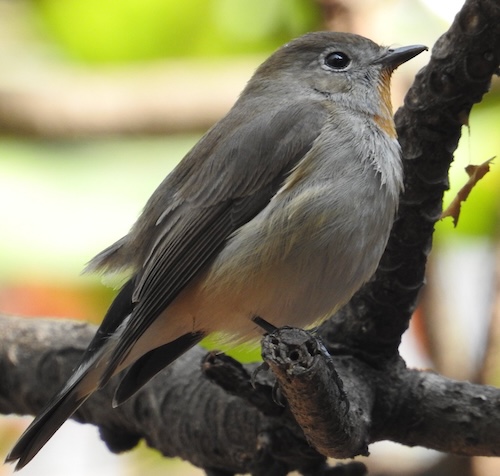
The Altai Republic is located in south central Russia in the southwest of Siberia being one of Russia’s most attractive birding places. It covers 92,600 km2 making it just a small part of the gigantic Siberian landmass which covers no less than 13,100,000 km2!
As well as Siberia, it also borders Mongolia to the southeast, China to the south and Kazakhstan to the southwest. The Republic is likely populated with only around 210,000 people. So, there is a great deal of open countryside. The Republic is likely populated with only around 210,000 people.
The highest peak in the Altai Mountains is Mount Belukha with 4506m. The republic is covered with Siberian Taiga, steppe zones and semi-deserts and 25% of the land is forested. More than 20,000 tributaries sprawl throughout the mountains, making for a total of more than 60,000 kilometres of waterways. The largest rivers are the Katun and the Baia, both of which originate in the mountains and flow northwards. The two rivers eventually form the Ob River, one of Siberia’s longest, which flows northward into the Arctic Ocean.
The source of the Black Biya River is Lake Teletskoye, the region’s largest lake, located in an isolated area far south of the mountains. The Katun has its source in the Gebler Glacier, situated on Mount Belukha. There are more than 7,000 lakes in the area, making for a total area of over 700 square kilometres. Many of the lakes are very deep, some over 1,000 feet.

Shavlo Lake in Northern Chuysky Range – ©Николай Соколов CC BY-SA 4.0 via Wikimedia Commons
Having a temperate continental climate with relatively short (June-August) and hot summers and long (November-March) and cold winters.
Birding Altai
The best time to plan your birding visit is end of May or during the entire month of June. Starting in Barnaul or Novosibirsk. As the Altai republic has no major airport you are need to start in one of the larger cities north of Altai, such as Barnaul or Novosibirsk. This is absolutely no bad thing as you can stray into the rich south Siberian farmlands holding yet another set of interesting species to the WP birder. In the surroundings of Barnaul, which is the closest of the two cities to Altai, you may find several interesting habitats near the Ob River. Wetlands, marshes and birch forests are located in the vicinity of this mighty river. Good species are Spotted Eagle, Sykes’s Wagtail, White-backed Woodpecker, Lanceolated Warbler, Pallas’s Grasshopper Warbler, Red-footed Falcon and White-tailed Eagles.
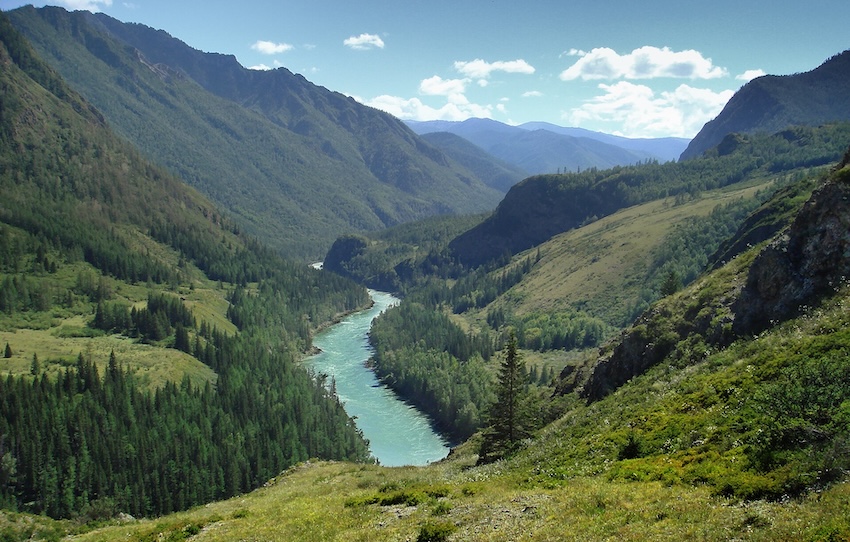
Katunn River – ©Ondřej Žváček CC BY-SA 3.0 via Wikimedia Commons
Birding the Taiga Two large rivers, the Katun and Biya, flow through this beautiful land. Originating in the mountains the junction of the two rivers eventually forms the Ob River, one of Siberia’s largest rivers. Holding both western and eastern Palearctic species a trip into this region can be very fruitful in the right period of time. Several Siberian gems, such as Siberian Rubythroat, Pallas’s Grasshopper Warbler and Yellow-breasted Bunting occur widely and are not difficult to find. Birding the taiga forests is a must do for every serious birder one time in their life. A true heaven with Thrushes, Flycatchers and many Warbler species. Black-throated Thrush is not rare and their loud call gives them away rather fast. White’s Thrush is a difficult to see species, a true skulker, but present by its call, a mechanical second-long whistle with pauses of 5-10 seconds. A long list of Flycatchers and Warblers are found in Siberian taiga forests: Spotted-, Taiga- and Dark-sided Flycatcher, White-browed-, Hume’s, Greenish-, Dusky- and Radde’s Warbler. The last two warblers being definitely the hardest to locate as they are situated on their most western range occurring more commonly to the east (Baikal and further). The forests hold more species such as, Crested Honey Buzzard, Ural Owl, Oriental Cuckoo, Pintail Snipe, Olive-backed Pipit, Brown Shrike, Red-flanked Bluetail, Eversmann’s Redstart, Siberian Tit, Black-throated Accentor and Pine Bunting! Almost all species mentioned earlier can be found around the Seminsk pass where there is a convenient hotel. Roads are good and hostels or guesthouses are available. Don’t expect too much from the accommodations as most places offer double-bedded rooms with shared facilities.
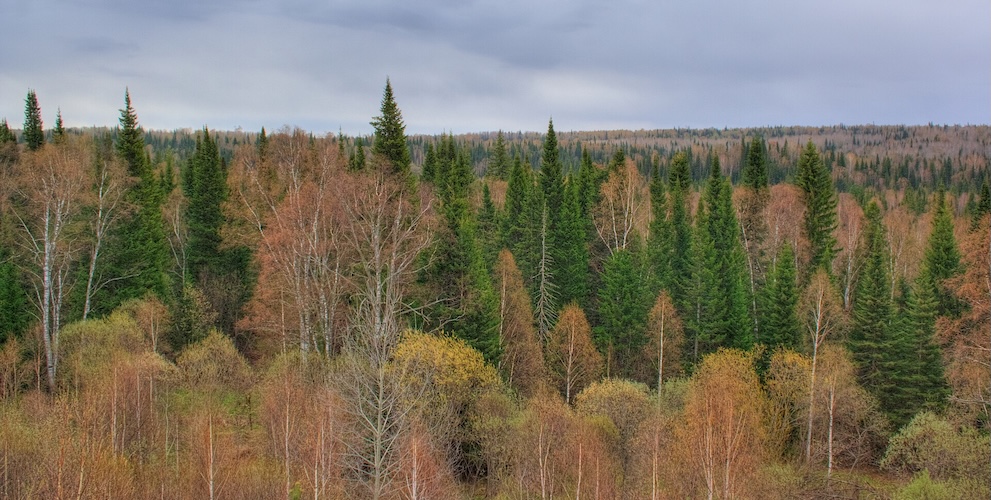
Taiga in Zalesovskiy area – ©Игоревич CC BY-SA 3.0 via Wikimedia Commons
Altai Mountains The high mountain zones are difficult to access and a good car with four-wheel drive capacities is definitely needed. These extra efforts could be rewarded with Altai Snowcock, Pallas’s Rosefinch and Altai Accentor. The illustrious ‘Altai Falcon’, closely related to both Saker and Gyr Falcon (Fox and Patapov 2001; Eastham and Nicholls 2002; ERWD 2006), occurs but like with all large Falcons their numbers are low. As well as good birding, the views are simple stunning – the slopes have not been affected by the large forestry industry giving the Altai a very green appearance when looking from the top of a mountain peak.
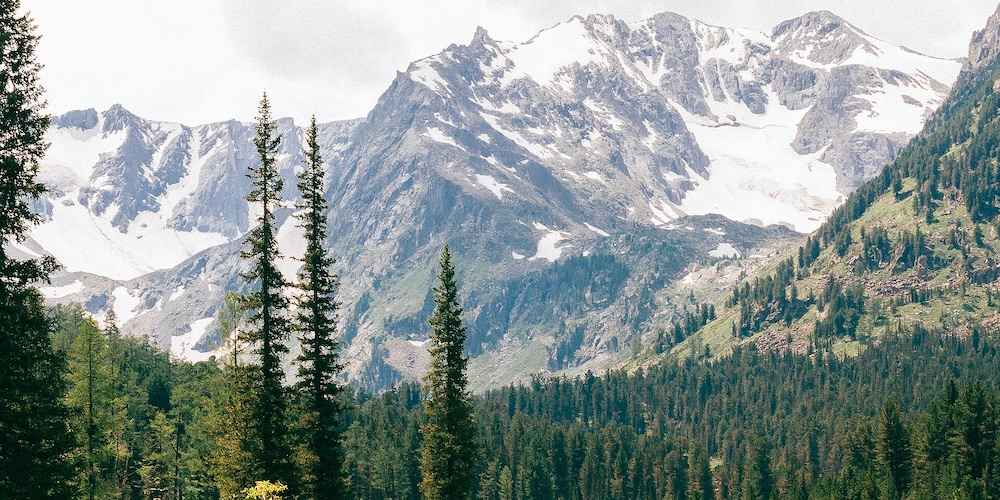
Mountains in Altai – ©Alex Kotomanov CC0, via Wikimedia Commons
The Steppe and Semi-deserts The steppe and semi-desert zones in the south bordering Mongolia hold yet another range of mouth-watering species. Upland Buzzard, Steppe Eagle, Eastern Imperial Eagle, Lesser Kestrel, Heuglin’s Gull, Demoiselle Crane, Pied Wheatear, Bar-headed Goose, Fork-tailed Swift, Azure Tit and the hard-to-find Père David’s Snowfinch are all present. You need a special border permit to be birding south of Kosh Agash. Not many people have birded the region, which is quite surprising considering the good connections with Moscow and the number of highly desirable species that can be seen in a short period of time.
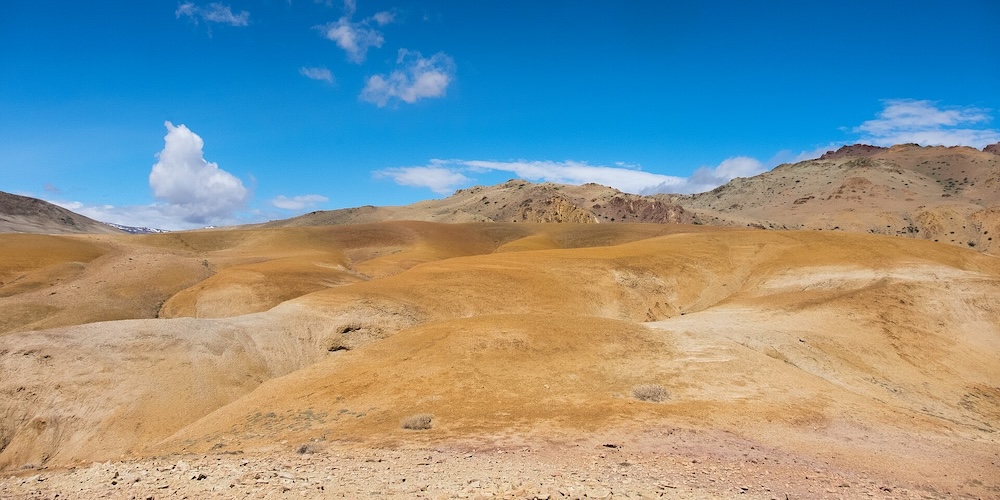
Altain Semi-desert – ©Alexandr frolov CC BY-SA 4.0 <]via Wikimedia Commons
When visiting the area, it is advised to hook up with a local birdtour operator as they know the best spots and otherwise you have a good chance spending many hours in registration offices, fighting with Russian speaking officials, to receive the right papers and stamps. As you need to register yourself in every large place during your visit and that takes some organisational skills.
-
Altaisky Reserve
InformationSatellite ViewAltai Nature Reserve (Russian: Алтайский заповедник, also called Altajskij Zapovednik) is a Russian 'zapovednik' (sanctuary, strict nature reserve) in the Altai Mountains of south Siberia, Russia. -
Chumysh Rivermouth
InformationSatellite ViewThis area consists of flat forest-steppe; typical of the countryside of the Altai region. It’s a unique wetland with floodplain willow forests and sedge marshes. A lot of waterfowl and waterloving birds have nest sites on the wetlands, but the most interesting time for breeding birds here is April and the first half of May. At this time river channels and flood reservoirs give places to rest during migration and many Geese, Ducks and other birds take advantage of it. Here you can find big groups of Great Crested Grebe, Great White Heron, Bean Goose and Whooper Swans. It is also noteworthy that a lot of waterfowl species spend winter in this territory. -
Katunsky Reserve
InformationSatellite ViewKatun Nature Reserve (Russian: Катунский заповедник) (also Katunsky) is a Russian zapovednik (strict nature reserve) located in the highlands of the central Altai Mountains of south Siberia.
-
Machiel Valkenburg
Almaty Oblast. Kazakhstan | machiel@centralasiabirding.com
Website
-
Number of bird species: 392
(As at June 2026)
-
Avibase
PDF ChecklistThis checklist includes all bird species found in Altay, Republic of , based on the best information available at this time. It is based on a wide variety of sources that I collated over many years. I am pleased to offer these checklists as a service to birdwatchers. If you find any error, please do not hesitate to report them. -
eBird
Illustrated ChecklistIllustrated Checklist
-
NR Altaisky Reserve
InformationSatellite ViewThere are over 70 species of mammals in the reserve, including two endangered species, the Snow Leopard and the Altai argali. There are 19 species of fish, mostly in Lake Teletskoye, including pike, perch, and whitefish. In the streams the most common fish is the grayling. Of the 331 species of birds found in the reserve, most (48%) are passerine (159 species), waders (48 species), Falconiformes (30 species), and geese (29 species). The remaining 66 species account for only 20%. -
NR Katun
InformationSatellite ViewThe reserve is located in the highlands of the central Altai Mountains of south Siberia. The Katun River runs down through a valley in the reserve, serving as the primary source of the Ob River. The headwaters of the Katun River originate on Mount Belukha, the highest mountain in Siberia at 4,506 metres (14,783 ft), which is located on the far eastern edge of the preserve. Katun is an internationally important center of biodiversity, forming part of the "Golden Mountains of Altai" UNESCO World Heritage Site supporting around 140 species of birds.
-
eBird
SightingseBirding This Month
-
Ecological Travel Center
Local Tour OperatorThe Altai Mountain is a beautiful part of wildlife on the Earth. If you are interested in birds and Altai Mountain you may join to Bird Watching trip 'Listening to the sky'. The route passes through the alpine Ukok Plato and Teletskoe Lake. During the trip we may observe about 120 species of birds. Here you will be able to meet such rare species as Imperial Eagle, Sacer Falkon, Demoiselle Crane, Whooper Swan, endemic species Altai Snowcock, Brandt -
Rubythroat Birding Tours
Local Tour OperatorRubythroat Birding Tours is a fully specialised all-inclusive tour company with ventures throughout Central Asia and Russia
-
2016 [07 July] - Machiel Valkenburg - Russia & Mongolia
PDF ReportIn these meadows, on earlier trips, we had found the endangered Yellow-breasted Bunting but unfortunately this bird has disappeared from this spot; the species has declined all over Siberia. We did however come across our only Common Kingfisher along the meandering river, singing Blyth’s Reed Warblers, several Pine Buntings and a stunning Black Stork flew over.