

Philepittidae – Asities
The Philepittidae or asities and sunbird-asities are a family of birds that are endemic to Madagascar. They consist of four species in two genera. The Neodrepanis species are known as sunbird-asities and were formerly known as false sunbirds. They were formerly included with the broadbills.
Some authors have previously placed the Sapayoa of South America in this family, or with the Broadbills, although it is now considered by many to be in its own family, the Sapayoidae. The unified world list places the Philepittidae in linear sequence before the two broadbill families Eurylaomidae (Typical Broadbills) & Calytomenidae (Green & African Broadbills), the Sapayoidae (Sapoyoa) and Pittidae (Pittas); broadly grouped with those four families.
Asities are small forest birds with sexually dichromic plumage and brightly coloured wattles around the eyes of the males. These wattles, which are most conspicuous during the breeding season, get their colour from arrays of collagen fibres. This method of pigmentation is unique in the animal kingdom.
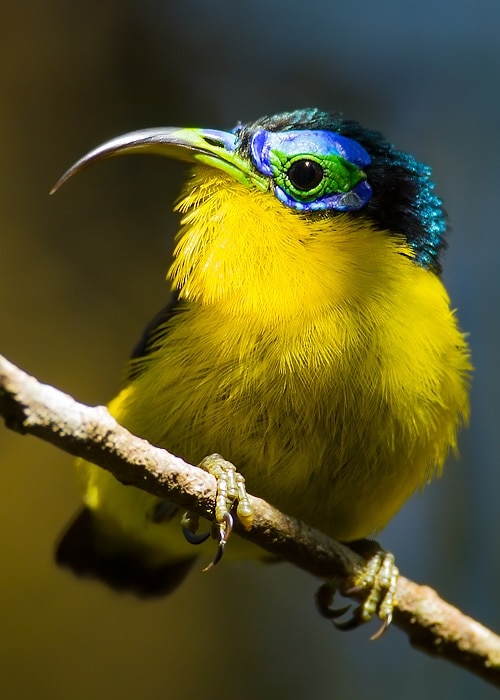
Yellow-bellied Sunbird-Asity Neodrepanis hypoxantha – ©Dubi Shapiro
Several other features separate them from the broadbills, they possess twelve tail feathers on extremely short (almost non-existent in the Philepitta species) tails, their syrinx is encased with a large bronchial ring and they have forked tongues adapted to nectivory. They have a long outer primary which buzzes in flight, possibly used in signalling during courtship. The two genera are quite distinct.
The major component of the diet of asities is fruit. A wide range of different fruit is taken by the family, and they are among the most important avian dispersers of seeds, as there are very few other frugivorous birds in the forests of Madagascar. They will also take insects. The Neodrepanis sunbird-asities will sometimes take nectar, but do so with a long tongue rather than inserting their curved bills far into flowers.
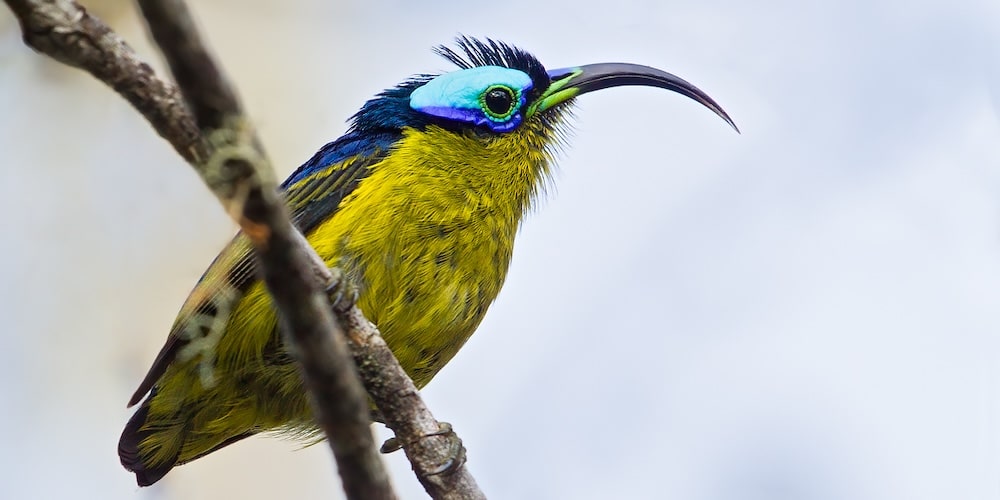
Common Sunbird-Asity Neodrepanis coruscans – ©Dubi Shapiro
Rainforest asities breed during the Malagasy rainy season, beginning just before the rains in September to November. The Velvet Asity begins breeding slightly sooner in the north of its range. That species is the only one for which detailed information about breeding is available. It has a polygynous breeding system, with males holding small territories or leks where they display to passing females.
Nest building and raising the incubating the eggs and young is done solely by the females. There are reports of yellow-bellied sunbird-asities feeding young in the nest and recently fledged chicks, so there is clearly some variation in breeding strategies in the family. The nests of the family are elaborate; pear-shaped woven structures hanging from branches, similar to those of broadbills, although, uniquely amongst birds which weave nests, the entrance to the nest is created by pushing through the wall after constructed (instead of the usual scenario where the entrance is weaved into the fabric of the nest).
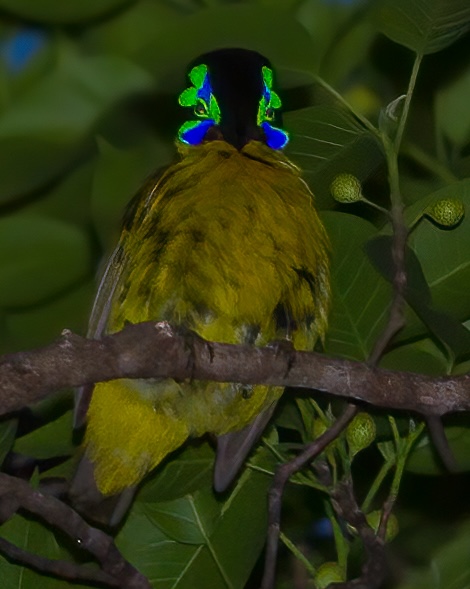
Schlegel’s Asity Philepitta schlegeli – ©Dubi Shapiro
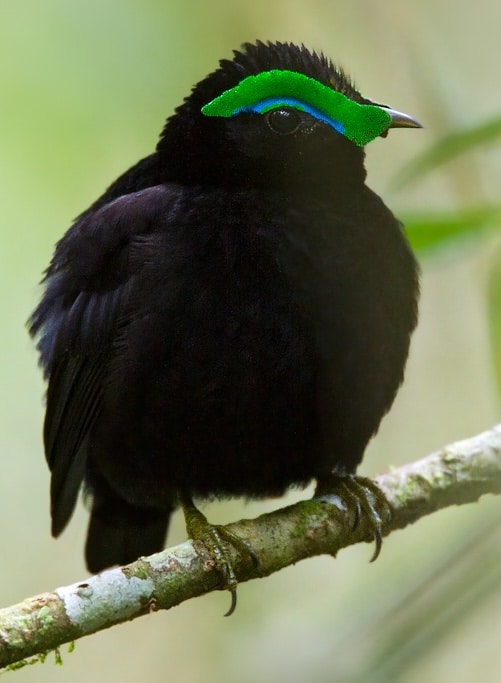
The Velvet Asity Philepitta castanea, lives in the subtropical or tropical, moist, lowland forest. Ther males have yellow tips to their feathers when newly molted, but these wear off, leaving the bird’s plumage all black; at the same time, a green wattle grows above the eye. The female is greenish and mottled without a wattle. They tend to be sedentary and mostly eat berries and other fruit in the undergrowth. They build their hanging nests with a little roof over the entrance.
From the other genera, the Yellow-bellied Sunbird-Asity Neodrepanis hypoxantha, is small and very brightly coloured with black upper parts in the male with an iridescent bluish sheen and yellow underparts, and is sometimes known simply as the Yellow-bellied Asity. The eye is surrounded by a bright blue wattle which derives its colour, like the rest of the asities, from collagen bundles. The bill is long and decurved, as it is adapted for nectar feeding. The female is much duller.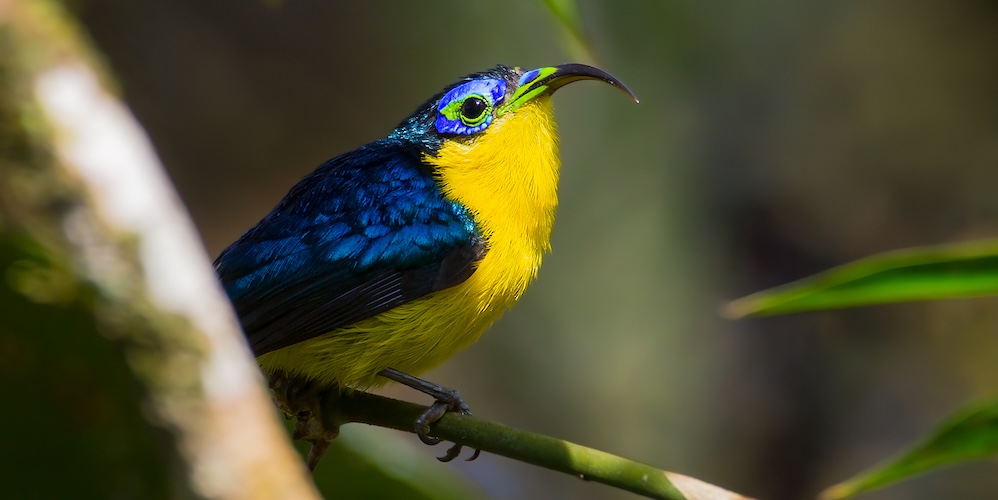
Yellow-bellied Sunbird-Asity Neodrepanis hypoxantha – ©Dubi Shapiro
It is found only in montane rainforests above 1600 metres where it feeds on nectar that it sips from flowers, defending a good nectar source from other nectar-feeding birds. It is listed by the International Union for Conservation of Nature as vulnerable due to the diminution and fragmentation of its forest habitat.
-
Number of bird species: 4
(As at July 2025)
Velvet Asity Philepitta castanea
Schlegel’s Asity Philepitta schlegeli
Common Sunbird-Asity Neodrepanis coruscans
Yellow-bellied Sunbird-Asity Neodrepanis hypoxantha
-
Asity
Family AccountThe asities are a family of birds, Philepittidae, that are endemic to Madagascar.
-
Common Sunbird-Asity Neodrepanis coruscans
Conservation Status -
Common Sunbird-Asity Neodrepanis coruscans
Species AccountThe common sunbird-asity or sunbird asity (Neodrepanis coruscans) is a species of bird in the family Philepittidae. It is endemic to Madagascar. Its natural habitat is subtropical or tropical moist lowland forests. -
Common Sunbird-Asity Neodrepanis coruscans
Species AccountSound archive and distribution map etc. -
Schlegel's Asity Philepitta schlegeli
Species AccountChunky, olive-backed bird. Males have a black head, multi-colored bare facial skin, and yellow underparts. Females have pale underparts with scaly markings. -
Schlegel's Asity Philepitta schlegeli
Species AccountSchlegel's asity (Philepitta schlegeli) is a species of bird in the family Philepittidae. It is endemic to Madagascar. -
Schlegel's Asity Philepitta schlegeli
Species AccountSound archive and distribution map etc. -
Velvet Asity Philepitta castanea
Species AccountDark, dumpy bird of the rainforest understory. Males are all black with green bare skin on the head in breeding plumage and black with yellow scaling in non-breeding plumage. -
Velvet Asity Philepitta castanea
Species AccountThe velvet asity (Philepitta castanea) is a species of bird in the family Philepittidae. It is endemic to Madagascar. -
Velvet Asity Philepitta castanea
Species AccountSound archive and distribution map etc. -
Yellow-bellied Sunbird-Asity Neodrepanis hypoxantha
Species AccountTiny, round, short-tailed yellow-bellied bird with a thin curved bill. Males are blue on the back and have bright bare skin around the eye in breeding plumage. -
Yellow-bellied Sunbird-Asity Neodrepanis hypoxantha
Species AccountThe yellow-bellied sunbird-asity (Neodrepanis hypoxantha) is a small species of passerine bird from the asity family. -
Yellow-bellied Sunbird-Asity Neodrepanis hypoxantha
Distribution and CallsSound archive and distribution map etc.
-
Wikipedia
https://en.wikipedia.org/wiki/Asity