

Calyptomenidae – African & Green Broadbills
Calyptomenidae is a family of passerine birds found in Africa, the Malay Peninsula and Borneo. There are just six species in two genera. This family were formerly included in the broadbill family Eurylaimidae. A molecular phylogenetic study published (2006) found that the species in these two genera were, in fact, not closely related to the other broadbills. So, they are now placed in this separate family.
An example of one genus, is the Green Broadbill Calyptomena viridis, which is found in the broadleaved, evergreen forests of Borneo, Sumatra, and the Malay Peninsula where it frequents lowland rainforest and the wooded slopes of higher ground. The sexes do not differ greatly, and each have mostly brilliant green feathers with a black ear patch, gaping bill, short tail and has three black wing-bars. Overall, they are c.17 cm (6.5 inches) long. Their beaks are rather short below a prominent crest. The female is somewhat duller and has lacks the black markings on its ear patch and wing coverts. They are often overlooked as the green plumage matches foliage and because they sit motionless inside the canopy and quickly fly to new locations if disturbed.
They feed largely on ripe figs and consequently help to distribute the seeds around the forest. The female lays between two or three whitish eggs, and the young fledge in around three weeks. Although it is still common in many parts of its large range, it is considered near threatened because it is so sensitive to habitat loss and degradation, causing population decline throughout its range.
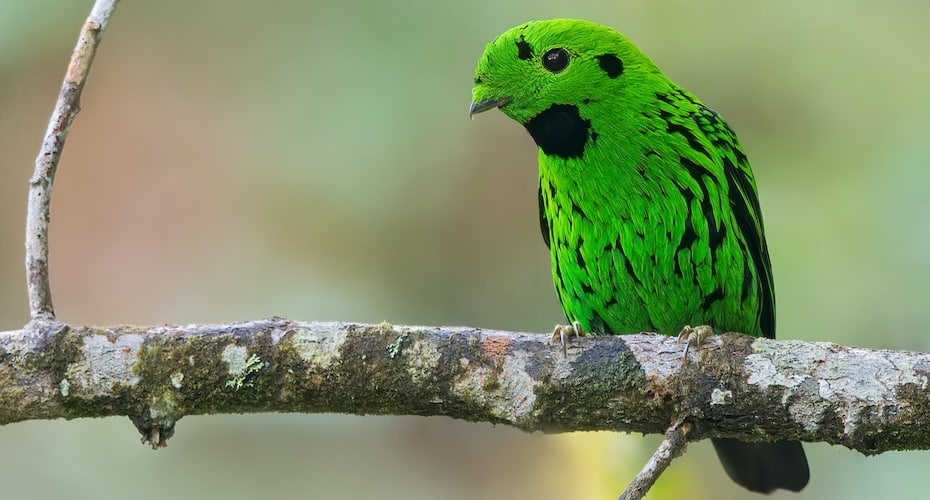
Whitehead’s Broadbill Calyptomena whiteheadi – ©Dubi Shapiro
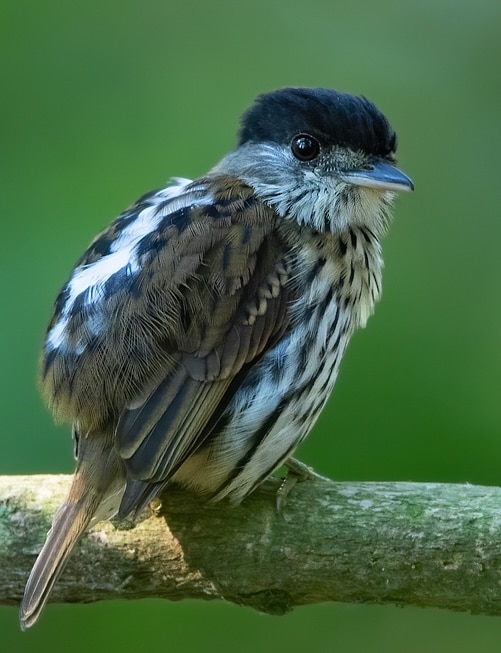
The other genus includes the African Broadbill Smithornis capensis, also known as the Black-capped or sometimes Delacour’s Broadbill. It is a small, broad-billed, boldly streaked, largely brown, stocky flycatcher-like bird. They have dark crowns which are black, although grey in the females of one subspecies. Its upperparts are mainly olive-brown with black streaks, the bases of the feathers on the lower back and rump are white, hidden when the bird is at rest. Underparts are creamy-white with black streaks on the flanks and breast. Like the other genus, they are found in forested areas and are shy and inconspicuous except when displaying.
Both sexes perform a display flight, closely circling around a perch while rapidly fluttering their wings, and puffing out the back and rump feathers to show the white feathers while giving their call, which is said to sound like a car horn. It is loud, vibrating ‘Prrrrup’ produced during a display flight, sometimes preceded by softer more plaintive ‘tui-tui-tui’ calls, which are also sometimes made without the car horn call. Unusually, the call of the African Broadbill, like other birds in the genus, is produced by the vibration of its wings during flight, coming from the sixth and seventh primary feathers.
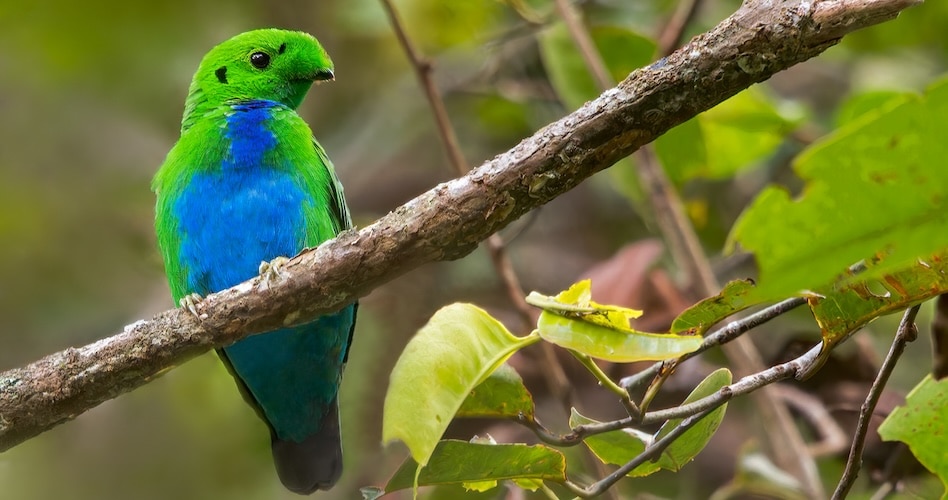
Hose’s Broadbill Calyptomena hosii – ©Dubi Shapiro
Their nests are oval with a side entrance and are built (by both sexes) from bark, dry leaves, twigs, grass and rootlets, often held together by strands of spider web. It is suspended conspicuously from a low branch of a tree, usually between one and a half and three metres above the ground. The one to three eggs are usually laid between October and January, depending on location and incubated solely by the female, fledging in around 17 days. The males guard the nest, signalling danger with a high-pitched call. The development and care of the young is little known but the male is the main provider.
The African broadbill is native to Africa, especially the southeastern part of the continent. There are two separate allopatric distributions, one rather disjunct distribution in coastal West Africa from Sierra Leone in the west eastwards to the Central African Republic and south to Gabon and the northern Congo. The main distribution covers southern and eastern Africa from Kenya south to KwaZulu Natal. They prefer lowland forest, dense deciduous thickets or other dense woodland, including riverine gallery forest, making them difficult to see. They too often remain motionless for long periods, perching upright on a low horizontal branch and calling infrequently. They feed exclusively on invertebrates for which it forages on the ground, in the trees and occasionally hawking them in flight. Beetles, grasshoppers, wasps, caterpillars and spiders have all been recorded as food items
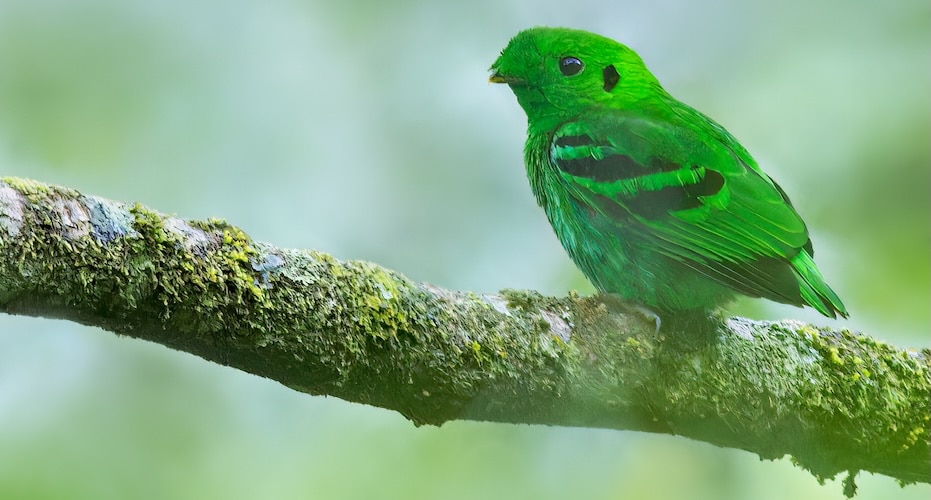
Green Broadbill Calyptomena viridis – ©Dubi Shapiro
They have a broad range and are common in several regions. In southern Africa, they have scattered distribution because of habitat fragmentation in the area. In general, they are considered to be a least-concern species, but are locally vulnerable due to habitat loss.
-
Number of bird species: 6
(As at July 2025)
There are just six species of Green and African Broadbills in the family Calyptomenidae. They are:
Green Broadbill Calyptomena viridis
Hose’s Broadbill Calyptomena hosii
Whitehead’s Broadbill Calyptomena whiteheadi
African Broadbill Smithornis capensis
Grey-headed Broadbill Smithornis sharpie
Rufous-sided Broadbill Smithornis rufolateralis
-
Calyptomenidae
InformationCalyptomenidae is a family of passerine birds found in Africa, the Malay Peninsula and Borneo. -
Calyptomenidae - African and Green Broadbills
InformationThese mid-sized passerines, united by their large heads, short legs, small feet, and eponymous broad bills, are of two distinct types.
-
African Broadbill Smithornis capensis
Species AccountThe African broadbill (Smithornis capensis), also known as the black-capped broadbill or Delacour's broadbill, is a species of bird in the sub-oscine family... -
African Broadbill Smithornis capensis
Species AccountSound archive & distribution map etc. -
African Broadbill Smithornis capensis
Species AccountThe African broadbill (Smithornis capensis), also known as the black-capped broadbill or Delacour's broadbill, is a species of bird in the sub-oscine family... -
Green Broadbill Calyptomena viridis
Species AccountLuminous green bird with an oddly umbrella-like head shape, found in lowland forests. Male has black wingbars and a dark “comma” behind the eye. -
Green Broadbill Calyptomena viridis
Species AccountThe green broadbill (Calyptomena viridis) also known as the lesser green broadbill is a small bird in the family Calyptomenidae. -
Green Broadbill Calyptomena viridis
Species AccountSound archive & distribution map etc. -
Grey-headed Broadbill Smithornis sharpie
Species AccountGrey-headed Broadbill Smithornis sharpei Call is a thin high-pitched whistle “heeeuuw”; the species also displays with a bizarre mechanical rattle... -
Grey-headed Broadbill Smithornis sharpie
Species AccountThe grey-headed broadbill (Smithornis sharpei) is a species of bird in the family Calyptomenidae. It is found in Cameroon, Central African Republic... -
Grey-headed Broadbill Smithornis sharpie
Species AccountSound archive & distribution map etc. -
Hose’s Broadbill Calyptomena hosii
Species AccountSound archive & distribution map etc. -
Hose’s Broadbill Calyptomena hosii
Species AccountHose's Broadbill Calyptomena hosii Uncommon and elusive green broadbill. Both sexes distinguished from other Bornean green broadbills by blue wash on belly... -
Hose’s Broadbill Calyptomena hosii
Species AccountHose's broadbill (Calyptomena hosii) is a species of bird in the family Calyptomenidae. -
Rufous-sided Broadbill Smithornis rufolateralis
Species AccountA small broadbill of lowland wet forests, often found near water in thick vines and tangles -
Rufous-sided Broadbill Smithornis rufolateralis
Species AccountIt is sparsely distributed throughout the intra-tropical rainforest of Sub-Saharan Africa. -
Rufous-sided Broadbill Smithornis rufolateralis
Species AccountSound archive & distribution map etc. -
Whitehead’s Broadbill Calyptomena whiteheadi
Species AccountHose's broadbill (Calyptomena hosii) is a species of bird in the family Calyptomenidae. Magnificent emerald-green giant of a broadbill, with distinctive black mottling and streaking. Males have black streaking on the underparts which females lack. -
Whitehead’s Broadbill Calyptomena whiteheadi
Species AccountWhitehead's broadbill (Calyptomena whiteheadi) is a species of bird in the family Calyptomenidae. It is endemic to the mountain ranges of north-central Borneo... -
Whitehead’s Broadbill Calyptomena whiteheadi
Species AccountSound archive & distribution map etc.