
| Outsider Animals: How the Creatures at the Margins of Our Lives Have the Most to Teach Us | By Marlene Zuk | PUP | 2026 | Hardback | 312 Pages | ISBN: 9780691264240 |
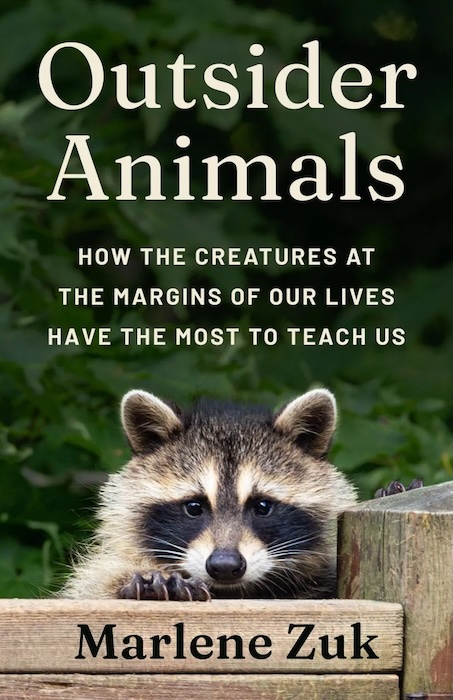
The Publisher’s View:
When we think of animals that provide the greatest insights into animal cognition and behavior, primates and honeybees come to mind, or perhaps whales or octopus. What about the raccoons that plunder our rubbish at night, or the coyotes that threaten pets and livestock, or the gulls that divebomb for snacks at the beach? Outsider Animals challenges everything you thought you knew about the overlooked animals that live in proximity to humans, sharing the stories that each has to tell about adaptation and cohabitation on our increasingly crowded planet.
Marlene Zuk gives us a new appreciation for the animals we often shun, explaining why these unpopular creatures have something special to teach us not only about the ways we deal with other species but about our own place in nature and what it means for an animal to belong somewhere. You will discover how coyotes and snakes shed light on our coevolution with predators, what cockroaches tell us about the evolution of pregnancy, how butterflies make us reconsider the effects of roadside pollution, how cowbirds and mynas are forcing ecologists to think differently about invasive species, and much moreWriting with an infectious blend of humor and curiosity, Zuk invites us to reflect on our relationships with these close-to-home creatures and the ways our lives encroach on theirs, and to draw lessons from their behavior in all its fascinating complexity.
The Author:
Marlene Zuk is an American evolutionary biologist and behavioral ecologist. She worked as professor of biology at the University of California, Riverside until she transferred to the University of Minnesota in 2012. Her studies involve sexual selection and parasites. Her noted ‘claim to fame’ is that, with W D Hamilton, she proposed the ‘good genes’ hypothesis of sexual selection (1982). Her books include Dancing Cockatoos and the Dead Man Test: How Behavior Evolves and Why It Matters and Paleofantasy: What Evolution Really Tells Us About Sex, Diet, and How We Live.
Other Views:
“A delightful, eye-opening exploration of the talents and skills of animals that live close to us – animals we often refuse to accept. Zuk engages with each species on its own terms, peeling away human interpretations to show their true natures, talents, and adaptations. Her clear-eyed, joyful scientific curiosity will leave you captivated by cowbirds and charmed by cockroaches. An engaging and heartening read that will make you smile even as you store away another science fact to share.” Bethany Brookshire, author of Pests: How Humans Create Animal Villains
“Raccoons and cowbirds and gulls, oh my! Marlene Zuk has written a fascinating book about the creatures we know all too well but haven’t welcomed into our lives. And yet, she convinces us, maybe we should.” Jonathan B. Losos, author of The Age of Cats: How Cats Evolved from the Savanna to Your Sofa
“This is a truly compelling book, rich with scientific expertise and humor. Marlene Zuk shows how the animals we tend to overlook have remarkable stories to tell, inviting us to rethink nature and our place in it. You’ll never see these creatures the same way again.” Isabella Rossellini, actress and author of Green Porno and My Chickens and I
“Marlene Zuk’s smart, clever, and charmingly written Outsider Animals shows how widely unpopular creatures offer special lessons about our attitudes toward other species more generally. She does this through essays on some of the most widely detested species on Earth, in ways that are caring yet critical, devoid of excessive sentimentalism, and backed up by an impressive knowledge of science and the humanities.” Harry W. Greene, author of Tracks and Shadows: Field Biology as Art
Fatbirder View:
Since we installed a camera feeder in the garden, we discovered several birds that we didn’t realise came to the feeders. A couple of Jackdaws were welcome and a new garden tick, less welcome, was one of our neighbourhood Herring Gulls. Living by the sea as we do, Herring Gulls are an inevitable frequent companion, and we most often are aware of their presence by the deposits they leave on our car, or how they manage to ravage the neighbourhood’s bin when it’s put out for collection. In the case of our new visitor, camera captured action was fascinating to watch as they seemed to swallow suet pellets faster than the speed of light.
We’re not generally prejudiced against any bird or any animal come to that. The voracious appetite of the gulls would not only cost us a fortune, but, more importantly, prevent other birds from getting a look-in. Fortunately for us, Hawkeye, my better half, had read the study at one of the UK universities about how to deter gulls, and she used the same method she uses on the neighbourhood cats. She stared out the gull.
Indeed, this very morning, on the gull’s second visit, she stood in the garden and stared it out until it disappeared behind our chimney. Knowing its tricks, she waited until it peeped around again and caught sight of her stare and thought discretion would be the better part of valour and flew off.
I share this tale just to show that we are susceptible to some of the prejudices against animals that are frequently in contact with human beings and is generally eschewed. So well understood the approach that Marlene Zuk has taken. Bringing to the reader tales of some of these shunned animals and highlighting just how clever and indeed fascinating they often are. As an overseas visitor, I never put raccoons in that category, although a wildlife ranger I’m acquainted with tells me that they are the main vector for rabies in the US.
I did share some concern in Australasia about the invasive nature of the common miner there and particularly in New Zealand where environmental niches are few and often local species are outcompeted by incomers.
I also once in the countryside came across what is called, I believe, a rat castle, the equivalent of a warren teeming with these super clever rodents. Even though I was bitten by one as a youth, I can’t help but admire just how cleverly they exploit so much of what man has put in the way of other creatures.
The author not only is persuasive, but her light and humorous style, completely laden with scientific fact, is a joy to read. Moreover, although they are few, the illustrations supplied by David J. Tuss are really charming.
One of the many reasons I thoroughly recommend this book, and I guarantee once you start reading one of the sections, you won’t take a break until you’ve finished it.
Fatbirder