

Apodidae – Swifts

The Apodidae, or swifts, form a family of highly aerial birds. Swifts are placed in the order Apodiformes along with the Hemiprocnidae, (Treeswifts) and Trochilidae (Hummingbirds). They are superficially similar to swallows, but are not closely related to any passerine species. Resemblances between swifts and swallows are due to convergent evolution, reflecting similar life styles based on catching insects in flight.
The family name, Apodidae, is derived from the Greek ἄπους (ápous), meaning ‘footless’, a reference to the small, weak legs of these most aerial of birds. The tradition of depicting swifts without feet continued into the Middle Ages, as seen in the heraldic martlet.
Taxonomists have long classified swifts and treeswifts as relatives of the hummingbirds, a judgment corroborated by the discovery of the Jungornithidae (apparently swift-like hummingbird-relatives) and of primitive hummingbirds such as Eurotrochilus. Traditional taxonomies place the hummingbird family (Trochilidae) in the same order as the swifts and treeswifts (and no other birds); the Sibley-Ahlquist taxonomy treated this group as a superorder in which the swift order was called Trochiliformes.
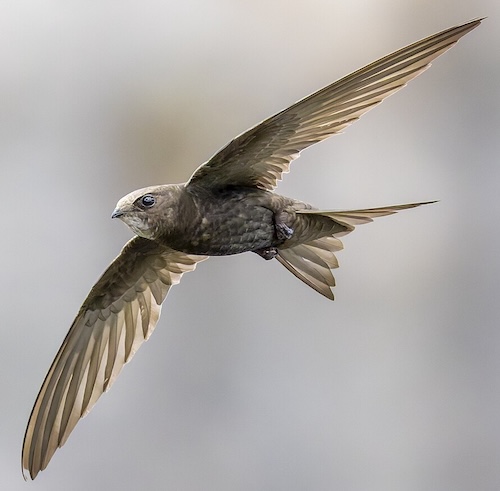
Common Swift Apus apus – ©Alexis Lours CC BY 4.0 via Wikimedia Commons
The taxonomy of the swifts is complicated, with genus and species boundaries widely disputed, especially amongst the swiftlets. Analysis of behaviour and vocalisations is complicated by common parallel evolution, while analyses of different morphological traits and of various DNA sequences have yielded equivocal and partly contradictory results. The list on this page is from the combine AvbiList (2025), which recognises fewer species (105) than the previous IOC list (113), but calls for more research, especially of swiftlets.
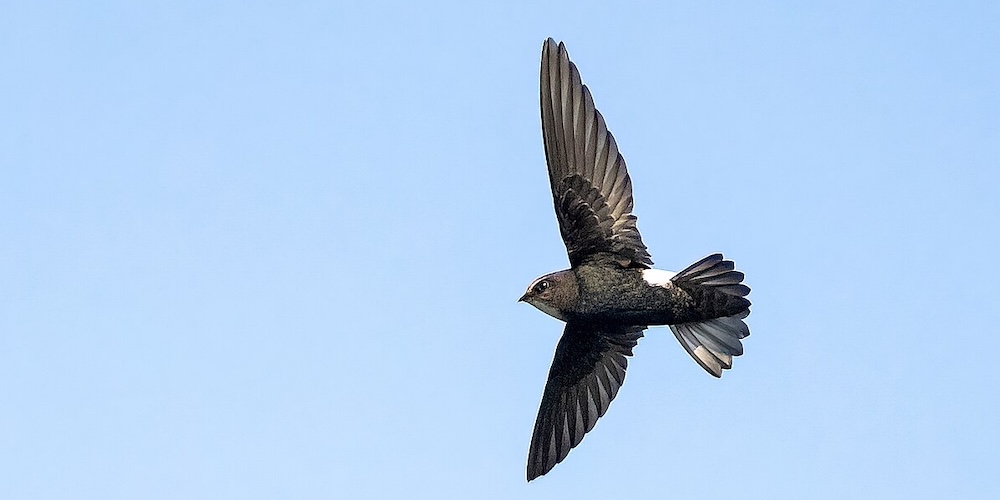
House Swift Apus nipalensis – ©Prasan Shrestha CC BY-SA 4.0 via Wikimedia Commons
The Apodiformes diversified during the Eocene, at the end of which the extant families were present; fossil genera are known from all over temperate Europe, between today’s Denmark and France, such as the primitive swift-like Scaniacypselus (Early–Middle Eocene) and the more modern Procypseloides (Late Eocene/Early Oligocene – Early Miocene). A prehistoric genus sometimes assigned to the swifts, Primapus (Early Eocene of England), might also be a more distant ancestor.
Swifts are among the fastest of birds in level flight, and larger species like the white-throated needletail have been reported travelling at up to 169 km/h (105 mph). Even the common swift can cruise at a maximum speed of 31 metres per second (112 km/h; 70 mph). In a single year the common swift can cover at least 200,000 km, and in a lifetime, about two million kilometres.
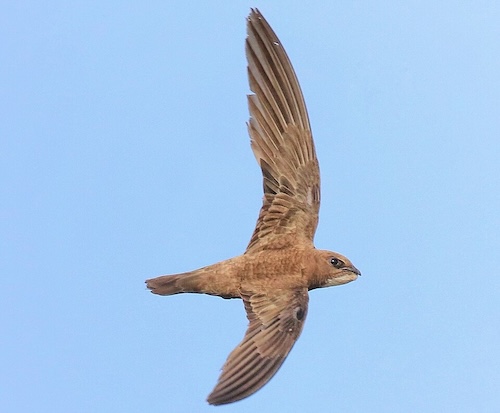
Alpine Swift Tachymarptis melba – ©Afsarnayakkan CC BY-SA 4.0 via Wikimedia Commons
The wingtip bones of swiftlets are of proportionately greater length than those of most other birds. Changing the angle between the bones of the wingtips and forelimbs allows swifts to alter the shape and area of their wings to increase their efficiency and manoeuvrability at various speeds. They share with their relatives the hummingbirds a special ability to rotate their wings from the base, allowing the wing to remain rigid and fully extended and derive power on both the upstroke and downstroke. The downstroke produces both lift and thrust, while the upstroke produces a negative thrust (drag) that is 60% of the thrust generated during the downstrokes, but simultaneously it contributes lift that is also 60% of what is produced during the downstroke. This flight arrangement might benefit the bird’s control and manoeuvrability in the air.
The swiftlets or cave swiftlets have developed a form of echolocation for navigating through dark cave systems where they roost. One species, the Three-toed swiftlet, has recently been found to use this navigation at night outside its cave roost too.
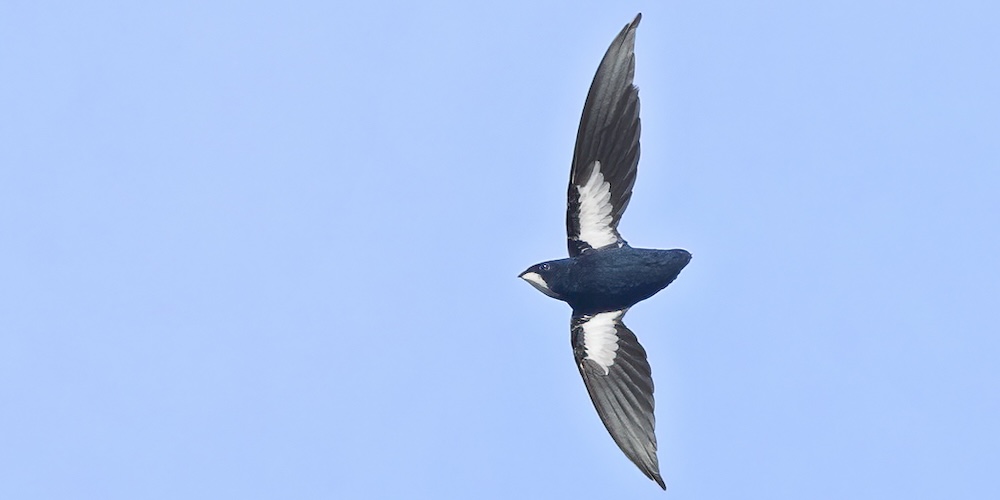
Philippine Spine-tailed Swift Mearnsia picina – ©Dubi Shapiro
Swifts occur on all the continents except Antarctica, but not in the far north, in large deserts, or on many oceanic islands. The swifts of temperate regions are strongly migratory and winter in the tropics. Some species can survive short periods of cold weather by entering torpor, a state similar to hibernation.
Many have a characteristic shape, with a short, forked tail and very long swept-back wings that resemble a crescent or a boomerang. The flight of some species is characterised by a distinctive flicking action quite different from swallows. Swifts range in size from the Pygmy Swiftlet Collocalia troglodytes, which weighs 5.4 g and measures 9 cm (3.5 inches) long, to the Purple Needletail Hirundapus celebensis, which weighs 184 g (6.5 oz) and measures 25 cm (9.8 inches) long.
The nest of many species is glued to a vertical surface with saliva, and the genus Aerodramus use only that substance, which is the basis for bird’s nest soup. Other swifts select holes and small cavities in walls. The eggs hatch after 19 to 23 days, and the young leave the nest after a further six to eight weeks. Both parents assist in raising the young.
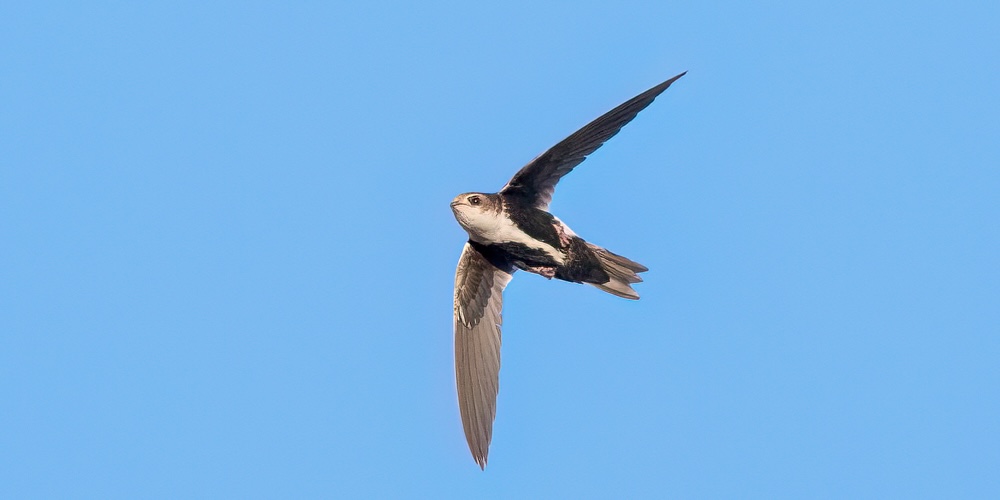
White-throated Swift Aeronautes saxatalis – ©Dubi Shapiro
Swifts as a family have smaller egg clutches and much longer and more variable incubation and fledging times than passerines with similarly sized eggs, resembling tubenoses in these developmental factors. Young birds reach a maximum weight heavier than their parents; they can cope with not being fed for long periods of time, and delay their feather growth when undernourished. Swifts and seabirds have generally secure nest sites, but their food sources are unreliable, whereas passerines are vulnerable in the nest but food is usually plentiful.
All swifts eat insects, such as dragonflies, flies, ants, aphids, wasps and bees as well as aerial spiders. Prey is typically caught in flight using the beak. Some species, like the chimney swift, hunt in mixed species flocks with other aerial insectivores such as members of Hirundinidae (swallows).
No swift species has become extinct since 1600, but BirdLife International has assessed the Guam Swiftlet as endangered and lists the Atiu, Dark-rumped, Seychelles, and Tahiti Swiftlets as vulnerable; twelve other species are near threatened or lack sufficient data for classification.
The hardened saliva nests of the edible-nest swiftlet and the black-nest swiftlet have been used in Chinese cooking for over 400 years, most often as bird’s nest soup. Over-harvesting of this expensive delicacy has led to a decline in the numbers of these swiftlets, especially as the nests are also thought to have health benefits and aphrodisiac properties. Most nests are built during the breeding season by the male swiftlet over a period of 35 days. They take the shape of a shallow cup stuck to the cave wall. The nests are composed of interwoven strands of salivary cement and contain high levels of calcium, iron, potassium, and magnesium.
-
Number of bird species: 105
(As at August 2025)
There are, according to the newly (2025) unified AviList, Apodidae – 105 species of Swifts, Swiftlets, Spinetails, Needletails and Palm-Swifts in nineteen genera. They are:
Chestnut-collared Swift Streptoprocne rutila
Tepui Swift Streptoprocne phelpsi
White-collared Swift Streptoprocne zonaris
White-naped Swift Streptoprocne semicollaris
Biscutate Swift Streptoprocne biscutata
American Black Swift Cypseloides niger
White-chested Swift Cypseloides lemosi
Rothschild’s Swift Cypseloides rothschildi
Sooty Swift Cypseloides fumigatus
White-fronted Swift Cypseloides storeri
White-chinned Swift Cypseloides cryptus
Spot-fronted Swift Cypseloides cherriei
Great Dusky Swift Cypseloides senex
White-throated Needletail Hirundapus caudacutus
Silver-backed Needletail Hirundapus cochinchinensis
Brown-backed Needletail Hirundapus giganteus
Purple Needletail Hirundapus celebensis
Philippine Spine-tailed Swift Mearnsia picina
Papuan Spine-tailed Swift Mearnsia novaeguineae
Sabine’s Spinetail Rhaphidura sabini
Silver-rumped Spinetail Rhaphidura leucopygialis
Cassin’s Spinetail Neafrapus cassini
Böhm’s Spinetail Neafrapus boehmi
Black Spinetail Telacanthura melanopygia
Mottled Spinetail Telacanthura ussheri
Madagascan Spinetail Zoonavena grandidieri
Sao Tome Spinetail Zoonavena thomensis
White-rumped Spinetail Zoonavena sylvatica
Grey-rumped Swift Chaetura cinereiventris
Band-rumped Swift Chaetura spinicaudus
Costa Rican Swift Chaetura fumosa
Lesser Antillean Swift Chaetura martinica
Pale-rumped Swift Chaetura egregia
Chimney Swift Chaetura pelagica
Vaux’s Swift Chaetura vauxi
Chapman’s Swift Chaetura chapmani
Ashy-tailed SwiftChaetura andrei
Sick’s Swift Chaetura meridionalis
Short-tailed Swift Chaetura brachyura
White-throated Swift Aeronautes saxatalis
White-tipped Swift Aeronautes montivagus
Andean Swift Aeronautes andecolus
Antillean Palm Swift Tachornis phoenicobia
Pygmy Palm Swift Tachornis furcata
Neotropical Palm Swift Tachornis squamata
Lesser Swallow-tailed Swift Panyptila cayennensis
Great Swallow-tailed Swift Panyptila sanctihieronymi
Asian Palm Swift Cypsiurus balasiensis
African Palm Swift Cypsiurus parvus
Malagasy Palm Swift Cypsiurus gracilis
Mottled Swift Tachymarptis aequatorialis
Alpine Swift Tachymarptis melba
Scarce Swift Schoutedenapus myoptilus
Dark-rumped Swift Apus acuticauda
Pacific Swift Apus pacificus
White-rumped Swift Apus caffer
Bates’s Swift Apus batesi
Horus Swift Apus horus
House Swift Apus nipalensis
Little Swift Apus affinis
Nyanza Swift Apus niansae
Malagasy Black Swift Apus balstoni
Bradfield’s Swift Apus bradfieldi
African Black Swift Apus barbatus
Cape Verde Swift Apus alexandri
Forbes-Watson’s Swift Apus berliozi
Plain Swift Apus unicolor
Common Swift Apus apus
Pallid Swift Apus pallidus
Pygmy Swiftlet Collocalia troglodytes
Bornean Swiftlet Collocalia dodgei
Christmas Island Swiftlet Collocalia natalis
Cave Swiftlet Collocalia linchi
Plume-toed Swiftlet Collocalia affinis
Grey-rumped Swiftlet Collocalia margina
Ridgetop Swiftlet Collocalia isonota
Tenggara Swiftlet Collocalia sumbawae
Drab Swiftlet Collocalia neglecta
Glossy Swiftlet Collocalia esculenta
Satin Swiftlet Collocalia uropygialis
Giant Swiftlet Hydrochous gigas
Seychelles Swiftlet Aerodramus elaphrus
Mascarene Swiftlet Aerodramus francicus
Indian Swiftlet Aerodramus unicolor
Halmahera Swiftlet Aerodramus infuscatus
Philippine Swiftlet Aerodramus mearnsi
Mountain Swiftlet Aerodramus hirundinaceus
White-rumped Swiftlet Aerodramus spodiopygius
Australian Swiftlet Aerodramus terraereginae
Himalayan Swiftlet Aerodramus brevirostris
Volcano Swiftlet Aerodramus vulcanorum
Whitehead’s Swiftlet Aerodramus whiteheadi
Bare-legged Swiftlet Aerodramus nuditarsus
Mayr’s Swiftlet Aerodramus orientalis
Ameline Swiftlet Aerodramus amelis
Uniform Swiftlet Aerodramus vanikorensis
Mossy-nest Swiftlet Aerodramus salangana
Palau Swiftlet Aerodramus pelewensis
Mariana Swiftlet Aerodramus bartschi
Island Swiftlet Aerodramus inquietus
Atiu Swiftlet Aerodramus sawtelli
Tahiti Swiftlet Aerodramus leucophaeus
Black-nest Swiftlet Aerodramus maximus
Edible-nest Swiftlet Aerodramus fuciphagus
Three-toed Swiftlet Aerodramus papuensis
-
Chimney Swift Chaetura pelagica Conservation Project
WebsiteThe purpose of this site is to promote the conservation of Chimney Swifts through public education, preservation of existing habitat and creation of new nesting and roosting sites. -
Concern For Swifts
WebsiteSwifts are a familiar part of summer. It would be a great loss if the summer skies no longer played host to their aerial chasing and screaming. We believe that action is needed to prevent their loss... -
Swift Conservation
WebsiteOur aim is to protect and encourage Swifts, truly amazing birds that live with us for just three months every Summer. We provide advice to homeowners, construction professionals, educators, and government. Find out why Swifts matter, what they give us, and how you can get a great deal of pleasure and satisfaction helping them survive and thrive
-
Nature Needs You - The Fight to Save Our Swifts
| By Hannah Bourne-Taylor | Elliott & Thompson | 2025 | Hardback | 272 pages, no illustrations | ISBN: 9781783968688 Buy this book from NHBS.com -
One Midsummer's Day - Swifts and the Story of Life on Earth
| By Mark Cocker | Vintage | 2024 | Paperback | 330 pages, no illustrations | ISBN: 9781529921991 Buy this book from NHBS.com -
RSPB Spotlight: Swifts and Swallows
| By Mike Unwin | Bloomsbury Publishing | 2018 | Paperback | 128 pages, colour photos, colour maps | ISBN: 9781472950116 Buy this book from NHBS.com -
Swift Summers
| (My Life with the Common Swift) | Mark Walker | M`ark Walker | 2016 | Paperback | 140 pages, b/w photos, b/w illustrations | ISBN: 9781329963092 Buy this book from NHBS.com -
Swiftlets of Borneo - Builders of Edible Nests
| By Lim Chan Choon & Earl of Cranbrook | Natural History Publications Borneo | 2014 | Edition 2 | Hardback | 170 pages, 137 colour photos, b/w illustrations and colour maps, colour tables | ISBN: 9789838121484 Buy this book from NHBS.com -
Swifts
| (A Guide to the Swifts and Treeswifts of the World) | Phil Chantler & Gerald Driessens | Pica Press | 2000 | Edition 2 | Hardback | 272 pages, 24 colour plates, line illustrations, maps ISBN: 9781873403839 Buy this book from NHBS.com -
Swifts and Us - The Life of the Bird that Sleeps in the Sky
| By Sarah Gibson | William Collins (HarperCollins imprint) | 2022 | Paperback | 336 pages, 8 plates with colour photos; b/w photos, b/w illustrations | ISBN: 9780008350666 Buy this book from NHBS.com -
Swifts in a Tower
| By David Lack | Unicorn Publishing Group | 2018 | Hardback | 286 pages, 12 plates with 19 colour photos; 28 b/w illustrations, 2 tables | ISBN: 9781911604365 Buy this book from NHBS.com -
The Screaming Sky - In Pursuit of Swifts
| By Charles HW Foster | Little Toller Books | 2022 | Paperback | 185 pages, b/w illustrations | ISBN: 9781915068002 Buy this book from NHBS.com
-
Apodidae
Family AccountThe Apodidae, or swifts, form a family of highly aerial birds. They are superficially similar to swallows, but are not closely related to any passerine species. -
Apodidae
Family Account'Swift' is an apt name for this group, which includes the world's fastest flying bird, the White-throated Needletail.
Given the number of species in this family, Fatbirder does not provide quick links to all of them. However, the entries below do include links to representatives of every genera, all those illustrated and some of the most often encountered, iconic or sought-after species.
-
African Palm Swift Cypsiurus parvus
Species AccountThe African palm swift (Cypsiurus parvus) is a small swift. It is very similar to the Asian palm swift, Cypsiurus balasiensis, and was formerly considered to be the same species. The Malagasy palm swift was also recently split from this species. -
African Palm Swift Cypsiurus parvus
Species AccountSound archive and distribution map. -
Alpine Swift Tachymarptis melba
Species AccountThe Alpine swift (Tachymarptis melba) formerly Apus melba, is a species of swift. The genus name is from the Ancient Greek takhus, "fast", and marptis, "seizer". The specific melba has no known explanation. -
Alpine Swift Tachymarptis melba
Species AccountThe IUCN Red List of Threatened Species -
Alpine Swift Tachymarptis melba
Species AccountSound archive and distribution map. -
American Black Swift Cypseloides niger
Species AccountLarge swift with long, angular, and pointed wings. -
American Black Swift Cypseloides niger
Species AccountThe American black swift or more simply black swift (Cypseloides niger) is a name given to birds that are found from northern British Columbia in Canada through the United States and Mexico to Costa Rica and Brazil. -
American Black Swift Cypseloides niger
Species AccountSound archive and distribution map. -
Antillean Palm Swift Tachornis phoenicobia
Species AccountAntillean Palm-swift is a small blackish brown and white swift with a distinctly forked tail. Mainly found in low, seasonally wet grasslands and second growth scrub in the Greater Antilles, Antillean Palm-Swift spends most of the day on the wing in search of flying insects. -
Antillean Palm Swift Tachornis phoenicobia
Species AccountSound archive and distribution map. -
Asian Palm Swift Cypsiurus balasiensis
Species AccountThe Asian palm swift (Cypsiurus balasiensis) is a small swift. It is very similar to the African palm swift, Cypsiurus parvus, and was formerly considered to be the same species. -
Asian Palm Swift Cypsiurus balasiensis
Species AccountSound archive and distribution map. -
Böhm’s Spinetail Neafrapus boehmi
Species AccountExtraordinary short-tailed swift with weak, fluttery, bat-like flight. Note the pale underparts and white rump patch. -
Böhm’s Spinetail Neafrapus boehmi
Species AccountSound archive and distribution map. -
Cave Swiftlet Collocalia linchi
Species AccountThe cave swiftlet (Collocalia linchi) is a species of swift in the family Apodidae. It is found in Indonesia, Malaysia and India. It is a woodland species and nests in caves. The Bornean swiftlet was considered a subspecies, but is now usually considered distinct. -
Cave Swiftlet Collocalia linchi
Species AccountSound archive and distribution map. -
Chestnut-collared Swift Streptoprocne rutila
Species AccountSound archive and distribution map. -
Chestnut-collared Swift Streptoprocne rutila
Species AccountBirdLife International 2016. Streptoprocne rutila. The IUCN Red List of Threatened Species -
Chestnut-collared Swift Streptoprocne rutila
Species AccountThe chestnut-collared swift (Streptoprocne rutila) is a resident breeding bird from Mexico and Trinidad south to Peru and Bolivia. It was one of the species of Cypseloides controversially moved to Streptoprocne by the AOU (BLI 2004). -
Chestnut-collared Swift Streptoprocne rutila
Species AccountAbout the size of a Chimney Swift, but typically has a slightly notched tail. Slightly larger and longer winged than Vaux's Swift with stronger flight... -
Chimney Swift Chaetura pelagica
Species AccountThe "flying cigar" with a blunt head, squared-off tail, and long, sickle-shaped wings. Body is dark gray with a slightly paler throat. Flies all day long. -
Chimney Swift Chaetura pelagica
Species AccountThe chimney swift (Chaetura pelagica) is a bird belonging to the swift family Apodidae. A member of the genus Chaetura, it is closely related to both the Vaux's swift and the Chapman's swift; in the past, the three were sometimes considered to be conspecific. -
Chimney Swift Chaetura pelagica
Species Accounthe IUCN Red List of Threatened Species 2018: e.T22686709A131792415 -
Chimney Swift Chaetura pelagica
Species AccountSound archive and distribution map. -
Common Swift Apus apus
Species AccountSound archive and distribution map. -
Common Swift Apus apus
Species AccountThe swift is a medium-sized aerial bird, which is a superb flier. It evens sleeps on the wing! It is plain sooty brown, but in flight against the sky it appears black. -
Common Swift Apus apus
Species AccountBirdLife International 2016. Apus apus. The IUCN Red List of Threatened Species 2016: e.T22686800A86111691 -
Common Swift Apus apus
Species AccountThe common swift (Apus apus) is a medium-sized bird, superficially similar to the barn swallow or house martin but somewhat larger. It is, however, completely unrelated to those passerine species, since swifts are in the separate order Apodiformes. The resemblances between the groups are due to convergent evolution reflecting similar life styles. Swifts' nearest relatives are thought to be the New World hummingbirds and the Southeast Asian treeswifts.... -
Giant Swiftlet Hydrochous gigas
Species AccountThe giant swiftlet (Hydrochous gigas), also known as the waterfall swift, is a species of bird in the swift family, Apodidae. -
Giant Swiftlet Hydrochous gigas
Species AccountSound archive and distribution map. -
Great Swallow-tailed Swift Panyptila sanctihieronymi
Species AccountThe great swallow-tailed swift (Panyptila sanctihieronymi) is a species of bird in subfamily Apodinae of the swift family... -
Great Swallow-tailed Swift Panyptila sanctihieronymi
Species AccountSound archive and distribution map. -
House Swift Apus nipalensis
Species AccountThe house swift (Apus nipalensis) is a species of swift in the family Apodidae. It is found in Nepal, and Southeast Asia. It was formerly considered a subspecies of the little swift. -
House Swift Apus nipalensis
Species AccountSound archive and distribution map. -
Malagasy Palm Wwift Cypsiurus gracilis
Species AccountSound archive and distribution map. -
Malagasy Palm Wwift Cypsiurus gracilis
Species AccountA very slender gray-brown swift with a long, deeply forked tail that is often held closed, making it look needle-like and pointed. -
Malagasy Palm Wwift Cypsiurus gracilis
Species AccountThe Malagasy palm swift (Cypsiurus gracilis) is a small swift in the family Apodidae. It is very similar to the African palm swift, Cypsiurus parvus, with which it was formerly considered conspecific. It was split based on differences in vocalizations and plumage coloration. -
Mottled Spinetail Telacanthura ussheri
Species AccountThe mottled spinetail (Telacanthura ussheri) is a species of swift in the family Apodidae. It is found in Angola, Benin, Burkina Faso, Cameroon, Central... -
Mottled Spinetail Telacanthura ussheri
Species AccountSound archive and distribution map. -
Mountain Swiftlet Aerodramus hirundinacea
Species AccountThe mountain swiftlet (Aerodramus hirundinaceus) is a species of swift in the family Apodidae. It is endemic to the island of New Guinea and the nearby islands of Karkar, Yapen and Goodenough. -
Mountain Swiftlet Aerodramus hirundinacea
Species AccountBirdLife International 2016. Aerodramus hirundinaceus. The IUCN Red List of Threatened Species 2016: e.T22686525A93116128 -
Mountain Swiftlet Aerodramus hirundinacea
Species AccountSound archive and distribution map. -
Pallid Swift Apus pallidus
Species AccountThe pallid swift (Apus pallidus) is a small bird, superficially similar to a barn swallow or house martin. It is, however, completely unrelated to those passerine species, since the swifts are in the order Apodiformes. The resemblances between the groups are due to convergent evolution reflecting similar life styles. -
Pallid Swift Apus pallidus
Species AccountSound archive and distribution map. -
Philippine Spine-tailed Swift Mearnsia picina
Species AccountThe Philippine spinetail (Mearnsia picina), also known as the Philippine needletail or Philippine spine-tailed swift... -
Philippine Spine-tailed Swift Mearnsia picina
Species AccountSound archive and distribution map. -
Philippine Spine-tailed Swift Mearnsia picina
Species AccountA little-known medium-sized, short-tailed swift found over forest, usually at higher elevations. -
Scarce Swift Schoutedenapus myoptilus
Species AccountMedium-sized, uniformly dark swift with a long, thin tail. Overall coloration is pale gray with a paler throat, but often looks blackish when seen in flight ... -
Scarce Swift Schoutedenapus myoptilus
Species AccountSound archive and distribution map. -
Silver-rumped Spinetail Rhaphidura leucopygialis
Species AccountThe silver-rumped spinetail or silver-rumped needletail is a species of swift in the family Apodidae. It is found in Brunei, Indonesia, Malaysia, Myanmar... -
Silver-rumped Spinetail Rhaphidura leucopygialis
Species AccountSound archive and distribution map. -
Vaux's Swift Chaetura vauxi
Species AccountA bird of the Pacific Northwest, Vaux's Swift spends almost all of daylight hours in the air foraging for insects. -
Vaux's Swift Chaetura vauxi
Species AccountSound archive and distribution map. -
Vaux's Swift Chaetura vauxi
Species AccountVaux's swift (Chaetura vauxi) is a small swift native to North America and northern South America. It was named for the American scientist William Sansom Vaux. -
Vaux's Swift Chaetura vauxi
Species AccountBirdLife International 2016. Chaetura vauxi. The IUCN Red List of Threatened Species 2016: e.T22733935A95069659 -
White-collared Swift Streptoprocne zonaris
Species AccountLarge, spectacular swift, often seen in swirling flocks, at times with other species of swifts. Roosts and nests mainly in caves and behind waterfalls. -
White-collared Swift Streptoprocne zonaris
Species AccountBirdLife International 2018. Streptoprocne zonaris. The IUCN Red List of Threatened Species 2018: e.T22686476A130106561 -
White-collared Swift Streptoprocne zonaris
Species AccountSound archive and distribution map. -
White-rumped Spinetail Zoonavena sylvatica
Species AccountA small swift with short square tail (rounded when spread), a relatively large head, black upperparts, and a white rump patch. -
White-rumped Spinetail Zoonavena sylvatica
Species AccountSound archive and distribution map. -
White-rumped Swift Apus caffer
Species AccountThe white-rumped swift (Apus caffer) is a small swift. Although this bird is superficially similar to a house martin, it is not closely related to that passerine species. The resemblances between the swallows and swifts are due to convergent evolution reflecting similar life styles. -
White-rumped Swift Apus caffer
Species AccountBirdLife International 2018. Apus caffer. The IUCN Red List of Threatened Species 2018: e.T22686882A131921201. -
White-rumped Swift Apus caffer
Species AccountSound archive and distribution map. -
White-rumped Swiftlet Aerodramus spodiopygius
Species AccountThe white-rumped swiftlet (Aerodramus spodiopygius) is a species of swift in the family Apodidae. -
White-rumped Swiftlet Aerodramus spodiopygius
Species AccountBirdLife International 2016. Aerodramus spodiopygius. The IUCN Red List of Threatened Species 2016: e.T22686528A93116300. -
White-rumped Swiftlet Aerodramus spodiopygius
Species AccountSound archive and distribution map. -
White-throated Needletail Hirundapus caudacutus
Species AccountThe white-throated needletail (Hirundapus caudacutus), also known as needle-tailed swift or spine-tailed swift, is a large swift in the genus Hirundapus. -
White-throated Needletail Hirundapus caudacutus
Species AccountSound archive and distribution map.