

Artamidae – Woodswallows, Butcherbirds & Currawongs
Artamidae (Butcherbirds, Woodswallows & Currawongs) is a family of passerines found in Australia, the Indo-Pacific region, and Southern Asia. It includes 24 extant species in seven genera and two subfamilies: Artaminae (with two genera, the woodswallows & Peltops) and Cracticinae (currawongs, butcherbirds, and the Australian magpie). Artamids used to be monotypic, containing only the woodswallows, but it was expanded to include the family Cracticidae (1994). Some authors, however, still treat the two as separate families. We follow the AviList (2025) that treats them as one family. Extensive analysis of both the mitochondrial and nuclear DNA of the artamid family suggests that the group may have existed in Australasia for as long as 45 million years, dating back to the late Eopcene.
Some species in this family are known for their beautiful song. Their feeding habits vary from the nectar sucking of the woodswallows to the fearless predation on small birds of the Pied Currawong.
Artamid species occur throughout Australasia with most species occurring in Australia and New Guinea. Their social interactions vary from the solitary Black Butcherbird, which live alone or in a single pair, to the White-breasted Woodswallow which live in flocks or loose colonies. While some species are sedentary, staying close to suburbia and ample food sources, others are migratory or even nomadic like the Masked Woodswallow, moving around in response to changes in climate such as rainfall or temperature.
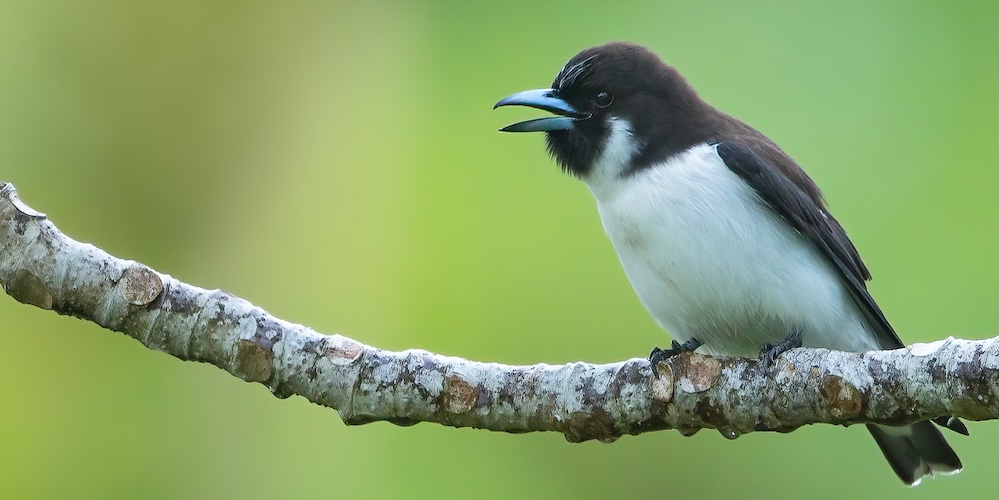
Fiji Woodswallow Artamus mentalis – ©Dubi Shapiro

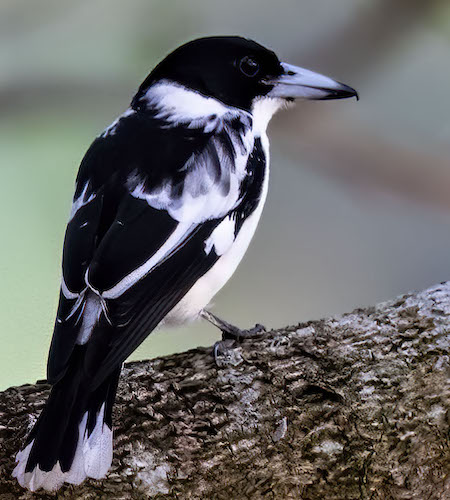
Hooded Butcherbird Cracticus cassicus – ©Dubi Shapiro
Their range of habitats varies between species, but most will adapt to rain forests, woodlands, coastal scrubs (swallows), water courses, playing fields, pastoral lands and paperbark mangroves (butcher birds). One of their greatest abilities is to adapt to urban landscapes where they contend with fragmented and degraded remnants of native vegetation.
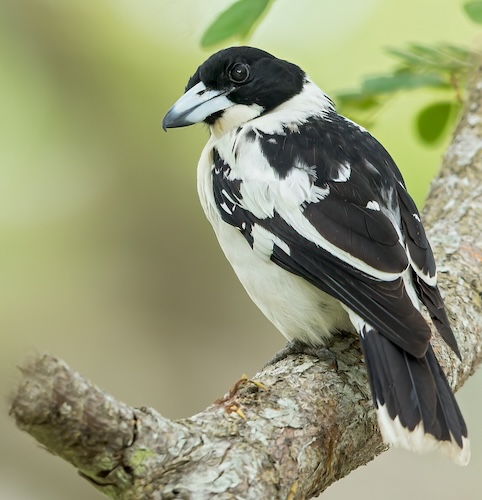
Black-backed Butcherbird Cracticus mentalis – ©Dubi Shapiro
It is a diverse family showing a notable variation in size and shape. They range in size from the short stocky Fiji Woodswallow Artamus mentalis and the Ashy Woodswallow Artamus fuscus, both of which are around 19 centimetres in length and weigh about 40 grams, to the larger Grey Currawong Strepera versicolour, which measures up to 50 cm and weighs up to 440 g.
Their beaks are strong and robust. Like falcons, some of the subfamily Cracticinae possess a sharp projection along the upper mandible, with a corresponding notch on the lower mandible. This hook-like tooth is used to catch and fatally sever the bodies of insects, lizards and small mammals. A trait of all passerines is that they possess an anisodactyl foot arrangement: three toes are directed forward and one toe directed backward, enabling them to perch on horizontal objects such as tree branches and power lines.
Because they possess a syrinx, all are able to create subtle songs; those of the Pied Butcherbird, the Pied Currawong and the Australian Magpie are particularly notable. Uniquely among other perching birds, some woodswallows possess special feathers called powder down. The tips of the barbules on powder down feathers disintegrate, forming fine particles of keratin, which appear as a powder, or ‘feather dust’, among the feathers and is spread when preening. The plumage of the artamids is relatively dull, most birds showing a combination of greys, earthy browns, blacks and patches of white. There is seldom sexual dimorphism in plumage, but when it occurs the males are brighter and the females appear dull or resemble juveniles. In many species juveniles have a distinctly duller plumage. The notarium, a fused vertebra of the shoulder in birds that helps brace the chest against the forces generated by the wings, is a distinctive osteological trait that has evolved repeatedly in the passerines including this family.
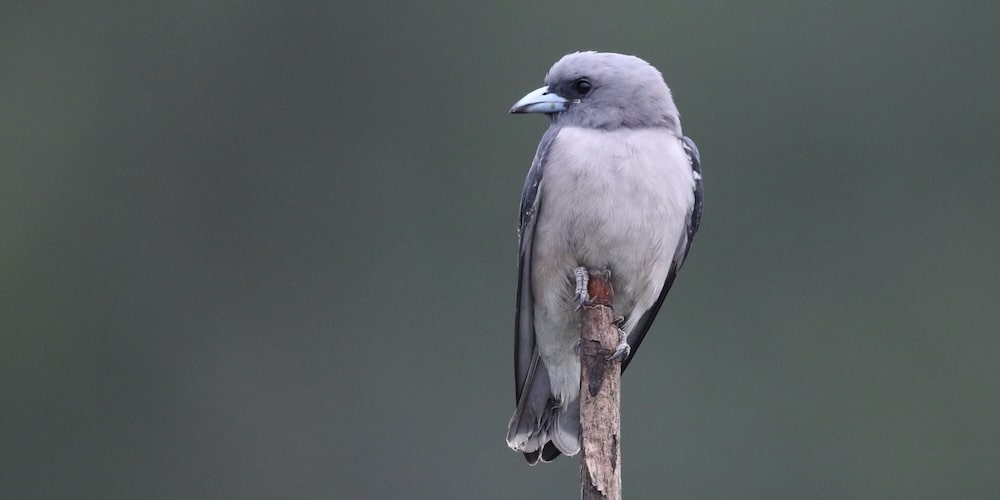
Ashy Woodswallow Artamus fuscus – ©Nick Ludovic Green Bird-Photo-Tours ASIA
The woodswallows in particular, have been known to cluster together during the night and day. Accounts have appeared in literature from the earliest days of ornithological documentation in Australia. The habit of clustering is believed to serve two purposes: retaining body heat during cooler weather and as a social form of camouflage. Another unusual behaviour exhibited by the family is the swooping on humans by Australian Magpies. While there is not much information on this behaviour, previous studies have suggested that magpie attacks on humans may be strongly influenced by hormone levels. For example, recent investigations indicate that the stress hormone corticosterone may cause magpie aggression and swooping.
All are omnivorous to some degree: the butcherbirds mostly eat meat; Australian Magpies usually forage through short grass looking for worms and other small creatures; currawongs are true omnivores, taking fruit, grain, meat, insects, eggs and nestlings; and woodswallows feed on insects and nectar. Most are opportunistic feeders, such as the woodswallows, taking advantage of the flowering plants such as the Silky Oak Grevillea robusta, Box Mistletoe Amyema miquelii, and the long flowering stalks of Xanthorrhoea spp. or insects such as cockroaches or spiders eaten by the Black Butcherbird.
Bigger species such as the Grey Currawong prey on many vertebrates, including frogs, lizards such as skinks, and juveniles of smaller birds such as the native Eastern Spinebill Acanthorhynchus tenuirostris or the introduced House Sparrow Passer domesticus. The evolution of vertical feeding zones (feeding strategies subdividing into vertical space, e.g. upper, mid- and ground canopy) is noted among the Artamidae. While species will sometimes overlap vertical terrains, most woodswallows use the upper canopy, feeding on insects and pollen, while magpies and currawongs tend to use the ground or swoop down from the mid-story pouncing on their food. Being accomplished in extractive foraging is another trait of the Artamidae; although they are opportunistic feeders they are very methodical foragers, often following a set routine.
-
Number of bird species: 24
(As at November 2025)
According to the recently (2025) amalgamated AviList, there are twenty-four species, in six genera in the Artamidae family. They are:
Ashy Woodswallow Artamus fuscus
Fiji Woodswallow Artamus mentalis
Ivory-backed Woodswallow Artamus monachus
Great Woodswallow Artamus maximus
White-breasted Woodswallow Artamus leucorynchus
White-backed [Bismark] Woodswallow Artamus insignis
Masked Woodswallow Artamus personatus
White-browed Woodswallow Artamus superciliosus
Black-faced Woodswallow Artamus cinereus
Dusky Woodswallow Artamus cyanopterus
Little Woodswallow Artamus minor
Lowland Peltops Peltops blainvillii
Mountain Peltops Peltops montanus
Pied Currawong Strepera graculina
Black Currawong Strepera fuliginosa
Grey Currawong Strepera versicolor
Black Butcherbird Melloria quoyi
Australian Magpie Gymnorhina tibicen
Black-backed Butcherbird Cracticus mentalis
Grey Butcherbird Cracticus torquatus
Silver-backed Butcherbird Cracticus argenteus
Hooded Butcherbird Cracticus cassicus
Tagula Butcherbird Cracticus louisiadensis
Pied Butcherbird Cracticus nigrogularis
-
Artamidae
Family AccountThese medium to large songbirds inhabit forests, gardens, and open areas from Australia to Southeast Asia. -
Artamidae
Family AccountArtamidae is a family of passerine birds found in Australia, the Indo-Pacific region, and Southern Asia.
Given the number of species in this family, Fatbirder does not provide quick links to all of them. However, the entries below do include links to representatives of every genera, all those illustrated and some of the most often encountered, iconic or sought-after species.
-
Ashy Woodswallow Artamus fuscus
Species AccountThe ashy woodswallow (Artamus fuscus), sometimes also called the ashy swallow-shrike, is a woodswallow which is found in south Asia. -
Ashy Woodswallow Artamus fuscus
Species AccountSound archive and distribution map -
Australian Magpie Gymnorhina tibicen
Species AccountThe Australian magpie (Cracticus tibicen) is a medium-sized black and white passerine bird native to Australia and southern New Guinea. Although once considered to be three separate species, it is now considered to be one, with nine recognised subspecies. -
Australian Magpie Gymnorhina tibicen
Species AccountThe Australian Magpie is black and white, but the plumage pattern varies across its range. Its nape, upper tail and shoulder are white in males, grey in females. Across most of Australia, the remainder of the body is black. In the south-east, centre, extreme south-west and Tasmania, the back and rump are entirely white. The eye of adult birds is chestnut brown. -
Australian Magpie Gymnorhina tibicen
Species AccountSound archive and distribution map -
Black Butcherbird Melloria quoyi
Species AccountThe black butcherbird (Melloria quoyi, also known as Cracticus quoyi) is a species of butcherbird in the family Artamidae. It is found in Australia, Indonesia, and Papua New Guinea. Its natural habitats are subtropical or tropical dry forest, subtropical or tropical moist lowland forest, and subtropical or tropical mangrove forest. -
Black Butcherbird Melloria quoyi
Species AccountSound archive and distribution map -
Black-backed Butcherbird Cracticus mentalis
Species AccountMedium-sized black-and-white predator with a white chin. with a black head and face black back, black wing tips, and mostly black tail. -
Black-backed Butcherbird Cracticus mentalis
Species AccountSound archive and distribution map -
Dusky Woodswallow Artamus cyanopterus
Species AccountThe dusky woodswallow (Artamus cyanopterus),[2][3] is a bird species of forests and woodlands in temperate and subtropical regions, extending into tropical areas around the Atherton Tableland,[1] in eastern and southern Australia. -
Dusky Woodswallow Artamus cyanopterus
Species AccountSound archive and distribution map -
Fiji Woodswallow Artamus mentalis
Species AccountThe Fiji woodswallow (Artamus mentalis) is a species of woodswallow in the family Artamidae. It is endemic to most of the islands of Fiji, y, rump and throat. -
Fiji Woodswallow Artamus mentalis
Species AccountSound archive and distribution map -
Grey Butcherbird Cracticus torquatus
Species AccountThe grey butcherbird (Cracticus torquatus) is a widely distributed species endemic to Australia. -
Grey Butcherbird Cracticus torquatus
Species AccountSound archive and distribution map -
Hooded Butcherbird Cracticus cassicus
Species AccountThe hooded butcherbird (Cracticus cassicus) is a species of passerine bird in the family Artamidae. It is found in New Guinea. -
Hooded Butcherbird Cracticus cassicus
Species AccountSound archive and distribution map -
Masked Woodswallow Artamus personatus
Species AccountChunky bird with broad, triangular wings and short, decurved bill. Male dark gray above, pale below, with a black face and throat and very pale underwings. -
Masked Woodswallow Artamus personatus
Species AccountSound archive and distribution map -
Mountain Peltops Peltops montanus
Species AccountThe mountain peltops (Peltops montanus) is a species of bird in the family Cracticidae. It is found in Indonesia and Papua New Guinea. -
Mountain Peltops Peltops montanus
Species AccountSound archive and distribution map -
Pied Currawong Strepera graculina
Species AccountScientific Name: Strepera graculina. The Pied Currawong is a large, mostly black bird, with a bright yellow eye. -
Pied Currawong Strepera graculina
Species AccountSound archive and distribution map -
White-breasted Woodswallow Artamus leucorynchus
Species AccountThe White-breasted Woodswallow is a medium-sized bird with a dark grey head and neck. It has dark blue-grey upperparts, tail and wings, white white underparts and underwings. The bill is bluish, tipped black and the eye is dark brown. Young birds tend to be mottled brown on the upperparts with a creamy tinge to the white underparts and have a thin cream eyebrow. This species can be seen in flocks of 10 to 50, even up to 100, birds. These flocks may cluster together day or night in roosts. -
White-breasted Woodswallow Artamus leucorynchus
Species AccountThe white-breasted woodswallow (Artamus leucorynchus) is a small passerine bird which breeds from the Andaman Islands east through Indonesia and northern Australia. The name "woodswallow" is a misnomer as they are not closely related to true swallows. Instead, they belong to the family Artamidae, which also includes butcherbirds, currawongs and the Australian magpie. -
White-breasted Woodswallow Artamus leucorynchus
Species AccountArtamus leucoryn is listed as Least Concern. -
White-breasted Woodswallow Artamus leucorynchus
Species AccountSound archive and distribution map