

Bucerotidae – Hornbills
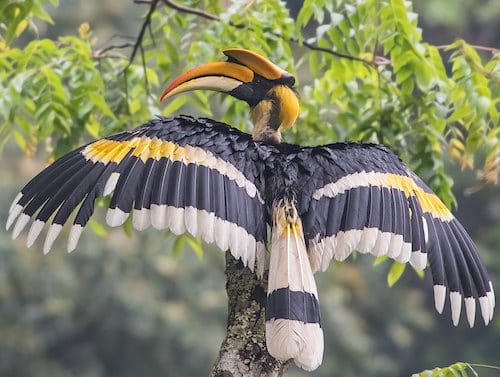
The Phoeniculidae or Hornbills are a family of near passerine birds in the Bucerotiformes order, along with Phoeniculidae (Wood Hoopoes & Scimitarbills) and Upupidae (Hoopoes).
Until recently Ground Hornbills were classed as a separate family (Bucorvidae) of the order Bucerotiformes, with a single genus Bucorvus and two extant species (though possibly including another genus with six extant species). That group is endemic to Sub-Saharan Africa. They are large, with adults around a metre tall. Both species are ground-dwelling, unlike other hornbills, and feed on insects, snakes, other birds, amphibians and even tortoises. They are among the longest-lived of all birds and the larger southern species is possibly the slowest-breeding (triennially) and may be the longest-lived of all birds. It is currently thought that the ground hornbills, along with Tockus and Tropicranus, are almost exclusively carnivorous and lack the gular pouch that allows other, less closely related hornbill genera to store fruit. They are now considered to be a different clade of the one family.
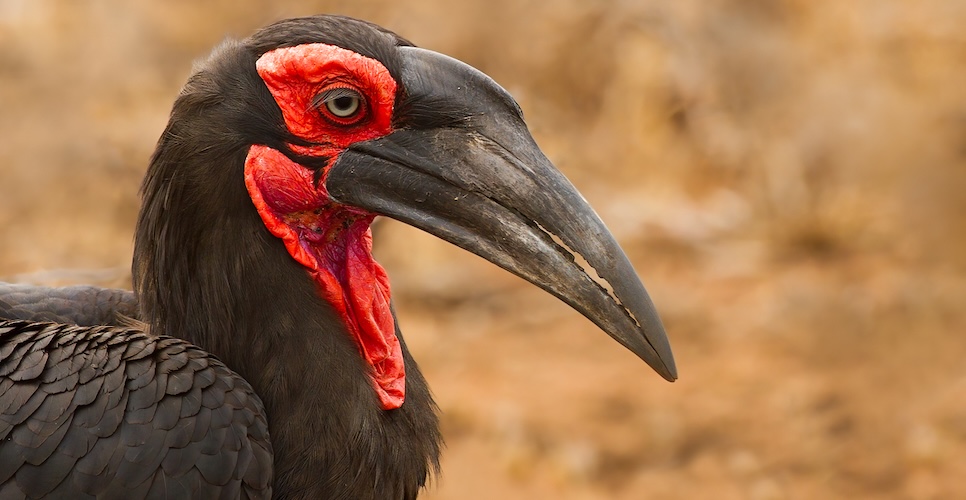
Southern Ground-Hornbill Bucorvus leadbetteri – ©Dubi Shapiro
The Bucerotidae or Hornbills are, as a whole, a family of birds found in tropical and subtropical Africa, Asia and Melanesia. They are characterised by a long, down-curved bill which is frequently brightly coloured and sometimes has a casque on the upper mandible. Both the common English and the scientific name of the family refer to the shape of the bill, ‘buceros’ being ‘cow horn’ in Greek.
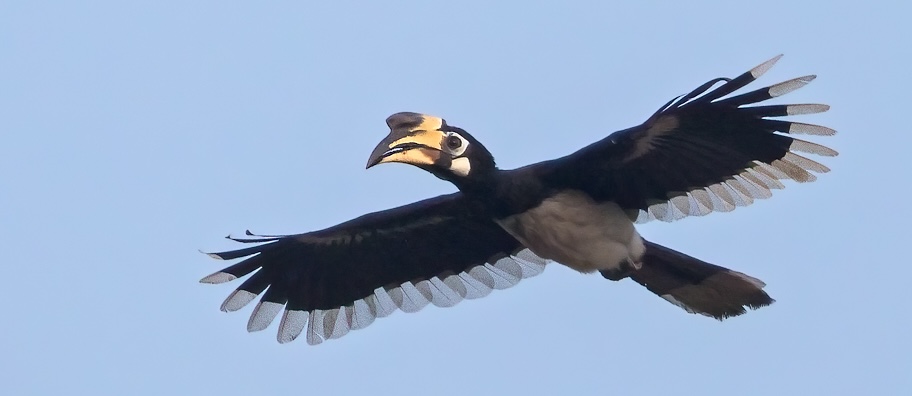
Oriental Pied Hornbill Anthracoceros albirostris – ©Dubi Shapiro
Hornbills have a two-lobed kidney. They are the only birds in which the first and second neck vertebrae (the atlas and axis respectively) are fused together; this probably provides a more stable platform for carrying their large bills. The family is omnivorous, feeding on fruit and small animals. They are monogamous breeders nesting in natural cavities in trees and sometimes cliffs. A number of species of hornbill are threatened with extinction, mostly insular species with small ranges.
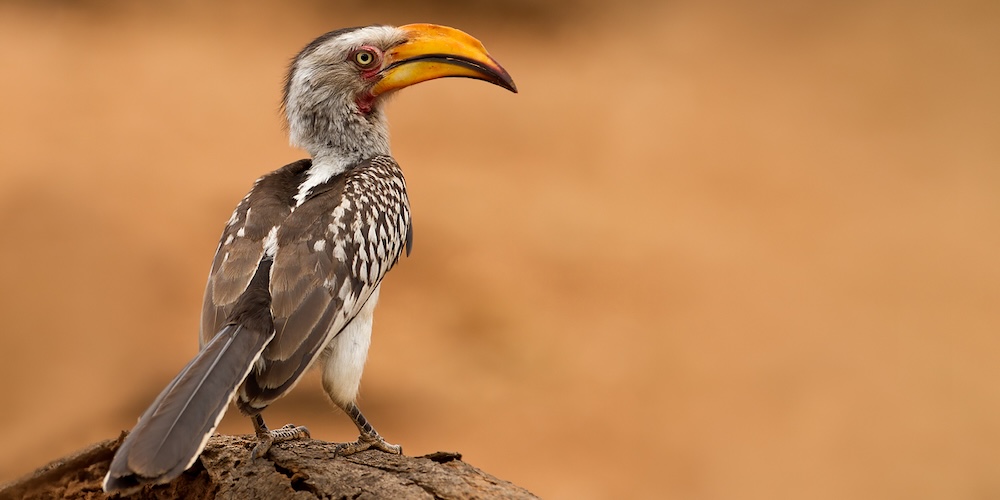
Southern Yellow-billed Hornbill Tockus leucomelas – ©Dubi Shapiro
Hornbills show considerable variation in size, ranging from the Ground Hornbills and Black Dwarf Hornbill Tockus hartlaubi, at 102 grams and 30cm. Males are always bigger than the females, though the extent to which this is true varies according to species. The extent of sexual dimorphism also varies with body parts. For example, the difference in body mass between males and females is as little as 1% to as much as 17%, but the variation is 8% to 30% for bill length and 1% to 21% in wing length.
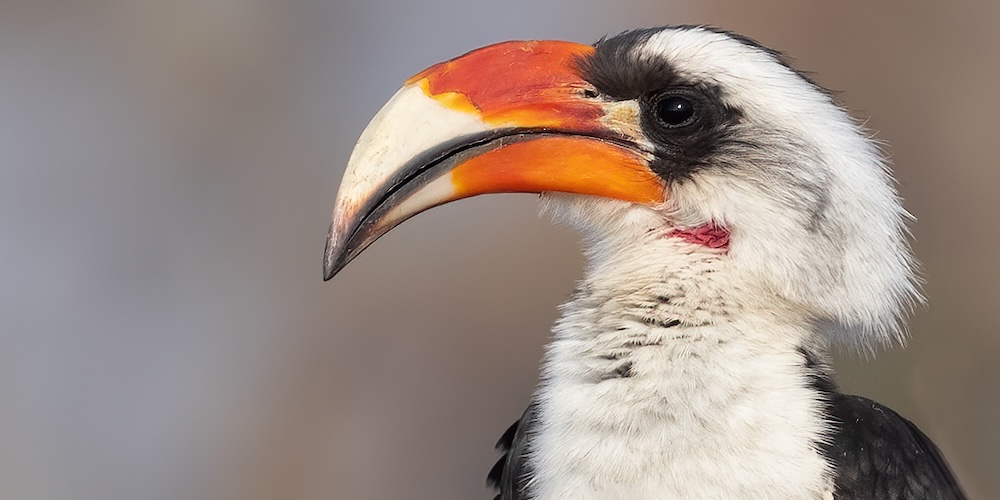
Von der Decken’s Hornbill Tockus deckeni – ©Dubi Shapiro
The most distinctive feature of the hornbills is the heavy bill, supported by powerful neck muscles as well as by the fused vertebrae. The large bill assists in fighting, preening, constructing the nest, and catching prey. A feature unique to the hornbills is the casque, a hollow structure that runs along the upper mandible. In some species it is barely perceptible and appears to serve no function beyond reinforcing the bill. In other species it is quite large, is reinforced with bone, and has openings between the hollow centre, allowing it to serve as a resonator for calls. In the Helmeted Hornbill the casque is not hollow but is filled with hornbill ivory and is used as a battering ram in dramatic aerial jousts. Aerial casque-butting has also been reported in the Great Hornbill.

Silvery-cheeked Hornbill Bycanistes brevis – ©Dubi Shapiro
Their plumage is typically black, grey, white, or brown, and is frequently offset by bright colours on the bill, or by patches of bare coloured skin on the face or wattles. Some species exhibit sexual dichromatism.
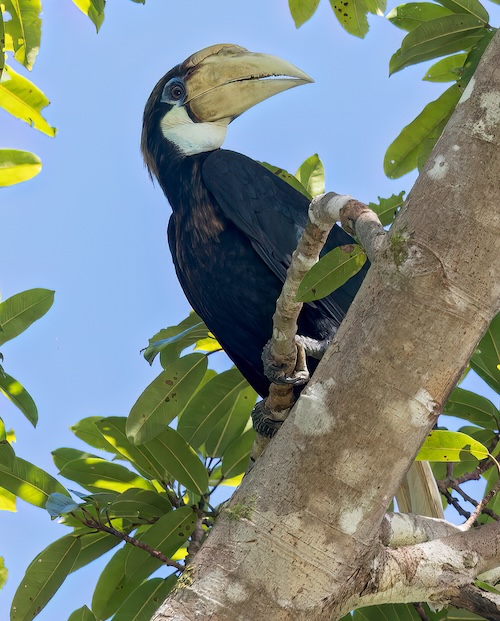
Blyth’s (Papuan) Hornbill Rhyticeros plicatus – Dubi Shapiro
The calls of hornbills are loud and vary distinctly between different species. They possess binocular vision, although unlike most birds with this type of vision, the bill intrudes on their visual field. This allows them to see their own bill tip and aids in precision handling of food objects with their bill. The eyes are also protected by large eyelashes which act as a sunshade. They are diurnal, generally travelling in pairs or small family groups. Larger flocks sometimes form outside the breeding season. The largest assemblies of hornbills form at some roosting sites, where as many as 2400 individual birds have been recorded.
-
Number of bird species: 64
(As at August 2025)
According to the newly (2025) amalgamated AviList there are sixty-four species of Hornbills in sixteen genera the family Bucerotidae. They are:
Abyssinian Ground Hornbill Bucorvus abyssinicus
Southern Ground-Hornbill Bucorvus leadbetteri
Red-billed Dwarf Hornbill Lophoceros camurus
Crowned Hornbill Lophoceros alboterminatus
Bradfield’s Hornbill Lophoceros bradfieldi
West African Pied Hornbill Lophoceros semifasciatus
Congo Pied Hornbill Lophoceros fasciatus
Hemprich’s Hornbill Lophoceros hemprichii
African Grey Hornbill Lophoceros nasutus
Pale-billed Hornbill Lophoceros pallidirostris
Eastern Yellow-billed Hornbill Tockus flavirostris
Southern Yellow-billed Hornbill Tockus leucomelas
Jackson’s Hornbill Tockus jacksoni
Von der Decken’s Hornbill Tockus deckeni
Monteiro’s Hornbill Tockus monteiri
Southern Red-billed Hornbill Tockus rufirostris
Damara Red-billed Hornbill Tockus damarensis
Tanzanian Red-billed Hornbill Tockus ruahae
Western Red-billed Hornbill Tockus kempi
Northern Red-billed Hornbill Tockus erythrorhynchus
White-crowned Hornbill Berenicornis comatus
Western Long-tailed Hornbill Horizocerus albocristatus
Eastern Long-tailed Hornbill Horizocerus cassini
Western Dwarf Hornbill Horizocerus hartlaubi
Eastern Dwarf Hornbill Horizocerus granti
Yellow-casqued Hornbill Ceratogymna elata
Black-casqued Hornbill Ceratogymna atrata
Silvery-cheeked Hornbill Bycanistes brevis
Black-and-white-casqued Hornbill Bycanistes subcylindricus
Brown-cheeked Hornbill Bycanistes cylindricus
White-thighed Hornbill Bycanistes albotibialis
Trumpeter Hornbill Bycanistes bucinator
Piping Hornbill Bycanistes fistulator
Helmeted Hornbill Rhinoplax vigil
Rufous Hornbill Buceros hydrocorax
Rhinoceros Hornbill Buceros rhinoceros
Great Hornbill Buceros bicornis
Bushy-crested Hornbill Anorrhinus galeritus
Austen’s Brown Hornbill Anorrhinus austeni
Tickell’s Brown Hornbill Anorrhinus tickelli
Indian Grey Hornbill Ocyceros birostris
Malabar Grey Hornbill Ocyceros griseus
Sri Lanka Grey Hornbill Ocyceros gingalensis
Black Hornbill Anthracoceros malayanus
Sulu Hornbill Anthracoceros montani
Malabar Pied Hornbill Anthracoceros coronatus
Oriental Pied Hornbill Anthracoceros albirostris
Palawan Hornbill Anthracoceros marchei
Rufous-necked Hornbill Aceros nipalensis
Knobbed Hornbill Rhyticeros cassidix
Sumba Hornbill Rhyticeros everetti
Wreathed Hornbill Rhyticeros undulatus
Plain-pouched Hornbill Rhyticeros subruficollis
Narcondam Hornbill Rhyticeros narcondami
Blyth’s Hornbill Rhyticeros plicatus
Sulawesi Hornbill Rhabdotorrhinus exarhatus
Wrinkled Hornbill Rhabdotorrhinus corrugatus
Walden’s Hornbill Rhabdotorrhinus waldeni
Writhed Hornbill Rhabdotorrhinus leucocephalus
Visayan Hornbill Penelopides panini
Luzon Hornbill Penelopides manillae
Mindoro Hornbill Penelopides mindorensis
Samar Hornbill Penelopides samarensis
Mindanao Hornbill Penelopides affinis
-
Hornbill Research Foundation
WebpageHornbill Research Foundation (HRF) support the research program of the Thailand Hornbill Project (THP) and in addition sustain the conservation of hornbills and natural resources in Thailand. HRF/THP also provide research training for the park staff, undergraduate and graduate students in Thailand and countries in Southeast Asia.
-
Handbook of the Birds of the World, Volume 6: Mousebirds to Hornbills
| Edited by Josep del Hoyo Calduch, Andrew Elliott & Jordi Sargatal | Lynx Edicions | 2001 | Hardback | 589 pages, 45 plates with colour illustrations; 385 colour photos, 270 colour distribution maps, 11 illustrations and tables | ISBN: 9788487334306 Buy this book from NHBS.com -
Hornbills in the City - A Conservation Approach to Hornbill Study in Singapore
| By Marc Cremades & Soon Chye Ng | National Parks Board Singapore | 2013 | Hardback | 222 pages, 600 colour photos and colour illustrations, 100+ colour maps, includes 40-minute DVD | ISBN: 9789810734534 Buy this book from NHBS.com
-
Bucerotidae
Family AccountResembling toucans in general appearance, hornbills have diversified much more in the relative size and elaboration of the bill. -
Bucerotidae
Family AccountHornbills are birds found in tropical and subtropical Africa, Asia and Melanesia of the family Bucerotidae. They are characterized by a long, down-curved bill.
Given the number of species in this family, Fatbirder does not provide quick links to all of them. However, the entries below do include links to representatives of every genera, all those illustrated and some of the most often encountered, iconic or sought-after species.
-
Abyssinian Ground Hornbill Bucorvus abyssinicus
Species AccountThe Abyssinian ground hornbill or northern ground hornbill (Bucorvus abyssinicus) is an African bird, found north of the equator, and is one of two species of ground hornbill. The other is the slightly larger southern ground hornbill; the two are the largest species of hornbills found in Africa. -
Abyssinian Ground Hornbill Bucorvus abyssinicus
Species AccountNorthern Ground-hornbill Bucorvus abyssinicus has most recently been assessed for The IUCN Red List of Threatened Species in 2018. Bucorvus abyssinicus is listed as Vulnerable under criteria A2bcd+3bcd+4bcd. -
Abyssinian Ground Hornbill Bucorvus abyssinicus
Species AccountSound archive and distribution map. -
African Grey Hornbill Tockus nasutus
Species AccountThe African grey hornbill (Tockus nasutus) is a member of the hornbill family of tropical near-passerine birds found in the Old World. It is a widespread and common resident breeder in much of sub-Saharan Africa and into Arabia. -
Black Hornbill Anthracoceros malayanus
Species AccountSound archive and distribution map. -
Black Hornbill Anthracoceros malayanus
Species AccountThe black hornbill (Anthracoceros malayanus) is a species of bird of the hornbill family Bucerotidae. It lives in Asia in Brunei Darussalam, Indonesia, Malaysia, Singapore, Thailand. -
Blyth's Hornbill Rhyticeros plicatus
Species AccountSound archive and distribution map. -
Blyth's Hornbill Rhyticeros plicatus
Species AccountBlyth's hornbill (Rhyticeros plicatus), also known as the Papuan hornbill, is a large hornbill inhabiting the forest canopy in Wallacea and Melanesia. Its local name in Tok Pisin is kokomo. -
Crowned Hornbill Tockus alboterminatus
Species AccountThe crowned hornbill (Tockus alboterminatus) is an African hornbill. -
Eastern Yellow-billed Hornbill Tockus flavirostris
Species AccountSound archive and distribution map. -
Eastern Yellow-billed Hornbill Tockus flavirostris
Species AccountThe eastern yellow-billed hornbill (Tockus flavirostris), also known as the northern yellow-billed hornbill,[1] is a species of hornbill in the Bucerotidae family. It is found in Djibouti, Eritrea, Ethiopia, Kenya, Somalia, South Sudan, Tanzania, and Uganda. It resembles the southern yellow-billed hornbill, but has blackish (not pinkish) skin around the eyes. -
Helmeted Hornbill Rhinoplax vigil
Species AccountThe helmeted hornbill (Rhinoplax vigil) is a very large bird in the hornbill family. It is found on the Malay Peninsula, Sumatra, Borneo, Thailand and Myanmar. -
Helmeted Hornbill Rhinoplax vigil
Species AccountSound archive and distribution map. -
Knobbed Hornbill Rhyticeros cassidix
Species AccountThe knobbed hornbill (Rhyticeros cassidix), also known as Sulawesi wrinkled hornbill, is a colourful hornbill native to Indonesia. The species is sometimes placed in the genus Aceros. The knobbed hornbill is the faunal symbol of South Sulawesi province. -
Knobbed Hornbill Rhyticeros cassidix
Species AccountSound archive and distribution map. -
Luzon Hornbill Penelopides manillae
Species AccountThe Luzon hornbill (Penelopides manillae), sometimes called Luzon tarictic hornbill, is a species of hornbill in the family Bucerotidae. -
Luzon Hornbill Penelopides manillae
Species AccountSound archive and distribution map. -
Malabar Grey Hornbill Ocyceros griseus
Species AccountThe Malabar gray hornbill (Ocyceros griseus) is a hornbill endemic to the Western Ghats and associated hills of southern India. -
Malabar Grey Hornbill Ocyceros griseus
Species AccountSound archive and distribution map. -
Northern Red-billed Hornbill Tockus erythrorhynchus
Species AccountSound archive and distribution map. -
Northern Red-billed Hornbill Tockus erythrorhynchus
Species AccountThe red-billed hornbills are a group of hornbills found in savanna and woodland of sub-Saharan Africa. They are now usually split into five species. -
Oriental Pied Hornbill Anthracoceros albirostris
Species AccountA small black-and-white hornbill with a whitish-yellow bill and “helmet.” Primarily black, but with a white belly, facial patch, and wing and tail edges. -
Oriental Pied Hornbill Anthracoceros albirostris
Species AccountSound archive and distribution map. -
Palawan Hornbill Anthracoceros marchei
Species AccountSound archive and distribution map. -
Palawan Hornbill Anthracoceros marchei
Species AccountThe Palawan hornbill (Anthracoceros marchei), known as Talusi in the Filipino language, is a smallish (approximately 70 centimetres (28 in) long) forest-dwelling bird. Its plumage is predominantly black, with a white tail, a dark green gloss on its upper parts and a large creamy-white beak with a casque typical of the hornbill family. It emits loud calls which can be transcribed as kaaww and kreik-kreik. -
Rhinoceros Hornbill Buceros rhinoceros
Species AccountThe rhinoceros hornbill (Buceros rhinoceros) is a large species of forest hornbill (Bucerotidae). In captivity it can live for up to 35 years. -
Rhinoceros Hornbill Buceros rhinoceros
Species AccountSound archive and distribution map. -
Rufous-necked Hornbill Aceros nipalensis
Species AccountThe rufous-necked hornbill (Aceros nipalensis) is a species of hornbill in the northeastern India, especially in Arunachal Pradesh, Indian Subcontinent and Southeast Asia. Numbers have declined significantly due to habitat loss and hunting, and it has been entirely extirpated from Nepal. -
Rufous-necked Hornbill Aceros nipalensis
Species AccountSound archive and distribution map. -
Silvery-cheeked Hornbill Bycanistes brevis
Species AccountThe silvery-cheeked hornbill (Bycanistes brevis) is a large species of hornbill found in Africa. Silvery-cheeked hornbills are residents of the tall evergreen... -
Silvery-cheeked Hornbill Bycanistes brevis
Species AccountSound archive and distribution map. -
Southern Ground Hornbill Bucorvus leadbeateri
Species AccountBirdLife species profile... -
Southern Ground Hornbill Bucorvus leadbeateri
Species AccountThe southern ground hornbill (Bucorvus leadbeateri; formerly known as Bucorvus cafer), is one of two species of ground hornbill and is the largest species of hornbill. The other species of the genus Bucorvus is the Abyssinian ground hornbill, B. abyssinicus. -
Southern Ground Hornbill Bucorvus leadbeateri
Species AccountSouthern Ground-hornbill Bucorvus leadbeateri has most recently been assessed for The IUCN Red List of Threatened Species in 2016. Bucorvus leadbeateri is listed as Vulnerable under criteria A4bcd. -
Southern Ground Hornbill Bucorvus leadbeateri
Species AccountSound archive and distribution map. -
Southern Yellow-billed Hornbill Tockus leucomelas
Species AccountThe southern yellow-billed hornbill (Tockus leucomelas) is a hornbill found in southern Africa. Yellow-billed hornbills feed mainly on the ground. -
Southern Yellow-billed Hornbill Tockus leucomelas
Species AccountSound archive and distribution map. -
Sulu Hornbill Anthracoceros montani
Species AccountSound archive and distribution map. -
Sulu Hornbill Anthracoceros montani
Species AccountThe Sulu hornbill or Montano's hornbill (Anthracoceros montani) is a species of hornbill in the Bucerotidae family. It is endemic to the Philippines. Its natural habitat is subtropical or tropical moist montane forests. -
Tickell's Brown Hornbill Anorrhinus tickelli
Species AccountBrownish, medium-sized hornbill. Male is dusty brown above and rusty-colored below, with a pale bill and blue-gray skin around the eye. -
Tickell's Brown Hornbill Anorrhinus tickelli
Species AccountSound archive and distribution map. -
Trumpeter Hornbill Bycanistes bucinator
Species AccountThe trumpeter hornbill is a gregarious bird, usually living in groups of two to five individuals, although sometimes as many as fifty. This hornbill is a locally common resident of the tropical evergreen forests of Burundi, Mozambique, Botswana, Congo, Kenya, the Caprivi strip of Namibia and eastern South Africa, where it feeds on fruits and large insects. -
Trumpeter Hornbill Bycanistes bucinator
Species AccountSound archive and distribution map. -
Von der Decken's Hornbill Tockus deckeni
Species AccountVon der Decken's hornbill (Tockus deckeni) is a hornbill found in East Africa, especially to the east of the East African Rift, from Ethiopia south to Tanzania. -
Von der Decken's Hornbill Tockus deckeni
Species AccountSound archive and distribution map. -
Western Long-tailed Hornbill Horizocerus albocristatus
Species AccountA small-bodied hornbill with an extremely long tail, a dark bill, and an almost entirely white head with a unique crest. Usually found in thick rainforest. -
Western Long-tailed Hornbill Horizocerus albocristatus
Species AccountSound archive and distribution map. -
White-crowned Hornbill Berenicornis comatus
Species AccountThe white-crowned hornbill (Berenicornis comatus), also known as the long-crested hornbill or white-crested hornbill is a species of hornbill. -
White-crowned Hornbill Berenicornis comatus
Species AccountSound archive and distribution map. -
Wreathed Hornbill Rhyticeros undulatus
Species AccountSound archive and distribution map. -
Wreathed Hornbill Rhyticeros undulatus
Species AccountThe wreathed hornbill (Rhyticeros undulatus), also known as the bar-pouched wreathed hornbill, is a species of hornbill found in forests from far north-eastern India and Bhutan, east and south through mainland Southeast Asia and the Greater Sundas in Indonesia, except Sulawesi. -
Wrinkled Hornbill Rhabdotorrhinus corrugatus
Species AccountBrightly-colored medium-large hornbill. Both sexes are black with bare facial skin, blobby throat “pouches”, yellowish tails, and casqued bills. -
Wrinkled Hornbill Rhabdotorrhinus corrugatus
Species AccountSound archive and distribution map. -
Writhed Hornbill Aceros leucocephalus
Species AccountThe writhed hornbill (Aceros leucocephalus), also known as the Mindanao wrinkled hornbill, is a species of hornbill in the Bucerotidae family. It is endemic to humid forests on the Philippine islands of Mindanao, Dinagat and Camiguin Sur. It formerly included the Walden's hornbill as a subspecies, but unlike that species, both sexes of the writhed hornbill have orange-red throat and peri-ocular skin. -
Yellow-casqued Hornbill Ceratogymna elata
Species AccountHuge, spectacular, mostly black hornbill. Males have a large cream-and-white bill, and females a much smaller horn-colored one. -
Yellow-casqued Hornbill Ceratogymna elata
Species AccountSound archive and distribution map.