

Cacatuidae – Cockatoos
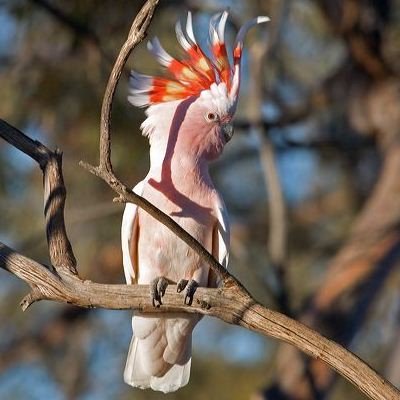
The Cacatuidae (Cockatoos) family is one of four in the order Psittaciformes; the other three families are Strigopoidea (New Zealand Parrots), Psittacidae (African & New World Parrots) and Psittaculiudae (Old World Parrots). Cockatoos have a mainly Australasian distribution, ranging from the Philippines and the eastern Indonesian islands of Wallacea to New Guinea, the Solomon Islands and Australia.
They are recognisable by the showy crests and curved bills. Their plumage is generally less colourful than that of other parrots, being mainly white, grey or black and often with coloured features in the crest, cheeks or tail. On average they are larger than other parrots; however, the Cockatiel, the smallest cockatoo species, is a small bird.
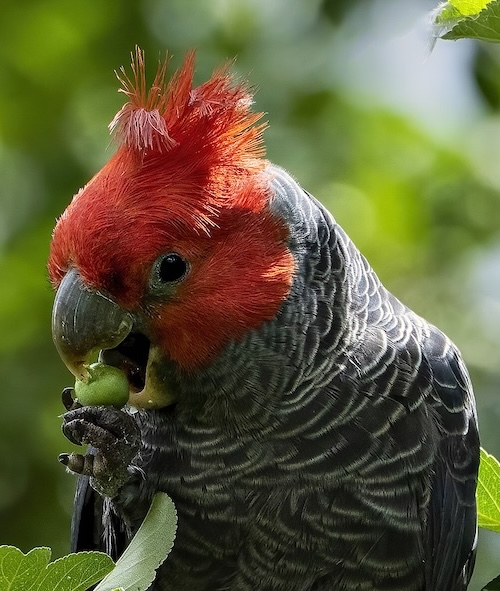
Gang-gang Cockatoo Callocephalon fimbriatum – ©Rod Waddington CC BY-SA 2.0 via Wikimedia Commons
The phylogenetic position of the cockatiel remains unresolved, other than that it is one of the earliest offshoots of the cockatoo lineage. The five large black coloured cockatoos of the genus Calyptorhynchus form one branch. The second and larger branch is formed by the genus Cacatua, comprising 11 species of white-plumaged cockatoos and four monotypic genera that branched off earlier; namely the pink and white Major Mitchell’s Cockatoo, the pink and grey Galah, the mainly grey Gang-gang Cockatoo and the large black-plumaged Palm Cockatoo.
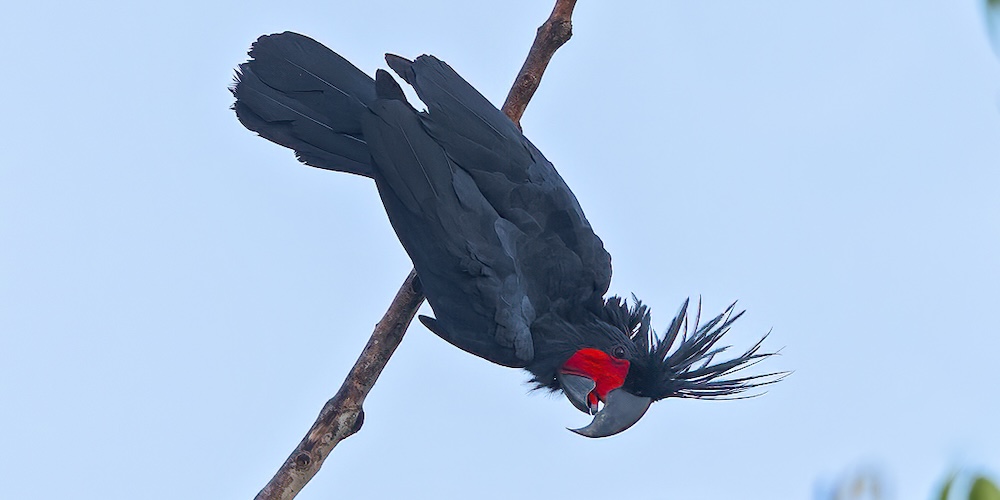
Palm Cockatoo Probosciger aterrimus – ©Dubi Shapiro
Cockatoos prefer to eat seeds, tubers, corms, fruit, flowers and insects. They often feed in large flocks, particularly when ground-feeding. They are monogamous and nest in tree hollows. Some cockatoo species have been adversely affected by habitat loss, particularly from a shortage of suitable nesting hollows after large mature trees are cleared; conversely, some species have adapted well to human changes and are considered agricultural pests.
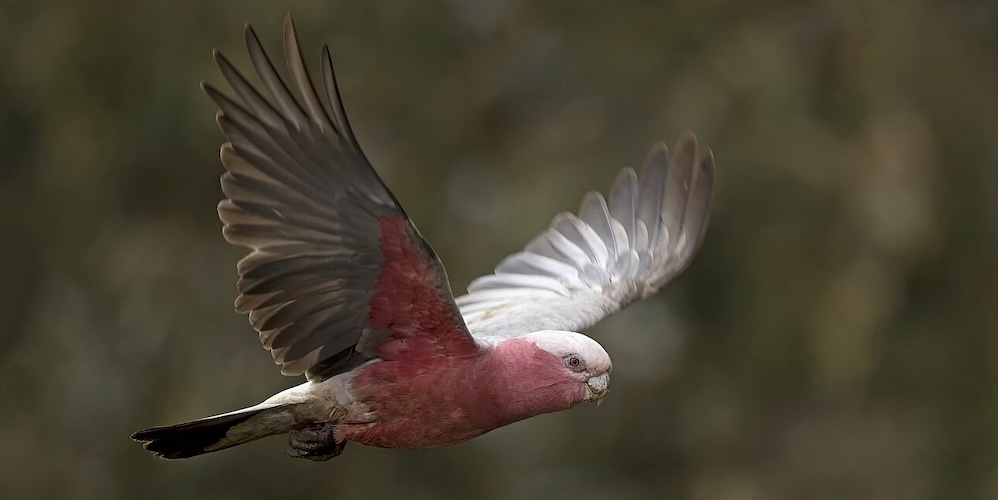
Galah Eolophus roseicapilla – ©Charles J Sharp via Wikimedia Commons
Cockatoos are popular birds in aviculture, but their needs are difficult to meet. The cockatiel is the easiest cockatoo species to maintain and is by far the most frequently kept in captivity. White Cockatoos are more commonly found in captivity than Black Cockatoos. Illegal trade in wild-caught birds contributes to the decline of some cockatoo species in the wild.
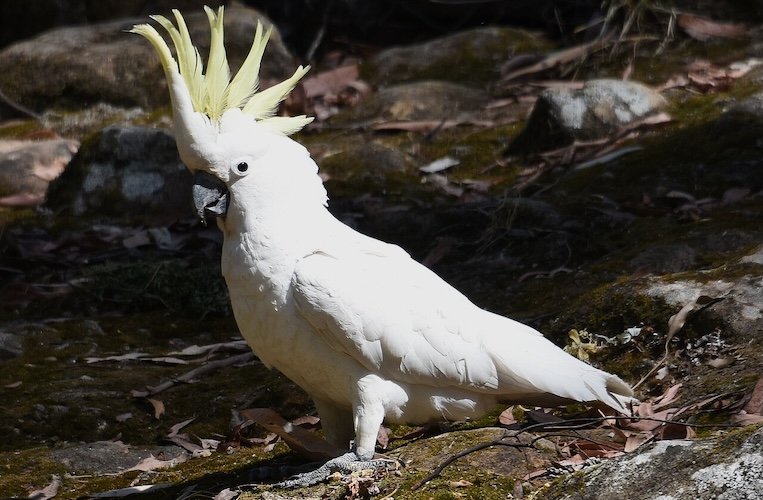
Sulphur-crested Cockatoo Cacatua galerita
– ©Sardaka CC BY-SA 4.0 via Wikimedia Commons
They are diurnal and require daylight to find their food. They are not early risers, instead waiting until the sun has warmed their roosting sites before feeding. All species are generally highly social and roost, forage and travel in colourful and noisy flocks. These vary in size depending on availability of food; in times of plenty, flocks are small and number a hundred birds or less, while in droughts or other times of adversity, they may swell up to contain thousands or even tens of thousands of birds; one record from the Kimberley noted a flock of 32,000 Little Corellas. Species that inhabit open country form larger flocks than those of forested areas. Some species require roosting sites that are located near drinking sites; other species travel great distances between the roosting and feeding sites. They have several characteristic methods of bathing; they may hang upside down or fly about in the rain or flutter in wet leaves in the canopy.
-
Number of bird species: 22
(As at August 2025)
According to the newly (2025) combined AviList, there are twenty-two species of extant cockatoos in seven genera of the Cacatuidae family. They are:
Red-tailed Black Cockatoo Calyptorhynchus banksii
Glossy Black Cockatoo Calyptorhynchus lathami
*Yellow-tailed Black Cockatoo Zanda funerea
Carnaby’s Black Cockatoo Zanda latirostris
Baudin’s Black Cockatoo Zanda baudinii
Cockatiel Nymphicus hollandicus
Palm Cockatoo Probosciger aterrimus
Gang-gang Cockatoo Callocephalon fimbriatum
Galah Eolophus roseicapilla
Major Mitchell’s Cockatoo Cacatua leadbeateri
Red-vented Cockatoo Cacatua haematuropygia
Tanimbar Corella Cacatua goffiniana
Solomons Cockatoo Cacatua ducorpsii
Western Corella Cacatua pastinator
Little Corella Cacatua sanguinea
Long-billed Corella Cacatua tenuirostris
White Cockatoo Cacatua alba
Blue-eyed Cockatoo Cacatua ophthalmica
Salmon-crested Cockatoo Cacatua moluccensis
Yellow-crested Cockatoo Cacatua sulphurea
Citron-crested Cockatoo Cacatua citrinocristata
Sulphur-crested Cockatoo Cacatua galerita
-
World Parrot Trust
WebsiteProtecting parrots with your help
-
Cockatoo
| Thames & Hudson (Australia) | 2017 | Paperback | 128 pages, colour illustrations | ISBN: 9780500501122 Buy this book from NHBS.com -
The Cockatoos - A Complete Guide to the 21 Species
| By Edward John Mulawka | McFarland | 2014 | Paperback | 286 pages, colour photos | ISBN: 9780786479252 Buy this book from NHBS.com
-
Cacatuidae
Family AccountCockatoos are large parrots of Australo-Papua, almost all of which sport distinctive crests... -
Cacatuidae
Family AccountA cockatoo is any of the 21 species of parrots belonging to the family Cacatuidae, the only family in the superfamily Cacatuoidea.
Given that this is a small to medium sized family with twenty-two species in seven genera, Fatbirder provides active links below to all species.
-
Baudin's Black Cockatoo Zanda baudinii
Species AccountBaudin's black cockatoo (Zanda baudinii), also known as Baudin's cockatoo or the long-billed black cockatoo -
Baudin's Black Cockatoo Zanda baudinii
Species AccountSound archive and distribution map. -
Blue-eyed Cockatoo Cacatua ophthalmica
Species AccountA large, bulky white parrot with a tall yellow-and-white crest that it often raises when perched and bright blue skin around the eyes. -
Blue-eyed Cockatoo Cacatua ophthalmica
Species AccountSound archive and distribution map. -
Carnaby's Black Cockatoo Zanda latirostris
Species AccountCarnaby's black cockatoo (Zanda latirostris), also known as the short-billed black cockatoo, is a large black cockatoo endemic to southwest Australia. -
Carnaby's Black Cockatoo Zanda latirostris
Species AccountSound archive and distribution map. -
Citron-crested Cockatoo Cacatua citrinocristata
Species AccountThe citron-crested cockatoo (Cacatua citrinocristata) is a medium-sized cockatoo with an orange crest, dark grey beak, pale orange ear patches, and strong feet -
Citron-crested Cockatoo Cacatua citrinocristata
Species AccountThe Citron-Crested Cockatoo is a unique bird in every sense of the word. Hailing only from a tiny tropical island in southern Indonesia, it was never going to be a surprise that their population would be so small. -
Cockatiel Nymphicus hollandicus
Species AccountTiny cockatoo with a long pointed tail. When perched, the yellowish face and crest and orange cheek patch of the male are distinctive. -
Cockatiel Nymphicus hollandicus
Species AccountSound archive and distribution map. -
Galah Eolophus roseicapilla
Species AccountCommon and familiar across almost the entire Australian continent. -
Galah Eolophus roseicapilla
Species AccountSound archive and distribution map. -
Gang-gang Cockatoo Callocephalon fimbriatum
Species AccountSound archive and distribution map. -
Gang-gang Cockatoo Callocephalon fimbriatum
Species AccountThe gang-gang cockatoo (Callocephalon fimbriatum) is a parrot found in the cooler and wetter forests and woodlands of Australia, particularly alpine bushland. -
Glossy Black Cockatoo Calyptorhynchus lathami
Species AccountSound archive and distribution map. -
Glossy Black Cockatoo Calyptorhynchus lathami
Species AccountThe glossy black cockatoo (Calyptorhynchus lathami), is the smallest member of the subfamily Calyptorhynchinae found in eastern Australia. -
Little Corella Cacatua sanguinea
Species AccountThe little corella (Cacatua sanguinea), also known as the short-billed corella, bare-eyed cockatoo, blood-stained cockatoo, and little cockatoo is a white... -
Little Corella Cacatua sanguinea
Species AccountSound archive and distribution map. -
Long-billed Corella Cacatua tenuirostris
Species AccountThe long-billed corella, also known as long-billed cockatoo or slender-billed corella (Cacatua tenuirostris), is a cockatoo native to Australia... -
Long-billed Corella Cacatua tenuirostris
Species AccountSound archive and distribution map. -
Major Mitchell's Cockatoo Lophochroa leadbeateri
Species AccountThe Pink Cockatoo, also known as Major Mitchell's Cockatoo or Leadbeater's Cockatoo, is a medium-sized bird that graces the arid and semi-arid inland areas of... -
Major Mitchell's Cockatoo Lophochroa leadbeateri
Species AccountThe Major Mitchell's cockatoo (Lophochroa leadbeateri) also known as Leadbeater's cockatoo or pink cockatoo,[2] is a medium-sized cockatoo restricted to arid and semi-arid inland areas of Australia. -
Major Mitchell's Cockatoo Lophochroa leadbeateri
Species AccountThe Major Mitchell's Cockato is a small, largely white cockatoo with pink on the sides of its head, around its neck, on its underbody and under its wings. -
Major Mitchell's Cockatoo Lophochroa leadbeateri
Species AccountMajor Mitchell's Cockatoo Cacatua leadbeateri has most recently been assessed for The IUCN Red List of Threatened Species in 2018. Cacatua leadbeateri is listed as Least Concern. -
Major Mitchell's Cockatoo Lophochroa leadbeateri
Species AccountSound archive and distribution map. -
Palm Cockatoo Probosciger aterrimus
Species AccountSound archive and distribution map. -
Palm Cockatoo Probosciger aterrimus
Species AccountPalm Cockatoo Probosciger aterrimus has most recently been assessed for The IUCN Red List of Threatened Species in 2016. Probosciger aterrimus is listed as Least Concern. -
Palm Cockatoo Probosciger aterrimus
Species AccountThe palm cockatoo (Probosciger aterrimus), also known as the goliath cockatoo or great black cockatoo, is a large smoky-grey or black parrot of the cockatoo family native to New Guinea, Aru Islands and Cape York Peninsula. It has a very large black beak and prominent red cheek patches. -
Palm Cockatoo Probosciger aterrimus
Species AccountAlso known as: Cape York Cockatoo, Great Palm Cockatoo, Black Macaw, Great Black Cockatoo, Goliath Cockatoo -
Red-tailed Black-Cockatoo Calyptorhynchus banksii
Species AccountLarge black cockatoo with tall rounded crest. Mostly black plumage with red or orange panels on the tail. Female has yellow spots and barring on the chest. -
Red-tailed Black-Cockatoo Calyptorhynchus banksii
Species AccountThe red-tailed black cockatoo (Calyptorhynchus banksii) also known as Banksian- or Banks' black cockatoo, is a large black cockatoo native to Australia. Adult males have a characteristic pair of bright red panels on the tail that gives the species its name. -
Red-tailed Black-Cockatoo Calyptorhynchus banksii
Species AccountAlso known as: Red-tailed Cockatoo, Black Cockatoo, Banksian Cockatoo, Banksian Red-tailed Cockatoo, Bank's Black Cockatoo, Great-billed Cockatoo -
Red-tailed Black-Cockatoo Calyptorhynchus banksii
Species AccountRed-tailed Black-cockatoo Calyptorhynchus banksii has most recently been assessed for The IUCN Red List of Threatened Species in 2016. Calyptorhynchus banksii is listed as Least Concern. -
Red-tailed Black-Cockatoo Calyptorhynchus banksii
Species AccountSound archive and distribution map. -
Red-vented Cockatoo Cacatua haematuropygia
Species AccountA rare large parrot of forest on Palawan and several other scattered islands. Heavily persecuted. -
Red-vented Cockatoo Cacatua haematuropygia
Species AccountSound archive and distribution map. -
Salmon-crested Cockatoo Cacatua moluccensis
Species AccountThe salmon-crested cockatoo (Cacatua moluccensis), also known as the Moluccan cockatoo, is a cockatoo endemic to the Seram archipelago in eastern Indonesia. -
Salmon-crested Cockatoo Cacatua moluccensis
Species AccountSound archive and distribution map. -
Solomons Cockatoo Cacatua ducorpsii
Species AccountThe Solomon Islands Cockatoo, also known as Ducorp's Corella, is a cockatoo found in Oceania and is the only cockatoo in its range. -
Solomons Cockatoo Cacatua ducorpsii
Species AccountSound archive and distribution map. -
Sulphur-crested Cockatoo Cacatua galerita
Species AccountSulphur-crested Cockatoo Cacatua galerita has most recently been assessed for The IUCN Red List of Threatened Species in 2018. Cacatua galerita is listed as Least Concern. -
Sulphur-crested Cockatoo Cacatua galerita
Species AccountSound archive and distribution map. -
Sulphur-crested Cockatoo Cacatua galerita
Species AccountAlso Known As: Greater Sulphur-crested Cockatoo, White Cockatoo… -
Sulphur-crested Cockatoo Cacatua galerita
Species AccountThe Sulphur-crested Cockatoo is a large white parrot. It has a dark grey-black bill, a distinctive sulphur-yellow crest and a yellow wash on the underside of the wings. -
Sulphur-crested Cockatoo Cacatua galerita
Species AccountThe sulphur-crested cockatoo (Cacatua galerita) is a relatively large white cockatoo found in wooded habitats in Australia and New Guinea and some of the islands of Indonesia. They can be locally very numerous, leading to them sometimes being considered pests. They are well known in aviculture, although they can be demanding pets. -
Tanimbar Corella Cacatua goffiniana
Species AccountThe Tanimbar corella (Cacatua goffiniana), also known as Goffin's cockatoo or Tanimbar cockatoo, is a species of cockatoo endemic to forests of Yamdena... -
Tanimbar Corella Cacatua goffiniana
Species AccountSound archive and distribution map. -
Western Corella Cacatua pastinator
Species AccountSmall cockatoo with long pointed bill and a solid, short crest, typically found in farmland. This species is restricted to southwestern Australia. -
Western Corella Cacatua pastinator
Species AccountSound archive and distribution map. -
White Cockatoo Cacatua alba
Species AccountThe white cockatoo (Cacatua alba), also known as the umbrella cockatoo, is a medium-sized all-white cockatoo endemic to tropical rainforest on islands of... -
White Cockatoo Cacatua alba
Species AccountSound archive and distribution map. -
Yellow-crested Cockatoo Cacatua sulphurea
Species AccountA medium-sized white cockatoo with a yellow crest; rare and endangered throughout its native range but has several strong naturalized populations across Asia. -
Yellow-crested Cockatoo Cacatua sulphurea
Species AccountSound archive and distribution map. -
Yellow-tailed Black Cockatoo Zanda funerea
Species AccountEnormous black cockatoo with yellow cheek patches and tail panels. Most often observed flying above woodland or feeding in trees. -
Yellow-tailed Black Cockatoo Zanda funerea
Species AccountSound archive and distribution map.
-
*The Eponym Dictionary of Birds
Major Mitchell’s Cockatoo Cacatua leadbeateri NA Vigors, 1831 [Alt. Leadbeater’s Cockatoo; Syn. Lophochroa leadbeateri] Mitchell’s Hopping Mouse Notomys mitchellii W Ogilby, 1838 Lieutenant-Colonel Sir Thomas Livingstone Mitchell (1792-1855) was a Scottish army surveyor and explorer. He was the SurveyorGeneral of New South Wales (1828-1855) and led various expeditions into eastern Australia (1831-1836) and to tropical Australia (1845-1846). A very lifelike coloured plate of ‘his’ cockatoo appears in Mitchell’s: Three Expeditions into the Interior of Eastern Australia (1838). He also wrote: and Journal of an Expedition into the Interior of Tropical Australia, in search of a route from Sydney to the Gulf of Carpentaria (1848). He was hot-headed and was the last person in Australia to challenge an opponent, in this case a politician, to a duel. Fortunately, he only shot a hole in the man’s hat, but honour was satisfied. He was heavily criticised for killing aboriginal people, not only hostile tribesmen, but also harmless bystanders such as old women and children. These murders also cost the lives of members of his exploration party, such as his botanist Richard Cunningham, when local people fought back. A town in Queensland and a river are also named after him. The Eponym Dictionary of Birds(2014) Bo Beolens, Michael Grayson & Michael Watkins