
Chionidae – Sheathbill
The Chionididae or sheathbills family is related to the waders, but merits its own family. The order Charadriiformes also includes Pluvianellidae (Magellanic Plover), Burhinidae (Thick-knees & Stone Curlews), Pluvianidae (Egyptian Plover), Glareolidae (Coursers & Pratincoles), Ibidorhynchidae (Ibisbill), Haematopodidae (Oystercatchers), Recurvirostridae (Stilts & Avocets), Charadriidae (Plovers & Lapwings), Pedionomidae (Plains Wanderer), Thinocoridae (Seedsnipes), Rostratulidae (Painted Snipe), Jacanidae (Jacanas), Scolopacidae (Sandpipers), Dromadidae (Crab-Plover), Turnicidae (Buttonquails), Stercorariidae (Skuas), Alcidae (Auks) and Laridae (Gulls, Terns & Skimmers).
The family consists of just one genus, Chionis, with only two species. They breed on subantarctic islands and the Antarctic Peninsula, and the snowy sheathbill migrates to the Falkland Islands and coastal southern South America in the southern winter; they are the only bird family endemic as breeders to the Antarctic region. They are also the only Antarctic birds without webbed feet.

Black-faced Sheathbill Chionis minor – ©Nweider CC BY-SA 4.0 via Wikimedia Commons
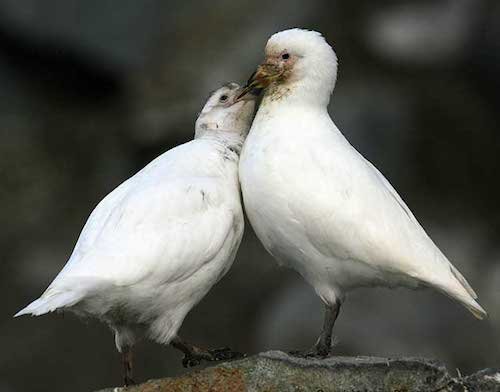
They have white plumage including a thick layer of down, with only the face and leg colours distinguishing the two species. They look plump and dove-like, but are believed to be similar to the ancestors of the modern gulls and terns. There is a rudimentary spur on the carpal joint, as in plovers. The skin around the eye is bare, as is the skin above the bill, which has carbuncular swellings. They derive their English name from the horny sheath which partially covers the upper mandible of their stout bills. They are commonly known in the Antarctic as ‘Mutts’ because of their call which is a soft ‘Mutt, mutt, mutt’.
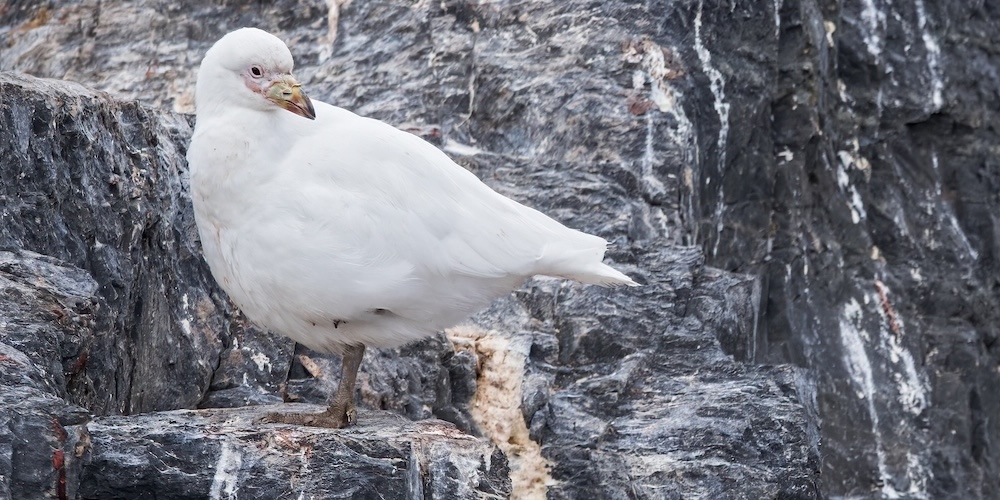
Snowy Sheathbill Chionis albus – ©Dubi Shapiro
They habitually walk on the ground, somewhat like rails. They fly only when alarmed or in migration, looking like pigeons and are opportunistic feeders, consuming invertebrates, faeces, and carrion, including seal afterbirths and stillborn seal pups, between the tidelines. They also take chicks and eggs from cormorants or penguins.
During the penguin breeding season, which is also their own breeding season, pairs of sheathbills establish territories in penguin colonies covering a number of penguin nests. Two mated sheathbills often work together to harass adult penguins, nimbly avoiding their attempts to peck; they gain access to the eggs or chicks or steal the krill that the adult penguins regurgitate to feed their chicks. Near the few human settlements of the region, they boldly forage for offal. Because of this diet, they spend a good deal of time cleaning themselves.
They lay 2 or 3 blotchy white eggs in crevices or rock cavities. The nests are lined messily with seaweed, stones, feathers, guano, bones, and occasionally plastic trash; even dead chicks may not be removed. Incubation lasts 28 to 32 days, and the young fledge 50 to 60 days later.
-
Number of bird species: 2
(As at September 2025)
According to the recently (2025) amalgamated AviList, there are just two species in the family Chionidae. They are:
Snowy Sheathbill Chionis albus
Black-faced Sheathbill Chionis minor
Snowy Sheathbill is monotypic but the Black-faced Sheathbill has four recognised subspecies:
Chionis minor marionensis Reichenow, 1908 – Prince Edward and Marion Is.
Chionis minor crozettensis (Sharpe, 1896) – Western Black-faced Sheathbill – Crozet Is.
Chionis minor minor Hartlaub, 1841 – Eastern Black-faced Sheathbill – Kerguelen Is.
Chionis minor nasicornis Reichenow, 1904 – Heard I and McDonald Is.
-
Seabirds - The New Identification Guide
| By Peter Harrison, Martin Perrow & Hans Larsson | Lynx Edicions | 2021 | Hardback | 600 pages, 239 plates with 3800+ colour illustrations; colour distribution maps | ISBN: 9788416728411 Buy this book from NHBS.com
-
Chionidae
Family AccountNamed for the odd horny sheath that covers the top half of their bills, these birds defend territories that include part of a seal or penguin colony. -
Chionidae
Family AccountThe sheathbills (Chionis) is a genus of birds in the monotypic family Chionidae of the wader order Charadriiformes; the family consists of one genus...
Given that this is a tiny family with just two species in one genus, Fatbirder provides active links below to both species.
-
Black-faced Sheathbill Chionis minor
Species AccountA bizarre pure white bird with pinkish legs and eye-ring and bare black skin in front of the eye. Bill is large and black with tubelike nostrils. -
Black-faced Sheathbill Chionis minor
Species AccountThe black-faced sheathbill (Chionis minor), also known as the lesser sheathbill or paddy bird, is one of only two species of sheathbills, aberrant shorebirds which are terrestrial scavengers of subantarctic islands. -
Black-faced Sheathbill Chionis minor
Species AccountSound archive and distribution map. -
Snowy Sheathbill Chionis albus
Species AccountUnique, stocky, and rather pigeonlike white bird (actually an aberrant shorebird) of Antarctic Peninsula and islands. Migrates north in winter. -
Snowy Sheathbill Chionis albus
Species AccountThe snowy sheathbill (Chionis albus), also known as the greater sheathbill, pale-faced sheathbill, and paddy, is one of two species of sheathbill. It is usually found on the ground. It is the only land bird native to Antarctica. -
Snowy Sheathbill Chionis albus
Species AccountChionis albus is listed as Least Concern. -
Snowy Sheathbill Chionis albus
Species AccountSound archive and distribution map.