

Diomedeidae – Albatrosses
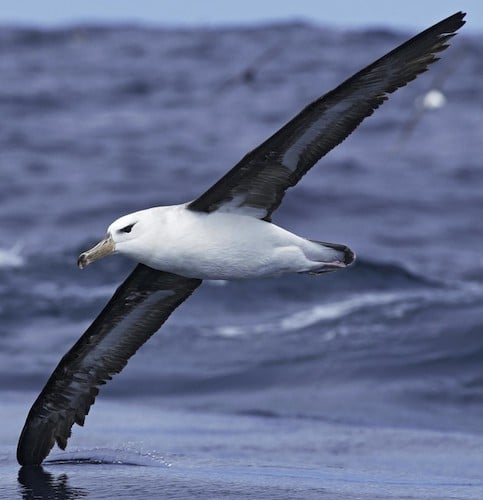
The Diomedeidae or Albatrosses are large seabirds allied to the procellariids (Petrels, Shearwaters, Storm Petrels and Diving Petrels) in the order Procellariiformes (the tubenoses). They range widely in the Southern Ocean and the North Pacific. They are absent from the North Atlantic, although fossil remains show they once occurred there and occasional vagrants are found. Albatrosses are among the largest of flying birds, and the great albatrosses (genus Diomedea) have the largest wingspans of any extant birds, reaching up to 3.7 metres. They are usually regarded as falling into four genera, but there is disagreement over the number of species, with several subspecies showing differences of mitochondrial DNA).
They are highly efficient in the air, using dynamic soaring and slope soaring to cover great distances with little exertion. They feed on squid, fish and krill by either scavenging, surface seizing or diving.
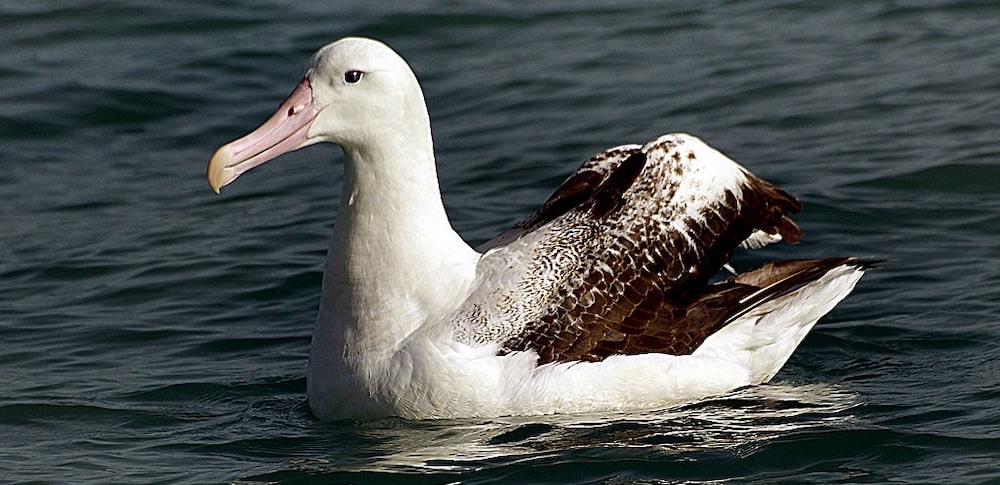
Wandering Albatross Diomedea exulans – ©Bernard Spragg CC0 via Wikimedia Commons
Most albatrosses range in the Southern Hemisphere from Antarctica to Australia, South Africa and South America. The exceptions to this are the four North Pacific albatrosses, of which three occur exclusively in the North Pacific, from Hawaii to Japan, California and Alaska; and one, the waved albatross, breeds in the Galápagos Islands and feeds off the coast of South America. The need for wind to enable gliding is the reason albatrosses are for the most part confined to higher latitudes: being unsuited to sustained flapping flight makes crossing the doldrums extremely difficult. The exception, the Waved Albatross, is able to live in the equatorial waters around the Galápagos Islands because of the cool waters of the Humboldt Current and the resulting winds.
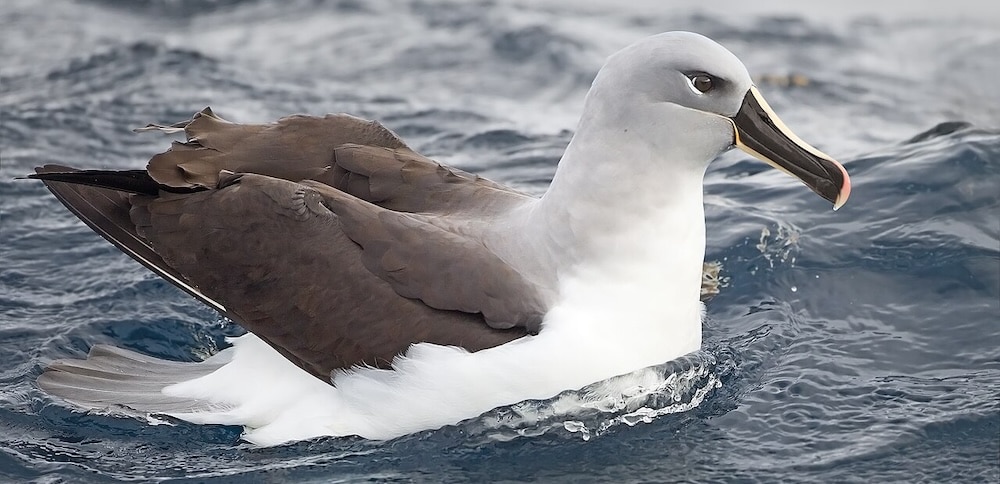
Grey-headed Albatross Thalassarche chrysostoma – ©JJ Harrison via Wikimedia Commons
The albatross diet is predominantly cephalopods, fish, crustaceans, and offal, although they will also scavenge carrion and feed on other zooplankton. Until recently it was thought that albatrosses were predominantly surface feeders, swimming at the surface and snapping up squid and fish pushed to the surface by currents, predators, or death. The deployment of capillary depth recorders, which record the maximum dive depth undertaken by a bird, has shown that while some species, like the Wandering Albatross, do not dive deeper than a metre, some species, like the Light-mantled Albatross, have a mean diving depth of almost 5 m and can dive as deep as 12.5m. In addition to surface feeding and diving, they have also been observed plunge diving from the air to snatch prey.
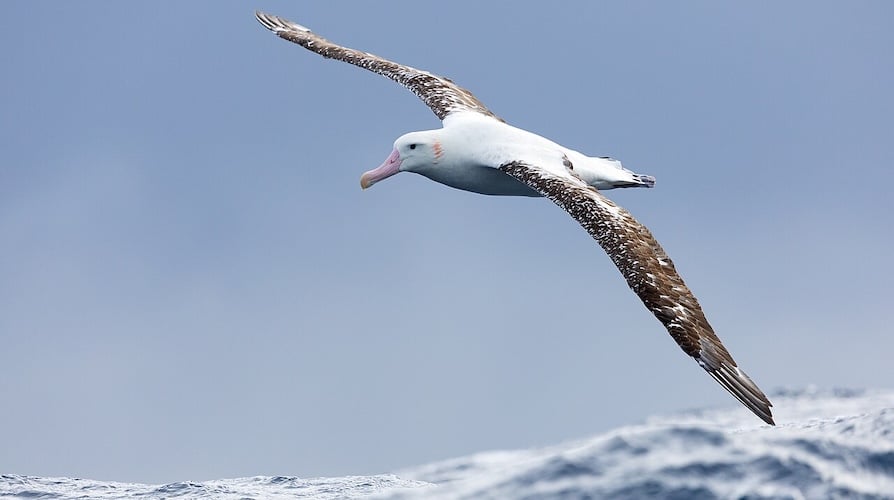
Antipodean Albatross Diomedea antipodensis – ©JJ Harrison via Wikimedia Commons
Albatrosses are colonial, nesting for the most part on remote oceanic islands, often with several species nesting together. Pair bonds between males and females form over several years, with the use of ‘ritualised dances’, and will last for the life of the pair. A breeding season can take over a year from laying to fledging, with a single egg laid in each breeding attempt.
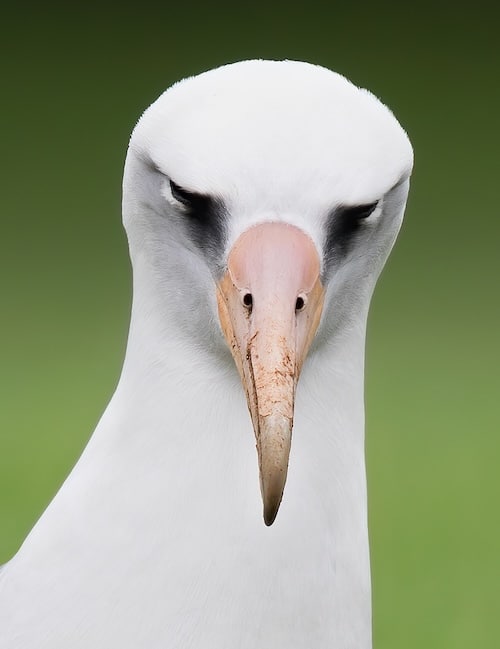
Laysan Albatross Phoebastria immutabilis – ©Dubi Shapiro
All the southern albatrosses create large nests for their egg, utilising grass, shrubs, soil, peat, and even penguin feathers, whereas the three species in the North Pacific make more rudimentary nests. The waved albatross, on the other hand, makes no nest and will even move its egg around the pair’s territory, as much as 50m, sometimes causing it to lose the egg. In all albatross species, both parents incubate the egg in stints that last between one day and three weeks. Incubation lasts around 70 to 80 days (longer for the larger albatrosses), the longest incubation period of any bird. It can be an energetically demanding process, with the adult losing as much as 83g of body weight a day.
Albatross chicks take a long time to fledge. In the case of the Great Albatrosses, it can take up to 280 days; even for the smaller albatrosses, it takes anywhere between 140 and 170 days.
Albatrosses live much longer than most other birds; they delay breeding for longer and invest more effort into fewer young. Most species survive upwards of 50 years, the oldest recorded being a Northern Royal Albatross that was ringed as an adult and survived for another 51 years, giving it an estimated age of 61. Given that most albatross ringing projects are considerably younger than that, it is thought likely that other species will prove to live at least as long.
-
Number of bird species: 20
(As at September 2025)
According to the recently (2025) amalgamated AviList, there are considered to be 20 species, in four genera of Albatrosses in the family Diomedeidae. They are:
Waved Albatross Phoebastria irrorata
Laysan Albatross Phoebastria immutabilis
Black-footed Albatross Phoebastria nigripes
Short-tailed Albatross Phoebastria albatrus
Northern Royal Albatross Diomedea sanfordi
Southern Royal Albatross Diomedea epomophora
Wandering Albatross Diomedea exulans
Tristan Albatross Diomedea dabbenena
Antipodean Albatross Diomedea antipodensis
Amsterdam Albatross Diomedea amsterdamensis
Light-mantled Albatross Phoebetria palpebrata
Sooty Albatross Phoebetria fusca
Atlantic Yellow-nosed Albatross Thalassarche chlororhynchos
Indian Yellow-nosed Albatross Thalassarche carteri
Grey-headed Albatross Thalassarche chrysostoma
Black-browed Albatross Thalassarche melanophris
Buller’s Albatross Thalassarche bulleri
Shy Albatross Thalassarche cauta
Salvin’s Albatross Thalassarche salvini
Chatham Albatross Thalassarche eremita
-
Albatross Task Force
WebpageThe Albatross Task Force, led by BirdLife International and its UK partner, the RSPB, is an international team of experts on a mission to reduce seabird bycatch by 80% in some of the world's deadliest fisheries. -
Friends of the Albatross
WebpageDiaries from newly appointed Task Force members
-
Albatross
| By Graham Barwell | Reaktion Books | 2014 | Paperback | 208 pages, 60 colour & 40 b/w photos and illustrations | ISBN: 9781780231914 Buy this book from NHBS.com -
Around the World for Albatrosses - Where to See All the Albatross Species
| By Otto Plantema | Otto Plantema | 2019 | Hardback | 148 pages, colour photos, colour maps | ISBN: Buy this book from NHBS.com -
Field Guide to the Albatrosses, Petrels and Shearwaters of the World
| By Derek Onley & Paul Scofield 2| Christopher Helm | 2007 | Paperback | 240 pages, 46 colour plates, distribution maps | ISBN: 9780713643329 Buy this book from NHBS.com -
Holy Mōlī - Albatross and Other Ancestors
| By Hob Osterlund | OSUP | 2016 | Paperback | 147 pages, b/w photos | ISBN: 9780870718489 Buy this book from NHBS.com -
Seabirds: A Natural History
| By Anthony J Gaston | A&C Black | 2004 | Hardback | 222 pages, 22 colour plates, b/w photos, illustrations, figures | ISBN: 9780713665574 Buy this book from NHBS.com
-
Diomedeidae
Family AccountThese birds have the longest, narrowest wings of any bird, and all the wing bones are elongated. Indeed, the humerus is so long that the wings have an extra... -
Diomedeidae
Family AccountAlbatrosses, of the biological family Diomedeidae, are large seabirds related to the procellariids, storm petrels, and diving petrels in the order...
Given that this is a quite small family with just twenty species in only four genera, Fatbirder provides active links below to all species.
-
Amsterdam Albatross Diomedea amsterdamensis
Species AccountA huge Wandering-type albatross that breeds only on Amsterdam Island in the southern Indian Ocean, with only a handful of records elsewhere (mainly Australia). -
Amsterdam Albatross Diomedea amsterdamensis
Species AccountSound archive and distribution map. -
Antipodean Albatross Diomedea antipodensis
Species AccountHuge albatross of the Southern Ocean. Two subspecies: “Gibson's” breeds primarily on Auckland Island and ranges at sea around New Zealand and eastern Australia. -
Antipodean Albatross Diomedea antipodensis
Species AccountSound archive and distribution map. -
Atlantic Yellow-nosed Albatross Thalassarche chlororhynchos
Species AccountMassive seabird, but relatively small and slender for an albatross. Breeds on Gough and Tristan da Cunha islands in South Atlantic. -
Atlantic Yellow-nosed Albatross Thalassarche chlororhynchos
Species AccountSound archive and distribution map. -
Black-browed Albatross Diomedea melanophris
Species AccountSound archive and distribution map. -
Black-browed Albatross Diomedea melanophris
Species AccountA common and widespread albatross of the southern oceans; often seen from shore and ferries. Like other albatrosses, often scavenges at fishing boats. -
Black-browed Albatross Diomedea melanophris
Species AccountThe black-browed albatross (Thalassarche melanophris), also known as the black-browed mollymawk,[3] is a large seabird of the albatross family Diomedeidae; it is the most widespread and common member of its family. -
Black-browed Albatross Diomedea melanophris
Species AccountThe Black-browed Albatross is the most common albatross seen in southern Australian waters for most of the year, and is the only one of the mollymawks (another name for the smaller black-and-white albatrosses) with a yellow bill. The bill has a pink tip. -
Black-browed Albatross Diomedea melanophris
Species AccountThalassarche melanophris is listed as Least Concern. -
Black-footed Albatross Phoebastria nigripes
Species AccountSound archive and distribution map. -
Black-footed Albatross Phoebastria nigripes
Species AccountSimilarly pelagic shearwaters and petrels are smaller with shorter wings. Also dark, but rare, first-year Short-tailed Albatross has pink bill and legs. Other albatross species have white bodies and heads… -
Black-footed Albatross Phoebastria nigripes
Species AccountPhoebastria nigripes is listed as Near Threatened under criteria A3cd. -
Black-footed Albatross Phoebastria nigripes
Species AccountVery large seabird, overall cold brown with whitish face. Some adults show a slightly paler belly. Juveniles are darker brown overall. -
Buller’s Albatross |Thalassarche bulleri
Species AccountBuller's albatross (Thalassarche bulleri) or Buller's mollymawk, is a small mollymawk in the albatross family. ... It breeds on islands around New Zealand... -
Buller’s Albatross |Thalassarche bulleri
Species AccountSound archive and distribution map. -
Chatham Albatross Thalassarche eremita
Species AccountThe Chatham albatross (Thalassarche eremita), also known as the Chatham mollymawk or Chatham Island mollymawk, is a medium-sized black-and-white albatross... -
Chatham Albatross Thalassarche eremita
Species AccountSound archive and distribution map. -
Grey-headed Albatross Thalassarche chrysostoma
Species AccountThe grey-headed albatross (Thalassarche chrysostoma) also known as the grey-headed mollymawk, is a large seabird from the albatross family. It has a circumpolar distribution, nesting on isolated islands in the Southern Ocean and feeding at high latitudes, further south than any of the other mollymawks. Its name derives from its ashy-grey head, throat and upper neck. -
Grey-headed Albatross Thalassarche chrysostoma
Species AccountSound archive and distribution map. -
Indian Yellow-nosed Albatross Thalassarche carteri
Species AccountThe Indian yellow-nosed albatross (Thalassarche carteri) is a member of the albatross family, and is the smallest of the mollymawks. In 2004, BirdLife International[2] split this species from the Atlantic yellow-nosed albatross. -
Indian Yellow-nosed Albatross Thalassarche carteri
Species AccountThalassarche carteri is listed as Endangered under criteria A4bde. -
Indian Yellow-nosed Albatross Thalassarche carteri
Species AccountSound archive and distribution map. -
Laysan Albatross Diomedea immutabilis
Species AccountSound archive and distribution map. -
Laysan Albatross Diomedea immutabilis
Cornell Species AccountOne of the most marvelous sights in the Pacific ocean is the graceful glide of a Laysan Albatross at play among the winds and waves. -
Laysan Albatross Diomedea immutabilis
Species AccountPhoebastria immutabilis is listed as Near Threatened under criteria A4bd. -
Laysan Albatross Diomedea immutabilis
Species AccountThe Laysan albatross (Phoebastria immutabilis) is a large seabird that ranges across the North Pacific. The Northwestern Hawaiian Islands are home to 99.7% of the population. -
Light-mantled Albatross Phoebetria palpebrata
Species AccountA small, dark albatross with pointed wings and tail. Note the ashy-gray neck and back feathers contrasting with the dark head. Generally solitary. -
Light-mantled Albatross Phoebetria palpebrata
Species AccountSound archive and distribution map. -
Northern Royal Albatross Diomedea sanfordi
Species AccountHuge albatross of the Southern Ocean; breeds mainly on Chatham Islands in New Zealand, but ranges widely. -
Northern Royal Albatross Diomedea sanfordi
Species AccountSound archive and distribution map. -
Salvin’s Albatross Thalassarche salvini
Species AccountBreeds in New Zealand and ranges across temperate South Pacific to Humboldt Current, where it is by far the most numerous “gray-hooded” albatross off Chile... -
Salvin’s Albatross Thalassarche salvini
Species AccountSound archive and distribution map. -
Short-tailed Albatross Phoebastria albatrus
Species AccountThe Short-tailed Albatross Phoebastria albatrus once bred in huge numbers on at least eleven uninhabited remote islands in subtropical waters west of the Izu-Bonin islands chain, south of Japan. These long-lived birds do not reach full maturity until about 12 years old; away from the breeding islands they ranged widely throughout the north Pacific Ocean (Hasegawa 1984). Here in California, it was once… -
Short-tailed Albatross Phoebastria albatrus
BirdLife Species AccountBirdLife species profile… -
Short-tailed Albatross Phoebastria albatrus
Species AccountThe short-tailed albatross or Steller's albatross (Phoebastria albatrus) is a large rare seabird from the North Pacific. Although related to the other North Pacific albatrosses, it also exhibits behavioural and morphological links to the albatrosses of the Southern Ocean. -
Short-tailed Albatross Phoebastria albatrus
Species AccountSound archive and distribution map. -
Short-tailed Albatrosses Phoebastria albatrus
Species AccountPhoebastria albatrus is listed as Vulnerable under criteria D2. -
Shy Albatross Thalassarche cauta
Species AccountThe shy albatross (Thalassarche cauta), also known as the shy mollymawk, is a medium-sized albatross that breeds on three remote islands off the coast... -
Shy Albatross Thalassarche cauta
Species AccountSound archive and distribution map. -
Sooty Albatross Phoebetria fusca
Species AccountThe sooty albatross (Phoebetria fusca), also known to sailors as the Quaker, is a species of marine bird belonging to the albatross family Diomedeidae. -
Sooty Albatross Phoebetria fusca
Species AccountSound archive and distribution map. -
Southern Royal Albatross Diomedea epomophora
Species AccountHuge albatross of the Southern Ocean; breeds mainly on Campbell and Auckland Islands in New Zealand, but ranges widely. -
Southern Royal Albatross Diomedea epomophora
Species AccountSound archive and distribution map. -
Tristan Albatross Diomedea dabbenena
Species AccountThe Tristan albatross (Diomedea dabbenena) is a large seabird from the albatross family. One of the great albatrosses of the genus Diomedea. -
Tristan Albatross Diomedea dabbenena
Species AccountSound archive and distribution map. -
Wandering Albatross Diomedea exulans
Species AccountThe snowy albatross (Diomedea exulans), also known as the wandering albatross, white-winged albatross, or goonie, is a large seabird from the family Diomedeidae... -
Wandering Albatross Diomedea exulans
Species AccountSound archive and distribution map. -
Waved Albatross Phoebastria irrorata
Species AccountSpecies Account -
Waved Albatross Phoebastria irrorata
Species AccountSound archive and distribution map.