

Haematopodidae – Oystercatchers
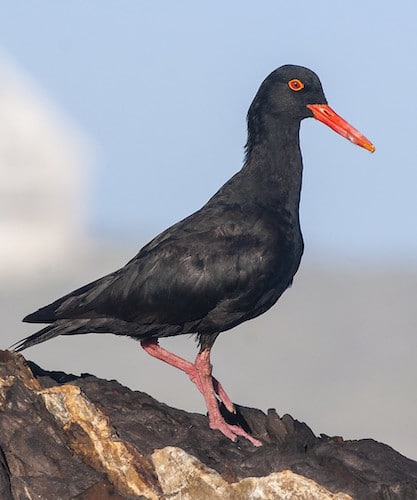
The Haematopodidae (Oystercatchers) family is related to the waders, but sufficiently distinctive to merit its own family. The order Charadriiformes also includes Pluvianellidae (Magellanic Plover), Chionidae (Sheathbills), Burhinidae (Thick-knees & Stone Curlews), Pluvianidae (Egyptian Plover), Recurvirostridae (Stilts & Avocets) Ibidorhynchidae (Ibisbill), Charadriidae (Plovers & Lapwings), Pedionomidae (Plains Wanderer), Thinocoridae (Seedsnipes), Rostratulidae (Painted Snipe), Jacanidae (Jacanas), Scolopacidae (Sandpipers), Turnicidae (Buttonquails), Dromadidae (Crab-Plover), Glareolidae (Coursers & Pratincoles), Stercorariidae (Skuas), Alcidae (Auks) and Laridae (Gulls, Terns & Skimmers).
All Haematopodidae belong to a single genus, Haematopus. They are found on coasts worldwide apart from the polar regions and some tropical regions of Africa and South East Asia. The exception to this is the Eurasian Oystercatcher and the South Island Oystercatcher, both of which breed inland, far inland in some cases. In the past there has been a great deal of confusion as to the species limits, with discrete populations of all black oystercatchers being afforded specific status but Pied Oystercatchers being considered one single species.
The different species of oystercatcher show little variation in shape or appearance. They range from 39cm to 50cm in length and 72cm to 91cm in wingspan. The Eurasian Oystercatcher is the lightest on average, at 526g, while the Sooty Oystercatcher is the heaviest, at 819g. The plumage of all species is either all-black, or black (or dark brown) on top and white underneath. The variable oystercatcher is slightly exceptional in being either all-black or pied. They are large, obvious, and noisy plover-like birds, with massive long orange or red bills used for smashing or prying open molluscs. The bill shape varies between species, according to the diet. Those birds with blade-like bill tips pry open or smash mollusc shells, and those with pointed bill tips tend to probe for annelid worms. They show sexual dimorphism, with females being longer-billed and heavier than males.
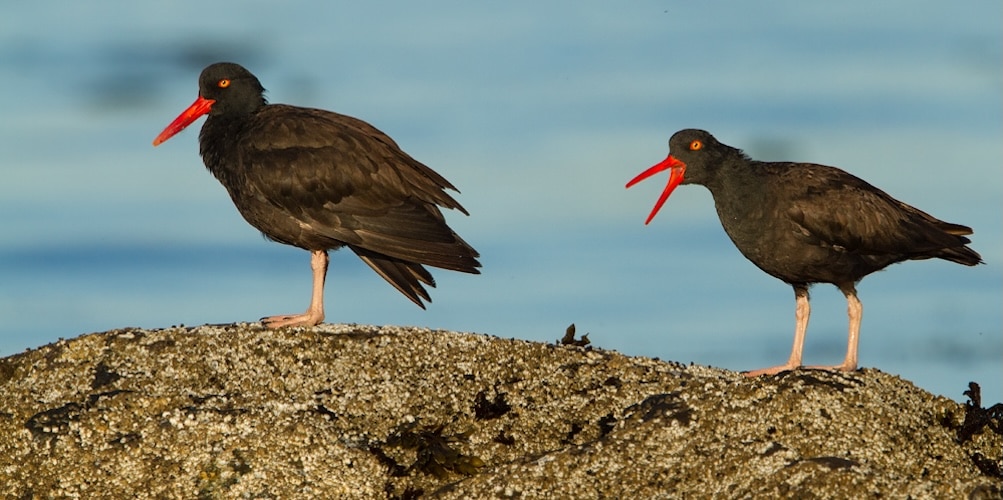
Black Oystercatcher Haematopus bachmani – ©Dubi Shapiro
The diet of oystercatchers varies with location. Species occurring inland feed upon earthworms and insect larvae. The diet of coastal oystercatchers is more varied, although dependent upon coast type; on estuaries bivalves, gastropods and polychaete worms are the most important part of the diet, whereas rocky shore oystercatchers, prey upon limpets, mussels, gastropods, and chitons. Other prey items include echinoderms, fish, and crabs.
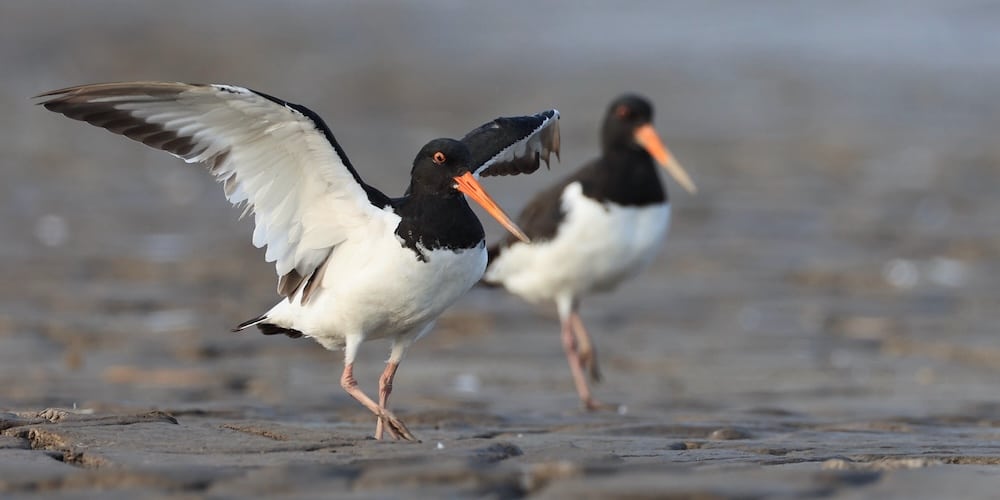
Eurasian Oystercatcher Haematopus ostralegus – ©Bird-Photo-Tours ASIA
Nearly all species of oystercatcher are monogamous, although there are reports of polygamy in the Eurasian Oystercatcher. They are territorial during the breeding season (with a few species defending territories year-round). There is strong mate and site fidelity in the species that have been studied, with one record of a pair defending the same site for 20 years. A single nesting attempt is made per breeding season, which is timed over the summer months. The nests of oystercatchers are simple affairs, scrapes in the ground which may be lined, and placed in a spot with good visibility. The eggs of oystercatchers are spotted and cryptic. Between one and four eggs are laid, with three being typical in the Northern Hemisphere and two in the south. Incubation is shared but not proportionally, females tend to take more incubation and males engage in more territory defence. Incubation varies by species, lasting between 24–39 days. Oystercatchers are also known to practice ‘egg dumping’. Like the cuckoo, they sometimes lay their eggs in the nests of other species such as gulls, abandoning them to be raised by those birds.
-
Number of bird species: 12
(As at August 2025)
According to the recently (2025) unified AviList there are just 12 extant species of Oystercatcher in one genus in the family Haematopodidae. They are:
Magellanic Oystercatcher Haematopus leucopodus
Blackish Oystercatcher Haematopus ater
Black Oystercatcher Haematopus bachmani
American Oystercatcher Haematopus palliatus
Sooty Oystercatcher Haematopus fuliginosus
African Oystercatcher Haematopus moquini
Canary Island Oystercatcher Haematopus meadewaldoi
Eurasian Oystercatcher Haematopus ostralegus
Pied Oystercatcher Haematopus longirostris
Chatham Oystercatcher Haematopus chathamensis
Variable Oystercatcher Haematopus unicolor
South Island Oystercatcher Haematopus finschi
-
International Wader Study Group
WebsiteThe International Wader Study Group (IWSG) is an association of amateurs and professionals from all parts of the world interested in Charadrii (waders or shorebirds). Membership of the WSG is currently over 650 worldwide. Members can be found in over 50 countries around the world, including all European countries and the Americas, Asia, Africa and Australasia. The interests of the group have diversified from its original focus from ringing and migration-related studies to embrace all aspects of wader biology. -
Western Hemisphere Shorebird Reserve Network
WebsiteWHSRN is a voluntary, non-regulatory coalition of over 200 private and public organizations in seven countries working together to study and conserve shorebirds throughout their habitats. Participation in WHSRN provides the site with international recognition as a major host for shorebirds
-
Geographical Variation in Waders
| By Meinte Engelmoer & Cees S Roselaar | Kluwer Academic Publishers | 1998 | Hardback | 331 pages, figures, tabs, maps | ISBN: 9780792350200 Buy this book from NHBS.com -
Shorebirds of North America - A Natural History and Photographic Celebration
| By Pete Dunne & Kevin T Karlson | PUP | 2024 | Hardback | 294 pages, 225 colour photos | ISBN: 9780691220956 Buy this book from NHBS.com -
The Oystercatcher - From Individuals to Populations
| By John D Goss-Custard | Oxford University Press | 1996 | Hardback | 442 pages, Figures, tables | ISBN: 9780198546474 Buy this book from NHBS.com -
Waders of Europe, Asia & North America
| By Stephen Message & Don Taylor | Helm | 2005 | Paperback | 224 pages, 80 plates with colour illustrations | ISBN: 9780713652901 Buy this book from NHBS.com
-
Haematopodidae
Family AccountThe oystercatchers are distinctive (and noisy) birds of the shoreline with their black and white (or, in some species, all black) plumage and stout orange...
Given that this is a relatively small family with just 12 species in only two genera, Fatbirder provides active links below to all species.
-
African OystercatcherHaematopus moquini
Species AccountThe African oystercatcher or African black oystercatcher (Haematopus moquini), is a large charismatic wader resident to the mainland coasts and offshore islands of southern Africa. -
African OystercatcherHaematopus moquini
Species AccountHaematopus moquini is listed as Least Concern. -
African OystercatcherHaematopus moquini
Species AccountSound archive and distribution map. -
American Oystercatcher Haematopus palliatus
Species AccountThe American oystercatcher (Haematopus palliatus), occasionally called the American pied oystercatcher, is a member of family Haematopodidae. The bird is marked by its black and white body and a long, thick orange beak. -
American Oystercatcher Haematopus palliatus
Species AccountA large, boldly patterned bird, the American Oystercatcher is conspicuous along ocean shores and salt marshes. -
American Oystercatcher Haematopus palliatus
Species AccountHaematopus palliatus is listed as Least Concern. -
American Oystercatcher Haematopus palliatus
Species AccountSound archive and distribution map. -
Black Oystercatcher Haematopus bachmani
Species AccountThe black oystercatcher (Haematopus bachmani) is a conspicuous black bird found on the shoreline of western North America. It ranges from the Aleutian Islands of Alaska to the coast of the Baja California peninsula. -
Black Oystercatcher Haematopus bachmani
Species AccountA large, conspicuous, and noisy bird of the Pacific Coast, the Black Oystercatcher can be found along rocky shores from Alaska to Baja California. -
Black Oystercatcher Haematopus bachmani
Species AccountSound archive and distribution map. -
Blackish Oystercatcher Haematopus ater
Species AccountThe blackish oystercatcher (Haematopus ater) is a species of wading bird in the oystercatcher family Haematopodidae. It is found in Argentina, Chile, the Falkland Islands and Peru, and is a vagrant to Uruguay. -
Blackish Oystercatcher Haematopus ater
Species AccountHaematopus ater is listed as Least Concern. -
Blackish Oystercatcher Haematopus ater
Species AccountSound archive and distribution map. -
Canary Island Oystercatcher Haematopus meadewaldoi
Species AccountAll dark oystercatcher with red eye, orange-red eye-ring and bill, and pale pinkish red legs; in flight, when seen from below, primaries have pale bases. -
Canary Island Oystercatcher Haematopus meadewaldoi
Species AccountThe Canary Islands oystercatcher, Canarian oystercatcher, or Canarian black oystercatcher (Haematopus meadewaldoi), is an extinct shorebird of uncertain... -
Canary Island Oystercatcher Haematopus meadewaldoi
Species AccountSound archive and distribution map. -
Chatham Oystercatcher Haematopus chathamensis
Species AccountSound archive and distribution map. -
Chatham Oystercatcher Haematopus chathamensis
Species AccountHaematopus chathamensis is listed as Endangered under criteria D. -
Chatham Oystercatcher Haematopus chathamensis
Species AccountThe Chatham oystercatcher or Chatham Island oystercatcher (Haematopus chathamensis) is a species of oystercatcher. It is a wading bird endemic to the Chatham Islands, New Zealand. This species is rated by the IUCN as endangered, and has a current population of 310 to 325 birds (2004 census). The main threat is from introduced predators -
Eurasian Oystercatcher Haematopus ostralegus
Species AccountCommon, conspicuous, and often noisy large wader (shorebird) of varied coastal habitats, especially beaches and mudflats; also nearby fields and locally inland. -
Eurasian Oystercatcher Haematopus ostralegus
Species AccountThe Eurasian oystercatcher (Haematopus ostralegus) also known as the common pied oystercatcher, or palaearctic oystercatcher,[2] or (in Europe) just oystercatcher, is a wader in the oystercatcher bird family Haematopodidae. It is the most widespread of the oystercatchers, with three races breeding in western Europe, central Eurasia, Kamchatka, China, and the western coast of Korea. No other oystercatcher occurs within this area. -
Eurasian Oystercatcher Haematopus ostralegus
Species AccountSound archive and distribution map. -
Magellanic Oystercatcher Haematopus leucopodus
Species AccountA boldly patterned large and chunky shorebird of southern South America and Falklands. Favors rocky coastlines and adjacent river mouths, but also frequent... -
Magellanic Oystercatcher Haematopus leucopodus
Species AccountThe Magellanic oystercatcher (Haematopus leucopodus) is a species of wader in the family Haematopodidae. It is found in Argentina, Chile and the Falkland Islands in freshwater lake and sandy shore habitats. -
Magellanic Oystercatcher Haematopus leucopodus
Species AccountSound archive and distribution map. -
Pied Oystercatcher Haematopus longirostris
Species AccountSound archive and distribution map. -
Pied Oystercatcher Haematopus longirostris
Species AccountThe Pied Oystercatcher is black with a white breast and belly. All oystercatchers have a bright orange-red bill, eye-rings and legs and a red eye. Young birds are similar in appearance to the adults, but lack the intense red-orange colours and are brown rather than black. -
Pied Oystercatcher Haematopus longirostris
Species AccountThe pied oystercatcher (Haematopus longirostris) is a species of oystercatcher. It is a wading bird native to Australia and commonly found on its coastline. The similar South Island pied oystercatcher (H. finschi) occurs in New Zealand. -
Sooty Oystercatcher Haematopus fuliginosus
Species AccountThe sooty oystercatcher (Haematopus fuliginosus) is a species of oystercatcher. It is a wading bird endemic to Australia and commonly found on its coastline. It prefers rocky coastlines, but will occasionally live in estuaries. All of its feathers are black. It has a red eye, eye ring and bill, and pink legs. -
Sooty Oystercatcher Haematopus fuliginosus
Species AccountThe Sooty Oystercatcher is a striking black shorebird with a long red bill, red eye and pink legs. Young birds are duller and browner. It is often seen with the similar Pied Oystercatcher and is only found in coastal areas. -
Sooty Oystercatcher Haematopus fuliginosus
Species AccountSound archive and distribution map. -
South Island Oystercatcher Haematopus finschi
Species Accounthe South Island oystercatcher or South Island pied oystercatcher (Haematopus finschi) is one of the two common oystercatchers found in New Zealand. -
South Island Oystercatcher Haematopus finschi
Species AccountThe South Island pied oystercatcher (SIPO) is the most abundant oystercatcher in New Zealand. -
South Island Oystercatcher Haematopus finschi
Species AccountSound archive and distribution map. -
Variable Oystercatcher Haematopus unicolor
Species AccountThe variable oystercatcher (Haematopus unicolor) is a species of wader in the family Haematopodidae. It is endemic to New Zealand. The Maori name is torea-pango. -
Variable Oystercatcher Haematopus unicolor
Species AccountThe variable oystercatcher is a familiar stocky coastal bird with a long, bright orange bill, found around much of New Zealand. -
Variable Oystercatcher Haematopus unicolor
Species AccountSound archive and distribution map.