

Ibidorhynchidae – Ibisbill
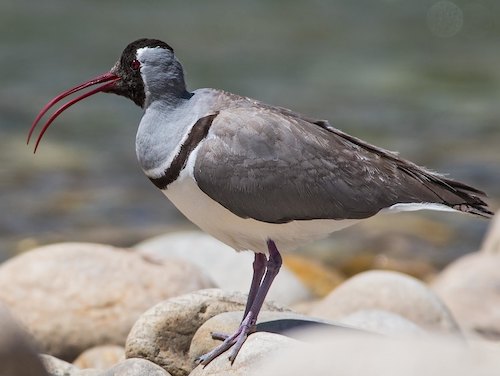
The Ibidorhynchidae family has just one member, the Ibisbill. The family is related to the waders, but sufficiently distinctive to merit its own family. The order Charadriiformes also includes Pluvianellidae (Magellanic Plover), Chionidae (Sheathbills), Burhinidae (Thick-knees & Stone Curlews), Pluvianidae (Egyptian Plover), Recurvirostridae (Stilts & Avocets) Haematopodidae (Oystercatchers), Charadriidae (Plovers & Lapwings), Pedionomidae (Plains Wanderer), Thinocoridae (Seedsnipes), Rostratulidae (Painted Snipe), Jacanidae (Jacanas), Scolopacidae (Sandpipers), Turnicidae (Buttonquails), Dromadidae (Crab-Plover), Glareolidae (Coursers & Pratincoles), Stercorariidae (Skuas), Alcidae (Auks) and Laridae (Gulls, Terns & Skimmers). It is grey with a white belly, red legs and long down-curved bill, and a black face and black breast band. It occurs on the shingle riverbanks of the high plateau of central Asia and the Himalayas.
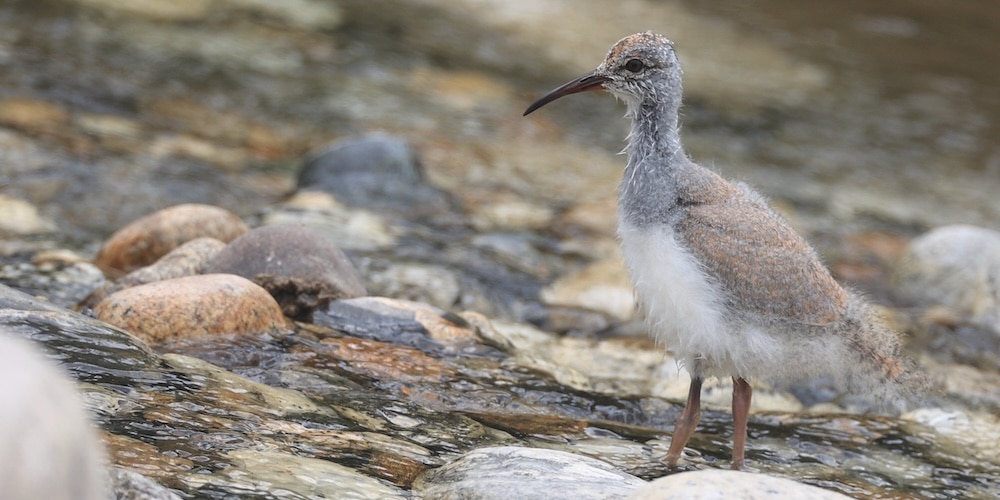
Ibisbill Chick Ibidorhyncha struthersii – ©Bird-Photo-Tours ASIA
The ibisbill is 38cm to 41cm long and is quite unmistakable in appearance. The adult is grey with a white belly, a crimson, long down-curved bill similar to that of the unrelated ibis, and a black face and black breast band. The sexes are similar, but young birds lack the black on the face and breast, and the bill is duller. The bill is 6.8cm to 8.2cm long and is slightly longer in females. The legs are greyish purple in the breeding adults and dull sepia in juveniles or greenish in younger or non-breeding adults. The legs of deceased ibisbills change colour to a crimson similar to the bill shade shortly after death. The tarsi is short and reticulated. The ibisbill has three toes, lacking the hind toe. The outer and middle toes are connected by a small, indented web, while the middle and inner toes possess no webbing. They typically weigh 270g to 320g with females weighing slightly more than males. In spite of its spectacular appearance, it is inconspicuous in its stony environment. The call is a ringing ‘Klew-klew’ similar to that of a greenshank. In flight, its outstretched neck and rounded wings give an ibis-like appearance.
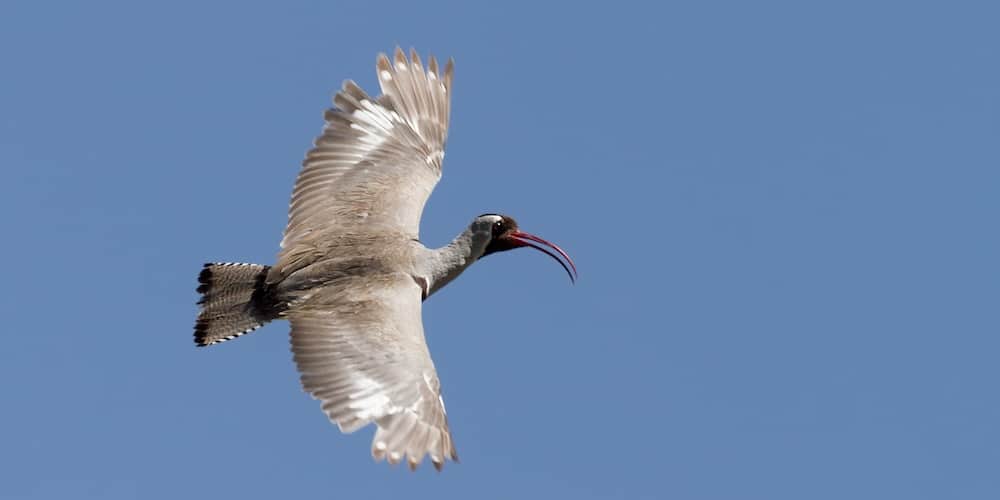
Ibisbill Ibidorhyncha struthersii – ©Dubi Shapiro
It breeds across southern Central Asia along stony riverbeds, typically between 1,700m and 4,400m although there are records of breeding as low as 500m. Outside the breeding season, it may descend as low as 100m. Typically, it is found in shingle-bed river valleys from 100m to 1,500m across with patches of sand and silt mixed in with pebbles and small boulders. The river valleys frequented by the ibisbill tend to have very little vegetation and gentle slopes to ensure a slow flow of water. It must live near slow-flowing water in order to feed, limiting its habitat despite a large range.
During the autumn and winter, they are typically solitary, though they can be found in pairs or in small flocks of up to eight birds. One group of 25 ibisbills has been reported. They breed solitarily and are territorial, though limited habitat availability can cause ibisbills to breed while neighbouring others. They are generally not shy of humans. They are good swimmers and prefer crossing rivers by swimming instead of flying.
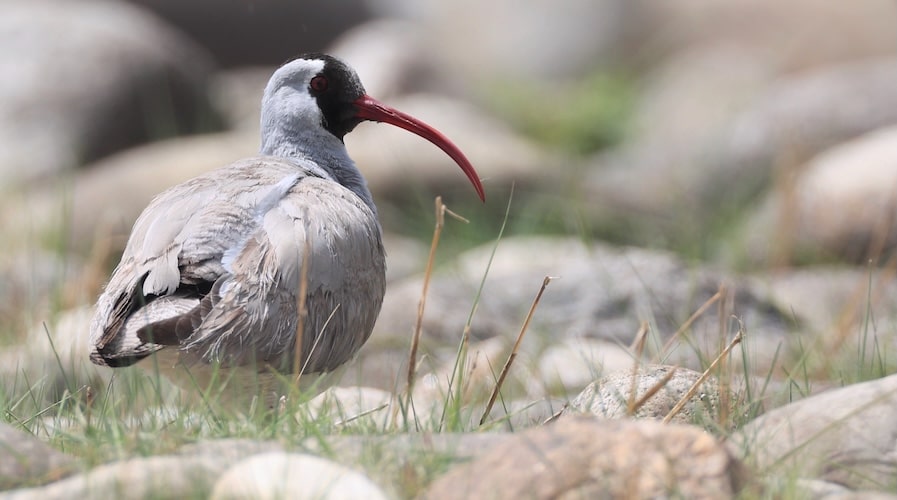
Ibisbill Ibidorhyncha struthersii – ©Bird-Photo-Tours ASIA
Wintering birds tend to be fairly inactive, while they become more active and noisier as the breeding season approaches. When scratching the feathers on their head with their toes, they reach from over the wings. This indirect approach pattern is also found in plovers and lapwings but not in stone-plovers and other waders, which reach directly from under the wing.
The ibisbill is apparently a monogamous breeder. During the breeding season, they are known to run short distances while holding the head down, only standing upright to look at its surroundings. The nest is located on a bank, island or peninsula on the river, and is little more than a scrape on the ground, which may sometimes be lined with small pebbles. Eggs are laid in the end of April and the beginning of May (exact timing varies due to the weather). The clutch size varies from two to four oval eggs. The behaviour of adults near the nest are said to be similar to lapwings. The exact time taken to incubate the eggs is unknown, but both parents share incubation duties. It is suspected that chicks from the previous brood may act as helpers at the nest.
They feed by probing under rocks or gravel on stream beds. It will take a variety of terrestrial and aquatic invertebrates including caddisfly and mayfly larvae that hide under boulders in streams, grasshoppers and also small fish.
-
Number of bird species: 1
(As at August 2025)
The Ibidorhynchidae family has just one species, which is:
Ibisbill Ibidorhyncha struthersii
-
Ibidorhynchidae
Family AccountThe Ibisbill is the sole member of Ibidorhynchidae, within the suborder Charadrii of Charadriiformes
-
Ibisbill Ibidorhyncha struthersii
Species AccountExpertly camouflaged amongst the fast-moving rocky rivers and streams it prefers, this specialized wader is often difficult to see. -
Ibisbill Ibidorhyncha struthersii
Species AccountThe ibisbill (Ibidorhyncha struthersii) is a bird related to the waders, but sufficiently distinctive to merit its own family Ibidorhynchidae. -
Ibisbill Ibidorhyncha struthersii
Species AccountSound archive and distribution map.