

Jacanidae – Jacanas
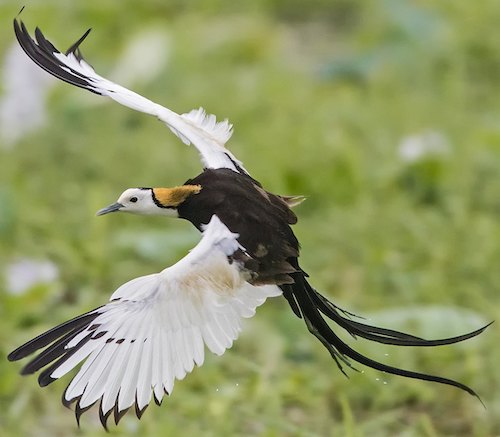
The Jacanidae (Jacanas) family is related to the waders, but sufficiently distinctive to merit its own family. The order Charadriiformes also includes Pluvianellidae (Magellanic Plover), Chionidae (Sheathbills), Burhinidae (Thick-knees & Stone Curlews), Pluvianidae (Egyptian Plover), Ibidorhynchidae (Ibisbill), Recurvirostridae (Stilts & Avocets) Haematopodidae (Oystercatchers), Charadriidae (Plovers & Lapwings), Pedionomidae (Plains Wanderer), Thinocoridae (Seedsnipes), Rostratulidae (Painted Snipe), Scolopacidae (Sandpipers), Turnicidae (Buttonquails), Dromadidae (Crab-Plover), Glareolidae (Coursers & Pratincoles), Stercorariidae (Skuas), Alcidae (Auks) and Laridae (Gulls, Terns & Skimmers). There are just eight species of birds, in six genera.
Jacanas are sometimes referred to as Jesus birds or lily trotters, because their very long toes enable them to walk across the surface of lake vegetation. They are found worldwide within the tropical zone. They are identifiable by their huge feet and claws which enable them to walk on floating vegetation in the shallow lakes that are their preferred habitat. They have sharp bills and rounded wings, and many species also have wattles on their foreheads.
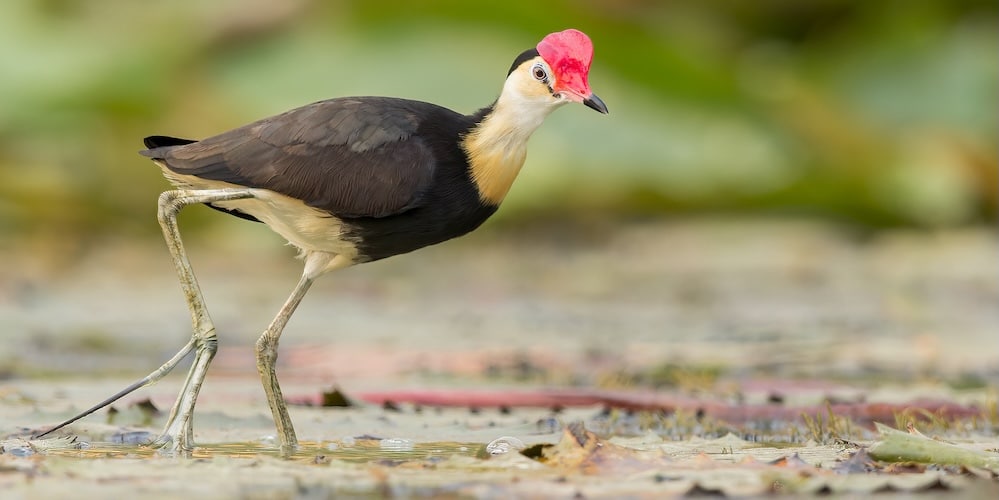
Comb-crested Jacana Irediparra gallinacean – ©Dubi Shapiro
Jacanas were once placed in the family Parridae based on the genus Parra but the family name is now Jacanidae based on the type genus Jacana. The family is placed within the order Charadriiformes under the suborder Scolopaci and is a sister of the Rostratulidae (Painted-snipes). They have 10 tail feathers unlike most others wader groups which have twelve. They have a rudimentary caecum.
There is some sexual dimorphism, female jacanas are larger than the males. The latter, as in some other wader families like the phalaropes, take responsibility for incubation, and some species (notably the Northern Jacana) are polyandrous. However, adults of both sexes look identical, as with most shorebirds. They construct relatively flimsy nests on floating vegetation, and lay eggs with dark irregular lines on their shells, providing camouflage amongst water weeds.
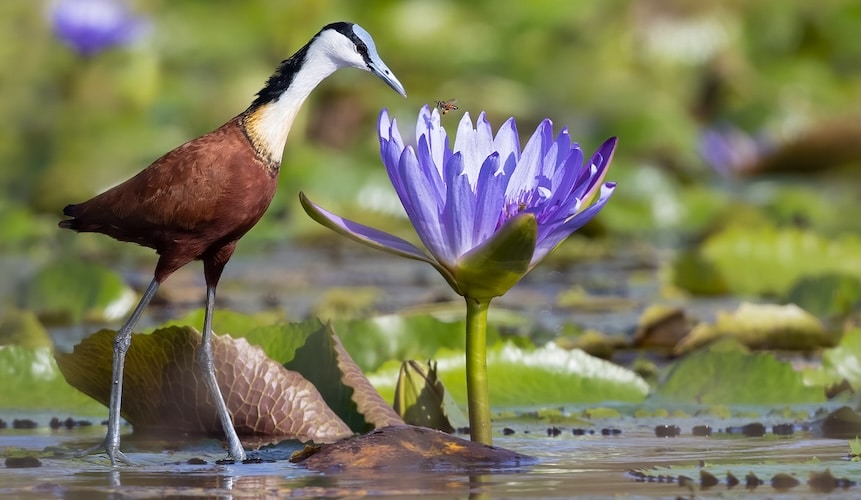
African Jacana Actophilornis africanus – ©Dubi Shapiro
The eggs are slightly smaller than in comparable species and it has been considered that this may be due to an evolutionary trade-off given the larger number of clutches that are laid. Male jacanas brood eggs between the wings and the body. This wing-brooding may be assisted by a special adaptation in the wing bones with either a broadening of the radius or a widening of the gap between the radius and ulna. Young chicks may also be held under the wing and transported to safety by the parent bird in some species. Young chicks dive underwater and stay submerged with only their bill out of water. Some adult jacanas also use the same technique. African jacanas go through a simultaneous moult of their flight feathers leading to a period of flightlessness. Their moult is related to their ability to breed opportunistically based on the availability of rains.
Their diet consists of insects and other invertebrates picked from the floating vegetation or the water’s surface. Most species are sedentary, but the Pheasant-tailed Jacana migrates from the north of its range into peninsular India and southeast Asia.
-
Number of bird species: 8
(As at August 2025)
According to the recently (2025) unified AviList there are just 8 species of Jacanidae in six genera. They are:
Pheasant-tailed Jacana Hydrophasianus chirurgus
Northern Jacana Jacana spinosa
Wattled Jacana Jacana jacana
Lesser Jacana Microparra capensis
Comb-crested Jacana Irediparra gallinacea
Bronze-winged Jacana Metopidius indicus
African Jacana Actophilornis africanus
Madagascar Jacana Actophilornis albinucha
-
Jacanidae
Family AccountJacanas are the water-striders of the bird world. Though they cannot walk on water, their exceedingly long slender toes, extended by long splint-like nails... -
Jacanidae
Family AccountThe jacanas are a group of tropical waders in the family Jacanidae. They are found in the tropical regions around the world.
Given that this is a small family with just 8 species in six genera, Fatbirder provides active links below to all species.
-
African Jacana Actophilornis africanus
Species AccountThe African jacana (Actophilornis africanus) is a wader in the family Jacanidae, identifiable by long toes and long claws that enable them to walk on floating vegetation in shallow lakes, their preferred habitat. -
African Jacana Actophilornis africanus
Species AccountAfrican Jacana Actophilornis africanus has most recently been assessed for The IUCN Red List of Threatened Species in 2016. Actophilornis africanus is listed as Least Concern. -
African Jacana Actophilornis africanus
Species AccountSound archive and distribution map. -
Bronze-winged Jacana Metopidius indicus
Species AccountThe bronze-winged jacana (Metopidius indicus) is a jacana. It is the only member of the genus Metopidius. -
Bronze-winged Jacana Metopidius indicus
Species AccountSound archive and distribution map. -
Comb-crested Jacana Irediparra gallinacea
Species AccountThe comb-crested jacana (Irediparra gallinacea), also known as the lotusbird or lilytrotter, is the only species of jacana in the genus Irediparra. Like other jacana species, it is adapted to the floating vegetation of tropical freshwater wetlands. -
Comb-crested Jacana Irediparra gallinacea
Species AccountSound archive and distribution map. -
Lesser Jacana Microparra capensis
Species AccountIt is found in Angola, Botswana, Burkina Faso, Burundi, Cameroon, Central African Republic, Chad, Democratic Republic of the Congo, Ivory Coast, Ethiopia, Kenya, Malawi, Mali, Mauritania, Mozambique, Namibia, Niger, Nigeria, Rwanda, Sierra Leone, South Africa, Sudan, Swaziland, Tanzania, Uganda, Zambia, and Zimbabwe.[1] Its primary habitats are coastal and inland wetlands and waterways -
Lesser Jacana Microparra capensis
Species AccountLesser Jacana Microparra capensis has most recently been assessed for The IUCN Red List of Threatened Species in 2016. Microparra capensis is listed as Least Concern. -
Lesser Jacana Microparra capensis
Species AccountSound archive and distribution map. -
Madagascar Jacana Actophilornis albinucha
Species AccountSound archive and distribution map. -
Madagascar Jacana Actophilornis albinucha
Species AccountMadagascar Jacana Actophilornis albinucha has most recently been assessed for The IUCN Red List of Threatened Species in 2020. Actophilornis albinucha is listed as Endangered under criteria C2a(ii). -
Madagascar Jacana Actophilornis albinucha
Species AccountThe Madagascan jacana (Actophilornis albinucha) is a species of bird in the Jacanidae family. It is endemic to Madagascar. -
Northern Jacana Jacana spinosa
Species AccountFancy-looking, vaguely chicken-like bird of freshwater marshes, lakes, and ponds in tropical lowlands, locally in highlands. -
Northern Jacana Jacana spinosa
Species AccountThe northern jacana or northern jaçana (Jacana spinosa) is a wader which is a resident breeder from coastal Mexico to western Panama, and on Cuba, Jamaica and Hispaniola. It sometimes breeds in Texas, United States. -
Northern Jacana Jacana spinosa
Species AccountNorthern Jacana Jacana spinosa has most recently been assessed for The IUCN Red List of Threatened Species in 2020. Jacana spinosa is listed as Least Concern. -
Northern Jacana Jacana spinosa
Species AccountSound archive and distribution map. -
Pheasant-tailed Jacana Hydrophasianus chirurgus
Species AccountThe pheasant-tailed jacana (Hydrophasianus chirurgus) is a jacana in the monotypic genus Hydrophasianus. Jacanas are a group of waders in the family Jacanidae that are identifiable by their wide feet and claws which enable them to walk on floating vegetation in shallow lakes, their preferred habitat. -
Pheasant-tailed Jacana Hydrophasianus chirurgus
Species AccountPheasant-tailed Jacana Hydrophasianus chirurgus has most recently been assessed for The IUCN Red List of Threatened Species in 2016. Hydrophasianus chirurgus is listed as Least Concern. -
Pheasant-tailed Jacana Hydrophasianus chirurgus
Species AccountSound archive and distribution map. -
Wattled Jacana Jacana jacana
Species AccountStriking marsh bird, medium-sized with exceptionally long toes. In some regions adult is entirely black; other populations more similar to Northern Jacana... -
Wattled Jacana Jacana jacana
Species AccountThe wattled jacana (Jacana jacana) is a wader which is a resident breeder from western Panama and Trinidad south through most of South America east of the Andes. -
Wattled Jacana Jacana jacana
Species AccountWattled Jacana Jacana jacana has most recently been assessed for The IUCN Red List of Threatened Species in 2019. Jacana jacana is listed as Least Concern. -
Wattled Jacana Jacana jacana
Species AccountSound archive and distribution map.