

Maluridae – Australasian Wrens
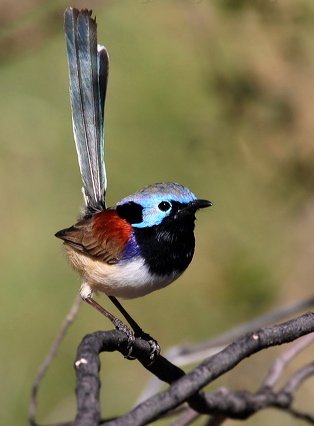
The Maluridae is a family of small, insectivorous passerines endemic to Australia and New Guinea. Commonly known as wrens, they are unrelated to the true wrens of the Northern Hemisphere. The family includes sixteen fairywrens, three emu-wrens, and thirteen grasswrens.
As with many other Australian creatures, and perhaps more than most, the species making up this family were comprehensively misunderstood by early researchers. They were variously classified as Old-World flycatchers, Old World warblers, and Old -World babblers. In the late 1960s, morphological studies began to suggest that the Australo-Papuan fairywrens, the grasswrens, emu-wrens and two monotypic wren-like genera from New Guinea were related and, following Charles Sibley’s pioneering work on egg-white proteins in the mid-1970s, Australian researchers adopted the family name Maluridae in 1975.
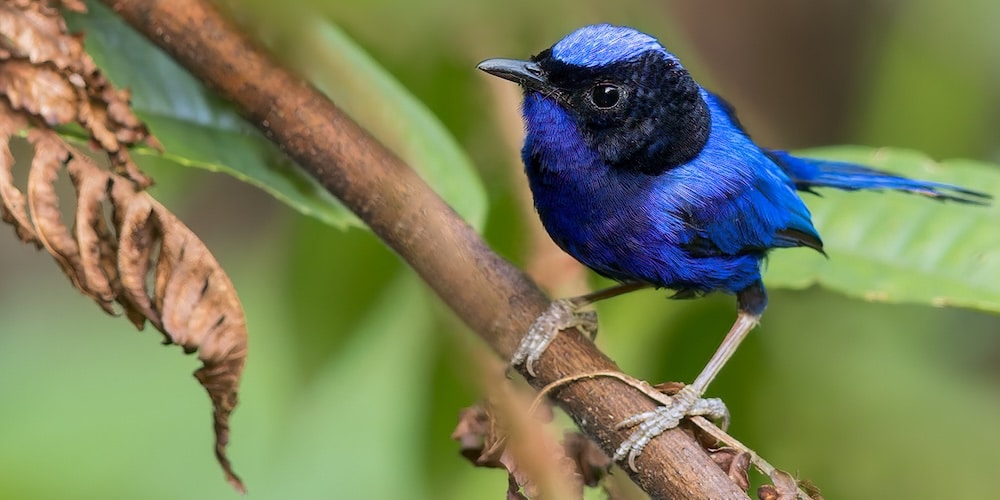
Male & Female Emperor Fairywren Malurus cyanocephalus – ©Dubi Shapiro
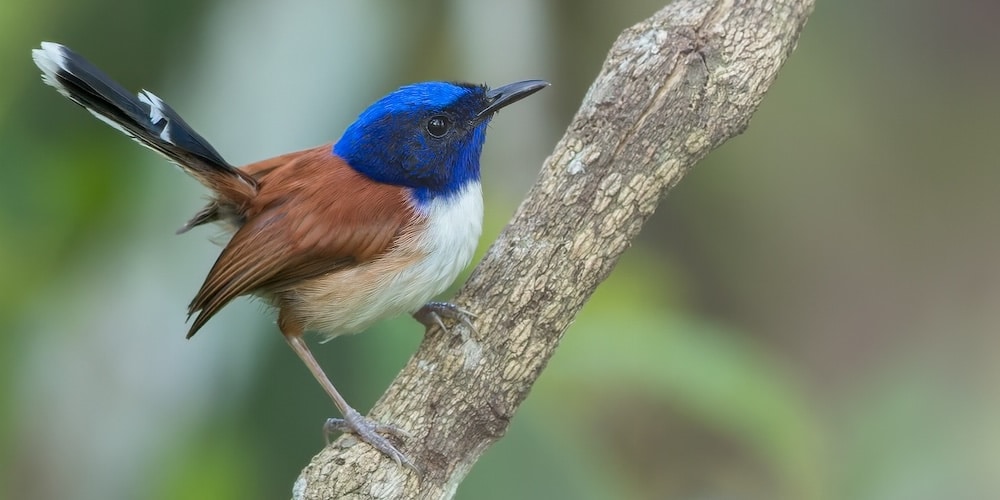
With further morphological work and the great strides made in DNA analysis towards the end of the 20th century, their position became clear: the Maluridae are one of the many families to have emerged from the great corvid radiation in Australasia. Their closest relatives are the Meliphagidae (Honeyeaters), and the Pardalotidae (Pardalotes). Their obvious similarity to the wrens of Europe and America is not genetic, but simply the consequence of convergent evolution between more-or-less unrelated species that share the same ecological niche.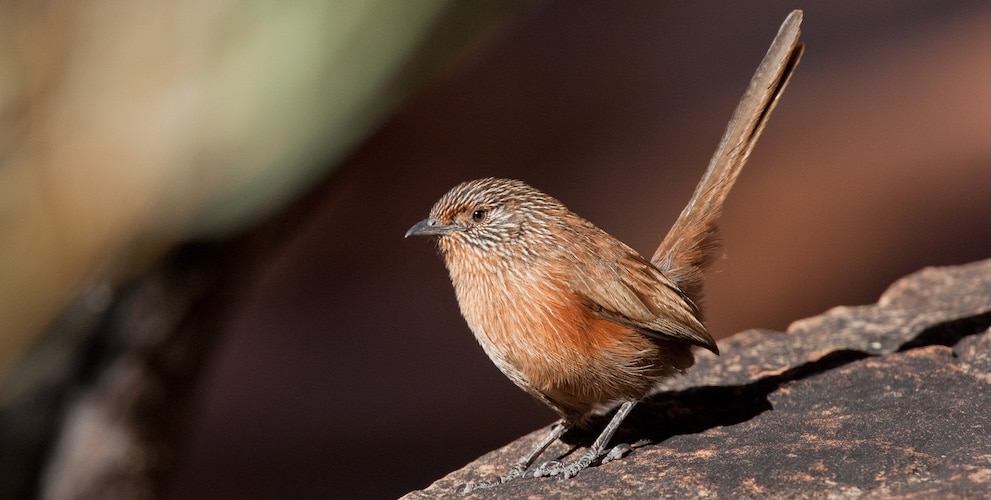
Dusky Grasswren Amytornis purnelli – ©Peter Jacobs CC BY-SA 2.0 via Wikimedia Commons
A analysis of mitochondrial and nuclear DNA found the broad-billed fairywren and Campbell’s fairywren (2011), both formerly lumped together in the genus Malurus, to lie in a clade with the two other monospecific New Guinea genera and as such, they were later re-classified as separate species within the genus Chenorhamphus.
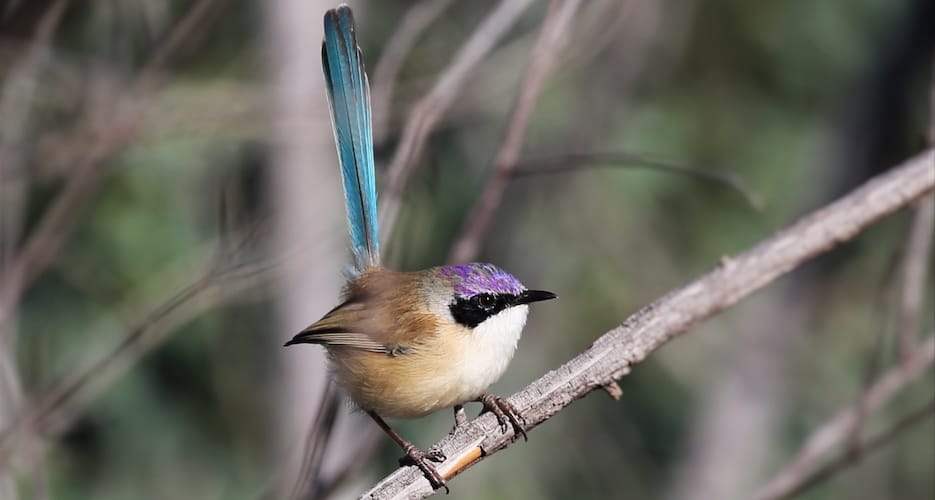
Purple-crowned Fairywren Malurus coronatus – ©Graham Winterflood CC BY-SA 2.0 via Wikimedia Commons
They are small birds, inhabiting a wide range of environments, from rainforest to desert, although most species inhabit grassland or scrub. The grasswrens are well camouflaged with black and brown patterns, but other species often have brilliantly coloured plumage, especially in the males. They live in a wide variety of habitats in Australia and New Guinea.
The whole family are insectivorous, typically foraging in underbrush. They build domed nests in areas of dense vegetation, and it is not unusual for the young to remain in the nest and assist in raising chicks from later clutches.
Fairywrens are notable for several peculiar behavioural characteristics. They are socially monogamous and sexually promiscuous, meaning that although they form pairs between one male and one female, each partner will mate with other individuals and even assist in raising the young from such pairings. Though their plumage colours are varied, some with exquisite splashes of blue and red and others streaked in muted earth tones, this diversity is grounded in a unified body plan and some of the most complicated mating systems in birds. Indeed, males in this family have reproductive tracts that are well adapted to meet the demands of sexual competition with their rivals, and some species practice high rates of extra-pair mating. But their courtship does not just entail well-developed gonads and feathered finery; males of several species pluck petals of conspicuous colours and display them to females, a behaviour yet to be explained.
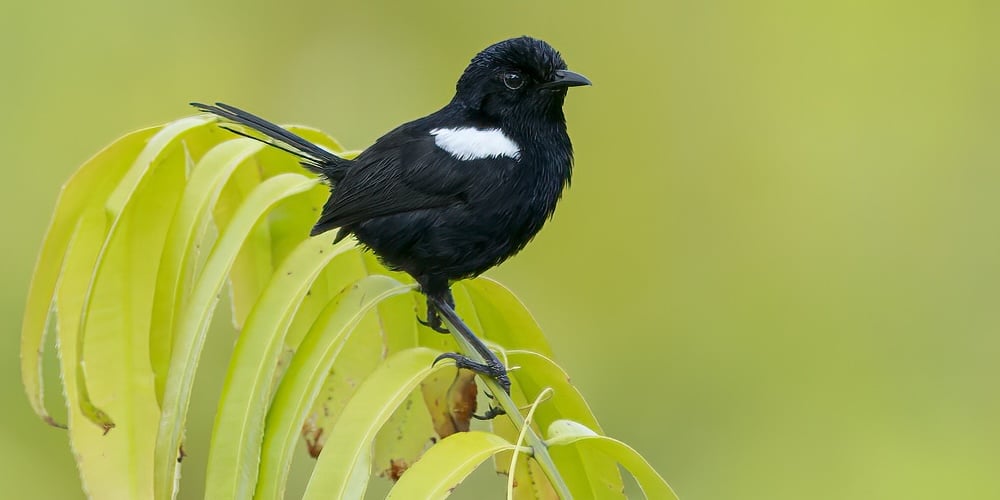
White-shouldered Fairywren Malurus alboscapulatus – ©Dubi Shapiro
The songs of fairywrens is pleasant and complex, and at least two species (superb and splendid), in addition to the alarm calls common to most small birds, have another vocalisation used when confronted by predators. This ‘Type II Vocalisation’, is song-like and used when confronted by calling butcherbirds, and sometimes other predatory birds. Its purpose is not yet understood; it is certainly not a warning call.
-
Number of bird species: 33
(As at November 2025)
According to the recently (2025) amalgamated AviList, there are thirty-three species, in six genera in the Maluridae family. They are:
Grey Grasswren Amytornis barbatus
Pilbara Grasswren Amytornis whitei
Sandhill Grasswren Amytornis oweni
Opalton Grasswren Amytornis rowleyi
Striated Grasswren Amytornis striatus
White-throated Grasswren Amytornis woodwardi
Carpentarian Grasswren Amytornis dorotheae
Short-tailed Grasswren Amytornis merrotsyi
Western Grasswren Amytornis textilis
Thick-billed Grasswren Amytornis modestus
Black Grasswren Amytornis housei
Eyrean Grasswren Amytornis goyderi
Dusky Grasswren Amytornis purnelli
Kalkadoon Grasswren Amytornis ballarae
Southern Emu-wren Stipiturus malachurus
Rufous-crowned Emu-wren Stipiturus ruficeps
Mallee Emu-wren Stipiturus mallee
Wallace’s Fairywren Sipodotus wallacii
Orange-crowned Fairywren Clytomyias insignis
Broad-billed Fairywren Chenorhamphus grayi
Campbell’s Fairywren Chenorhamphus campbelli
Emperor Fairywren Malurus cyanocephalus
Purple-crowned Fairywren Malurus coronatus
Red-winged Fairywren Malurus elegans
Blue-breasted Fairywren Malurus pulcherrimus
Purple-backed Fairywren Malurus assimilis
Variegated Fairywren Malurus lamberti
Lovely Fairywren Malurus amabilis
Splendid Fairywren Malurus splendens
Superb Fairywren Malurus cyaneus
White-winged Fairywren Malurus leucopterus
Red-backed Fairywren Malurus melanocephalus
White-shouldered Fairywren Malurus alboscapulatus
-
Maluridae
Family AccountThese perky, light-footed jewels live in a wide variety of habitats in Australia and New Guinea. -
Maluridae
Family AccountThe Australasian wrens are a family, Maluridae, of small, insectivorous passerine birds endemic to Australia and New Guinea.
Given the number of species in this family, Fatbirder does not provide quick links to all of them. However, the entries below do include links to representatives of every genera, all those illustrated and some of the most often encountered, iconic or sought-after species.
-
Broad-billed Fairywren Chenorhamphus grayi
Species AccountThe broad-billed fairywren (Chenorhamphus grayi) is a species of bird in the Australasian wren family, Maluridae. -
Broad-billed Fairywren Chenorhamphus grayi
Species AccountSound archive and distribution map -
Dusky Grasswren Amytornis purnelli
Species AccountDusky Grasswren Amytornis purnelli -
Dusky Grasswren Amytornis purnelli
Species AccountSound archive and distribution map -
Dusky Grasswren Amytornis purnelli
Species AccountSmall rusty-brown bird with finely streaked plumage and long cocked tail, found in rocky areas and gorges around spinifex clumps of central Australia. -
Dusky Grasswren Amytornis purnelli
Species AccountSound archive and distribution map -
Emperor Fairywren Malurus cyanocephalus
Species AccountThe emperor fairywren (Malurus cyanocephalus) is a species of bird in the Australasian wren family, Maluridae. It is found in New Guinea. -
Emperor Fairywren Malurus cyanocephalus
Species AccountSound archive and distribution map -
Grey Grasswren Amytornis barbatus
Species AccountThe grey grasswren (Amytornis barbatus) is a passerine bird of the family Maluridae native to inland Australia. It is a rarely seen elusive bird that was first sighted in 1921, but not taxonomically described until 1968. -
Grey Grasswren Amytornis barbatus
Species AccountSound archive and distribution map -
Lovely Fairy-wren Malurus amabilis
Species AccountThe lovely fairywren (Malurus amabilis) is a species of bird in the Maluridae family. It is endemic to northeastern Australia. Its natural habitats are subtropical or tropical dry forests and subtropical or tropical moist lowland forests. -
Lovely Fairy-wren Malurus amabilis
Species AccountSound archive and distribution map -
Mallee Emu-wren Stipiturus mallee
Species AccountThe Mallee Emu-wren (Stipiturus mallee) is a bird species in the family Maluridae. It is endemic to Australia. Its natural habitat is temperate grassland. It is threatened by habitat loss. -
Mallee Emu-wren Stipiturus mallee
Species AccountSound archive and distribution map -
Orange-crowned Fairywren Clytomyias insignis
Species AccountSound archive and distribution map -
Orange-crowned Fairywren Clytomyias insignis
Species AccountThe orange-crowned fairywren (Clytomyias insignis) is a species of passerine bird in the Australasian wren family, Maluridae. -
Purple-crowned Fairywren Malurus coronatus
Species AccountA small bird with a long blue tail that is held cocked. -
Purple-crowned Fairywren Malurus coronatus
Species AccountSound archive and distribution map -
Red-backed Fairy-wren Malurus melanocephalus
Species AccountThe red-backed fairywren (Malurus melanocephalus) is a species of passerine bird in the family Maluridae. It is endemic to Australia and can be found near rivers and coastal areas along the northern and eastern coastlines from the Kimberley in the northwest to the Hunter Region in New South Wales. -
Red-backed Fairy-wren Malurus melanocephalus
Species AccountThis is the smallest of the fairy-wrens, with the male in breeding plumage inmistakable; glossy black with a scarlet saddle, black bill and shortish tail with a squared tip. Adult non-breeding males and immature birds are very similar to the females which are plain warm-brown with a pinkish-brown bill, though males have a black bill. The tail of the females is longer and more pointed. These wrens have no blue in their plumage at all. They are usually in small family groups with mainly brownish birds. -
Red-backed Fairy-wren Malurus melanocephalus
Species AccountSound archive and distribution map -
Thick-billed Grasswren Amytornis modestus
Species AccountSmall brownish bird with fine white streaking and long cocked tail, found in open shrubland of northern South Australia and northwestern. -
Thick-billed Grasswren Amytornis modestus
Species AccountSound archive and distribution map -
Variegated Fairy-wren Malurus lamberti
Species AccountThe variegated fairywren (Malurus lamberti) is a fairywren that lives in diverse habitats across most of Australia. Four subspecies are recognised. -
Variegated Fairy-wren Malurus lamberti
Species AccountThe breeding male Variegated Fairy-wren is brightly coloured. The crown and sides of the head are blue, and the shoulder patch is a rich chestnut. The depth and variety of colours in the male varies among the four subspecies, distributed across the Australian mainland. Non-breeding males, females and young birds are brownish grey. Females -
Variegated Fairy-wren Malurus lamberti
Species AccountSound archive and distribution map -
Wallace's Fairywren Sipodotus wallacii
Species AccountA tiny bird of foothill forest mid-storey and canopy. -
Wallace's Fairywren Sipodotus wallacii
Species AccountSound archive and distribution map -
White-shouldered Fairywren Malurus alboscapulatus
Species AccountA small bird with a long tail that it often cocks. Male is all black with a white shoulder patch. -
White-shouldered Fairywren Malurus alboscapulatus
Species AccountSound archive and distribution map