

Pardalotidae – Pardalotes
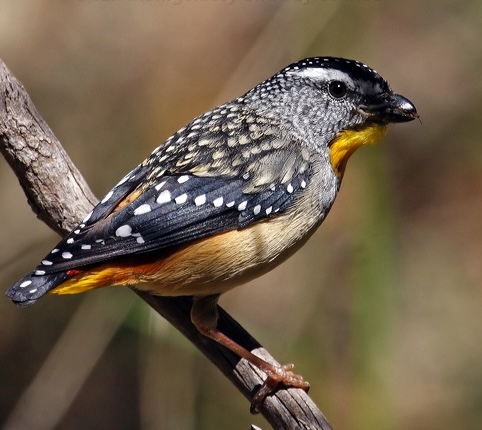
Pardalotidae (Pardalotes) (sometimes locally referred to as peep-wrens) are a family of very small, brightly coloured passerines that are native to Australia. They have short tails, strong legs, and stubby blunt beaks. The family is composed of four species in one genus, Pardalotus, and several subspecies. The name derives from a Greek word meaning ‘spotted’. The family was once thought to contain several other species now recognised as being in the family Acanthizidae.
They spend most of their time high in the outer foliage of trees, feeding on insects, spiders, and above all lerps (a type of sap-sucking insect). Their role in controlling lerp infestations in the eucalyptus forests of Australia may be significant. They generally live in pairs or small family groups but sometimes come together into flocks after breeding.
They are seasonal breeders in the temperate areas of Australia, but may breed year round in warmer areas. They are monogamous breeders, and both partners share nest construction, incubation and chick-rearing duties. All four species nest in deep horizontal tunnels drilled into banks of earth. Externally about the size of a mouse-hole, they can be very deep, at a metre or more. Some species also nest in tree hollows.
The pardalotes are small, compact birds that range in size from 8.5m to 12 cm in length. The Spotted Pardalote and Striated Pardalote conform to Bergmann’s rule and are larger in the south than they are in the north. The males and females are the same size as each other, but there are some differences in the plumage of some species. They have short, square-tipped tails and relatively short rounded wings (which are longer in the more dispersive species). The bill is short, deep and robust, but lacks the rictal bristles that surround the bills of many other insectivorous birds.
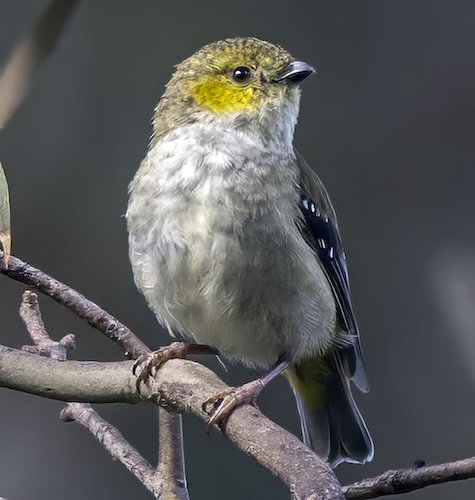
Forty-spotted Pardalote Pardalotus quadragintus – ©Charles J Sharp CC BY-SA 4.0 via Wikimedia Commons
The pardalotes are endemic to Australia. The Forty-spotted Pardalote has the most restricted distribution of the four species, being endemic to Tasmania; in contrast the most widespread species, the Striated Pardalote, is found throughout Australia, only absent from some of the driest areas of the inland central and western deserts. The Red-browed Pardalote is widespread in the north and west of Australia, whereas the Spotted Pardalote is found closer to the coast in southern and eastern Australia.
The family are eucalyptus forest specialists. While they may occur in forests and woodlands dominated by other tree types, these are marginal habitats for the family and are seldom used. They occupy a wide range of eucalypt habitats, from tall forests with a canopy over 30 metres high to low mallee woodlands with a canopy of just 3 metres.
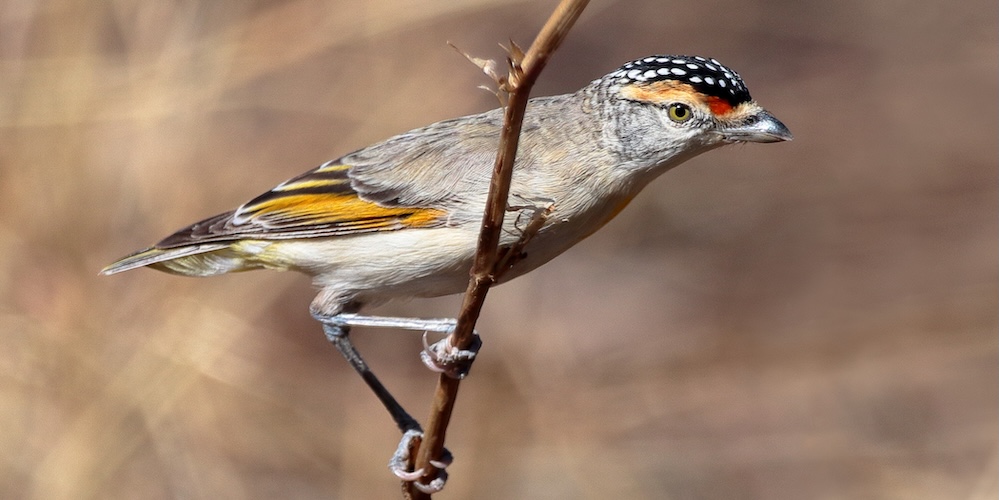
Red-browed Pardalote Pardalotus rubricatus – ©Summerdrought CC BY-SA 4.0 via Wikimedia Commons
Pardalotes are almost exclusively insectivores. They will occasionally consume some plant materials including seeds, and there has been an observation of one Striated Pardalote beating and then eating a lizard. They feed singly or in pairs during the breeding season, but have been recorded as joining mixed-species feeding flocks in the winter months. The majority of foraging occurs on Eucalyptus, with other trees being used much less frequently, and among the eucalypt, trees from the subgenus Symphyomyrtus are preferred. Pardalotes forage by gleaning insects from the foliage, as opposed to sallying and catching insects in the air. While they may consume a number of different types of insects, lerps, a honeydew casing exuded by insects of the family Psyllidae, form the major component of their diet and the one to which they are most adapted. These lerps are also highly sought after by the larger honeyeaters, which aggressively defend the resource.
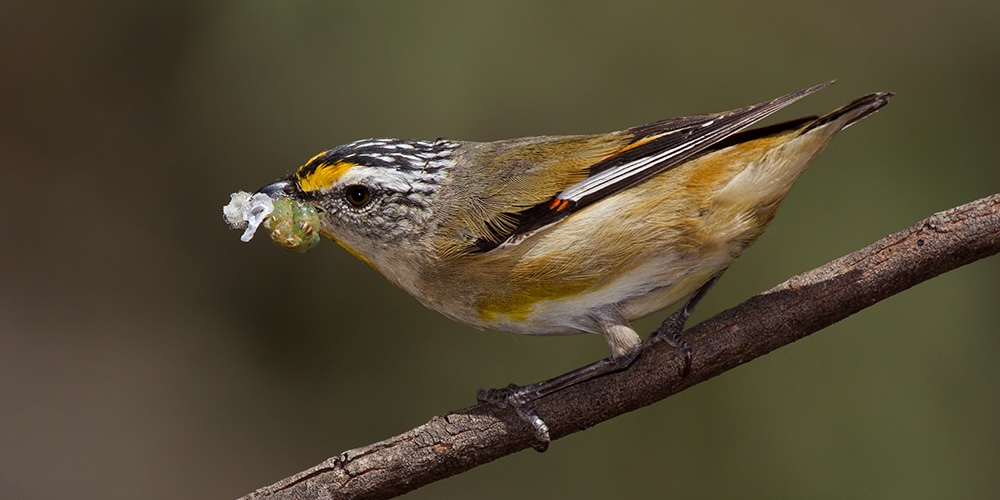
Striated Pardalote Pardalotus striatus – ©Patrick_K59 CC BY 2.0 via Wikimedia Commons
Pardalotes combine personality, attractive plumage, and intriguing habits to an extent matched by few other families of birds. These tiny short-tailed bundles of energy build their nests in holes in trees, in earthen banks, or even in potted plants left on a porch. Unlike many of their close relatives in Australasia, pardalotes raise their young without the assistance of offspring from prior nesting seasons, although they can be quite social in the non-breeding season. These stubby little birds often join mixed-species feeding flocks, where they tend to be dominated or excluded by their larger cousins the honeyeaters. A study of pardalotes in Australia estimated that 5% of a pardalote’s day is spent evading honeyeater attacks.
-
Number of bird species: 4
(As at December 2025)
According to the recently (2025) amalgamated AviList, there are just four species, in a single genus in the Pardalotidae family. They are:
Spotted Pardalote Pardalotus punctatus
Forty-spotted Pardalote Pardalotus quadragintus
Red-browed Pardalote Pardalotus rubricatus
Striated Pardalote Pardalotus striatus
-
Australian Birds, Pardalotes - Taxonomic and Natural History
By Maurizio Perini & Luca Milione | theOLVA | 2019 | Paperback | 167 pages, colour illustrations | ISBN: 9788890653544 Buy this book from NHBS.com
-
Pardalotidae
Family AccountPardalotes are cavity nesters, with some species excavating their own cavities in the ground and others burrowing or adopting preexisting tree... -
Pardalotidae
Family AccountPardalotes or peep-wrens are a family, Pardalotidae, of very small, brightly coloured birds native to Australia, with short tails, strong legs, and stubby...
Given that this is a small family with just four species in a single genus, Fatbirder provides active links below to all species.
-
Forty-spotted Pardalote Pardalotus quadragintus
Species AccountThe forty-spotted pardalote (Pardalotus quadragintus) is one of Australia's rarest birds and by far the rarest pardalote, being confined to the south-east corner of Tasmania. -
Forty-spotted Pardalote Pardalotus quadragintus
Species AccountThe Forty-spotted Pardalote is a small bird with a very short bill. It is a dull olive-green above with a pale grey chest and belly. The face and under the tail are olive-yellow. The wings are black, with prominent white spots, twenty on each side, that give the bird its name. -
Forty-spotted Pardalote Pardalotus quadragintus
Species AccountSound archive and distribution map. -
Red-browed Pardalote Pardalotus rubricatus
Species AccountThe red-browed pardalote (Pardalotus rubricatus) is a small brightly coloured insectivorous passerine, endemic to Australia (Schodde & Mason 1999). -
Red-browed Pardalote Pardalotus rubricatus
Species AccountPardalotus rubricatus is listed as Least Concern. -
Red-browed Pardalote Pardalotus rubricatus
Species AccountSound archive and distribution map -
Spotted Pardalote Pardalotus punctatus
Species AccountThe spotted pardalote (Pardalotus punctatus) is one of the smallest of all Australian birds at 8 to 10 centimetres (3.1 to 3.9 in) in length, and one of the most colourful; it is sometimes known as the diamondbird. -
Spotted Pardalote Pardalotus punctatus
Species AccountThe Spotted Pardalote is a tiny bird that is most often high in a eucalypt canopy, so it is more often detected by its characteristic call. -
Spotted Pardalote Pardalotus punctatus
Species AccountSound archive and distribution map. -
Striated Pardalote Pardalotus striatus
Species AccountThe striated pardalote (Pardalotus striatus) is the least colourful and most common of the four pardalote species. Other common names include pickwick, wittachew and chip-chip.[2] It is a very small, short-tailed bird that is more often heard than seen, foraging noisily for lerps and other small creatures in the treetops. -
Striated Pardalote Pardalotus striatus
Species AccountThe Striated Pardalote is more common than people usually think, with its call the first indication of the presence of this brightly coloured little bird. -
Striated Pardalote Pardalotus striatus
Species AccountSound archive and distribution map.