

Podicipedidae – Grebes
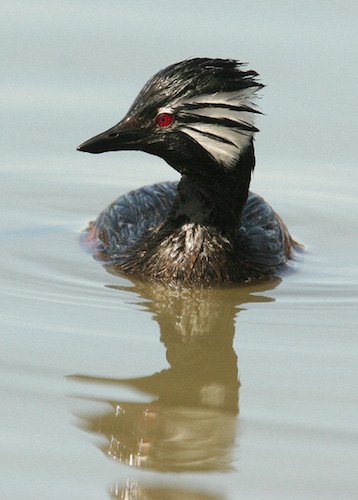
The Podicipediformes order is a widely distributed order of freshwater diving birds, some of which visit the sea when migrating and in winter. This order contains only a single family, the Podicipedidae, with twenty-two species in six genera. They are most closely related to flamingos.
They are small to medium-large in size, have lobed toes, and are excellent swimmers and divers. They swim by simultaneously spreading out the feet and bringing them inward, with the webbing expanded to produce the forward thrust in much the same way as frogs. Although they can run for a short distance, they are prone to falling over, since they have their feet placed far back on the body.
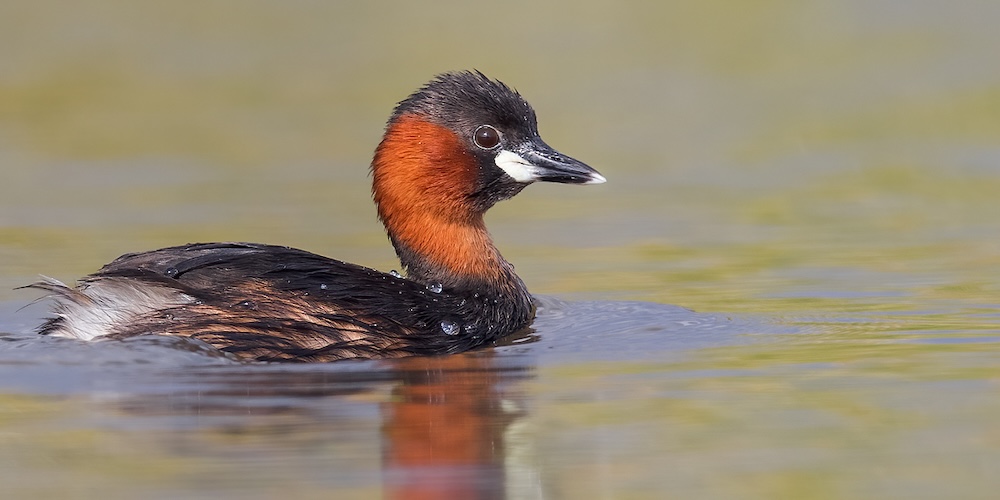
Little Grebe Tachybaptus ruficollis – ©Dubi Shapiro
Grebes have narrow wings, and some species are reluctant to fly; indeed, two South American species are completely flightless. They respond to danger by diving rather than flying, and are in any case much less wary than ducks. Extant species range in size from the Least Grebe, at 120 grams and 23.5cm to the Great Grebe, at 1.7kg and 71cm.
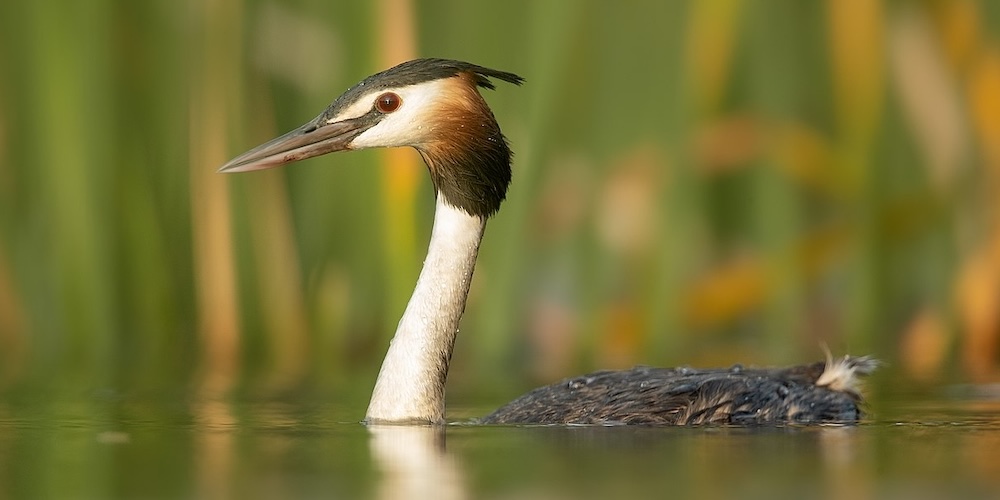
Great Crested Grebe Podiceps cristatus – ©JJ Harrison CC BY-SA 4.0 via Wikimedia Commons
The North American and Eurasian species are all, of necessity, migratory over much or all of their ranges, and those species that winter at sea are also seen regularly in flight. Even the small freshwater Pied-billed Grebe of North America has occurred as a transatlantic vagrant to Europe on many occasions.
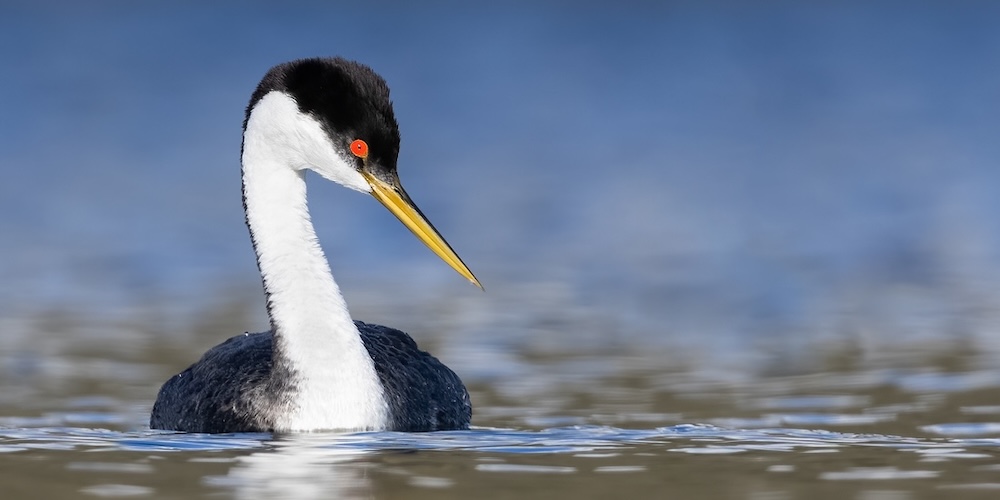
Western Grebe Aechmophorus occidentalis – ©Dubi Shapiro
Bills vary from short and thick to long and pointed, depending on the diet, which ranges from fish to freshwater insects and crustaceans. The feet are always large, with broad lobes on the toes and small webs connecting the front three toes. The hind toe also has a small lobe. Recent experimental work has shown that these lobes work like the hydrofoil blades of a propeller.
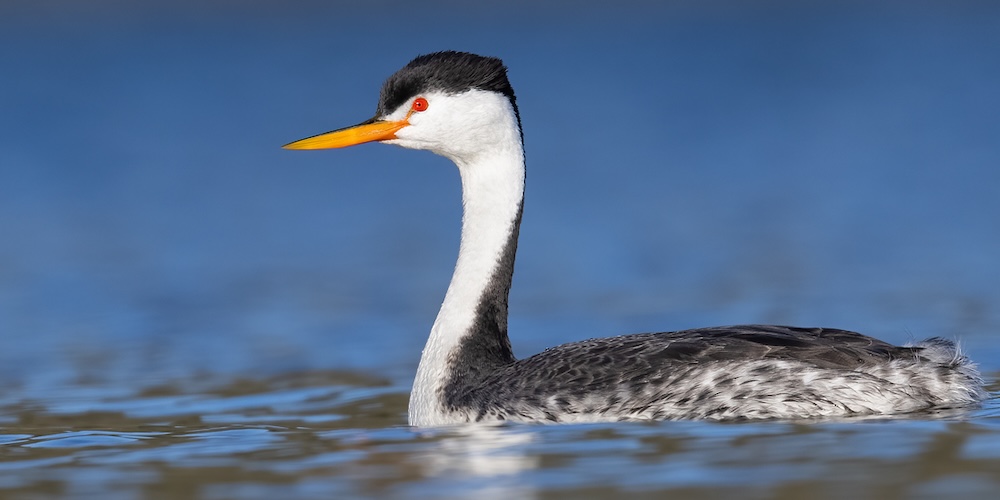
Clark’s Grebe Aechmophorus clarkii – ©Dubi Shapiro
Grebes have unusual plumage. On average grebes have 20,000 feathers, the highest among birds. The feathers are very dense and strongly curved. In the larger species feathers are more dense but shorter, while the opposite is true in smaller species where the feathers are longer but less dense. The density and length of feathers is correlated exponentially with heat-loss in cold water. For this reason, grebes invest the most time and effort of all birds in plumage maintenance. The uropygial glands secrete a high concentration of paraffin. The secretion provides a dual purpose of protecting the feathers from external parasites and fungi, as well as waterproofing them.
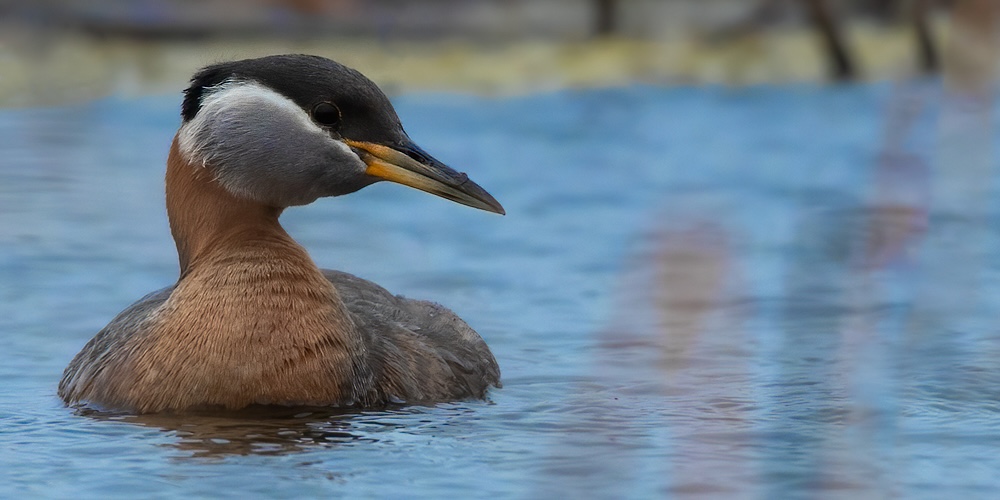
Red-necked Grebe Podiceps grisegena – ©Dubi Shapiro
In the non-breeding season, grebes are generally plain-coloured in dark browns and whites. However, most have ornate and distinctive breeding plumages, often developing chestnut markings on the head area, and performing elaborate display rituals. These can include ‘dancing’ across the water with the intended mate, with bodies fully erect and above the water. Nesting material may be offered by the male to the female. The young, particularly those of the Podiceps genus, are often striped and retain some of their juvenile plumage even after reaching full size. In the breeding season, they mate at freshwater lakes and ponds, but some species spend their non-breeding season along seacoasts.
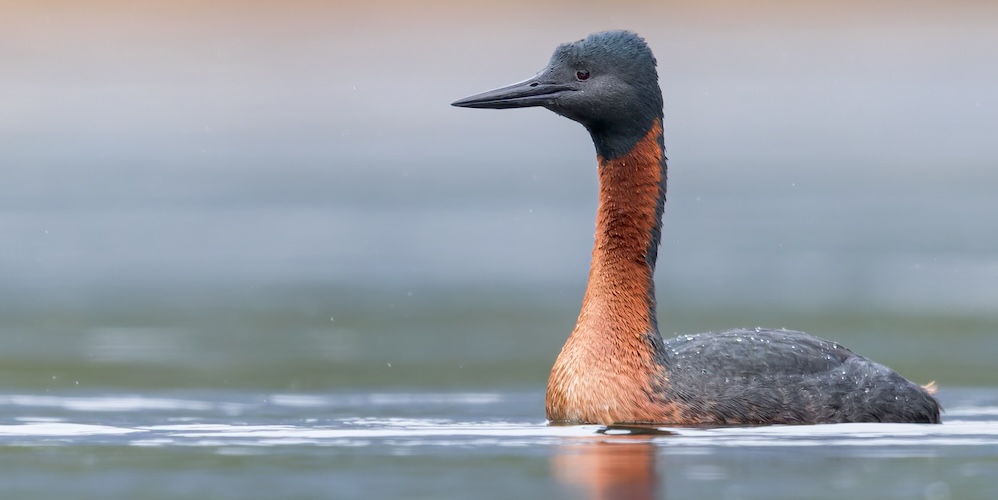
Great Grebe Podiceps major – ©Dubi Shapiro
When preening, grebes eat their own feathers, and feed them to their young. The function of this behaviour is uncertain but it is believed to assist with pellet formation, and to reduce their vulnerability to gastric parasites.
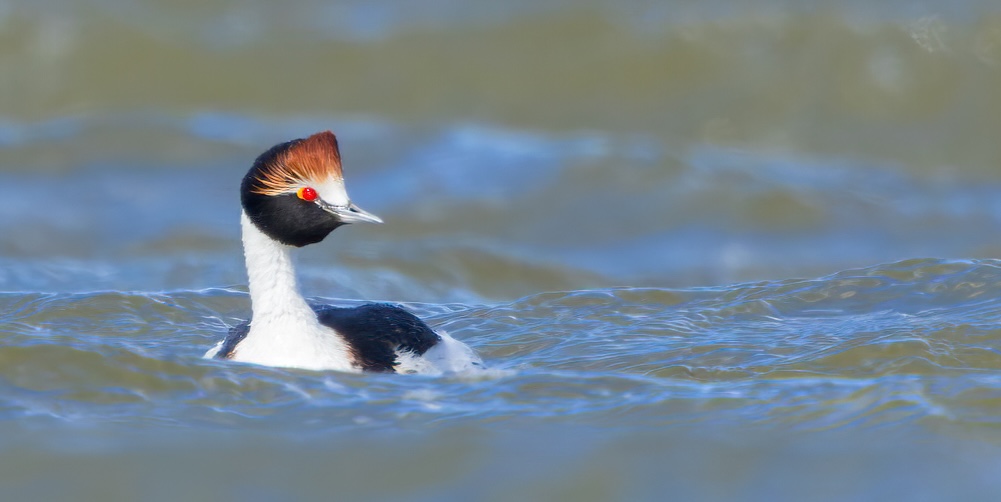
Hooded Grebe Podiceps gallardoi – ©Dubi Shapiro
They make floating nests of plant material concealed among reeds on the surface of the water. The young are precocial, and able to swim from birth.
-
Number of bird species: 22
(As at August 2025)
The recently compiled unified AviList (2025), shows 22 extant species of grebes, in just six genera in the Podicipedidae family, which are the only family of Podicipediformes. They are:
Titicaca Grebe Rollandia microptera
White-tufted Grebe Rollandia rolland
Alaotra Grebe Tachybaptus rufolavatus
Little Grebe Tachybaptus ruficollis
Australasian Grebe Tachybaptus novaehollandiae
Madagascan Grebe Tachybaptus pelzelnii
Least Grebe Tachybaptus dominicus
Atitlan Grebe Podilymbus gigas
Pied-billed Grebe Podilymbus podiceps
Hoary-headed Grebe Poliocephalus poliocephalus
New Zealand Grebe Poliocephalus rufopectus
Great Grebe Podiceps major
Horned Grebe Podiceps auritus
Red-necked Grebe Podiceps grisegena
Great Crested Grebe Podiceps cristatus
Black-necked Grebe Podiceps nigricollis
Colombian Grebe Podiceps andinus
Silvery Grebe Podiceps occipitalis
Junin Grebe Podiceps taczanowskii
Hooded Grebe Podiceps gallardoi
Western Grebe Aechmophorus occidentalis
Clark’s Grebe Aechmophorus clarkii
-
Flight Identification of European Seabirds
| By Anders Blomdahl, Bertil Breife & Niklas Holmstrom | Helm | 2007 | Paperback | 374 pages, 690 col photos | ISBN: 9780713686166 Buy this book from NHBS.com -
Grebes of the World
| By André Konter | Lynx Edicions | 2001 | Hardback | 187 pages, 85 colour photos, b/w illustrations | ISBN: 9788487334337 Buy this book from NHBS.com -
Grebes: Podicipedidae
| By Jon Fjeldsa | OUP | 2004 | Hardback | 246 pages, 16 col plates, 116 b/w illus, 31 maps | ISBN: 9780198500643 Buy this book from NHBS.com
-
Podicipedidae
Family AccountGrebes are foot-propelled divers specialized for life on and under water: their legs are set so far back on their bodies that they are unable to walk on land. -
Podicipedidae
Family AccountThe order contains a single family, the Podicipedidae, which includes 22 species in six extant genera -
Podicipedidae
Family AccountThe grebes are aquatic duck-like birds, with representatives on all continents except Antarctica.
Given the number of species in this family, Fatbirder does not provide quick links to all of them. However, the entries below do include links to representatives of every genera and some of the most often encountered, iconic or sought-after species.
-
Atitlan Grebe Podilymbus gigas
Species AccountExtinct, last reported in 1986. Formerly Lake Atitlan, Guatemala. -
Atitlan Grebe Podilymbus gigas
Species AccountThe Atitlán grebe (Podilymbus gigas), also known as the giant grebe, giant pied-billed grebe or poc, is an extinct species of grebe. -
Atitlan Grebe Podilymbus gigas
Species AccountSound archive and distribution map. -
Clark’s Grebe Aechmophorus clarkii
Species AccountLarge, long-necked grebe with very long, thin, yellow-orange bill. Black cap ends just above red eye, so the eye looks isolated in the white face. -
Clark’s Grebe Aechmophorus clarkii
Species AccountClark's grebe (Aechmophorus clarkii) is a North American waterbird species in the grebe family. -
Clark’s Grebe Aechmophorus clarkii
Species AccountSound archive and distribution map. -
Hoary-headed Grebe Poliocephalus poliocephalus
Species AccountSmall ducklike bird that rides low in the water. In breeding plumage note distinctive streaked head and pale neck. In non-breeding plumage it is much paler. -
Hoary-headed Grebe Poliocephalus poliocephalus
Species AccountThe hoary-headed grebe (Poliocephalus poliocephalus) is a member of the grebe family. It breeds in southern parts of Australia... -
Hoary-headed Grebe Poliocephalus poliocephalus
Species AccountSound archive and distribution map. -
Junin Grebe podiceps taczanowskii
Species AccountExtremely similar to the far more common Silvery Grebe, but Junin Grebe is slightly larger with a longer bill, a skinnier neck, darker flanks, and a paler bill. -
Junin Grebe podiceps taczanowskii
Species AccountThe Junín grebe, Junin flightless grebe or puna grebe (Podiceps taczanowskii) is a grebe found only on Lake Junin in the highlands of Junin, west-central Peru. -
Junin Grebe podiceps taczanowskii
Species AccountSound archive and distribution map. -
Little Grebe Tachybaptus ruficollis
Species AccountSound archive and distribution map. -
Little Grebe Tachybaptus ruficollis
Species AccountThe Little Grebe is a small, dumpy grebe which often appears to have a 'fluffy' rear end. It readily dives when disturbed, surfacing unseen some distance away. -
Little Grebe Tachybaptus ruficollis
Species AccountThe little grebe (Tachybaptus ruficollis), also known as dabchick, is a member of the grebe family of water birds. -
Pied-billed Grebe Podilymbus podiceps
Species AccountThe pied-billed grebe (Podilymbus podiceps) is a species of the grebe family of water birds. -
Pied-billed Grebe Podilymbus podiceps
Species AccountPart bird, part submarine, the Pied-billed Grebe is common across much of North America. -
Pied-billed Grebe Podilymbus podiceps
Species AccountPied-billed Grebe Podilymbus podiceps has most recently been assessed for The IUCN Red List of Threatened Species in 2020. Podilymbus podiceps is listed as Least Concern. -
Pied-billed Grebe Podilymbus podiceps
Species AccountSound archive and distribution map. -
Red-necked Grebe Podiceps grisegena
Species AccountThe Red-necked Grebe (Podiceps grisegena) is a migratory aquatic bird found in the temperate regions of the northern hemisphere. Its wintering habitat is largely restricted to calm waters just beyond the waves around ocean coasts, although some birds may winter on large lakes. Grebes prefer shallow bodies of fresh water such as lakes, marshes or fish-ponds as breeding sites…. -
Red-necked Grebe Podiceps grisegena
Species AccountThe Red-necked Grebe breeds on small inland lakes in Canada and Alaska, and winters along both coasts of North America. -
Red-necked Grebe Podiceps grisegena
Species AccountSound archive and distribution map. -
Western Grebe Aechmophorus occidentalis
Species AccountLarge, long-necked grebe with very long, thin, yellow bill. Black cap extends below red eye, sometimes with just a small white spot in front of the eye. -
Western Grebe Aechmophorus occidentalis
Species AccountDescription. The western grebe is the largest North American grebe. It is 55–75 cm (22–30 in) long, weighs 795–2,000 g (1.753–4.409 lb) and measures 79–102 cm (31–40 in) across the wings. -
Western Grebe Aechmophorus occidentalis
Species AccountSound archive and distribution map. -
White-tufted Grebe Rollandia rolland
Species AccountWidespread and often fairly common small dark grebe of lakes, ponds, wetlands; also river mouths and coastal waters, mainly in winter. -
White-tufted Grebe Rollandia rolland
Species AccountThe white-tufted grebe (Rollandia rolland), also known as Rolland's grebe, is a species of grebe in the family Podicipedidae. -
White-tufted Grebe Rollandia rolland
Species AccountSound archive and distribution map.