

Rallidae – Rails, Crakes, Gallinules & Coots etc.
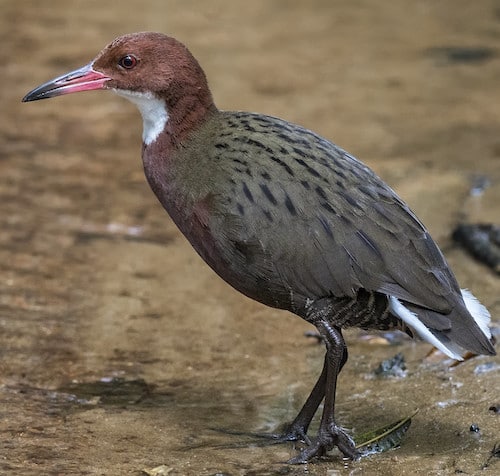
The Rallidae (Rails, Coots & Gallinules) is a family of small to medium sized ground-living (mostly water associated) birds. They are part of the Gruiformes order with Heliornithidae (Finfoots), Aramidae (Limpkin), Psophiidae (Trumpeters), Gruidae (Cranes) and Sarothruridae (Flufftails).
The family has been quite recently revised with many species switching genera. The jury is out on a lot of potential splits through mitochondrial DNA research, but more intensive study of nuclear DNA is needed to confirm or exclude these.
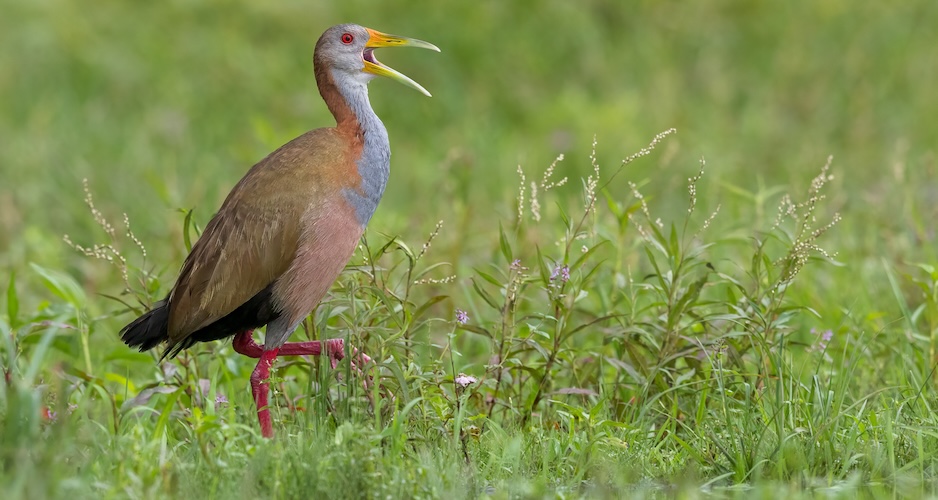
Giant Wood Rail Aramides ypecaha – ©Dubi Shapiro
They are a large cosmopolitan family that exhibits considerable diversity and the family also includes rails, crakes, coots, swamphens and gallinules. Many species are associated with wetlands, although the family is found in every terrestrial habitat except dry deserts, polar regions and alpine areas above the snow line.
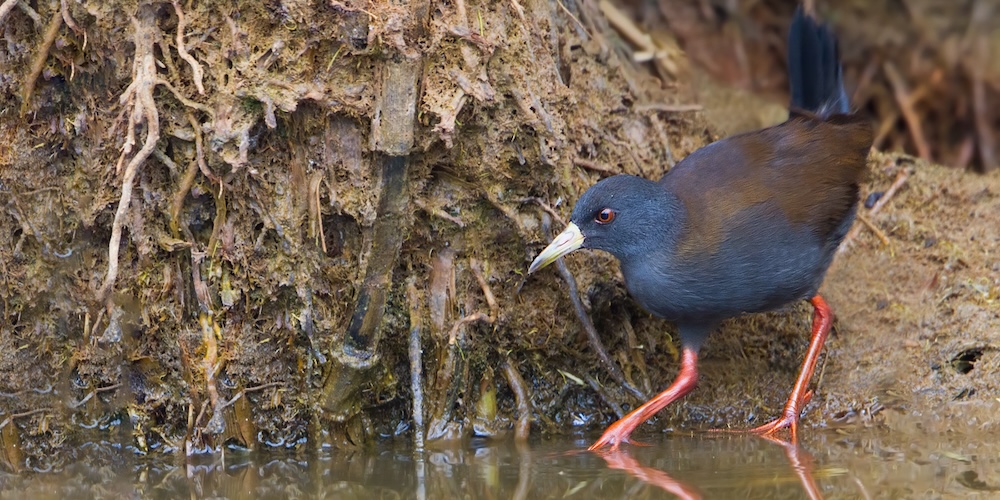
Sakalava Rail Zapornia olivieri – ©Dubi Shapiro
Members of the Rallidae are found on every continent except Antarctica. There are numerous island species. The most common habitats are marshland or dense forest. Rails are especially fond of dense vegetation. The most typical family members occupy dense vegetation in damp environments near lakes, swamps, or rivers. Reed beds are a particularly favoured habitat. They are omnivorous, and those that migrate do so at night: most nest in dense vegetation. In general, they are shy and secretive birds, and are difficult to observe.
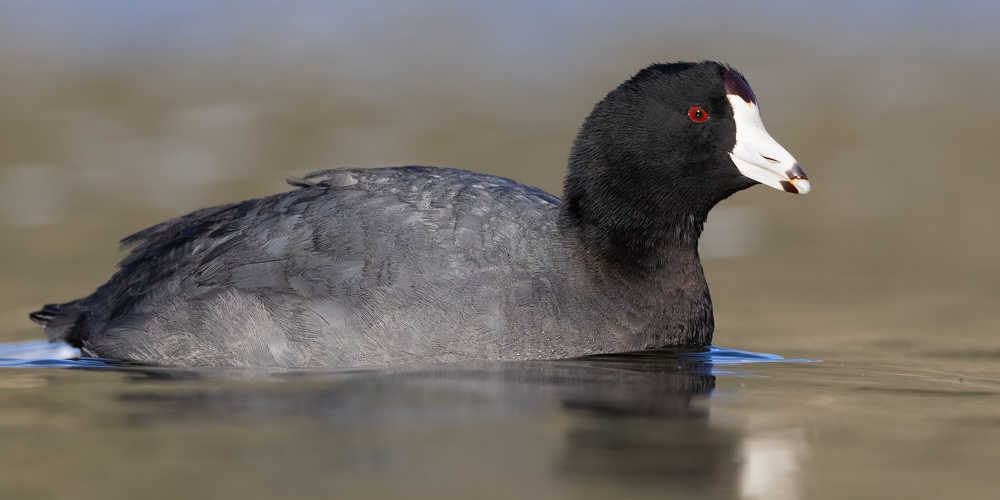
American Coot Fulica americana – ©Dubi Shapiro
Most species walk and run vigorously on strong legs, and have long toes which are well adapted to soft, uneven surfaces. They tend to have short, rounded wings and although they are generally weak fliers, they are, nevertheless, capable of covering long distances.
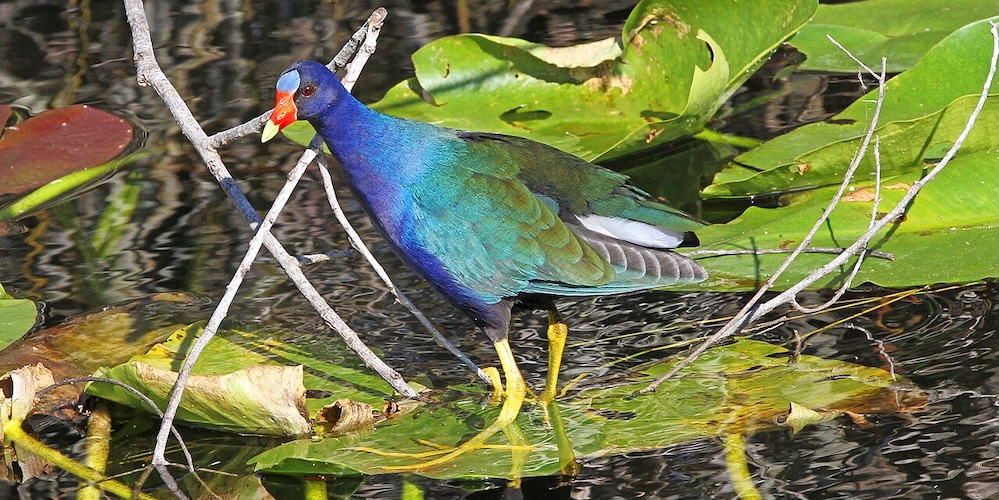
Purple Gallinule Porphyrio martinica – ©Judy Gallagher CC BY 2.0 via Wikimedia Commons
Island species often become flightless, and many of them are now extinct following the introduction of terrestrial predators such as cats, rats and pigs.
Many reedbed species are secretive (apart from loud calls), crepuscular, and have laterally flattened bodies. In the Old World, long-billed species tend to be called rails and short-billed species crakes. North American species are normally called rails irrespective of bill length.
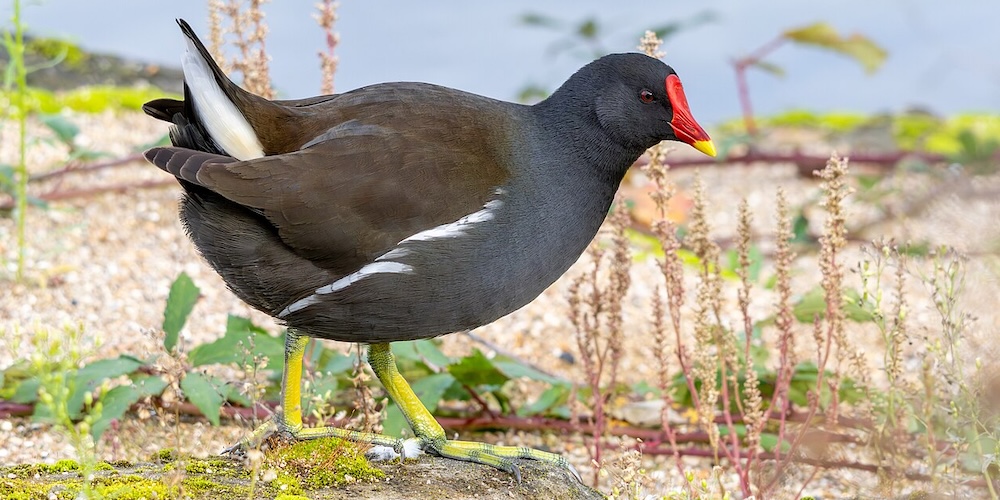
Common Moorhen Gallinula chloropus – ©Alexis Lours CC BY 4.0 via Wikimedia Commons
The larger species are also sometimes given other names. The black coots are more adapted to open water than their relatives, and some other large species are called gallinules and swamp hens.
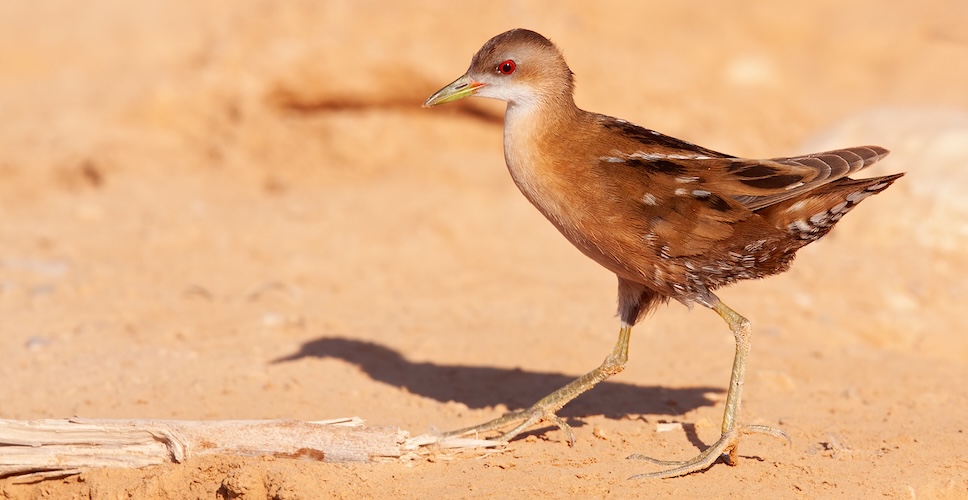
Little Crake Zapornia parva – ©Dubi Shapiro
The rails have suffered disproportionally from human changes to the environment and it is estimated that several hundred species of island rail have become extinct because of this. Several island species of rail remain endangered and conservation organisations and governments continue to work to prevent their extinction.
-
Number of bird species: 126
(As at September 2025)
According to the recently (2025) amalgamated AviList there are 126 extant species, in thirty-four genera in the Rallidae (Rails, Crakes, Coots & Gallinules) family. [The family has been overhauled with a number of species now assigned to the flufftails and many species reassigned to different genera than previously thought. Moreover, some former species have been ‘lumped’ together – such as the Swamphens – pending further nuclear DNA research]. They are:
Chestnut-headed Crake Anurolimnas castaneiceps
Spotted Rail Pardirallus maculatus
Blackish Rail Pardirallus nigricans
Plumbeous Rail Pardirallus sanguinolentus
Ash-throated Crake Mustelirallus albicollis
Zapata Rail Mustelirallus cerverai
Colombian Crake Mustelirallus colombianus
Paint-billed Crake Mustelirallus erythrops
Uniform Crake Amaurolimnas concolor
Giant Wood Rail Aramides ypecaha
Brown Wood Rail Aramides wolfi
Little Wood Rail Aramides mangle
Rufous-necked Wood Rail Aramides axillaris
Rufous-naped Wood Rail Aramides albiventris
Grey-necked Wood Rail Aramides cajaneus
Red-winged Wood Rail Aramides calopterus
Slaty-breasted Wood Rail Aramides saracura
Grey-throated Rail Canirallus oculeus
Ridgway’s Rail Rallus obsoletus
Aztec Rail Rallus tenuirostris
Mangrove Rail Rallus longirostris
King Rail Rallus elegans
Clapper Rail Rallus crepitans
Plain-flanked Rail Rallus wetmorei
Virginia Rail Rallus limicola
Ecuadorian Rail Rallus aequatorialis
Bogota Rail Rallus semiplumbeus
Austral Rail Rallus antarcticus
Water Rail Rallus aquaticus
Brown-cheeked Rail Rallus indicus
African Rail Rallus caerulescens
Madagascan Rail Rallus madagascariensis
Rouget’s Rail Rougetius rougetii
African Crake Crecopsis egregia
White-throated Rail Dryolimnas cuvieri
Corn Crake Crex crex
Snoring Rail Aramidopsis plateni
Slaty-breasted Rail Lewinia striata
Brown-banded Rail Lewinia mirifica
Lewin’s Rail Lewinia pectoralis
Auckland Rail Lewinia muelleri
Calayan Rail Gallirallus calayanensis
Invisible Rail Gallirallus wallacii
Chestnut Rail Gallirallus castaneoventris
Weka Gallirallus australis
New Caledonian Rail Gallirallus lafresnayanus
Lord Howe Woodhen Gallirallus sylvestris
Okinawa Rail Gallirallus okinawae
Buff-banded Rail Gallirallus philippensis
Pink-legged Rail Gallirallus insignis
Woodford’s Rail Gallirallus woodfordi
Guam Rail Gallirallus owstoni
Barred Rail Gallirallus torquatus
Roviana Rail Gallirallus rovianae
Nkulengu Rail Himantornis haematopus
Blue-faced Rail Gymnocrex rosenbergii
Bare-eyed Rail Gymnocrex plumbeiventris
Talaud Rail Gymnocrex talaudensis
Spot-flanked Gallinule Porphyriops melanops
Black-tailed Nativehen Tribonyx ventralis
Tasmanian Nativehen Tribonyx mortierii
Sora Porzana carolina
Spotted Crake Porzana porzana
Australian Crake Porzana fluminea
Lesser Moorhen Paragallinula angulata
Makira Woodhen Gallinula silvestris
Gough Moorhen Gallinula comeri
Common Moorhen Gallinula chloropus
Common Gallinule Gallinula galeata
Dusky Moorhen Gallinula tenebrosa
Red-fronted Coot Fulica rufifrons
Horned Coot Fulica cornuta
Red-gartered Coot Fulica armillata
Giant Coot Fulica gigantea
Eurasian Coot Fulica atra
Red-knobbed Coot Fulica cristata
Hawaiian Coot Fulica alai
American Coot Fulica americana
White-winged Coot Fulica leucoptera
Andean Coot Fulica ardesiaca
Allen’s Gallinule Porphyrio alleni
Purple Gallinule Porphyrio martinica
Azure Gallinule Porphyrio flavirostris
Western Swamphen Porphyrio porphyrio
South Island Takahe Porphyrio hochstetteri
Ocellated Crake Micropygia schomburgkii
Russet-crowned Crake Rufirrallus viridis
Black-banded Crake Rufirrallus fasciatus
Red-and-white Crake Rufirrallus leucopyrrhus
Rufous-faced Crake Rufirrallus xenopterus
Swinhoe’s Rail Coturnicops exquisitus
Yellow Rail Coturnicops noveboracensis
Inaccessible Island Rail Laterallus rogersi
Speckled Rail Laterallus notatus
Yellow-breasted Crake Laterallus flaviventer
Rusty-flanked Crake Laterallus levraudi
Rufous-sided Crake Laterallus melanophaius
Ruddy Crake Laterallus ruber
White-throated Crake Laterallus albigularis
Grey-breasted Crake Laterallus exilis
Galapagos Crake Laterallus spilonota
Black Rail Laterallus jamaicensis
Dot-winged Crake Laterallus spiloptera
White-browed Crake Poliolimnas cinereus
New Guinea Flightless Rail Megacrex inepta
Striped Crake Aenigmatolimnas marginalis
Watercock Gallicrex cinerea
Isabelline Bush-hen Amaurornis isabellina
Plain Bush-hen Amaurornis olivacea
White-breasted Waterhen Amaurornis phoenicurus
Talaud Bush-hen Amaurornis magnirostris
Pale-vented Bush-hen Amaurornis moluccana
Red-necked Crake Rallina tricolor
Andaman Crake Rallina canningi
Red-legged Crake Rallina fasciata
Slaty-legged Crake Rallina eurizonoides
Ruddy-breasted Crake Zapornia fusca
Band-bellied Crake Zapornia paykullii
Brown Crake Zapornia akool
Black Crake Zapornia flavirostra
Little Crake Zapornia parva
Baillon’s Crake Zapornia pusilla
Sakalava Rail Zapornia olivieri
Black-tailed Crake Zapornia bicolor
Henderson Crake Zapornia atra
Spotless Crake Zapornia tabuensis
-
Rails - A Guide to the Rails, Crakes, Gallinules and Coots of the World
| by Barry Taylor & Ber van Perlo | Pica Press | 2000 | Hardback | 600 pages, 43 colour plates, b/w illustrations, maps | ISBN: 9781873403594 Buy this book from NHBS.com
-
Rallidae
Family AccountRallidae spans a large morphological and ecological range. Most are secretive denizens of reeds, yet the gallinules and coots lead lifestyles more like ducks. -
Rallidae
Family AccountRails (avian family Rallidae) are a large, cosmopolitan family of small- to medium-sized terrestrial and/or semi-amphibious birds.
Given the number of species in this family, Fatbirder does not provide quick links to all of them. However, the entries below do include links to representatives of every genera, all those illustrated and some of the most often encountered, iconic or sought-after species.
-
African Crake Crecopsis egregia
Species AccountChunky, mid-sized rail. Note the black-and-brown scalloped back, gray head and chest, barred belly, reddish bill and yellowish legs. -
African Crake Crecopsis egregia
Species AccountSound archive and distribution maps. -
American Coot Fulica americana
Species AccountThe American coot (Fulica americana), also known as a mud hen, is a bird of the family Rallidae. Though commonly mistaken to be ducks, American coots belong to a distinct order. Unlike the webbed feet of ducks, coots have broad, lobed scales on their lower legs and toes that fold back with each step in order to facilitate walking on dry land. -
American Coot Fulica americana
Species AccountAmerican Coot Fulica americana has most recently been assessed for The IUCN Red List of Threatened Species in 2016. Fulica americana is listed as Least Concern. -
American Coot Fulica americana
Species AccountSound archive and distribution maps. -
Austral Rail Rallus antarcticus
Species AccountScarce, very local, and rarely seen rail of Patagonia. Found in fresh marshes and lake edges with tall reeds and rushes. -
Austral Rail Rallus antarcticus
Species AccountThe austral rail (Rallus antarcticus) is a species of bird in the family Rallidae. It is found in Argentina and Chile. Its natural habitats are swamps, freshwater lakes, and freshwater marshes. It is threatened by habitat loss. -
Austral Rail Rallus antarcticus
Species AccountAustral Rail Rallus antarcticus has most recently been assessed for The IUCN Red List of Threatened Species in 2021. Rallus antarcticus is listed as Vulnerable under criteria C2a(ii). -
Austral Rail Rallus antarcticus
Species AccountSound archive and distribution maps. -
Australian Crake Porzana fluminea
Species AccountSound archive and distribution maps. -
Australian Crake Porzana fluminea
Species AccountThe Australian crake, also known as Australian spotted crake, (Porzana fluminea) is a species of bird in the family Rallidae. It is endemic to Australia, where its natural habitat is dense reedbeds, shallow open water and mudflats or floating vegetation in fresh or salt water wetlands including lakes, swamps and salt-marsh. -
Australian Crake Porzana fluminea
Species AccountAustralian Crake Porzana fluminea has most recently been assessed for The IUCN Red List of Threatened Species in 2016. Porzana fluminea is listed as Least Concern. -
Australian Crake Porzana fluminea
Species AccountThe adult Australian Spotted Crake is dark grey on its face, forehead, throat and chest. The crown of its head, the back of its neck and its upper parts are brownish olive, streaked black and finely spotted with white. Its lower flanks are black barred white, and the underside of its tail is white. -
Azure Gallinule Porphyrio flavirostris
Species AccountSmall, pale chickenlike marsh bird with washed out gray-blue underparts that contrast with its olive brown back and crown. -
Azure Gallinule Porphyrio flavirostris
Species AccountThe azure gallinule (Porphyrio flavirostris) is a species of bird in the family Rallidae. It is found in Argentina, Bolivia, Brazil, Colombia, Ecuador, French Guiana, Guyana, Paraguay, Peru, Suriname, Trinidad and Tobago, the United States, and Venezuela. -
Azure Gallinule Porphyrio flavirostris
Species AccountSound archive and distribution maps. -
Baillon's Crake Zapornia pusilla
Species AccountThe Baillon's crake (Porzana pusilla) is a very small waterbird of the family Rallidae. -
Baillon's Crake Zapornia pusilla
Species AccountBaillon's Crake Zapornia pusilla has most recently been assessed for The IUCN Red List of Threatened Species in 2019. Zapornia pusilla is listed as Least Concern. -
Baillon's Crake Zapornia pusilla
Species AccountSound archive and distribution maps. -
Band-bellied Crake
Species AccountSound archive and distribution maps. -
Band-bellied Crake
Species AccountThe band-bellied crake (Zapornia paykullii) is a species of bird in the family Rallidae. It breeds in Manchuria, eastern China and northern Korea... -
Black Crake Zapornia flavirostris
Species AccountThe black crake (Amaurornis flavirostra) is a waterbird in the rail and crake family, Rallidae. It breeds in most of sub-Saharan Africa except in very arid areas. It undertakes some seasonal movements in those parts of its range which are subject to drought. No subspecies have been described. -
Black Crake Zapornia flavirostris
Species AccountBlack Crake Zapornia flavirostra has most recently been assessed for The IUCN Red List of Threatened Species in 2016. Zapornia flavirostra is listed as Least Concern. -
Black Crake Zapornia flavirostris
Species AccountSound archive and distribution maps. -
Black Rail Laterallus jamaicensis
Species AccountTiny rail, the size of a sparrow and nearly impossible to see without tremendous effort. Slate gray overall with a piercing red eye, brown nape, and white... -
Black Rail Laterallus jamaicensis
Species AccountThe black rail (Laterallus jamaicensis) is a mouse-sized member of the bird family Rallidae. It is found in scattered parts of North America and the Pacific region of South America, usually in coastal salt marshes but also in some freshwater marshes. It is extinct or threatened in many locations due to habitat loss. The largest populations in North America are in Florida and California. -
Black Rail Laterallus jamaicensis
Species AccountBlack Rail Laterallus jamaicensis has most recently been assessed for The IUCN Red List of Threatened Species in 2020. Laterallus jamaicensis is listed as Endangered under criteria A2ace+3ce+4ace. -
Black Rail Laterallus jamaicensis
Species AccountSound archive and distribution maps. -
Black-banded Crake Rufirrallus fasciatus
Species AccountDark, orange-and-black, barred crake. Deep red orange, with black wings, and bold black barring on the undersides. Occurs along the base of the Andes. -
Black-banded Crake Rufirrallus fasciatus
Species AccountSound archive and distribution maps. -
Black-tailed Nativehen Tribonyx ventralis
Species AccountThe black-tailed nativehen (Tribonyx ventralis) is a rail native to Australia. -
Black-tailed Nativehen Tribonyx ventralis
Species AccountSound archive and distribution maps. -
Blue-faced Rail Gymnocrex rosenbergii
Species AccountA large, distinctive, poorly known rail from the islands of Peleng and Sulawesi. Rich, deep chestnut above and jet black below, and a diagnostic patch of sky... -
Blue-faced Rail Gymnocrex rosenbergii
Species AccountSound archive and distribution maps. -
Buff-banded Rail Gallirallus philippensis
Species AccountThe buff-banded rail (Gallirallus philippensis) is a distinctively coloured, highly dispersive, medium-sized rail of the rail family, Rallidae. This species comprises several subspecies found throughout much of Australasia and the south-west Pacific region, including the Philippines (where it is known as tikling), New Guinea, Australia, New Zealand (where it is known as the banded rail or moho-pereru in Māori),[2] and numerous smaller islands, covering a range of latitudes from the tropics to the Subantarctic. -
Buff-banded Rail Gallirallus philippensis
Species AccountThe Buff-banded Rail is a medium-sized stout rail with short legs. It has a distinctive grey eyebrow and an orange-brown band on its streaked breast. The lores, cheek and hindneck are rich chestnut. The chin and throat are grey, the upperparts streaked brown and the underparts barred black and white. -
Buff-banded Rail Gallirallus philippensis
Species AccountBuff-banded Rail Hypotaenidia philippensis has most recently been assessed for The IUCN Red List of Threatened Species in 2016. Hypotaenidia philippensis is listed as Least Concern. -
Buff-banded Rail Gallirallus philippensis
Species AccountSound archive and distribution maps. -
Chestnut-headed Crake Anurolimnas castaneiceps
Species AccountTall, distinctively-colored crake. Grayish-brown body, with a big orange hood over the head and upper body; bright red eye. -
Chestnut-headed Crake Anurolimnas castaneiceps
Species AccountSound archive and distribution maps. -
Clapper Rail Rallus crepitans
Species AccountSound archive and distribution maps. -
Clapper Rail Rallus crepitans
Species AccountThe clapper rail (Rallus crepitans) is a member of the rail family, Rallidae. The taxonomy for this species is confusing and still being determined. The Ridgway's rail and the mangrove rail have been recently split. Furthermore, some taxonomists consider that the king rail and Aztec rail should be considered within this group, as those birds look similar and the birds are known to interbreed where they share territories -
Clapper Rail Rallus crepitans
Species AccountClapper Rail Rallus crepitans has most recently been assessed for The IUCN Red List of Threatened Species in 2018. Rallus crepitans is listed as Least Concern. -
Common Moorhen Gallinula chloropus
Species AccountThe common moorhen (Gallinula chloropus) (also known as the swamp chicken[2]) is a bird species in the family Rallidae. It is distributed across many parts of the Old World. -
Common Moorhen Gallinula chloropus
Species AccountCommon Moorhen Gallinula chloropus has most recently been assessed for The IUCN Red List of Threatened Species in 2016. Gallinula chloropus is listed as Least Concern. -
Common Moorhen Gallinula chloropus
Species AccountSound archive and distribution maps. -
Corncrake Crex crex
Species AccountThe corn crake, corncrake or landrail (Crex crex) is a bird in the rail family. It breeds in Europe and Asia as far east as western China, and migrates to Africa for the northern hemisphere's winter. It is a medium-sized crake with buff- or grey-streaked brownish-black upperparts, chestnut markings on the wings, and blue-grey underparts with rust-coloured and white bars on the flanks and undertail. -
Corncrake Crex crex
Species AccountCorncrake Crex crex has most recently been assessed for The IUCN Red List of Threatened Species in 2016. Crex crex is listed as Least Concern. -
Corncrake Crex crex
Species AccountAccount & status in UK… -
Corncrake Crex crex
Species AccountSound archive and distribution maps. -
Dusky Moorhen Gallinula tenebrosa
Species AccountThe dusky moorhen (Gallinula tenebrosa) is a bird species in the rail family and is one of the eight extant species in the moorhen genus. It occurs in India, Australia, New Guinea, Borneo and Indonesia. It is often confused with the purple swamphen and the Eurasian coot due to similar appearance and overlapping distributions. They often live alongside birds in the same genus, such as the Tasmanian nativehen and the common moorhen... -
Dusky Moorhen Gallinula tenebrosa
Species AccountSound archive and distribution maps. -
Eurasian Coot Fulica atra
Species AccountThe Eurasian coot (Fulica atra), also known as coot, is a member of the rail and crake bird family, the Rallidae. The scientific name is from Latin; Fulica is "coot", and atra is "black".[3] It is found in Europe, Asia, Australia and parts of Africa. The Australian subspecies is known as the Australian coot. -
Eurasian Coot Fulica atra
Species AccountThe Eurasian Coot is recognised by its snowy white bill and forehead shield. The remainder of the bird is dark sooty grey, except for its bright red eye. Immature birds are generally paler than adults with a white wash on the throat. Nestlings are downy, black with fine yellow tips. The head is orange-red and the bill is red with a cream-white tip. -
Eurasian Coot Fulica atra
Species AccountCommon Coot Fulica atra has most recently been assessed for The IUCN Red List of Threatened Species in 2019. Fulica atra is listed as Least Concern. -
Eurasian Coot Fulica atra
Species AccountSound archive and distribution maps. -
Giant Wood-Rail Aramides ypecaha
Species AccountEasy to recognize by its gigantic size. Note the rusty neck and belly that help to distinguish it from similar smaller wood-rails. -
Giant Wood-Rail Aramides ypecaha
Species AccountThe giant wood rail (Aramides ypecaha) is a species of bird in the family Rallidae. -
Giant Wood-Rail Aramides ypecaha
Species AccountSound archive and distribution maps. -
Grey-breasted Crake Laterallus exilis
Species AccountSound archive and distribution maps. -
Grey-breasted Crake Laterallus exilis
Species AccountThe grey-breasted crake (Laterallus exilis) is a species of bird in the family Rallidae. It is found in Argentina, Belize, Bolivia, Brazil, Colombia, Costa Rica, Ecuador, French Guiana, Guatemala, Guyana, Honduras, Nicaragua, Panama, Paraguay, Peru, Suriname, Trinidad and Tobago, and Venezuela. Its natural habitats are swamps and pastureland. -
Grey-breasted Crake Laterallus exilis
Species AccountVery small and elusive crake of damp grassy fields, brushy pastures, and marshes. Walks quietly and runs quickly, like all rails. -
Grey-necked Wood-Rail Aramides cajaneus
Species AccountThe grey-necked wood rail[2] or grey-cowled wood rail[3] (Aramides cajaneus) is a species of bird in the family Rallidae. It lives primarily in forests and mangroves of Central and South America. -
Grey-necked Wood-Rail Aramides cajaneus
Species AccountSound archive and distribution maps. -
Grey-throated Rail Canirallus oculeus
Species AccountA distinctive and rarely encountered forest rail with a gray face, a red neck and chest, and a banded appearance to the belly. -
Grey-throated Rail Canirallus oculeus
Species AccountSound archive and distribution maps. -
Hawaiian Coot Fulica alai
Species AccountThe 'ʻAlae keʻokeʻo (Fulica alai), also known as the Hawaiian coot in English, is a bird in the rail family, Rallidae, that is endemic to Hawaiʻi. -
Hawaiian Coot Fulica alai
Species AccountSound archive and distribution maps. -
King Rail Rallus elegans
Species AccountSound archive and distribution maps. -
King Rail Rallus elegans
Species AccountKing Rail Rallus elegans has most recently been assessed for The IUCN Red List of Threatened Species in 2021. Rallus elegans is listed as Near Threatened under criteria A2cde. -
King Rail Rallus elegans
Species AccountThe king rail (Rallus elegans) is a waterbird, the largest North American rail. -
Lesser Moorhen Paragallinula angulata
Species AccountThe lesser moorhen (Gallinula angulata) is a species of bird in the family Rallidae. -
Lesser Moorhen Paragallinula angulata
Species AccountLesser Moorhen Paragallinula angulata has most recently been assessed for The IUCN Red List of Threatened Species in 2016. Paragallinula angulata is listed as Least Concern. -
Lesser Moorhen Paragallinula angulata
Species AccountSound archive and distribution maps. -
Little Crake Zapornia parva
Species AccountThe little crake (Porzana parva) is a very small waterbird of the family Rallidae. The genus name Porzana is derived from Venetian terms for small rails, and parva is Latin for "small". -
Little Crake Zapornia parva
Species AccountSound archive and distribution maps. -
Little Crake Zapornia parva
Species AccountTiny, with long wings and a short greenish bill with a small red base. -
Little Crake Zapornia parva
Species AccountSound archive and distribution maps. -
Lord Howe Woodhen Gallirallus sylvestris
Species AccountThe Lord Howe woodhen (Gallirallus sylvestris) also known as the Lord Howe Island woodhen or Lord Howe (Island) rail, is a flightless bird of the rail family, (Rallidae). It is endemic to Lord Howe Island off the Australian coast. It is currently classified as endangered by the IUCN. -
Lord Howe Woodhen Gallirallus sylvestris
Species AccountLord Howe Woodhen Hypotaenidia sylvestris has most recently been assessed for The IUCN Red List of Threatened Species in 2022. Hypotaenidia sylvestris is listed as Endangered under criteria D. -
Lord Howe Woodhen Gallirallus sylvestris
Species AccountSound archive and distribution maps. -
Mangrove Rail Rallus longirostris
Species AccountSound archive and distribution maps. -
Mangrove Rail Rallus longirostris
Species AccountMangrove Rail Rallus longirostris has most recently been assessed for The IUCN Red List of Threatened Species in 2016. Rallus longirostris is listed as Least Concern. -
Mangrove Rail Rallus longirostris
Species AccountThe mangrove rail (Rallus longirostris) is a species of bird in the family Rallidae. It is found in South America. It was formerly considered conspecific with the clapper rail (Rallus crepitans).[ -
New Guinea Flightless Rail Megacrex inepta
Species AccountA very large, flightless rail of lowland swamp forests. Thick yellow bill and strong black legs. Dark brown back, buffy flanks and a pale face and chest. -
New Guinea Flightless Rail Megacrex inepta
Species AccountSound archive and distribution maps. -
Nkulengu Rail Himantornis haematopus
Species AccountThe Nkulengu rail (Himantornis haematopus) is a species of bird in the family Rallidae. It belongs to the monotypic genus Himantornis. -
Nkulengu Rail Himantornis haematopus
Species AccountSound archive and distribution maps. -
Ocellated Crake Micropygia schomburgkii
Species AccountA tiny rail found in dense grasslands, often far from water. Extremely difficult to see, but striking plumage renders this species unmistakable... -
Ocellated Crake Micropygia schomburgkii
Species AccountSound archive and distribution maps. -
Plumbeous Rail Pardirallus sanguinolentus
Species AccountThe plumbeous rail (Pardirallus sanguinolentus) is a species of bird in the family Rallidae. It is found in Argentina, Bolivia, Brazil, Chile, Ecuador, Paraguay, Peru and Uruguay, and is a vagrant to the Falkland Islands. Its natural habitat is swamps. -
Plumbeous Rail Pardirallus sanguinolentus
Species AccountPlumbeous Rail Pardirallus sanguinolentus has most recently been assessed for The IUCN Red List of Threatened Species in 2016. Pardirallus sanguinolentus is listed as Least Concern. -
Plumbeous Rail Pardirallus sanguinolentus
Species AccountSound archive and distribution maps. -
Purple Gallinule Porphyrula martinica
Species AccountPurple Gallinule Porphyrio martinicus has most recently been assessed for The IUCN Red List of Threatened Species in 2016. Porphyrio martinicus is listed as Least Concern. -
Purple Gallinule Porphyrula martinica
Species AccountBeautiful, colorful waterbird of marshes from southeast U.S. to South America, especially those with lots of emergent vegetation. -
Purple Gallinule Porphyrula martinica
Species AccountThe purple gallinule (Porphyrio martinicus) is a "swamp hen" in the rail family, Rallidae. Also known locally as the yellow-legged gallinule.[2] The genus name Porphyrio is the Latin for "swamphen", and martinica is "of Martinique". -
Red-knobbed Coot Fulica cristata
Species AccountThe red-knobbed coot or crested coot, (Fulica cristata), is a member of the rail and crake bird family, the Rallidae. -
Red-knobbed Coot Fulica cristata
Species AccountSound archive and distribution map. -
Red-necked Crake Rallina tricolor
Species AccountSecretive crake of rainforest habitats where there is thick cover alongside a stream or pool. -
Red-necked Crake Rallina tricolor
Species AccountSound archive and distribution maps. -
Rouget's Rail Rougetius rougetii
Species AccountThe Rouget's rail (Rougetius rougetii) is a species of bird in the Rallidae family. It is the only member of the genus Rougetius. It is found in Eritrea and Ethiopia... -
Rouget's Rail Rougetius rougetii
Species AccountSound archive and distribution maps. -
Ruddy Crake Laterallus ruber
Species AccountSound archive and distribution maps. -
Ruddy Crake Laterallus ruber
Species AccountThe ruddy crake (Laterallus ruber) is a bird in the rail family, Rallidae. -
Ruddy-breasted Crake Zapornia fusca
Species AccountThe ruddy-breasted crake (Porzana fusca), or ruddy crake, is a waterbird in the rail and crake family Rallidae. -
Ruddy-breasted Crake Zapornia fusca
Species AccountRuddy-breasted Crake Zapornia fusca has most recently been assessed for The IUCN Red List of Threatened Species in 2016. Zapornia fusca is listed as Least Concern. -
Ruddy-breasted Crake Zapornia fusca
Species AccountSound archive and distribution map -
Rufous-sided Crake Laterallus melanophaius
Species AccountThe rufous-sided crake (Laterallus melanophaius) is a species of bird in the family Rallidae. It is found in Argentina, Bolivia, Brazil, Colombia, Ecuador, Guyana, Paraguay, Peru, Suriname, Uruguay, and Venezuela. Its natural habitat is swamps. -
Rufous-sided Crake Laterallus melanophaius
Species AccountSound archive and distribution map. -
Sakalava Rail Zapornia olivieri
Species AccountThe Sakalava rail (Zapornia olivieri) is a species of bird in the family Rallidae. It is endemic to western Madagascar. -
Sakalava Rail Zapornia olivieri
Species AccountSound archive and distribution maps. -
Slaty-breasted Rail Lewinia striatus
Species AccountThe slaty-breasted rail (Gallirallus striatus) is a species of rail found in the Indian Subcontinent and Southeast Asia. Breeding has been recorded in July near Dehradun in the foothills of the Indian Himalayas. -
Slaty-breasted Rail Lewinia striatus
Species AccountSound archive and distribution map. -
Snoring Rail Aramidopsis plateni
Species AccountSound archive and distribution maps. -
Snoring Rail Aramidopsis plateni
Species AccountA large, little-known flightless rail from Sulawesi. Note the heavy bill, orange in females, duller in males, and the tailless appearance. -
Sora Rail Porzana carolinus
Species AccountThe sora (Porzana carolina) is a small waterbird of the family Rallidae, sometimes also referred to as the sora rail or sora crake. The genus name Porzana is derived from Venetian terms for small rails, and Carolina refers to the Carolina Colony.[2] "Sora" is probably taken from a Native American language. -
Sora Rail Porzana carolinus
Species AccountSora Porzana carolina has most recently been assessed for The IUCN Red List of Threatened Species in 2016. Porzana carolina is listed as Least Concern. -
Sora Rail Porzana carolinus
Species AccountSound archive and distribution maps. -
South Island Takahe Porphyrio hochstetteri
Species AccountThe takahē, Notornis, or South Island takahē (Porphyrio hochstetteri), is a flightless bird indigenous to New Zealand and belonging to the rail family. It was thought to be extinct after the last four known specimens were taken in 1898. However, after a carefully planned search effort the bird was rediscovered by Geoffrey Orbell near Lake Te Anau in the Murchison Mountains, South Island, on 20 November 1948. The specific scientific name commemorates the Austrian geologist Ferdinand von Hochstetter. -
South Island Takahe Porphyrio hochstetteri
Species AccountSouth Island Takahe Porphyrio hochstetteri has most recently been assessed for The IUCN Red List of Threatened Species in 2020. Porphyrio hochstetteri is listed as Endangered under criteria D. -
South Island Takahe Porphyrio hochstetteri
Species AccountSpecies account & Painted image -
South Island Takahe Porphyrio hochstetteri
Species AccountSound archive and distribution maps. -
Spot-flanked Gallinule Porphyriops melanops
Species AccountSmall marsh bird with a disjunct range in South America, from central Colombia to eastern Brazil to central Chile. -
Spot-flanked Gallinule Porphyriops melanops
Species AccountSound archive and distribution maps. -
Spotless Crake Zapornia tabuensis
Species AccountSound archive and distribution maps. -
Spotless Crake Zapornia tabuensis
Species AccountSpecies account… -
Spotless Crake Zapornia tabuensis
Species AccountSpotless Crake Zapornia tabuensis has most recently been assessed for The IUCN Red List of Threatened Species in 2016. Zapornia tabuensis is listed as Least Concern. -
Spotted Crake Porzana porzana
Species AccountSound archive and distribution maps. -
Spotted Crake Porzana porzana
Species AccountThe spotted crake (Porzana porzana) is a small waterbird of the family Rallidae. The scientific name is derived from Venetian terms for small rails. -
Spotted Crake Porzana porzana
Species AccountSpotted Crake Porzana porzana has most recently been assessed for The IUCN Red List of Threatened Species in 2016. Porzana porzana is listed as Least Concern. -
Striped Crake Aenigmatolimnas marginalis
Species AccountStriped Crake Amaurornis marginalis has most recently been assessed for The IUCN Red List of Threatened Species in 2016. Amaurornis marginalis is listed as Least Concern. -
Striped Crake Aenigmatolimnas marginalis
Species AccountSound archive and distribution maps. -
Striped Crake Aenigmatolimnas marginalis
Species AccountThe striped crake (Aenigmatolimnas marginalis) is a species of bird in the family Rallidae. It is the only species in the genus Aenigmatolimnas, having formerly been included in Porzana or in the defunct genus Poliolimnas. Its precise relationships, however, are still enigmatic. -
Swinhoe's Rail Coturnicops exquisitus
Species AccountThis sparrow-sized rail moves like a ghost through grassy meadows and wetlands. Prefers to run instead of fly, but white wing patches are unmistakable if seen. -
Swinhoe's Rail Coturnicops exquisitus
Species AccountSound archive and distribution maps. -
Tasmanian Native-Hen Tribobyx mortierii
Species AccountSound archive and distribution maps. -
Tasmanian Native-Hen Tribobyx mortierii
Species AccountTasmanian Native-hen Tribonyx mortierii has most recently been assessed for The IUCN Red List of Threatened Species in 2018. Tribonyx mortierii is listed as Least Concern. -
Tasmanian Native-Hen Tribobyx mortierii
Species AccountThe Tasmanian nativehen (also Tasmanian native-hen or Tasmanian native hen) (Tribonyx mortierii) is a flightless rail and one of twelve species of birds endemic to the Australian island of Tasmania. -
Uniform Crake Amaurolimnas concolor
Species AccountSound archive and distribution maps. -
Uniform Crake Amaurolimnas concolor
Species AccountThe uniform crake (Amaurolimnas concolor) is a species of bird in the subfamily Rallinae of the rail, crake, and coot family Rallidae. It is found in Mexico... -
Virginia Rail Rallus limicola
Species AccountThe Virginia rail (Rallus limicola) is a small waterbird, of the family Rallidae. These birds remain fairly common despite continuing loss of habitat, but are secretive by nature and more often heard than seen. -
Virginia Rail Rallus limicola
Species AccountVirginia Rail Rallus limicola has most recently been assessed for The IUCN Red List of Threatened Species in 2016. Rallus limicola is listed as Least Concern. -
Virginia Rail Rallus limicola
Species AccountSound archive and distribution maps. -
Watercock Gallicrex cinerea
Species AccountThe watercock (Gallicrex cinerea) is a waterbird in the rail and crake family, Rallidae. It is the only member of the genus Gallicrex. Traditionally held to be closely related to moorhens (which the adult male visually resembles a lot), it is actually member of a mostly tropical Asian clade containing also Aenigmatolimnas, Amaurornis, Himantornis and Megacrex. -
Watercock Gallicrex cinerea
Species AccountWatercock Gallicrex cinerea has most recently been assessed for The IUCN Red List of Threatened Species in 2016. Gallicrex cinerea is listed as Least Concern. -
Watercock Gallicrex cinerea
Species AccountSound archive and distribution maps. -
Weka Gallirallus australis
Species AccountSound archive and distribution maps. -
Weka Gallirallus australis
Species AccountThe weka (also known as Maori hen or woodhen) (Gallirallus australis) is a flightless bird species of the rail family. It is endemic to New Zealand, where four subspecies are recognized. Weka are sturdy brown birds, about the size of a chicken. As omnivores, they feed mainly on invertebrates and fruit. Weka usually lay eggs between August and January; both sexes help to incubate. -
Weka Gallirallus australis
Species AccountThe weka is one of New Zealand’s iconic large flightless birds. Likely derived from a flighted ancestor, weka are 3-6 times larger than banded rails, which are considered their nearest flying relatives. -
Weka Gallirallus australis
Species AccountWeka Gallirallus australis has most recently been assessed for The IUCN Red List of Threatened Species in 2018. Gallirallus australis is listed as Vulnerable under criteria A3bce+4bce. -
Western Swamphen Porphyrio porphyrio
Species AccountThe western swamphen (Porphyrio porphyrio) is a "swamp hen" in the rail family Rallidae. From its French name talève sultane, it is also known as the sultana bird. This chicken-sized bird, with its large feet, bright plumage and red bill and frontal shield is easily recognisable in its native range. It used to be considered the nominate subspecies of the purple swamphen. It is found in Iberia, France, Sardinia and North Africa to Tunisia. -
Western Swamphen Porphyrio porphyrio
Species AccountPurple Swamphen Porphyrio porphyrio has most recently been assessed for The IUCN Red List of Threatened Species in 2016. Porphyrio porphyrio is listed as Least Concern. -
Western Swamphen Porphyrio porphyrio
Species AccountSound archive and distribution maps. -
White-breasted Waterhen Amaurornis phoenicurus
Species AccountThe white-breasted waterhen (Amaurornis phoenicurus) is a waterbird of the rail and crake family, Rallidae, that is widely distributed across Southeast Asia and the Indian Subcontinent. They are dark slaty birds with a clean white face, breast and belly. They are somewhat bolder than most other rails and are often seen stepping slowly with their tail cocked upright in open marshes or even drains near busy roads. They are largely crepuscular in activity and during the breeding season, just after the first rains, make loud and repetitive croaking calls. -
White-breasted Waterhen Amaurornis phoenicurus
Species AccountWhite-breasted Waterhen Amaurornis phoenicurus has most recently been assessed for The IUCN Red List of Threatened Species in 2016. Amaurornis phoenicurus is listed as Least Concern. -
White-breasted Waterhen Amaurornis phoenicurus
Species AccountSound archive and distribution maps. -
White-browed Crake Poliolimnas cinereus
Species AccountSound archive and distribution maps. -
White-browed Crake Poliolimnas cinereus
Species AccountA delicate-looking inhabitant of densely vegetated wetlands, where it scrambles over floating plants and between the stems of standing ones. -
White-throated Crake Laterallus albigularis
Species AccountThe white-throated crake (Laterallus albigularis) is a species of bird in the family Rallidae. -
White-throated Crake Laterallus albigularis
Species AccountSound archive and distribution maps. -
White-throated Rail Dryolimnas cuvieri
Species AccountA big, robust, rather colorful rail. The olive-green back, reddish underparts, and white throat are distinctive. -
White-throated Rail Dryolimnas cuvieri
Species AccountSound archive and distribution maps. -
Yellow Rail Coturnicops noveboracensis
Species AccountThe yellow rail (Coturnicops noveboracensis)[2] is a small secretive marsh bird, of the family Rallidae. -
Yellow Rail Coturnicops noveboracensis
Species AccountYellow Rail Coturnicops noveboracensis has most recently been assessed for The IUCN Red List of Threatened Species in 2020. Coturnicops noveboracensis is listed as Least Concern. -
Yellow Rail Coturnicops noveboracensis
Species AccountSound archive and distribution map. -
Zapata Rail Mustelirallus cerverai
Species AccountThe Zapata rail (Mustelirallus cerverai) is a medium-sized, dark-coloured rail. It has brown upperparts, greyish-blue underparts, a red-based yellow bill... -
Zapata Rail Mustelirallus cerverai
Species AccountSound archive and distribution maps.