

Threskiornithidae – Ibises & Spoonbills
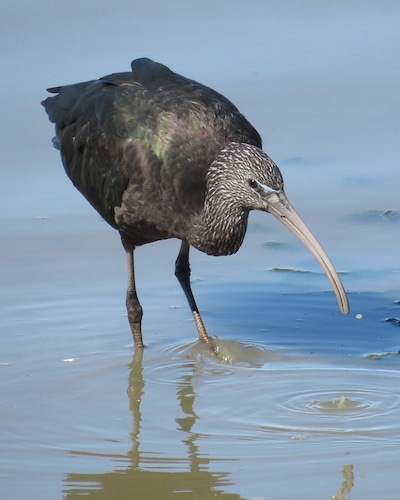
Threskiornithidae (Ibises & Spoonbills) are part of Pelecaniformes along with, Scopidae (Hamerkop), Balaenicipitidae (Shoebill) and Pelecanidae (Pelicans). The Threskiornithidae family includes 35 species of large wading birds. The family has been traditionally classified into two subfamilies, the ibises and the spoonbills; however recent genetic studies are casting doubt on the arrangement, and revealing the spoonbills to be nested within the old-world ibises, and the new-world ibises as an early offshoot.
Members of the family have long, broad wings with 11 primary feathers and about 20 secondaries. They are strong fliers and, rather surprisingly, given their size and weight, very capable soarers. The body tends to be elongated, the neck more so, with rather long legs. The bill is also long, decurved in the case of the ibises, straight and distinctively flattened in the spoonbills.
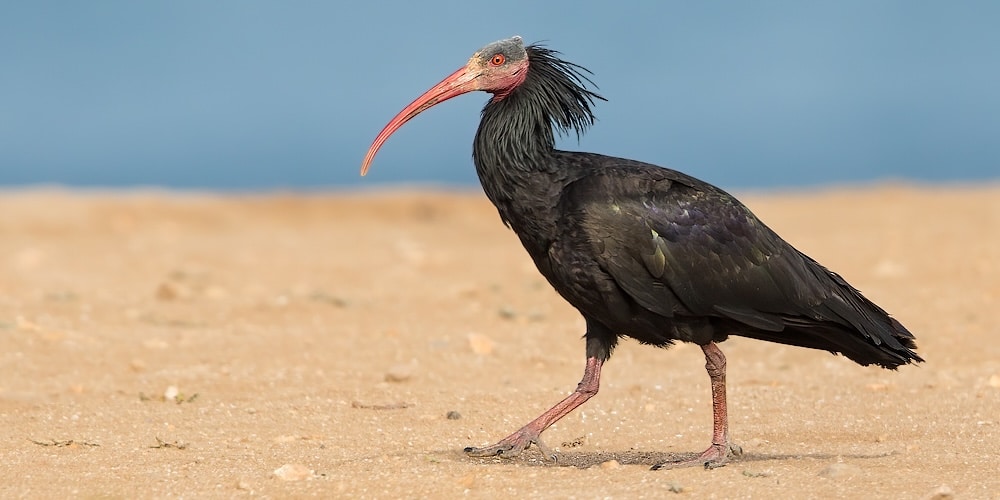
Northern Bald Ibis Geronticus eremita – ©Dubi Shapiro
They are large birds, but mid-sized by the standards of their order, ranging from the dwarf Olive Ibis Bostrychia bocagei, at 45cm and 450g, to the Giant Ibis Thaumatibis gigantea, at 100cm and 4.2kg.
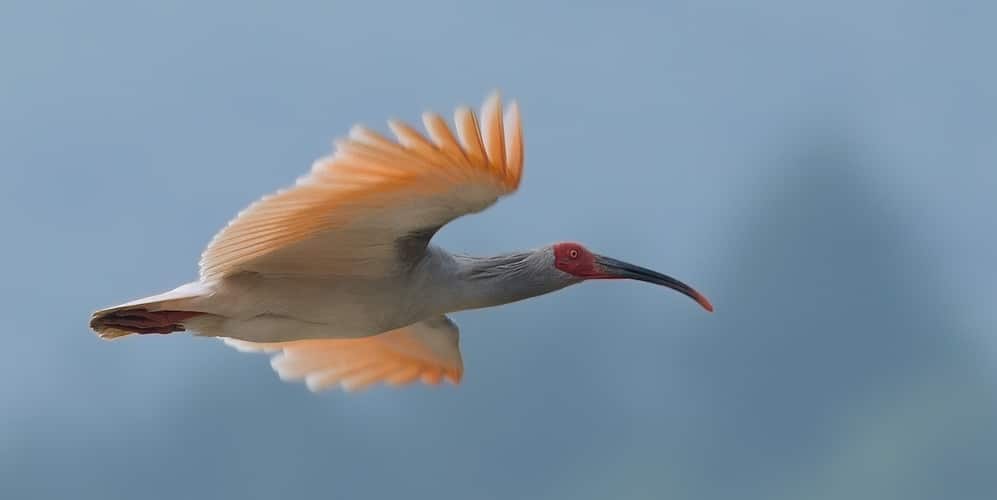
Crested Ibis Nipponia nippon – ©Dubi Shapiro
They are distributed almost worldwide, being found near almost any area of standing or slow-flowing fresh or brackish water. Ibises are also found in drier areas, including landfills. The Llanos wetland plains are notable in that they support seven species of ibis in the one region.
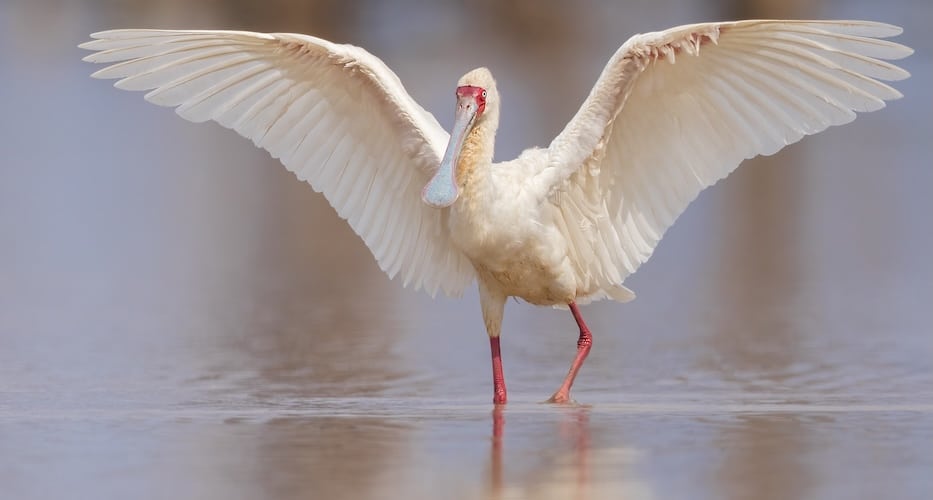
African Spoonbill Platalea alba – ©Dubi Shapiro
All ibises are diurnal; spending the day feeding on a wide range of invertebrates and small vertebrates: ibises by probing in soft earth or mud, spoonbills by swinging the bill from side to side in shallow water. At night, they roost in trees near water. They are gregarious, feeding, roosting, and flying together, often in formation.
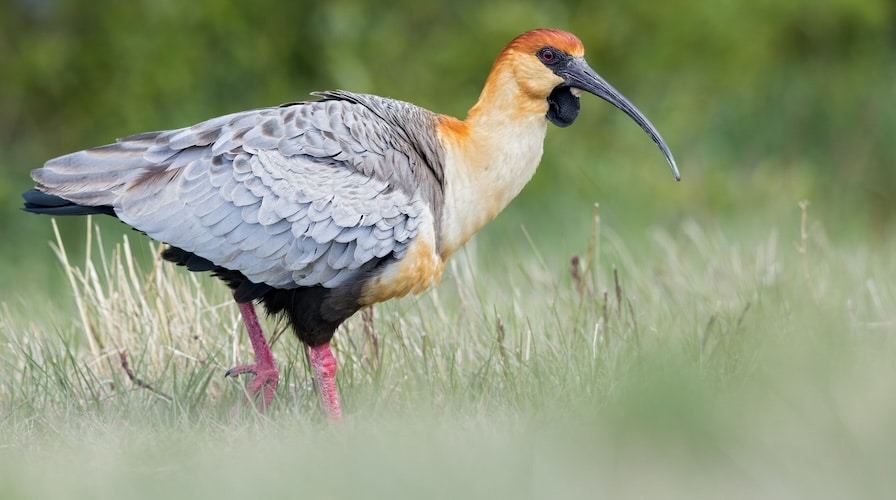
Black-faced Ibis Theristicus melanopis – ©Dubi Shapiro
Nesting is colonial in ibises, more often in small groups or singly in spoonbills, nearly always in trees overhanging water, but sometimes on islands or small islands in swamps. Generally, the female builds a large structure out of reeds and sticks brought by the male. Typical clutch size is two to five; hatching is asynchronic.
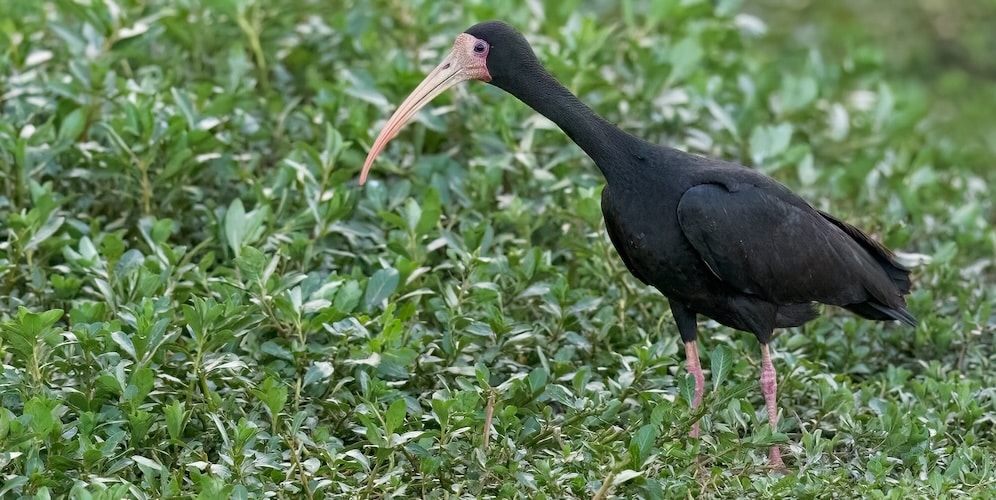
Bare-faced Ibis Phimosus infuscatus – ©Dubi Shapiro
Both sexes incubate in shifts, and after hatching feed the young by partial regurgitation. Two or three weeks after hatching, the young no longer need to be brooded continuously and may leave the nest, often forming creches but returning to be fed by the parents.
-
Number of bird species: 35
(As at August 2025)
According to the recently (2025) unified AviList, there are thirty-five species of Ibises and Spoonbills, in thirteen genera in the Threskiornithidae family. They are:
Scarlet Ibis Eudocimus ruber
American White Ibis Eudocimus albus
Plumbeous Ibis Theristicus caerulescens
Buff-necked Ibis Theristicus caudatus
Black-faced Ibis Theristicus melanopis
Andean Ibis Theristicus branickii
Sharp-tailed Ibis Cercibis oxycerca
Green Ibis Mesembrinibis cayennensis
Bare-faced Ibis Phimosus infuscatus
Glossy Ibis Plegadis falcinellus
White-faced Ibis Plegadis chihi
Puna Ibis Plegadis ridgwayi
Madagascan Ibis Lophotibis cristata
Olive Ibis Bostrychia olivacea
Sao Tome Ibis Bostrychia bocagei
Spot-breasted Ibis Bostrychia rara
Hadada Ibis Bostrychia hagedash
Wattled Ibis Bostrychia carunculata
Crested Ibis Nipponia nippon
Northern Bald Ibis Geronticus eremita
Southern Bald Ibis Geronticus calvus
Red-naped Ibis Pseudibis papillosa
White-shouldered Ibis Pseudibis davisoni
Giant Ibis Pseudibis gigantea
Roseate Spoonbill Platalea ajaja
Yellow-billed Spoonbill Platalea flavipes
African Spoonbill Platalea alba
Eurasian Spoonbill Platalea leucorodia
Royal Spoonbill Platalea regia
Black-faced Spoonbill Platalea minor
African Sacred Ibis Threskiornis aethiopicus
Malagasy Sacred Ibis Threskiornis bernieri
Black-headed Ibis Threskiornis melanocephalus
Australian White Ibis Threskiornis molucca
Straw-necked Ibis Threskiornis spinicollis
-
Scarlet Ibis in Brazil: The Preservation's Vibrant Colors
| By Robson Silva e Silva | Avisbrasilis | 2007 | Hardback | 240 pages, colour illustrations | ISBN: 9788560120024 Buy this book from NHBS.com -
Sinagote - The Biography of a Spoonbill
| By Theunis Piersma, Petra de Goeij, Willem Bouten & Carl Zuhorn | Lynx Edicions | 2022 | Paperback | 223 pages, colour photos, colour maps | ISBN: 9788416728558 Buy this book from NHBS.com
Given the number of species in this family, Fatbirder does not provide quick links to all of them. However, the entries below do include links to representatives of every genera and some of the most often encountered, iconic or sought-after species.
-
African Sacred Ibis Threskiornis aethiopicus
Species AccountStriking white ibis with a naked black head and neck and black legs and feet. White wings framed by black wingtips and trailing edges. -
African Sacred Ibis Threskiornis aethiopicus
Species AccountThe African sacred ibis (Threskiornis aethiopicus) is a species of ibis. Its sister species is the Australian white ibis. -
African Sacred Ibis Threskiornis aethiopicus
Species AccountSound archive and distribution map. -
African Spoonbill Platalea alba
Species AccountA distinctive pale waterbird with long pink-red legs, a bare bright pink-red face, and an odd and distinctive spoon-shaped bill that is obvious even in flight. -
African Spoonbill Platalea alba
Species AccountSound archive and distribution map. -
Bare-faced Ibis Phimosus infuscatus
Species AccountRather small ibis, widespread in South America but with an unusual distribution: found on either side of the Amazon basin. -
Bare-faced Ibis Phimosus infuscatus
Species AccountSound archive and distribution map. -
Black-faced Ibis Theristicus melanopis
Species AccountSound archive and distribution map. -
Black-faced Ibis Theristicus melanopis
Species AccountThe black-faced ibis (Theristicus melanopis) is a species of bird in the family Threskiornithidae. It is found in grassland and fields in southern and western... -
Crested Ibis Nipponia nippon
Species AccountThe crested ibis (Nipponia nippon), also known as the Japanese crested ibis, or Asian crested ibis, is a species of ibis, native to eastern Asia. -
Crested Ibis Nipponia nippon
Species AccountSound archive and distribution map. -
Giant Ibis Pseudibis gigantea
Species AccountThe giant ibis (Pseudibis gigantea) is a wading bird of the ibis family, Threskiornithidae. -
Giant Ibis Pseudibis gigantea
Species AccountSound archive and distribution map. -
Glossy Ibis Plegadis falcinellus
Species AccountThe glossy ibis (Plegadis falcinellus) is a water bird in the order Pelecaniformes and the ibis and spoonbill family Threskiornithidae. -
Glossy Ibis Plegadis falcinellus
Species AccountSound archive and distribution map. -
Green Ibis Mesembrinibis cayennensis
Species AccountAll-dark wading bird with a curved bill and short legs, giving it a rather dumpy look. Dark green overall with shimmering emerald and bronzy iridescence... -
Green Ibis Mesembrinibis cayennensis
Species AccountSound archive and distribution map. -
Hadada Ibis Bostrychia hagedash
Species AccountThe hadada ibis (Bostrychia hagedash) or hadeda is an ibis native to Sub-Saharan Africa. -
Hadada Ibis Bostrychia hagedash
Species AccountSound archive and distribution map. -
Madagascan Ibis Lophotibis cristata
Species AccountThe Madagascar ibis (Lophotibis cristata), also known as the Madagascar crested ibis, white-winged ibis or crested wood ibis... -
Madagascan Ibis Lophotibis cristata
Species AccountSound archive and distribution map. -
Northern Bald Ibis Geronticus eremita
Species Account -
Northern Bald Ibis Geronticus eremita
Species AccountThe northern bald ibis, hermit ibis, or waldrapp (Geronticus eremita) is a migratory bird found in barren, semi-desert or rocky habitats, often close to running water. This 70–80 cm (28–31 in) glossy black ibis, which, unlike other members of the ibis family, is non-wading, has an unfeathered red face and head, and a long, curved red bill. It breeds colonially on coastal or mountain cliff ledges, where it typically lays two to three eggs in a stick nest, and feeds on lizards, insects, and other small animals. -
Northern Bald Ibis Geronticus eremita
Species AccountSound archive and distribution map. -
Scarlet Ibis Eudocimus ruber
Species AccountThis species has a very large range, and hence does not approach the thresholds for Vulnerable under the range size criterion (Extent of Occurrence <20,000 km2 combined with a declining or fluctuating range size, habitat extent/quality, or population size and a small number of locations or severe fragmentation) -
Scarlet Ibis Eudocimus ruber
Species AccountThe scarlet ibis (Eudocimus ruber) is a species of ibis in the bird family Threskiornithidae. It inhabits tropical South America and islands of the Caribbean. In form it resembles most of the other twenty-seven extant species of ibis, but its remarkably brilliant scarlet coloration makes it unmistakable. It is 1 of 2 national birds of Trinidad and Tobago. -
Scarlet Ibis Eudocimus ruber
Species AccountSound archive and distribution map. -
Sharp-tailed Ibis Cercibis oxycerca
Species AccountThe sharp-tailed ibis (Cercibis oxycerca) is a species of ibis native to open wet savannas in parts of northern South America. -
Sharp-tailed Ibis Cercibis oxycerca
Species AccountSound archive and distribution map. -
Southern Bald Ibis Geronticus calvus
Species AccountThe southern bald ibis (Geronticus calvus) is a large bird found in open grassland or semi-desert in the mountains of southern Africa.... -
Southern Bald Ibis Geronticus calvus
Species AccountGeronticus calvus is listed as Near Threatened under criteria A3c; C2a(ii). -
Straw-necked Ibis Threskiornis spinicollis
Species AccountThe straw-necked ibis (Threskiornis spinicollis) is a bird of the ibis and spoonbill family Threskiornithidae. It can be found throughout Australia, New Guinea, and parts of Indonesia. Adults have distinctive straw-like feathers on their neck. -
Straw-necked Ibis Threskiornis spinicollis
Species AccountThe Straw-necked Ibis is a large waterbird with a naked black head, long downcurved black bill and yellow throat plumes. It has a glossy blue-black back, with metallic purple, green and bronze sheen, a white nape and sides of neck and white underparts. Its preference for grassland insects such as grasshoppers and locusts have earnt it the name of Farmer's Friend. -
Straw-necked Ibis Threskiornis spinicollis
Species AccountSound archive and distribution map.
-
Observaciones de Espátula [GRUSEC]
WebsiteBLOG about the European spoonbill - in Spanish…