

Todidae – Todies
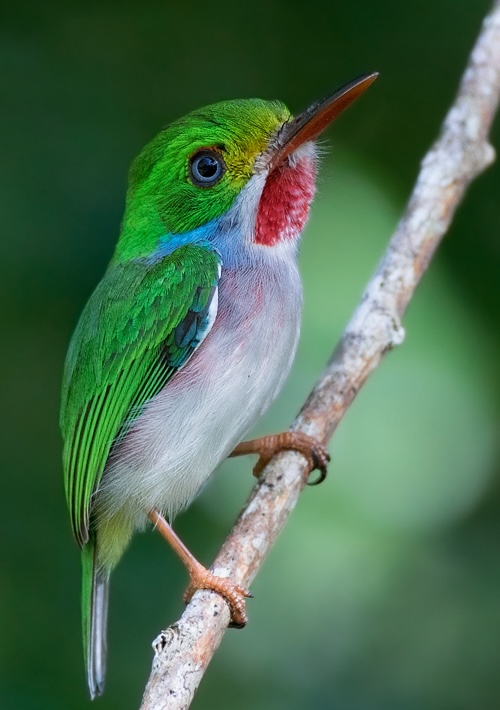
Todidae (Todies) are a family of Coraciiformes along with Brachypteraciidae (Ground-Rollers), Coraciidae (Rollers), Meropidae (Bee-eaters), Momotidae (Motmots) and Alcedinidae (Kingfishers). The Tody family is endemic to the Greater Antilles and is thought to have evolved six to seven million years ago. Five modern tody species are endemic on 4 islands: Puerto Rico (Puerto Rican Tody, Todus mexicanus); Jamaica (Jamaican Tody, Todus todus); Cuba (Cuban Tody, Todus multicolor); and Hispaniola (Narrow-billed Tody, Todus angustirostris, and Broad-billed Tody, Todus subulatus).
They are all tiny, brightly coloured forest birds with a short tail, emerald green upper parts, and a bright red throat and bill. The undersides are washed with light shades of different colours in the five species: yellow, green, red or blue.
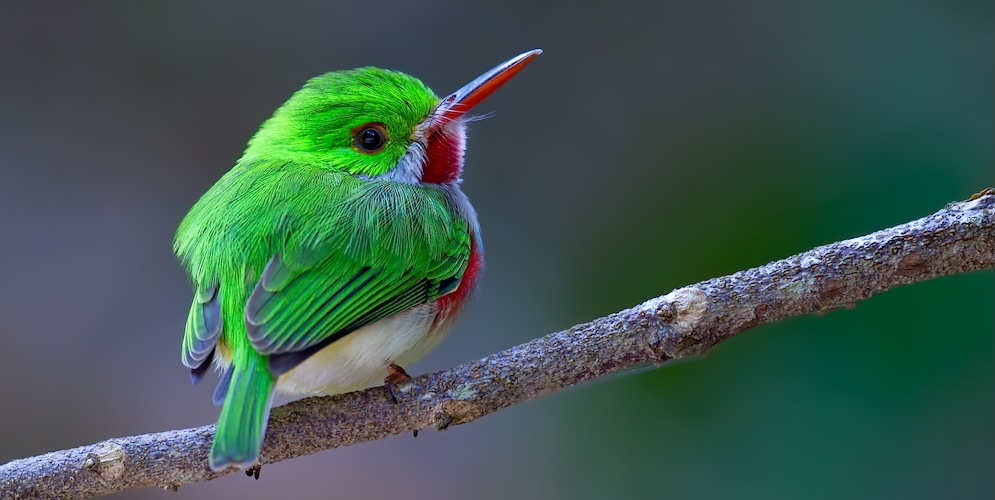
Broad-billed Tody Todus subulatus – ©Dubi Shapiro
The habits of the Puerto Rican Tody are fairly typical: This species sits quietly, with its bill tilted up, as it rapidly scans the forest under-story for insect prey. This posture accounts for its local name: San Pedrito (Little Saint Peter). It sits so still that it is often hard to see despite its bright colours. Suddenly it will fly up to grab an insect off the underside of a leaf or branch, and then land on a new perch. Less commonly it catches flying insects. The Puerto Rican Tody eats insects, including katydids, grasshoppers, crickets, earwigs, dragonflies, Diptera (flies); and Coleoptera (beetles); as well as spiders, and occasional small lizards and fruit. When excited, the Tody bobs its body up and down.
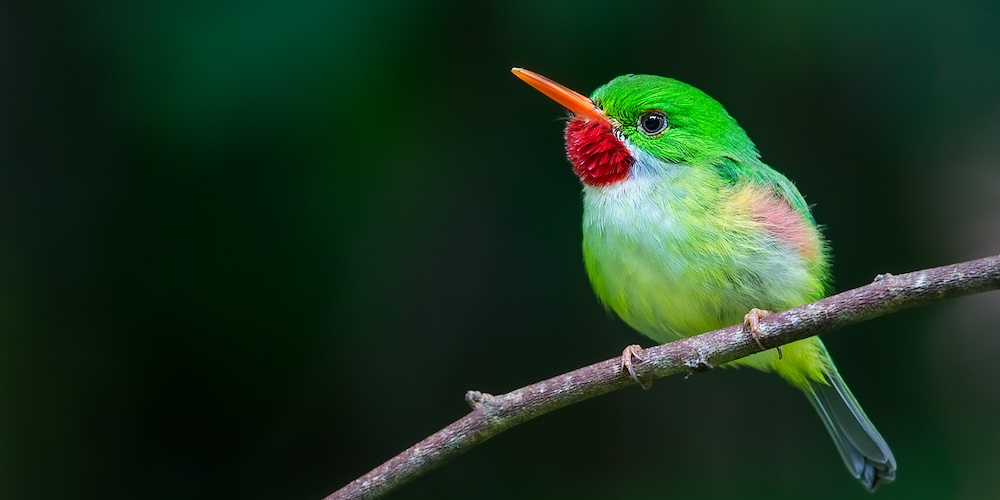
Jamaican Tody Todus todus – ©Dubi Shapiro
The average territory size in lowland forest is 0.7 hectares (1.8 acres); compared to two hectares per pair at higher elevations where insect prey is less abundant.
The breeding behaviour of the Tody is unusual among Puerto Rico birds. Every year, each pair digs a narrow, 25-35 cm. long burrow with a right angle, in an earth bank over an eight-week period, typically between February and May. The female lays tow to four white eggs. Each egg is equivalent to one quarter of the body weight of the female: more than twice as heavy, proportionately, as in most other bird species. The Tody can lower its body temperature by up to 11 degrees Centigrade to conserve heat during cold weather, especially when breeding. Both sexes incubate the eggs over a period of about twenty-one days. Sometimes, todies other than the parents assist in incubation and raising the young.
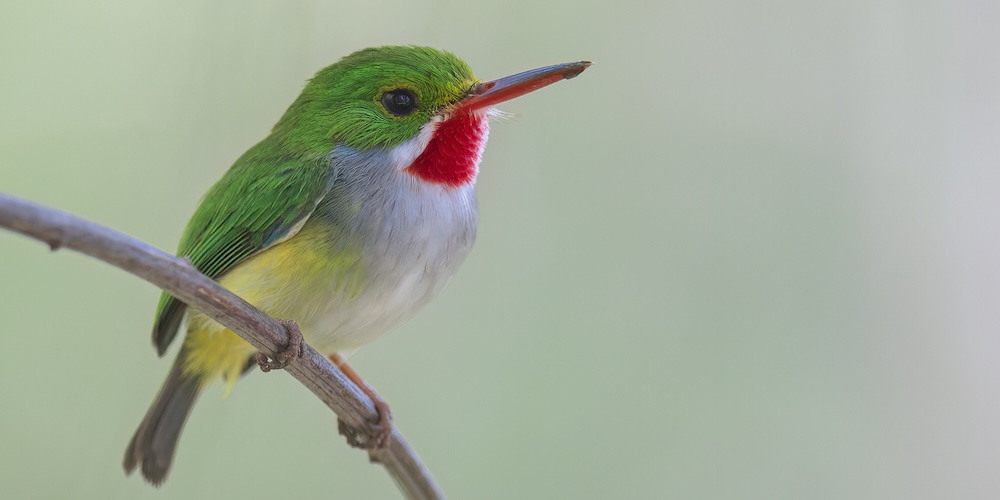
Puerto Rican Tody Todus mexicanus – ©Dubi Shapiro
Although common forest species on their respective islands, they suffer from nest predation by the introduced mongoose. In historical times, humans captured them for food.
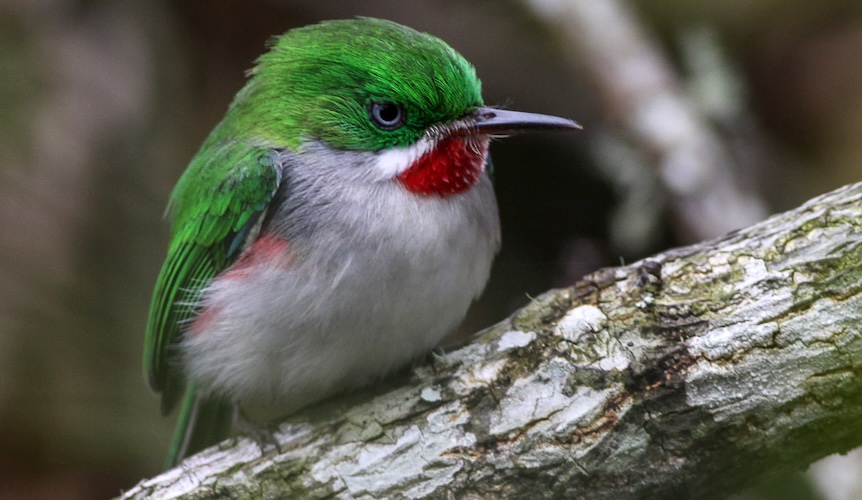
Narrow-billed Tody Todus angustirostris – ©Ron Knight CC BY 2.0 via Wikimedia Commons
NB The above account is excerpted from the book and CD-ROM, Puerto Rico’s Birds in Photographs, by Mark W. Oberle Editorial Humanitas Press, San Juan, PR. 2000, 2nd ed, (ISBN 0965010414). It has 1300 photos, 170+ audio clips, and natural history accounts (English text in the book; complete Spanish and English text plus web links on the CD-ROM).
References: Kepler, A.K. 1977. Comparative study of the Todies (Todidae): with emphasis on the Puerto Rican Tody (Todus mexicanus). Nuttall Ornithology Club #16. Cambridge, MA. 190pp. Kepler, A.K. 2001. Order Coraciiformes, Family Todidae (Todies) in del Hoyo, J., A. Elliott, and J. Sargatal, eds. Handbook of Birds of the World, Vol. 6. Mousebirds to hornbills. Lynx Edicions, Barcelona. Oberle, M. W. 2000. Puerto Rico’s Birds in Photographs, Editorial Humanitas Press, San Juan, PR. (ISBN 0965010414). Raffaele, H.A., J.W. Wiley, O.H. Garrido, A.R. Keith, and J.I. Raffaele. 1998. Guide to the birds of the West Indies. Princeton.
-
Number of bird species: 5
(As at August 2025)
According to the newly (2025) combined AviList, the family Todidae consists of just five monotypic species in one genus. They are:
Cuban Tody Todus multicolor
Broad-billed Tody Todus subulatus
Narrow-billed Tody Todus angustirostris
Jamaican Tody Todus todus
Puerto Rican Tody Todus mexicanus
-
Comparative Study of Todies (Todidae)
| By Angela Kay Kepler | Nuttall Ornithological Club Publications | 1977 | Hardback | 190 pages, 67 b/w photos and b/w illustrations, 7 b/w maps, 37 tables | ISBN: #14024 Buy this book from NHBS.com -
Puerto Rico's Birds in Photographs
| By Mark W. Oberle | Editorial Humanitas | 2000 | Paperback | ISBN: 9780965010412 Buy this book from NHBS.com
-
Todidae
Family AccountTodies are tiny, brilliant green insectivores with bright red, long, flat bills on heads seemingly too large for their bodies. -
Todidae
Family AccountThe todies are a family, Todidae, of tiny Caribbean birds in the order Coraciiformes, which also includes the kingfishers, bee-eaters and rollers.
-
Broad-billed Tody Todus subulatus
Species AccountA small, gemlike species of woodlands including coffee plantations and mangroves. The rather large head, long bill, and short tail create a profile shared only... -
Broad-billed Tody Todus subulatus
Species AccountThe broad-billed tody (Todus subulatus) is one of the two species of tody native to the island of Hispaniola. It can be identified by its small size, stubby beak, ruby-red throat, and green back. -
Broad-billed Tody Todus subulatus
Species AccountSound archive and distribution map. -
Cuban Tody Todus multicolor
Species AccountA small, gemlike, woodland species that is usually found in pairs. The rather large head, long bill, and short tail create a unique profile. -
Cuban Tody Todus multicolor
Species AccountThe Cuban tody (Todus multicolor) is a bird species in the family Todidae that is restricted to Cuba and adjacent islands. -
Cuban Tody Todus multicolor
Species AccountSound archive and distribution map. -
Jamaican Tody Todus todus
Species AccountA small, gemlike, woodland species usually found in pairs. Its rather large head, long bill, and short tail create a unique profile. -
Jamaican Tody Todus todus
Species AccountFound only in Jamaica, the Jamaican tody (Todus todus) is a small and colourful bird, predominantly green above, with a red throat and yellow underparts, with some pink on the sides. It has a large head and a long, flat bill. It perches on small branches, with its bills unturned and, like its Cuban relative (the Cuban tody), takes insects, larvae, and fruit. The Jamaican tody nests in burrows, which it excavates in muddy banks or rotted wood. -
Jamaican Tody Todus todus
Species AccountSound archive and distribution map. -
Narrow-billed Tody Todus angustirostris
Species AccountA small, gemlike species that prefers higher elevation moist woodlands, but also occurs in coffee plantations. The rather large head, long bill, and short... -
Narrow-billed Tody Todus angustirostris
Species AccountThe narrow-billed tody (Todus angustirostris) is a species of bird in the Todidae family. It is found in Haiti and the Dominican Republic. Its natural habitats are subtropical or tropical moist montane forests and heavily degraded former forest. -
Narrow-billed Tody Todus angustirostris
Species AccountSound archive and distribution map. -
Puerto Rican Tody Todus mexicanus
Species AccountA tiny, brilliant-green resident of wooded habitats. There are no similar species within its range. Typically perches at low to middle levels in the forest. -
Puerto Rican Tody Todus mexicanus
Species AccountThe Puerto Rican tody (Todus mexicanus) is a bird native to the island of Puerto Rico. Despite its scientific name, the Puerto Rican tody is endemic to the island and is locally known as "San Pedrito" ("Little Saint Peter"). -
Puerto Rican Tody Todus mexicanus
Species AccountSound archive and distribution map.
-
Mark Oberle
| oberle@mindspring.com
https://www.amazon.co.uk/stores/author/B001KC47J2/about