

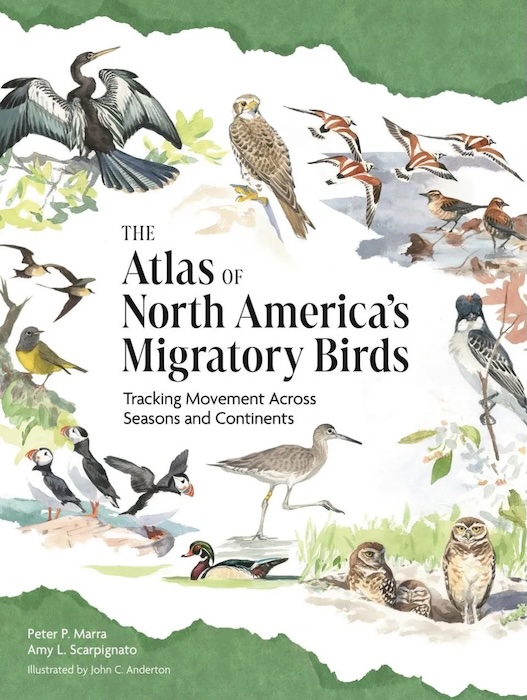
The Atlas of North America’s Migratory Birds
– Tracking Movement Across Seasons and Continents
| Edited By Peter P Marra & Amy L Scarpignato| PUP | 2026 | Hardback | 806 9780691163185 | £75 |
The Publisher’s View:
More than 70 per cent of North American bird species are migratory, travelling annually between separate breeding and nonbreeding areas. While we know the overall ranges of species, we have lacked an understanding of where specific populations move to across seasons and regions – but these limitations are rapidly disappearing. Thanks to the contributions of thousands of bird banders and researchers over the past century and recent efforts to develop and deploy ever smaller tracking devices, it is now possible to map where different breeding populations migrate and spend the nonbreeding season. The Atlas of North America’s Migratory Birds brings these findings together in one place, presenting a treasure trove of data for hundreds of species along with detailed range maps derived from eBird data for each species.
– Covers nearly 600 species
– Compiles diverse data types from thousands of contributors
– Brings together banding data collected over the past century with information gathered using the latest tracking technology, stable isotopes, and genetic tools
– Features eBird maps for every species, published here for the first time
– An essential and definitive resource for ornithologists, conservationists, and birdwatchers
The Editors: Peter P Marra is dean of the Earth Commons Institute and the Laudato Si’ Professor of Biology and the Environment at Georgetown University. His books include Cat Wars: The Devastating Consequences of a Cuddly Killer (Princeton) and Birds of Two Worlds: The Ecology and Evolution of Migration.
Amy L Scarpignato is an ecologist and bird conservation specialist at Smithsonian’s National Zoo and Conservation Biology Institute, Migratory Bird Center. books, including Ecological principles and environmental issues (2000).
Fatbirder View:
It’s been said elsewhere, already of course, but the fact is this really is a truly monumental publication bringing together the observations and hard work of thousands of observers across hundreds of sites in North America.
Given that 70% of the birds found in North America are migratory, it covers around 600 species in amazing detail. Brilliantly edited, for us ordinary birders, it’s a fantastic, brilliantly produced book, which we can pour over just to see what is where, when, so we can catch up with birds when they are closest to where we are. But, of course, that is a minor consideration. This sort of volume gives us a snapshot which allows us in time to see where patterns shift, species expand or decline and, to an extent discover those factors that affect these things.
We are lucky in Europe to have now a number of generations of these studies to allow us to mark those changes and, if the will is there, to try to reverse some of those things that badly affect birds everywhere. I’m sure this will be the case in the US as well; the work represents the efforts of so many citizen scientists, as well as many professional ornithologists.
Nothing seems to have been spared by the publisher and the production values are as high as the science that went into the work. It’s always inspiring to see a publication that is as careful with layout, print and feel as the time and effort of those who produced the data. It is also peppered throughout with very attractive illustrations of birds in habitat. I’m very much in favour of these sorts of illustrations, which I would condemn in a field guide as being of less use than they need to be for identification. But here the impressionistic nature of them purely as illustrations is very effective. The choice of colours throughout this volume, pastel and muted, is gentle on the eye, which given the extent of the work is exactly what is needed.
This is a truly magnificent work that will be used by ornithologists for many years. And at the same time, will be coveted by many birders. who would love to have this on their shelves, albeit after those shelves are reinforced to take the weight!
Fatbirder